
BuddhistCatholicContemplativeEvangelicalGeneral ChristianHinduJewishLatter-day SaintMuslimNew VisionsProgressive Christian
Beliefs
- Buddhist
- Catholic
- Contemplative
- Evangelical
- General Christian
- Hindu
- Jewish
- Latter-day Saint
- More Voices
- Muslim
- New Visions
- Pagan
- Progressive Christian
Topics
- Religion News
- Food and Religion
- Sports and Religion
- Religious Art
- Religious Music and Entertainment
- Religious Events
- History and Religion
- Style and Religion
- Politics and Religion
- Women in Religion
- Recreation Outdoors and Religion
- Business Finance and Religion
- Careers Workplace and Religion
- Education and Religion
- Family Parenting and Religion
- Health Fitness and Religion
- Home and Religion
- Relationships and Religion
- Technology and Religion
- Travel and Religion
Columnists
- Buddhist Columnists
- Business Finance and Religion Columnists
- Careers Workplace and Religion Columnists
- Catholic Columnists
- Contemplative Columnists
- Education and Religion Columnists
- Evangelists Columnists
- Family Parenting and Religion Columnists
- General Christian Columnists
- Health Fitness and Religion Columnists
- Hindu Columnists
- History and Religion Columnists
- Home and Religion Columnists
- Jewish Columnists
- More Voices Columnists
- Latter Day Columnists
- Muslim Columnists
- New Visions Columnists
- Nonreligious Columnists
- Pagan Columnists
- Politics and Religion Columnists
- Progressive Columnists
- Recreation Outdoors and Religion Columnists
- Relationships and Religion Columnists
- Religion News Columnists
- Religious Art Columnists
- Religious Events Columnists
- Religious Music and Entertainment Columnists
- Sports and Religion Columnists
- Style and Religion Columnists
- Technology and Religion Columnists
- Travel and Religion Columnists
- Women in Religion Columnists
Resource Library
- 2026 Calendar
- Library of World Religions
- The 100 Most Holy Places on Earth
- Patheos Answers
- Podcasts
- Videos
- Faith Leaders Database
- Anglican Episcopalian
- Bahai
- Baptist
- Buddhism
- Christianity
- Confucianism
- Eastern Orthodoxy
- Hinduism
- Holiness and Pentecostal
- ISKCON
- Islam
- Judaism
- Lutheran
- Methodist
- The Church of Jesus Christ of Latter-day Saints
- New Age
- Paganism
- Presbytarian and Reformed
- Protestantism
- Religion Behind the Scenes
- Roman Catholic
- Scientology
- Shia Islam
- Sikhism
- Sufism
- Sunni Islam
- Taoism
- Zen
- See all religions
Research Tools
 Ad-Free & Subscriber Log-In Subscription Support
Ad-Free & Subscriber Log-In Subscription Support
Follow Patheos 

- Trending:
- Forgiveness
- |
- Marriage
- |
- Consciousness
- |
- Death Penalty
- |
- Election
- |
- Halloween

-
About
-
Catholic Apologetics
-
Church History
-
Great Apologists
-
Christian Worldview
-
Protestantism & Misc.
- Home
- Catholic
- History and Religion
- Theological Debate, Dialogue, Discussion, & “Quarrels”
Theological Debate, Dialogue, Discussion, & “Quarrels”
Last updated on: July 27, 2019 at 12:02 pm by Dave Armstrong
Theological Debate, Dialogue, Discussion, & “Quarrels” 2019-07-27T12:02:11-04:00 Dave Armstrong
Patheos Explore the world's faith through different perspectives on religion and spirituality! Patheos has the views of the prevalent religions and spiritualities of the world.
As for the “utility (or lack thereof) of debates” question, here are a few observations:
1) I never assume that I will have any likelihood of persuading my debate opponent (in the rare event that I do, though, then it can be a pleasant surprise).
2) Debates are almost entirely for the benefit of those observing who are on the fence, or those who are open-minded enough to be persuaded of a different position, and sensible enough to be willing to change their views if these are shown to be false or seriously deficient.
3) A secondary positive effect of such debates is to increase the confidence of a person who holds the position being defended, since they see the support for same.
4) Moreover, a good defense of a position has a pedagogical function; i.e., it helps to teach others how to go about defending a position.
5) Generally speaking, I feel very strongly that one very fruitful avenue for seeking and finding truth is dialogue and interaction with other opinions. It sharpens the mind by challenging it, and thus allows for further and deeper understanding, and this is always a good thing. On my blog sidebar I have posted this gem of a thought by John Milton: “Where there is much desire to learn, there of necessity will be much arguing, much writing, many opinions; for opinion in good men is but knowledge in the making.”
6) Dialogue and even debates are presented as good things in Scripture. Note that Jesus often engaged in dialogues with the Pharisees, though as God, He knew beforehand that they would be unsuccessful. But He also knew that many of these discussions would be recorded for posterity in Scripture (see #4 above). The Apostle Paul is often described as “arguing” and “reasoning” with Jews and Greeks alike. The Greek word from which we derive “dialogue” (dialegomai) is even used.
7) Those who truly seek truth are always willing to engage other points of view, because they recognize the factors I mentioned in #5.
8) Scripture commands us to know and defend our faith; particularly in 1 Peter 3:15, Jude 3, and (by strong implication), 1 Corinthian 9:19-23.
9) In dialoguing and debating or just plain sharing our faith, we are never fully aware of the seeds that are planted. There may be one little thing that “stuck” at the time. We are utterly unaware, but it has in fact caused the beginning of doubt or confusion that may turn into, by God’s grace, a conversion journey, or a radically changed life, in some way. Truth has its own inherent power. It has a power that falsehood doesn’t possess, because truth is from God (and we know who the “father of lies” is). Something we say or do may be the initial “human” cause for a change of direction.
10) God is always the ultimate cause of any good thing. We’re merely His vessels. It is the Holy Spirit’s job to cause someone to change or convert or repent or experience personal spiritual revival. Our job is to share what we know, in a charitable, amiable fashion. If it can’t be done in a cordial, good-natured spirit, then we shouldn’t do it at all, because that turns folks off faster than anything. We can’t hope to spread Good News and a joyful message without exhibiting at least a modicum of joyfulness and “spiritual confidence” (with humility) ourselves.
11) Debating and dialoguing, rightly understood, are not mere quarrels. The goal ought to be the seeking of truth, for both parties, not to embarrass, humiliate, belittle, or conquer the other. If we persuade the other of some truth previously unrecognized, they should be happy and thankful for the opportunity, rather than resentful that they “lost.” And we should rejoice with them in a “non-triumphant” fashion and not engage in juvenile “I told you so” behavior and vibes.
Likewise, if we are convinced of something new, we should be grateful, etc., rather than feel inferior because our old opinion “lost.” We ought to rejoice at the discarding of any falsehood, because it was from the devil in the first place.
12) Sometimes with close friends and family, there is an unspoken agreement or understanding not to discuss things that have always caused friction in the past. There is a time to agree to disagree, and to rejoice in what is held in common. I’m a professional apologist myself, but I have long recognized that doing what I do in my own family (that is, the one I grew up in) just does not work.
It’s downright “counter-productive”. I can pray and hopefully be a good example, but to share serious spiritual and theological things has to come from someone else. That may not be true in every family, but I think it is very often (and especially if one is the “baby” of the family: a wonderful “blessing” that is true in my case).
13) There definitely is such a thing as a vain discussion and one to be avoided, after prudential consideration. It is up to us to discern when a discussion has crossed that line, and can serve little useful purpose (at least as far as we can tell). St. Paul writes quite a bit about this (RSV):
2 Timothy 3:2-5 For men will be lovers of self, . . . proud, arrogant, abusive, . . . implacable, slanderers, . . . swollen with conceit . . . Avoid such people . . .
1 Timothy 1:4, 6 . . . nor to occupy themselves with myths and endless genealogies which promote speculations rather than the divine training that is in faith . . . vain discussion . . .
2 Timothy 2:14 . . . avoid disputing about words which does no good, but only ruins the hearers.
Titus 3:9-11 But avoid stupid controversies, genealogies, dissensions, and quarrels over the law, for they are unprofitable and futile. As for a man who is factious, after admonishing him once or twice, have nothing more to do with him, knowing that such a person is perverted and sinful; he is self-condemned.
Romans 16:17 Mark them which cause divisions and offences contrary to the doctrine ye have learned; and avoid them.
2 Timothy 2:23 Have nothing to do with stupid, senseless controversies; you know that they breed quarrels.
1 Timothy 6:3-5 If anyone teaches otherwise and does not agree with the sound words of our Lord Jesus Christ and the teaching which accords with godliness, he is puffed up with conceit, he knows nothing; he has a morbid craving for controversy and for disputes about words, which produce envy, dissension, slander, base suspicions, and wrangling among men who are depraved in mind and bereft of the truth, imagining that godliness is a means of gain.
***
(originally 3-4-08)
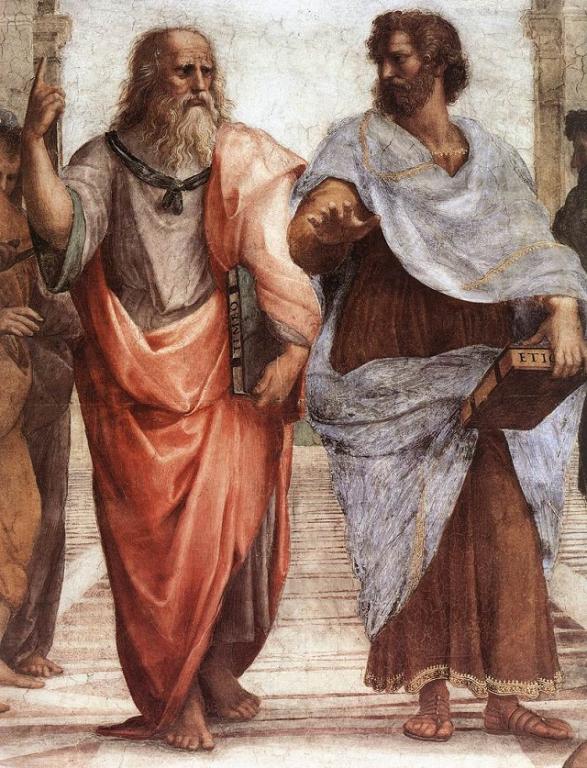
Photo credit: The great Greek philosophers Plato and Aristotle, from The School of Athens (1509) by Raphael (1483-1520) [public domain / Wikimedia Commons]

***
Previous Post

July 27, 2019
Japanese "Universal" Military Conscription & Nuclear Bombings
Next Post

July 29, 2019 Contraception: Chesterton, C. S. Lewis, & Teddy Roosevelt
Browse Our Archives
Select a Category & Last Things About Me Anti-Catholicism Atheism & Agnosticism Baptism and Sacramentalism Bible and Tradition Blessed Virgin Mary Books by Dave Armstrong C. S. Lewis Calvinism & General Protestantism Catholic Apologetics Catholic Apologists Catholic conversion Catholic converts Christmas Church (Ecclesiology) Church History Conversion and Converts Development of Doctrine Eastern Orthodoxy Ecumenism & Christian Unity Eucharist & Liturgy Fathers of the Church French Translations G. K. Chesterton Hell Hell & Satan Hell & Satan & Last Things Heresies & Comparative Religion Holistic Health Inquisition & Crusades & Scandals James White Jews & Judaism & Old Testament John Calvin John Henry Newman Liberal / Modernist Theology Life Issues Literary Resume Lutheranism Mariology Martin Luther Music Orthodoxy Papacy & Infallibility Personal Page Philosophy & Science Political & Ethical & Moral Issues Protestant Persecution & Intolerance Protestantism Purgatory Purgatory & Penance Romantic & Imaginative Theology Saints & Purgatory & Penance Salvation Salvation & Justification Satan & Last Things Sexuality and Gender Issues Spanish Translations Traditionalism vs. Radical Catholic Reactionaries Traducciones al español / tradução para português Trinitarianism & Christology Uncategorized Videos
Select a Month October 2026 September 2026 August 2026 July 2026 June 2026 May 2026 April 2026 March 2026 February 2026 January 2026 December 2025 November 2025 October 2025 September 2025 August 2025 July 2025 June 2025 May 2025 April 2025 March 2025 February 2025 January 2025 December 2024 November 2024 October 2024 September 2024 August 2024 July 2024 June 2024 May 2024 April 2024 March 2024 February 2024 January 2024 December 2023 November 2023 October 2023 September 2023 August 2023 July 2023 June 2023 May 2023 April 2023 March 2023 February 2023 January 2023 December 2022 November 2022 October 2022 September 2022 August 2022 July 2022 June 2022 May 2022 April 2022 March 2022 February 2022 January 2022 December 2021 November 2021 October 2021 September 2021 August 2021 July 2021 June 2021 May 2021 April 2021 March 2021 February 2021 January 2021 December 2020 November 2020 October 2020 September 2020 August 2020 July 2020 June 2020 May 2020 April 2020 March 2020 February 2020 January 2020 December 2019 November 2019 October 2019 September 2019 August 2019 July 2019 June 2019 May 2019 April 2019 March 2019 February 2019 January 2019 December 2018 November 2018 October 2018 September 2018 August 2018 July 2018 June 2018 May 2018 April 2018 March 2018 February 2018 January 2018 December 2017 November 2017 October 2017 September 2017 August 2017 July 2017 June 2017 May 2017 April 2017 March 2017 February 2017 January 2017 December 2016 November 2016 October 2016 September 2016 August 2016 July 2016 June 2016 May 2016 April 2016 March 2016 February 2016 January 2016 December 2015 November 2015 October 2015 September 2015 August 2015 July 2015 June 2015 May 2015 April 2015 March 2015 February 2015 January 2015 December 2014 November 2014 October 2014 September 2014 August 2014 July 2014 June 2014 April 2014 March 2014 February 2014 January 2014 December 2013 November 2013 October 2013 September 2013 August 2013 July 2013 June 2013 April 2013 March 2013 February 2013 January 2013 December 2012 November 2012 October 2012 September 2012 August 2012 July 2012 June 2012 May 2012 April 2012 March 2012 February 2012 January 2012 December 2011 November 2011 October 2011 September 2011 August 2011 July 2011 June 2011 April 2011 March 2011 February 2011 October 2010 September 2010 August 2010 July 2010 April 2010 March 2010 December 2009 October 2009 August 2009 July 2009 June 2009 May 2009 March 2009 February 2009 October 2008 September 2008 April 2008 March 2008 February 2008 January 2008 December 2007 November 2007 October 2007 May 2007 March 2007 February 2007 January 2007 November 2006 October 2006 September 2006 August 2006 July 2006 June 2006 May 2006 April 2006 March 2006 February 2006 October 2005 June 2005 April 2005 February 2005 July 2004 May 2004 April 2004
Follow Us!
TAKE THE
Religious Wisdom Quiz
What book of the Bible comes after Genesis?
Select your answer to see how you score.
Deuteronomy Exodus Leviticus Numbers
Books by This Author Books by Dave Armstrong
Related posts from Biblical Evidence for Catholicism

Why Wes Huff (and Everyone) Should Be Catholic
Biblical Evidence for Catholicism

Invocation of Saints: Catholic Scholars vs. Me? Nope!
Biblical Evidence for Catholicism

My “Number Articles”: Alphabetized by Topic
Biblical Evidence for Catholicism
Big Plans for Catholic Bible Highlights in 2026!
Biblical Evidence for Catholicism
TRENDING AT PATHEOS Catholic

In "Irreplaceable," our book on vocation and technology, Trevor Sutton and I...

I was strolling through the top floor of the brand new Parthenon...

What Does Gêvâh Mean For Kimberley Guifoyle &...
This week, a lot of the news is focused on Kimberly Guilfoyle....

INNER CIRCLE: Profound Mystery (Of Christ In All...
Ephesians 5:31-32 “For this reason, a man will leave his father and...

Do Not Rejoice When Your Enemy Falls: The...
Turning an execution into a public spectacle is a disturbing expression of...

'The Chosen' S6 Trailer: The Passion Gets Very...
Not many watching 'The Chosen' worry about spoilers, but just because they...
view all Catholic blogs
Ad-Free & Subscriber Log-In Subscription Support
- About Us
- 2026 Calendar
- Videos
- Podcasts
- Library of World Religions
- Faith In Media Tracker
- Advertise With Us
- Write for Us
- Privacy Policy
- Terms of Service
- Do Not Sell My Data
- Contact Us
- Radiant Digital
- Manage Newsletter Subscriptions
- Unsubscribe From Notifications
- Sitemap
Copyright 2008-2026, Patheos. All rights reserved.
Subscription Support Ad-Free & Subscriber Log-In
Follow Patheos