
BuddhistCatholicContemplativeEvangelicalGeneral ChristianHinduJewishLatter-day SaintMuslimNew VisionsProgressive Christian
Beliefs
- Buddhist
- Catholic
- Contemplative
- Evangelical
- General Christian
- Hindu
- Jewish
- Latter-day Saint
- More Voices
- Muslim
- New Visions
- Pagan
- Progressive Christian
Topics
- Religion News
- Food and Religion
- Sports and Religion
- Religious Art
- Religious Music and Entertainment
- Religious Events
- History and Religion
- Style and Religion
- Politics and Religion
- Women in Religion
- Recreation Outdoors and Religion
- Business Finance and Religion
- Careers Workplace and Religion
- Education and Religion
- Family Parenting and Religion
- Health Fitness and Religion
- Home and Religion
- Relationships and Religion
- Technology and Religion
- Travel and Religion
Columnists
- Buddhist Columnists
- Business Finance and Religion Columnists
- Careers Workplace and Religion Columnists
- Catholic Columnists
- Contemplative Columnists
- Education and Religion Columnists
- Evangelists Columnists
- Family Parenting and Religion Columnists
- General Christian Columnists
- Health Fitness and Religion Columnists
- Hindu Columnists
- History and Religion Columnists
- Home and Religion Columnists
- Jewish Columnists
- More Voices Columnists
- Latter Day Columnists
- Muslim Columnists
- New Visions Columnists
- Nonreligious Columnists
- Pagan Columnists
- Politics and Religion Columnists
- Progressive Columnists
- Recreation Outdoors and Religion Columnists
- Relationships and Religion Columnists
- Religion News Columnists
- Religious Art Columnists
- Religious Events Columnists
- Religious Music and Entertainment Columnists
- Sports and Religion Columnists
- Style and Religion Columnists
- Technology and Religion Columnists
- Travel and Religion Columnists
- Women in Religion Columnists
Resource Library
- 2026 Calendar
- Library of World Religions
- The 100 Most Holy Places on Earth
- Patheos Answers
- Podcasts
- Videos
- Faith Leaders Database
- Anglican Episcopalian
- Bahai
- Baptist
- Buddhism
- Christianity
- Confucianism
- Eastern Orthodoxy
- Hinduism
- Holiness and Pentecostal
- ISKCON
- Islam
- Judaism
- Lutheran
- Methodist
- The Church of Jesus Christ of Latter-day Saints
- New Age
- Paganism
- Presbytarian and Reformed
- Protestantism
- Religion Behind the Scenes
- Roman Catholic
- Scientology
- Shia Islam
- Sikhism
- Sufism
- Sunni Islam
- Taoism
- Zen
- See all religions
Research Tools
 Ad-Free & Subscriber Log-In Subscription Support
Ad-Free & Subscriber Log-In Subscription Support
Follow Patheos 

- Trending:
- Forgiveness
- |
- Marriage
- |
- Consciousness
- |
- Death Penalty
- |
- Election
- |
- Halloween

-
About
-
Catholic Apologetics
-
Church History
-
Great Apologists
-
Christian Worldview
-
Protestantism & Misc.
- Home
- Catholic
- History and Religion
- Seidensticker Folly #34: Does God “Regret” or “Repent”?
Seidensticker Folly #34: Does God “Regret” or “Repent”?
Last updated on: July 25, 2019 at 12:23 pm by Dave Armstrong
Seidensticker Folly #34: Does God “Regret” or “Repent”? 2019-07-25T12:23:28-04:00 Dave Armstrong
Patheos Explore the world's faith through different perspectives on religion and spirituality! Patheos has the views of the prevalent religions and spiritualities of the world.
Atheist and anti-theist Bob Seidensticker, who was “raised Presbyterian”, runs the influential Cross Examined blog. He asked me there, on 8-11-18: “I’ve got 1000+ posts here attacking your worldview. You just going to let that stand? Or could you present a helpful new perspective that I’ve ignored on one or two of those posts?” He also made a general statement on 6-22-17: “Christians’ arguments are easy to refute . . . I’ve heard the good stuff, and it’s not very good.” He added in the combox: “If I’ve misunderstood the Christian position or Christian arguments, point that out. Show me where I’ve mischaracterized them.”
Such confusion would indeed be predictable, seeing that Bob himself admitted (2-13-16): “My study of the Bible has been haphazard, and I jump around based on whatever I’m researching at the moment.” I’m always one to oblige people’s wishes if I am able, so I decided to do a series of posts in reply. It’s also been said, “be careful what you wish for.” If Bob responds to this post, and makes me aware of it, his reply will be added to the end along with my counter-reply. If you don’t see that, rest assured that he either hasn’t replied, or didn’t inform me that he did. But don’t hold your breath.
Bob (for the record) virtually begged and pleaded with me to dialogue with him in May 2018, via email. But by 10-3-18, following massive, childish name-calling attacks against me, encouraged by Bob on his blog (just prior to his banning me from it), his opinion was as follows: “Dave Armstrong . . . made it clear that a thoughtful intellectual conversation wasn’t his goal. . . . [I] have no interest in what he’s writing about.”
And on 10-25-18, utterly oblivious to the ludicrous irony of his making the statement, Bob wrote in a combox on his blog: “The problem, it seems to me, is when someone gets these clues, like you, but ignores them. I suppose the act of ignoring could be deliberate or just out of apathy, but someone who’s not a little bit driven to investigate cognitive dissonance will just stay a Christian, fat ‘n sassy and ignorant.” Again, Bob mocks some Christian in his combox on 10-27-18: “You can’t explain it to us, you can’t defend it, you can’t even defend it to yourself. Defend your position or shut up about it. It’s clear you have nothing.” And again on the same day: “If you can’t answer the question, man up and say so.” And on 10-26-18: “you refuse to defend it, after being asked over and over again.” And again: “You’re the one playing games, equivocating, and being unable to answer the challenges.” Bob’s cowardly hypocrisy knows no bounds. He still hasn’t yet uttered one peep in reply to — now — 33 of my critiques of his atrocious reasoning.
Bob’s words will be in blue. To find these posts, word-search “Seidensticker” on my atheist page or search “Seidensticker Folly #” in my sidebar search (near the top).
*****
In his article, The Leaky Noah’s Ark Tale (2 of 2) (9-2-16; updated from a post on 7-4-13), Bible-Basher Bob pontificates:
What was going through God’s mind?
Here’s how God begins the project.
[Jehovah] regretted that he had made human beings on the earth, and his heart was deeply troubled. So [Jehovah] said, “I will wipe from the face of the earth the human race I have created—and with them the animals, the birds and the creatures that move along the ground—for I regret that I have made them.” (Gen. 6:6–7)
God regrets? God changes his mind? As an omniscient being, why didn’t he see this coming? . . .
But in the early days, of course, God was merely powerful, not omniscient. And not particularly benevolent either.
I covered this general ground in my treatment of anthropopathism last time. The present issue involves the same dynamics; that is: the Bible states something about God that human beings can relate to. He (at least prima facie in the text, interpreted literally) thinks differently now about something He did. So the text says that He “regretted” it.
Kevin DeYoung, writing at The Gospel Coalition site, stated:
The word of the Lord came to Samuel: “I regret that I have made Saul king, for he has turned back from following me and has not performed my commandments.” (1 Samuel 15:10-11)
In 1 Samuel 15:35, we see a similar statement:
And Samuel did not see Saul again until the day of his death, but Samuel grieved over Saul. And the Lord regretted that he had made Saul king over Israel.
Strong words. And surprising too. What does it mean for God to say “I regret”? Can God change his mind? Can we thwart God’s plans? Is God ignorant about the future? Is God just like us in that he makes honest mistakes and sometimes look back at his decisions and says, “Golly, I wish I could do that one over again”? It seems like our God makes mistakes and is forced to change course.
And yet, we know this is not the right way to understand God’s regret because of what we read a few verses earlier in 1 Samuel 15:
And Samuel said to him, “The Lord has torn the kingdom of Israel from you this day and has given it to a neighbor of yours, who is better than you. And also the Glory of Israel will not lie or have regret, for he is not a man, that he should have regret.” (28-29)
. . . As God’s ways appear to us, there will be change and variation, but as God is in his character and essence there can be no variation of shadow due to change (James 1:17; cf. Mal.3:6; Heb. 13:8; 2 Tim. 2:13). (“Does God Have Regret?”, 10-7-14)
The magnificent multi-volume Keil & Delitzsch Commentary on the Old Testament elaborates a bit more:
To confirm his own words, he adds in 1 Samuel 15:29 : “ And also the Trust of Israel doth not lie and doth not repent, for He is not a man to repent .” נצח signifies constancy, endurance, then confidence, trust, because a man can trust in what is constant. . . . the context suggests the idea of unchangeableness. For a man’s repentance or regret arises from his changeableness, from the fluctuations in his desires and actions. This is never the case with God; consequently He is ישׂראל נצח , the unchangeable One, in whom Israel can trust, since He does not lie or deceive, or repent of His purposes . These words are spoken θεοπρεπῶς (theomorphically), whereas in 1 Samuel 15:11 and other passages, which speak of God as repenting, the words are to be understood ἀνθρωποπαθῶς (anthropomorphically; cf. Numbers 23:19).
Here is the latter passage in RSV:
Numbers 23:19 God is not man, that he should lie, or a son of man, that he should repent. Has he said, and will he not do it? Or has he spoken, and will he not fulfil it?
The word, anthropomorphically is used several other times in the Keil & Delitzsch Commentary, as we learn from a search function at the online version. Here are two examples:
[Exodus 33:18-23] The manifested glory of the Lord would so surely be followed by the destruction of man, that even Moses needed to be protected before it (Exodus 33:21, Exodus 33:22). Whilst Jehovah, therefore, allowed him to come to a place upon the rock near Him, i.e., upon the summit of Sinai (Exodus 34:2), He said that He would put him in a cleft of the rock whilst He was passing by, and cover him with His hand when He had gone by, that he might see His back, because His face could not be seen. The back, as contrasted with the face, signifies the reflection of the glory of God that had just passed by. The words are transferred anthropomorphically from man to God, because human language and human thought can only conceive of the nature of the absolute Spirit according to the analogy of the human form. As the inward nature of man manifests itself in his face, and the sight of his back gives only an imperfect and outward view of him, so Moses saw only the back and not the face of Jehovah. It is impossible to put more into human words concerning this unparalleled vision, which far surpasses all human thought and comprehension.
Keil & Delitzsch comment on the very passage that Bob brought up:
[Genesis 6:5-8] Now when the wickedness of man became great, and “ every imagination of the thoughts of his heart was only evil the whole day ,” i.e., continually and altogether evil, it repented God that He had made man, and He determined to destroy them. . . .
The force of ינּחם , “it repented the Lord,” may be gathered from the explanatory יתעצּב , “it grieved Him at His heart.” This shows that the repentance of God does not presuppose any variableness in His nature of His purposes. In this sense God never repents of anything (1 Samuel 15:29), “ quia nihil illi inopinatum vel non praevisum accidit ” ( Calvin ). The repentance of God is an anthropomorphic expression for the pain of the divine love at the sin of man, and signifies that “God is hurt no less by the atrocious sins of men than if they pierced His heart with mortal anguish” ( Calvin ).
Dr. Bert Thompson, writing for the wonderful Apologetics Press site in 2003 (“Why does God Sometimes Repent?”) observes:
On occasion, within Scripture we find the comment made that God “repented” of certain actions (or intended actions) on His part. [e.g., Jonah 3:10 (RSV): “When God saw what they did, how they turned from their evil way, God repented of the evil which he had said he would do to them; and he did not do it.”] . . .
[D]uring the Patriarchal Age in which they were living, Noah and his contemporaries had received instructions on how to live righteously (see 1 Peter 3:18-20), and as long as they continued in this manner, God’s presence and blessings would abide with them. But when they became sinful and unrepentant, He no longer could condone their actions. As a consequence of their sinful rebelliousness, God withdrew His spirit (Genesis 6:3), and pledged to send a flood to destroy all mankind except Noah and his immediate family (6:7). God was grieved (6:6), not because He did not know that this series of events would happen, or because He somehow “regretted” having created man in the first place, but because, having given man the choice to serve Him or reject Him, man had chosen the latter with such unanimity. . . .
The examples described above (from Genesis 6 and Jonah 3) represent situations in which God’s actions were necessary because of the fact that man, although created in the image and likeness of God (Genesis 1:26-27), had morphed into a sinful creature. Thus, God’s decision to judge man via a universal flood, or to destroy the inhabitants of an entire city, was dependent upon man’s (negative) response to the conditions of righteousness that God had imposed at an earlier time via His divine commands. . . .
Consider the following passage.
At what instant I shall speak concerning a nation, and concerning a kingdom, to pluck up, and to pull down, and to destroy it; if that nation, against whom I have pronounced, turn from their evil, I will repent of the evil that I thought to do unto them. And at what instant I shall speak concerning a nation, and concerning a kingdom, to build and to plant it; if it do evil in my sight, that it obey not my voice, then I will repent of the good, wherewith I said I would benefit them (Jeremiah 18:7-10).
This passage is an explicit statement of the very principle under consideration here—i.e., God’s plan or rule of conduct in dealing with man. God’s promises and/or threats may be either directly stated, or implied. Whenever God, in reacting to a change of character or intent in certain persons, does not execute the threats, nor fulfill the promises He made to them, the reason is clear. If a wicked man turns from his wickedness, God no longer holds the threat against him. If a righteous man turns from righteousness to wickedness, God withdraws the previously promised blessings. It is precisely because God is immutable that His relationship to men, and/or His treatment of them, varies with the changes in their conduct. When the Scriptures thus speak of “God having repented,” the wording is accommodative (viz., written from a human vantage point). As Samuel Davidson has well said: “When repentance is attributed to God, it implies a change in His mode of dealing with men, such as would indicate on their part a change of purpose” (1843, p. 527). From a human vantage point, we view God’s act(s) as “repentance.” But, in reality, God’s immutable law has not changed one iota; only the response of man to that law has changed. Seen in this light, God cannot be accused of any self-contradictory attributes.
Bob (always fair to and accurate about God at all times) also opined: “in the early days, of course, God was merely powerful, not omniscient.” I disposed of this self-serving, complately groundless and arbitrary myth about the Bible and its presentation of God’s attributes in the paper: Seidensticker Folly #20: An Evolving God in the OT? (God’s Omnipotence, Omniscience, & Omnipresence in Early Bible Books & Ancient Jewish Understanding).
It’s one thing to simply state, “I don’t believe or accept what the Bible / Christianity teaches.” We understand that this is (broadly speaking) the position of the atheist.
It’s quite another, on the other hand, to state, “The Bible teaches particulars x, y, and z” [in this case, the claim is submitted that God repents or regrets just as men do, and is therefore changeable and not immutable, as classic and orthodox Christianity holds], which opens one up to the possibility of being shown that the claims made are demonstrably false statements as to fact.
The necessity of interpretation is inescapable. If atheists wish to enter into serious, in-depth discussions about what the Bible actually teaches, they’re going to have to understand (at least in a rudimentary way) biblical exegesis and hermeneutics, and the wide variety of literary genre present in the Bible: as it is in all languages and cultures of all times. They are in our realm when they want to intelligently discuss the Bible (to the extent that they actually do that).
Bob (typically of atheists) doesn’t do that at all. He assumes that 1) Christians are stupid and ignorant, and that 2) the ancient Hebrews were stupid and ignorant (therefore, so is the Bible). Then he proceeds to “tear down” what he has only a very dim comprehension of in the first place: thus presenting (irony of ironies!) a very stupid and ignorant critique of this, that, or the other in Holy Scripture.
And I will keep pointing out the flimsiness and fallaciousness of all such pseudo-“arguments” as Bob almost certainly continues to offer ample and golden opportunities to do so.
***
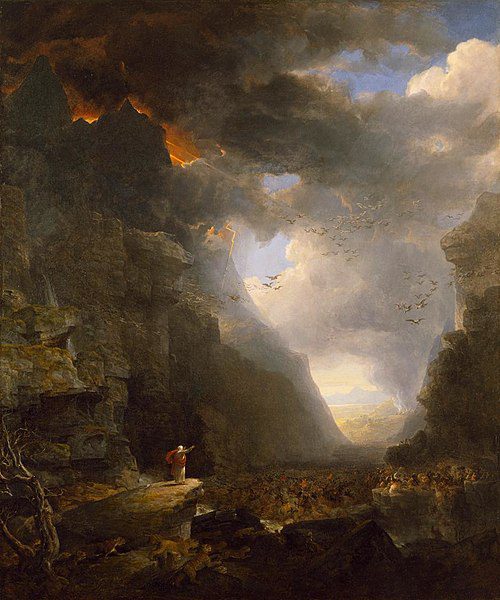
Photo credit: God’s Judgment upon Gog (1852), by Asher Brown Durand (1796-1886) [public domain / Wikimedia Commons]

***
alleged biblical contradictions
Previous Post

July 24, 2019
Seidensticker Folly #33: Clueless Re Biblical Anthropopathism
Next Post

July 25, 2019 Seidensticker Folly #35: Is God an Inveterate Liar?
Browse Our Archives
Select a Category & Last Things About Me Anti-Catholicism Atheism & Agnosticism Baptism and Sacramentalism Bible and Tradition Blessed Virgin Mary Books by Dave Armstrong C. S. Lewis Calvinism & General Protestantism Catholic Apologetics Catholic Apologists Catholic conversion Catholic converts Christmas Church (Ecclesiology) Church History Conversion and Converts Development of Doctrine Eastern Orthodoxy Ecumenism & Christian Unity Eucharist & Liturgy Fathers of the Church French Translations G. K. Chesterton Hell Hell & Satan Hell & Satan & Last Things Heresies & Comparative Religion Holistic Health Inquisition & Crusades & Scandals James White Jews & Judaism & Old Testament John Calvin John Henry Newman Liberal / Modernist Theology Life Issues Literary Resume Lutheranism Mariology Martin Luther Music Orthodoxy Papacy & Infallibility Personal Page Philosophy & Science Political & Ethical & Moral Issues Protestant Persecution & Intolerance Protestantism Purgatory Purgatory & Penance Romantic & Imaginative Theology Saints & Purgatory & Penance Salvation Salvation & Justification Satan & Last Things Sexuality and Gender Issues Spanish Translations Traditionalism vs. Radical Catholic Reactionaries Traducciones al español / tradução para português Trinitarianism & Christology Uncategorized Videos
Select a Month October 2026 September 2026 August 2026 July 2026 June 2026 May 2026 April 2026 March 2026 February 2026 January 2026 December 2025 November 2025 October 2025 September 2025 August 2025 July 2025 June 2025 May 2025 April 2025 March 2025 February 2025 January 2025 December 2024 November 2024 October 2024 September 2024 August 2024 July 2024 June 2024 May 2024 April 2024 March 2024 February 2024 January 2024 December 2023 November 2023 October 2023 September 2023 August 2023 July 2023 June 2023 May 2023 April 2023 March 2023 February 2023 January 2023 December 2022 November 2022 October 2022 September 2022 August 2022 July 2022 June 2022 May 2022 April 2022 March 2022 February 2022 January 2022 December 2021 November 2021 October 2021 September 2021 August 2021 July 2021 June 2021 May 2021 April 2021 March 2021 February 2021 January 2021 December 2020 November 2020 October 2020 September 2020 August 2020 July 2020 June 2020 May 2020 April 2020 March 2020 February 2020 January 2020 December 2019 November 2019 October 2019 September 2019 August 2019 July 2019 June 2019 May 2019 April 2019 March 2019 February 2019 January 2019 December 2018 November 2018 October 2018 September 2018 August 2018 July 2018 June 2018 May 2018 April 2018 March 2018 February 2018 January 2018 December 2017 November 2017 October 2017 September 2017 August 2017 July 2017 June 2017 May 2017 April 2017 March 2017 February 2017 January 2017 December 2016 November 2016 October 2016 September 2016 August 2016 July 2016 June 2016 May 2016 April 2016 March 2016 February 2016 January 2016 December 2015 November 2015 October 2015 September 2015 August 2015 July 2015 June 2015 May 2015 April 2015 March 2015 February 2015 January 2015 December 2014 November 2014 October 2014 September 2014 August 2014 July 2014 June 2014 April 2014 March 2014 February 2014 January 2014 December 2013 November 2013 October 2013 September 2013 August 2013 July 2013 June 2013 April 2013 March 2013 February 2013 January 2013 December 2012 November 2012 October 2012 September 2012 August 2012 July 2012 June 2012 May 2012 April 2012 March 2012 February 2012 January 2012 December 2011 November 2011 October 2011 September 2011 August 2011 July 2011 June 2011 April 2011 March 2011 February 2011 October 2010 September 2010 August 2010 July 2010 April 2010 March 2010 December 2009 October 2009 August 2009 July 2009 June 2009 May 2009 March 2009 February 2009 October 2008 September 2008 April 2008 March 2008 February 2008 January 2008 December 2007 November 2007 October 2007 May 2007 March 2007 February 2007 January 2007 November 2006 October 2006 September 2006 August 2006 July 2006 June 2006 May 2006 April 2006 March 2006 February 2006 October 2005 June 2005 April 2005 February 2005 July 2004 May 2004 April 2004
Follow Us!
TAKE THE
Religious Wisdom Quiz
Where was Paul's hometown?
Select your answer to see how you score.
Damascus Tarsus Antioch Jerusalem
Books by This Author Books by Dave Armstrong
Related posts from Biblical Evidence for Catholicism

A Few "Worst" & "Best" Arguments vs. Protestantism
Biblical Evidence for Catholicism

Jerusalem Council vs. James White & Sola Scriptura
Biblical Evidence for Catholicism

Biblical Perspicuity: Absurd Anti-Catholic "Defense"
Biblical Evidence for Catholicism

50 Biblical Disproofs of "Evident Clearness" of the...
Biblical Evidence for Catholicism
TRENDING AT PATHEOS Catholic

The Sermon on the Mount, Part I: Matthew...
The Sermon on the Mount, Part I (Matthew 4:12-5:12) St. Matthew moves...

What's up from Crossway: Reviewing some of their latest A few weeks...

Janie Learns the Way of the Cross: A...
Teaching children about Jesus' Passion can be challenging. Many parents and educators...

Looking For Good Catholic Writing - October 2026
He alone extends the heavens, and he walks upon the waves of...

In "Irreplaceable," our book on vocation and technology, Trevor Sutton and I...

I was strolling through the top floor of the brand new Parthenon...
view all Catholic blogs
Ad-Free & Subscriber Log-In Subscription Support
- About Us
- 2026 Calendar
- Videos
- Podcasts
- Library of World Religions
- Faith In Media Tracker
- Advertise With Us
- Write for Us
- Privacy Policy
- Terms of Service
- Do Not Sell My Data
- Contact Us
- Radiant Digital
- Manage Newsletter Subscriptions
- Unsubscribe From Notifications
- Sitemap
Copyright 2008-2026, Patheos. All rights reserved.
Subscription Support Ad-Free & Subscriber Log-In
Follow Patheos