
BuddhistCatholicContemplativeEvangelicalGeneral ChristianHinduJewishLatter-day SaintMuslimNew VisionsProgressive Christian
Beliefs
- Buddhist
- Catholic
- Contemplative
- Evangelical
- General Christian
- Hindu
- Jewish
- Latter-day Saint
- More Voices
- Muslim
- New Visions
- Pagan
- Progressive Christian
Topics
- Religion News
- Food and Religion
- Sports and Religion
- Religious Art
- Religious Music and Entertainment
- Religious Events
- History and Religion
- Style and Religion
- Politics and Religion
- Women in Religion
- Recreation Outdoors and Religion
- Business Finance and Religion
- Careers Workplace and Religion
- Education and Religion
- Family Parenting and Religion
- Health Fitness and Religion
- Home and Religion
- Relationships and Religion
- Technology and Religion
- Travel and Religion
Columnists
- Buddhist Columnists
- Business Finance and Religion Columnists
- Careers Workplace and Religion Columnists
- Catholic Columnists
- Contemplative Columnists
- Education and Religion Columnists
- Evangelists Columnists
- Family Parenting and Religion Columnists
- General Christian Columnists
- Health Fitness and Religion Columnists
- Hindu Columnists
- History and Religion Columnists
- Home and Religion Columnists
- Jewish Columnists
- More Voices Columnists
- Latter Day Columnists
- Muslim Columnists
- New Visions Columnists
- Nonreligious Columnists
- Pagan Columnists
- Politics and Religion Columnists
- Progressive Columnists
- Recreation Outdoors and Religion Columnists
- Relationships and Religion Columnists
- Religion News Columnists
- Religious Art Columnists
- Religious Events Columnists
- Religious Music and Entertainment Columnists
- Sports and Religion Columnists
- Style and Religion Columnists
- Technology and Religion Columnists
- Travel and Religion Columnists
- Women in Religion Columnists
Resource Library
- 2026 Calendar
- Library of World Religions
- The 100 Most Holy Places on Earth
- Patheos Answers
- Podcasts
- Videos
- Faith Leaders Database
- Anglican Episcopalian
- Bahai
- Baptist
- Buddhism
- Christianity
- Confucianism
- Eastern Orthodoxy
- Hinduism
- Holiness and Pentecostal
- ISKCON
- Islam
- Judaism
- Lutheran
- Methodist
- The Church of Jesus Christ of Latter-day Saints
- New Age
- Paganism
- Presbytarian and Reformed
- Protestantism
- Religion Behind the Scenes
- Roman Catholic
- Scientology
- Shia Islam
- Sikhism
- Sufism
- Sunni Islam
- Taoism
- Zen
- See all religions
Research Tools
 Ad-Free & Subscriber Log-In Subscription Support
Ad-Free & Subscriber Log-In Subscription Support
Follow Patheos 

- Trending:
- Forgiveness
- |
- Marriage
- |
- Consciousness
- |
- Death Penalty
- |
- Election
- |
- Halloween

-
About
-
Catholic Apologetics
-
Church History
-
Great Apologists
-
Christian Worldview
-
Protestantism & Misc.
- Home
- Catholic
- History and Religion
- Jesus Didn’t Always Turn the Other Cheek (Proverbs)
Jesus Didn’t Always Turn the Other Cheek (Proverbs)
Last updated on: July 6, 2019 at 12:01 pm by Dave Armstrong
Jesus Didn’t Always Turn the Other Cheek (Proverbs) 2019-07-06T12:01:10-04:00 Dave Armstrong
Patheos Explore the world's faith through different perspectives on religion and spirituality! Patheos has the views of the prevalent religions and spiritualities of the world.
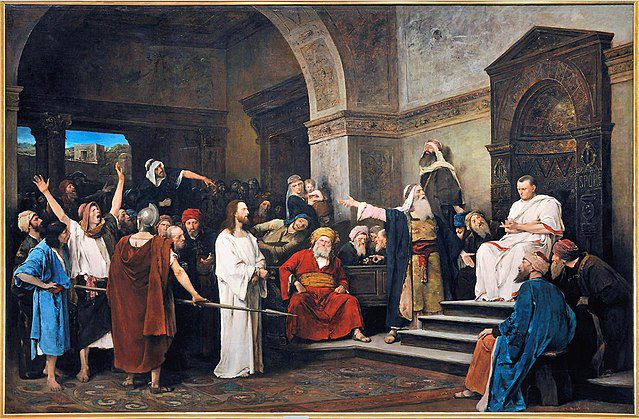
So many times, I am told (when opposing some falsehood being spewed about me or my work or alleged opinion) that we (and I) must “turn the other cheek” and not respond: as if this were an unwavering biblical command.
But I have reflected recently about how even Jesus didn’t totally turn the other cheek at His trial. He responded to Caiaphas the high priest:
Matthew 26:62-64 (RSV) And the high priest stood up and said, “Have you no answer to make? What is it that these men testify against you?” [63] But Jesus was silent. And the high priest said to him, “I adjure you by the living God, tell us if you are the Christ, the Son of God.” [64] Jesus said to him, “You have said so. But I tell you, hereafter you will see the Son of man seated at the right hand of Power, and coming on the clouds of heaven.”
This hearkened back to Daniel 7:13: a well-known messianic prophecy (“behold, with the clouds of heaven there came one like a son of man”: RSV). This was the immediate cause of His being accused of blasphemy, leading to His execution, and they mocked Him as “Christ” (i.e., messiah) precisely because He had agreed that He was (26:65-68) .
Jesus also replied to Pontius Pilate: “You would have no power over me unless it had been given you from above; therefore he who delivered me to you has the greater sin” (Jn 19:11). And He answered him earlier at some considerable length:
John 18:33-38 Pilate entered the praetorium again and called Jesus, and said to him, “Are you the King of the Jews?” [34] Jesus answered, “Do you say this of your own accord, or did others say it to you about me?” [35] Pilate answered, “Am I a Jew? Your own nation and the chief priests have handed you over to me; what have you done?” [36] Jesus answered, “My kingship is not of this world; if my kingship were of this world, my servants would fight, that I might not be handed over to the Jews; but my kingship is not from the world.” [37] Pilate said to him, “So you are a king?” Jesus answered, “You say that I am a king. For this I was born, and for this I have come into the world, to bear witness to the truth. Every one who is of the truth hears my voice.” [38] Pilate said to him, “What is truth?” . . .
And He answered “Annas . . . the father-in-law of Ca’iaphas, who was high priest” (Jn 18:13) at some length as well:
John 18:19-23 The high priest then questioned Jesus about his disciples and his teaching. [20] Jesus answered him, “I have spoken openly to the world; I have always taught in synagogues and in the temple, where all Jews come together; I have said nothing secretly. [21] Why do you ask me? Ask those who have heard me, what I said to them; they know what I said.” [22] When he had said this, one of the officers standing by struck Jesus with his hand, saying, “Is that how you answer the high priest?” [23] Jesus answered him, “If I have spoken wrongly, bear witness to the wrong; but if I have spoken rightly, why do you strike me?”
So He wasn’t “silent” at all. He actually said quite a bit during His trial, which is often brought up as an example of His “turning the other cheek.” He didn’t always (in fact, hardly at all). He replied at length to three different people. It’s true, however, that He was silent during His Passion, as far as we know, excepting His seven sayings from the cross. And that is probably what the messianic prophecy of Isaiah 53 refers to:
Isaiah 53:7 He was oppressed, and he was afflicted, yet he opened not his mouth; like a lamb that is led to the slaughter, and like a sheep that before its shearers is dumb, so he opened not his mouth.
The saying of Jesus: “Do not resist one who is evil. But if any one strikes you on the right cheek, turn to him the other also” (Mt 5:39) is not an absolute. Like many things Jesus says, and that many other Bible writers say (particularly David and Solomon), this is a proverb, and admits of exceptions. They were never intended to be absolutely binding in every situation. It’s not teaching pacifism.
The same Jesus Who said that we should turn our cheeks also said, “And let him who has no sword sell his mantle and buy one” (Luke 22:36). He also said, “all who take the sword will perish by the sword” (Mt 26:52). It’s not a contradiction. It’s proverbial language: wisdom to be applied differently in different situations.
Another example I always give is St. Paul vigorously defending himself all through his trial, even appealing to his Roman citizenship (so he wouldn’t be crucified), and playing up his pharisaical training, so as to cleverly divide his accusers (Acts 16:37-38; 22:25-29 / “Pharisee”: Acts 23:6; 26:5; Phil 3:5).
Moreover, Jesus also stated that His disciples would be given words to say in the event of their martyrdom or false public accusations. They were not to remain absolutely silent (it’s assumed throughout that they would speak and bear witness to the truth):
Matthew 10:16-22 “Behold, I send you out as sheep in the midst of wolves; so be wise as serpents and innocent as doves. [17] Beware of men; for they will deliver you up to councils, and flog you in their synagogues, [18] and you will be dragged before governors and kings for my sake, to bear testimony before them and the Gentiles. [19] When they deliver you up, do not be anxious how you are to speak or what you are to say; for what you are to say will be given to you in that hour; [20] for it is not you who speak, but the Spirit of your Father speaking through you. [21] Brother will deliver up brother to death, and the father his child, and children will rise against parents and have them put to death; [22] and you will be hated by all for my name’s sake. But he who endures to the end will be saved.”
Obviously, then, if neither our Lord Jesus nor St. Paul applied this saying as an absolute in all situations (and Paul tells us to imitate him: 2 Thess 3:7, 9 and many others), then neither should we. It’s certainly good advice in many situations, but not all. We have to use our best judgment and discernment as to when we should apply which method. This “optional” nature of a proverbial saying (with regard to defense or non-defense) is classically illustrated in a couplet in Proverbs, which are diametrically opposed to each other:
Proverbs 26:4-5 [4] Answer not a fool according to his folly, lest you be like him yourself. [5] Answer a fool according to his folly, lest he be wise in his own eyes.
In other words, there is no hard and fast answer. There are situations where fools and abusers / revilers / slanderers ought to be ignored (where that course of action is the wisest or most prudent) and others where they ought to be responded to, which is consistent with (among many other biblical passages) Proverbs 24:25: “those who rebuke the wicked will have delight, and a good blessing will be upon them.”
*
Related Reading:
***
Photo credit: Christ in Front of Pilate (1881), by Mihály Munkácsy (1844-1900) [public domain / Wikimedia Commons]

***
Previous Post

July 5, 2019
Bodily Assumption of Mary: Harmonious with the Bible?
Next Post

July 6, 2019 Apologetics Sometimes Entails "Vinegary" Conflict
Browse Our Archives
Select a Category & Last Things About Me Anti-Catholicism Atheism & Agnosticism Baptism and Sacramentalism Bible and Tradition Blessed Virgin Mary Books by Dave Armstrong C. S. Lewis Calvinism & General Protestantism Catholic Apologetics Catholic Apologists Catholic conversion Catholic converts Christmas Church (Ecclesiology) Church History Conversion and Converts Development of Doctrine Eastern Orthodoxy Ecumenism & Christian Unity Eucharist & Liturgy Fathers of the Church French Translations G. K. Chesterton Hell Hell & Satan Hell & Satan & Last Things Heresies & Comparative Religion Holistic Health Inquisition & Crusades & Scandals James White Jews & Judaism & Old Testament John Calvin John Henry Newman Liberal / Modernist Theology Life Issues Literary Resume Lutheranism Mariology Martin Luther Music Orthodoxy Papacy & Infallibility Personal Page Philosophy & Science Political & Ethical & Moral Issues Protestant Persecution & Intolerance Protestantism Purgatory Purgatory & Penance Romantic & Imaginative Theology Saints & Purgatory & Penance Salvation Salvation & Justification Satan & Last Things Sexuality and Gender Issues Spanish Translations Traditionalism vs. Radical Catholic Reactionaries Traducciones al español / tradução para português Trinitarianism & Christology Uncategorized Videos
Select a Month October 2026 September 2026 August 2026 July 2026 June 2026 May 2026 April 2026 March 2026 February 2026 January 2026 December 2025 November 2025 October 2025 September 2025 August 2025 July 2025 June 2025 May 2025 April 2025 March 2025 February 2025 January 2025 December 2024 November 2024 October 2024 September 2024 August 2024 July 2024 June 2024 May 2024 April 2024 March 2024 February 2024 January 2024 December 2023 November 2023 October 2023 September 2023 August 2023 July 2023 June 2023 May 2023 April 2023 March 2023 February 2023 January 2023 December 2022 November 2022 October 2022 September 2022 August 2022 July 2022 June 2022 May 2022 April 2022 March 2022 February 2022 January 2022 December 2021 November 2021 October 2021 September 2021 August 2021 July 2021 June 2021 May 2021 April 2021 March 2021 February 2021 January 2021 December 2020 November 2020 October 2020 September 2020 August 2020 July 2020 June 2020 May 2020 April 2020 March 2020 February 2020 January 2020 December 2019 November 2019 October 2019 September 2019 August 2019 July 2019 June 2019 May 2019 April 2019 March 2019 February 2019 January 2019 December 2018 November 2018 October 2018 September 2018 August 2018 July 2018 June 2018 May 2018 April 2018 March 2018 February 2018 January 2018 December 2017 November 2017 October 2017 September 2017 August 2017 July 2017 June 2017 May 2017 April 2017 March 2017 February 2017 January 2017 December 2016 November 2016 October 2016 September 2016 August 2016 July 2016 June 2016 May 2016 April 2016 March 2016 February 2016 January 2016 December 2015 November 2015 October 2015 September 2015 August 2015 July 2015 June 2015 May 2015 April 2015 March 2015 February 2015 January 2015 December 2014 November 2014 October 2014 September 2014 August 2014 July 2014 June 2014 April 2014 March 2014 February 2014 January 2014 December 2013 November 2013 October 2013 September 2013 August 2013 July 2013 June 2013 April 2013 March 2013 February 2013 January 2013 December 2012 November 2012 October 2012 September 2012 August 2012 July 2012 June 2012 May 2012 April 2012 March 2012 February 2012 January 2012 December 2011 November 2011 October 2011 September 2011 August 2011 July 2011 June 2011 April 2011 March 2011 February 2011 October 2010 September 2010 August 2010 July 2010 April 2010 March 2010 December 2009 October 2009 August 2009 July 2009 June 2009 May 2009 March 2009 February 2009 October 2008 September 2008 April 2008 March 2008 February 2008 January 2008 December 2007 November 2007 October 2007 May 2007 March 2007 February 2007 January 2007 November 2006 October 2006 September 2006 August 2006 July 2006 June 2006 May 2006 April 2006 March 2006 February 2006 October 2005 June 2005 April 2005 February 2005 July 2004 May 2004 April 2004
Follow Us!
TAKE THE
Religious Wisdom Quiz
What Christian group refers to their leaders as "General Superintendents"?
Select your answer to see how you score.
Orthodox Nazarene Catholic Methodist
Books by This Author Books by Dave Armstrong
Related posts from Biblical Evidence for Catholicism

A Few "Worst" & "Best" Arguments vs. Protestantism
Biblical Evidence for Catholicism

Jerusalem Council vs. James White & Sola Scriptura
Biblical Evidence for Catholicism

Biblical Perspicuity: Absurd Anti-Catholic "Defense"
Biblical Evidence for Catholicism

50 Biblical Disproofs of "Evident Clearness" of the...
Biblical Evidence for Catholicism
TRENDING AT PATHEOS Catholic

Pope Leo Celebrates Mass for Nurses & Docs...
I don't have any idea how he did it, but Pope Leo...

The Sermon on the Mount, Part I: Matthew...
The Sermon on the Mount, Part I (Matthew 4:12-5:12) St. Matthew moves...

What's up from Crossway: Reviewing some of their latest A few weeks...

Janie Learns the Way of the Cross: A...
Teaching children about Jesus' Passion can be challenging. Many parents and educators...

Looking For Good Catholic Writing - October 2026
He alone extends the heavens, and he walks upon the waves of...

In "Irreplaceable," our book on vocation and technology, Trevor Sutton and I...
view all Catholic blogs
Ad-Free & Subscriber Log-In Subscription Support
- About Us
- 2026 Calendar
- Videos
- Podcasts
- Library of World Religions
- Faith In Media Tracker
- Advertise With Us
- Write for Us
- Privacy Policy
- Terms of Service
- Do Not Sell My Data
- Contact Us
- Radiant Digital
- Manage Newsletter Subscriptions
- Unsubscribe From Notifications
- Sitemap
Copyright 2008-2026, Patheos. All rights reserved.
Subscription Support Ad-Free & Subscriber Log-In
Follow Patheos