
BuddhistCatholicContemplativeEvangelicalGeneral ChristianHinduJewishLatter-day SaintMuslimNew VisionsProgressive Christian
Beliefs
- Buddhist
- Catholic
- Contemplative
- Evangelical
- General Christian
- Hindu
- Jewish
- Latter-day Saint
- More Voices
- Muslim
- New Visions
- Pagan
- Progressive Christian
Topics
- Religion News
- Food and Religion
- Sports and Religion
- Religious Art
- Religious Music and Entertainment
- Religious Events
- History and Religion
- Style and Religion
- Politics and Religion
- Women in Religion
- Recreation Outdoors and Religion
- Business Finance and Religion
- Careers Workplace and Religion
- Education and Religion
- Family Parenting and Religion
- Health Fitness and Religion
- Home and Religion
- Relationships and Religion
- Technology and Religion
- Travel and Religion
Columnists
- Buddhist Columnists
- Business Finance and Religion Columnists
- Careers Workplace and Religion Columnists
- Catholic Columnists
- Contemplative Columnists
- Education and Religion Columnists
- Evangelists Columnists
- Family Parenting and Religion Columnists
- General Christian Columnists
- Health Fitness and Religion Columnists
- Hindu Columnists
- History and Religion Columnists
- Home and Religion Columnists
- Jewish Columnists
- More Voices Columnists
- Latter Day Columnists
- Muslim Columnists
- New Visions Columnists
- Nonreligious Columnists
- Pagan Columnists
- Politics and Religion Columnists
- Progressive Columnists
- Recreation Outdoors and Religion Columnists
- Relationships and Religion Columnists
- Religion News Columnists
- Religious Art Columnists
- Religious Events Columnists
- Religious Music and Entertainment Columnists
- Sports and Religion Columnists
- Style and Religion Columnists
- Technology and Religion Columnists
- Travel and Religion Columnists
- Women in Religion Columnists
Resource Library
- 2026 Calendar
- Library of World Religions
- The 100 Most Holy Places on Earth
- Patheos Answers
- Podcasts
- Videos
- Faith Leaders Database
- Anglican Episcopalian
- Bahai
- Baptist
- Buddhism
- Christianity
- Confucianism
- Eastern Orthodoxy
- Hinduism
- Holiness and Pentecostal
- ISKCON
- Islam
- Judaism
- Lutheran
- Methodist
- The Church of Jesus Christ of Latter-day Saints
- New Age
- Paganism
- Presbytarian and Reformed
- Protestantism
- Religion Behind the Scenes
- Roman Catholic
- Scientology
- Shia Islam
- Sikhism
- Sufism
- Sunni Islam
- Taoism
- Zen
- See all religions
Research Tools
 Ad-Free & Subscriber Log-In Subscription Support
Ad-Free & Subscriber Log-In Subscription Support
Follow Patheos 

- Trending:
- Forgiveness
- |
- Marriage
- |
- Consciousness
- |
- Death Penalty
- |
- Election
- |
- Halloween

-
About
-
Catholic Apologetics
-
Church History
-
Great Apologists
-
Christian Worldview
-
Protestantism & Misc.
- Home
- Catholic
- History and Religion
- Debate: Teach & Enforce Liturgical Rubrics Or No?
Debate: Teach & Enforce Liturgical Rubrics Or No?
Last updated on: July 16, 2019 at 7:07 pm by Dave Armstrong
Debate: Teach & Enforce Liturgical Rubrics Or No? 2019-07-16T19:07:27-04:00 Dave Armstrong
Patheos Explore the world's faith through different perspectives on religion and spirituality! Patheos has the views of the prevalent religions and spiritualities of the world.
This lively debate with several people took place on my Facebook page (see the complete, unabridged discussion) underneath a posting on the topic of the widespread “orans” posture during the Our Father at Mass. As usual, a “firestorm” ensued and (mostly) the same points that are always raised were made in opposition. I responded to them. Readers may make up their own minds, having seen both general “sides” of the dispute. That’s the beauty of dialogue, why I love it so much, and why I will continue hosting dialogues on my site with more than one opinion fully presented. I already have probably 900-1000 of ’em posted. Enjoy!
Color codes:
Fr. Angel Sotelo: blue
Jennifer Brown: green
Kristina Johnson: purple
Patrick Roos: brown
*****
This is one issue where I tell people to “just give it up.” Not because I like holding hands during the Our Father, or am a fan of the orans position, but simply because such a wide swatch of priests disagree and teach the opposite.
It is akin to the issue of female altar servers and washing the feet of women. When enough parishes, throughout the world, begin to abide by a different practice, and that practice then becomes custom, and custom lasts for decades–well, you know the rest.
What was once law or rubric, gives way to custom, and what was once custom, eventually becomes enshrined in law or rubrics. Or, the practice is tolerated enough, so that the rubric disappears and the law remains silent.
Hi Father,
I’ve always wondered: “why is it so hard for priests to simply explain what the rubrics teach?” I think congregants would listen if they did that. But they don’t. I find it odd and puzzling. I do it as an apologist and catch hell for it, and then I wonder again why priests don’t teach about this.
If we allowed laypeople to determine everything liturgical, obviously it would become chaotic.
Remember, just because parishioners flout our rules, does not mean we did not teach and explain them. Do kids always obey what their parents have taught and explained to them? When they don’t, people blame the parents, but it is not always the case that the parents didn’t do their job.
So you did explain it and they ignored it? That surprises me. I assumed they would obey if it was explained. I’ve only seen one priest in my 29 years as a Catholic (which is at least 1500 Masses), explain the rubrics and what to do and not do.
The interesting question is also why “a wide swatch of priests disagree and teach the opposite.” Do they not care at all about what the rubrics teach? What is their rationale?
I always said no to female servers, until JPII said yes. I always said no to washing the feet of women. Francis changed that. I still discourage hand holding and orans, but my parishioners visit other places where the priest told them I was wrong. So, while a lot of my parishioners don’t hold hands, some do, and I don’t make a big deal of it.
So it’s a case where you weren’t listened to. Therefore, you have to decide if it’s worth further pursuing or not, in your parish. I understand and accept that.
***
I managed to educate my wife and our kids why we don’t hold hands during the Our Father, but having been a RCIA catechist who gets a little Southern Baptist-y at times (fired up, excited and animated when evangelizing) when teaching the Faith geared toward evangelizing, I have gained an appreciation for the Herculean task priests have to pass on the Faith and inspire people’s faith (fides quae and fides qua) during a short homily (remember, Pope Francis says no more than 10 minute homilies).
With limited time, he has to decide what his time will be more fruitfully spent on, and getting people to a point where they want to develop a relationship with Christ, or hear the why behind the Church’s what that could pull them back from walking down the road to perdition will feature more prominently in his mind. Teaching that holding hands and the orans posture are a no-no is pretty far down the list. Not unimportant, but farther down the hierarchy of urgency. That will come later, when people are asking “how can I worship the God whom I love better at Mass?” Sadly, the majority of pew-warming cultural Catholics who were poorly catechized and not evangelized aren’t at that point. That’s why you don’t hear priests preach about it.
They can easily write an article in the bulletin, then, and if it raises a fuss, have a class about it on a weekday night.
A class which no one but the usual few will come to because they aren’t evangelized and haven’t been witnessed to. As an apologist, you are a teacher of sorts, but there has to be that relationship built first, then evangelizing, then teaching.
“Modern man listens more willingly to witnesses than to teachers, and if he does listen to teachers, it is because they are witnesses.” ~Pope Paul VI, Evangelium Nuntiandi, 41
The witness and evangelizing comes first, then they will be open to hearing why they shouldn’t be engaging in some Protestantesque kumbaya during the Our Father. Your article on why is good, Dave, but it’s putting the cart before the horse for the vast majority of parishioners.
Do you accept the premise that the rubrics ought to be followed or not (and so ought to be taught if there are massive violations)?
That also comes first before we start discussing all these grand issues about what is more important, etc. I still say it’s not “either/or.” It’s the Protestants who pit things against each other and possess a “dichotomous” mindset, as Louis Bouyer wrote about at length in The Spirit and Forms of Protestantism.
I said “if it raises a fuss, have a class about it.” If there is a fuss, then folks would come (or so it seems to me).
I could take the same view as an apologist that priests who don’t wanna discuss this issue take: “people don’t give a damn about contraception or the in partu virginity of Mary or capital punishment or the proper rule of faith (over against sola Scriptura) or hell or why homosexual acts are intrinsically wrong or [insert 50 other topics no one cares about], and people give me hell about almost as many topics; therefore, I won’t write about them. Why bother?”
I obviously don’t do that. I write about everything and anything concerning the faith, and am quite willing to take all the slings and arrows for it. It’s a weekly occurrence, and has been going on since 1997 when I began my website.
I’m totally sympathetic to priests like Fr. Angel, who did teach his flock and they didn’t abide by it. I already conceded that point. That’s fine. At that point it’s not a hill to die on. My beef is with priests or catechists like you (if you have not taught this) who decide not to teach something simply because it will be controversial or unpopular.
Of course the rubrics ought to be followed (including facing ad orientam and following the rubric to turn toward the people at the appropriate times). That’s why I taught my family not to hold hands.
My point is not an either/or argument, but a cart-before-the-horse argument. A foundation needs to be laid first upon which to build, and holding hands is one brick higher up in the wall, while the foundational bricks need to be laid first. Strategy needs to be employed in what gets addressed first: things that violate natural law and moral doctrine need to be addressed before changeable rubrics. The Church understands a hierarchy of truths, and the more basic truths and those that have far larger implications for a person’s soul need to be addressed earlier than rubrics at Mass.
Yes, it needs to be addressed (never have liked it, even in my more fervent Charismatic days at Steubenville), but with finite time, I will address why a catechumen/parishioner needs to change their thinking on contraception first, and get to holding hands later. As a catechist I have more time to do this than a priest does, and personally I addressed it when we taught the parts of the Mass. Your average parish priest won’t have the time.
As for people coming to a class if they raise a fuss over something: you obviously have not worked in a parish. The people who make a fuss over it don’t come to classes. They gripe about it to any/everyone who will listen, complain to the bishop, and get the priest’s hand smacked by the bishop for being “divisive.”
This is a different argument. That is what Fr. Angel was saying too: priorities, emphases, prudential considerations . . .
But in the big dialogue I am having today with canonist Pete Vere and another canon law-trained person (which will be a separate posted dialogue for my blog), they are saying something very different: it’s no big deal, period, and customs can change and are permitted. You freely concede that these things are improper and against the rubrics. They do not.
My opinion is that we can walk and chew gum at the same time; that just because some things are more important than others (truism), it doesn’t follow that we therefore ignore the lesser things altogether, as of no import whatever, until the more important things are done. The more important things will never be fully accomplished at any given time, anyway.
But I fully grant that there are priorities, given finite time, as you say. I have to make those decisions all the time in my own work, too: a million topics could be addressed, so which to write about now? What’s relatively more important? But you did say, “personally I addressed it when we taught the parts of the Mass.” Good! That’s all I’m saying. Teach the thing . . .
In Fr. Angel’s case, he also taught it (he didn’t ignore it, whereas you said, “Your average parish priest won’t have the time”) and people disobeyed his instruction. He did his duty and it was unheeded; so did you, and so you can both shake the dust off of your “sandals” and move on, having done what you were charged to do. One can only do so much.
So I have been arguing with two different positions, and indeed a third, too, where I was ridiculously accused of not caring about evangelism, simply because I have written three articles on this, out of my 2400+, and dared to express an opinion. LOL [see the dialogue with the opponent’s words in green below]
***
Orans position; I don’t see how this is the same as holding hands.
It’s not. Both are against the rubrics.
This is going to sound completely Protestant but I actually think it makes sense to hold hands during the Our Father. We are the Royal priesthood; individually as well as officially. This is one prayer we all say together in that role. Catholics are visual. Seeing hands united in prayer and reciting the prayer all together as the Royal, priestly family of God is a visual representation of a greater reality.
I obey Holy Mother Church. If I wasn’t willing to do so there would have been no reason to leave Protestantism. I was perfectly happy there.
Are you a convert? I did not know. I’m a cradle. My parents always held my hand during the Our Father, as do most of my parish. There are a few that are obedient. The rest of us, I suppose, are heathens. My heart hasn’t convicted me yet on this one. Like I said, it kinda makes a lot of sense to hold hands.
Yes, I’m a convert.
The question is whether you are willing to follow the rules of the Church or not. If we don’t follow simple rules, chances are we likely reject required Catholic doctrines and moral teachings as well. We see plenty of that. Contraception and cohabitation immediately come to mind.
Holy Mother Church is there precisely so we don’t have to rely on our “heart” and subjectivism. She won’t lead us astray.
Well, I don’t do either of those you mention so I haven’t been corrupted yet.
You don’t care about the rules in the rubrics. The question you and others who do this need to ask yourself is “why?”
Seems petty? When does the average Catholic even get exposed to the “rubrics”?
I agree there, which is why I think it is the fault of priests if they don’t teach their congregations. But right now, if you read my article or the one I linked to, you do know, so you are more culpable than you were before.
I don’t remember there being a rubrics class? I don’t remember it being touched on in my Catholic elementary? Or during RCIA when My then fiancé (now husband) converted? I didn’t even know it was supposedly “wrong” until I read an article about it (probably yours) two years ago. I’ve been Catholic for 39 years. If it was that important you’d think maybe I would have heard of it before? Or have been instructed about it at some point?
Yeah, I’ve been culpable for a few years then, but I still haven’t been convicted about it… yet.
So you need a personal revelation in order to follow a Church law that you have been informed about? I agreed that it wasn’t the fault of someone whose priest didn’t teach it. But that doesn’t prove that it is unimportant. What it proves is that many priests didn’t teach it, and many disagree with it (as Fr. Angel has stated in this thread).
I’m just trying to figure out what else I’ve missed. I must really be a heathen.
You’re doing fine. It’s just a point you weren’t taught about — just as tens of millions were not — (not your fault) and now you have been . . .
It’s hard to break traditions, and feels almost antiCatholic to suggest it.
This [article] brought up some good points too.
Benedictine Fr. Anthony Ruff, a liturgist and theology professor at St. John’s University in Collegeville, Minnesota, told NCR that the practice is neither allowed nor forbidden.
“You could make a loose comparison to the common practice, at the announcement of the Gospel reading, of crossing ourselves on our forehead, lips and heart. For a long time that wasn’t in the official books either, but people just did it in imitation of the deacon’s (or priest’s) action. Then it became official. That’s oftentimes how liturgy evolves,” he emailed to NCR. (“Should we hold hands or not during the Our Father?”; Peter Feuerherd, National Catholic Reporter, Jun 29, 2017)
I cited Fr. Peter Stravinskas in my article: himself a renowned liturgist, scholar, and magazine editor, who has written books about the Mass. And Jimmy Akin, who has written several books about the Mass and the liturgy.
I wouldn’t make these claims without that back-up because liturgy isn’t particularly my “area” (though I still have written many articles about it, just like everything else).
But you notice that even those who are disputing with me about how relatively important it is to teach or enforce this (Fr. Angel, Patrick Roos), agree that it is the position of the rubrics).
***
I dunno. On the level of what is important and what should be focused on, how folks hold their hands at the Our Father doesn’t need to merit such a fuss. Maybe whether or not those in the pews understand Christ’s sacrifice for us and are applying the sacramental graces to their daily lives would be a better thing to worry about.
That and the fact that most parishes have no idea how to be missionary.
But I digress…
No one has said it’s the most important thing in the world [sarcasm]. That is your assumption. It doesn’t have to be either/or.
I teach about this (and practice it) because it is what the Church teaches us to do. Period. There is no other reason. As an apologist, it’s my duty to pass along the teachings of the Church — as an educator.
You’re my Facebook friend, so you know that in my 2400+ articles on my blog and in 50 books I am teaching lots and lots of things. 99.9% of them are different topics than this. I have exactly three blog articles about it.
But there must also be a reason why one of my articles on this is my most popular of all (stats from Google Analytics). People must feel that they learned something valuable that they didn’t know. Articles don’t become that popular if everyone hates them.
Dave, that you feel the need to point it out at all is the issue. It’s like talking about where to put the furniture when the house is burning down. Plus it only encourages people to focus on the maintenance minutia instead of the mission changes that have to take place.
That articles on this topic are popular tells me we focus people on the wrong thing.
Just because it is a relatively minor thing in the scheme of things, it doesn’t follow that it means nothing. I’m passing it along. If you don’t like it, get mad at Holy Mother Church. I’m just the messenger. It’s like people getting mad at weather reporters for a bad forecast . . .
It’s not opinion as much as the mission of the Church.
Dave, I’m not going to let you off that easy. You have a voice, a big voice. So much needs to change for our parishes to fulfill the mission of the Church. When we focus on insider minutia, we don’t teach people:
1. To know Christ personally
2. To share what he has done and is doing in our lives and
3. Preach the Gospel
When we are failing at our mission at such a massive level, we who can need to help parishioners do the above. The Church exists to evangelize. No this doesn’t mean we don’t also attend to having good Liturgy, but a fruitful Liturgy doesn’t come from obeying the rules. It comes from disciples who know, love and are loved by Christ and fervently live the Sacramental life. Which then sends us out on mission, “ite missa est”.
You have a platform. From one working for the Church, to do precisely the above (and have for many years) let’s not focus on insider navel gazing but in empowering people to be missionary disciples.
Again, it’s not an either/or scenario. Doing one thing doesn’t nullify doing the other. I’ve been an apologist and evangelist for almost 29 years as a Catholic, and 38, including my Protestant years.
Obviously, then, I’m the last person to ever want to minimize that. But I don’t see how a simple statement that the rubrics teach us about bodily posture during the Our Father somehow is counter to, or pitted against how committed we ought to be to mission and evangelism. It’s apples and oranges.
If you want to see how much I write about salvation and evangelization (compared to three posts about this stuff), see my Salvation & Justification web page.
Just read your readers’ reactions! You’d think we were headed to hell for holding hands! Even within what is important in the Mass this is such a small matter. If you’d have posted about, say, a priest using the wrong words at consecration, spouting heresy during his homily or including nuns or any other but a priest or deacon at the consecration, yes, that’s an issue.
But your readers treat it as though it’s the worst thing. It’s. Just. Not. I’d like to ask them how they are making disciples? Are they taking daily prayer and listening to the Holy Spirit about their lives? Seeking the ways God wants them to be missionary today? This week? This month? Have they shared the Gospel with anyone this past week or month? Have they discerned their spiritual gifts so that they know how to help build the Kingdom? Are they tithing well and regularly?
Whether you hold hands or not during Mass doesn’t make disciples.
It’s you who have made it one against the other by bringing it up as a “problem” and letting folks get bothered by it.
I love a debate, and I am responding. But a true dialogue has mutual interaction, not mutual monologue. You keep saying the same thing with the same fallacy, which I have replied to over and over. That doesn’t strengthen your argument. It only shows that it’s weak, because you don’t interact with my replies.
Evangelize and do all these other things and respect the liturgical rubrics. Pitting them against each other is the Protestant mindset, not a Catholic one. We don’t grade things in importance and discard those we think are “secondary.” That’s the mentality that caused Luther to ditch five of the seven sacraments.
I’m bothered by how few laborers there are in the field. How about writing about that and help people learn how to be missionary disciples? That might be a better use of your time and the readers’ education.
Totally agree as I already said. Looks like you haven’t visited my Salvation & Justification web page. Word-search “THE GOSPEL, FAITH, AND “PERSONAL RELATIONSHIP WITH JESUS” and see the 29 articles I have posted there.
***
I also had a related exchange on Facebook with Deacon Steven D. Greydanus.
***
Related Reading:
*
Liturgical Abuses at Mass: What to Do? [2-19-08]
*
Posture During the “Our Father” Over Against the Rubrics [7-7-08]
*
Holding Hands at Mass During the “Our Father” [2-19-14]
*
Dialogues on Church Rubrics (Laws) & Hand-Holding at Mass [11-15-17]
*
***
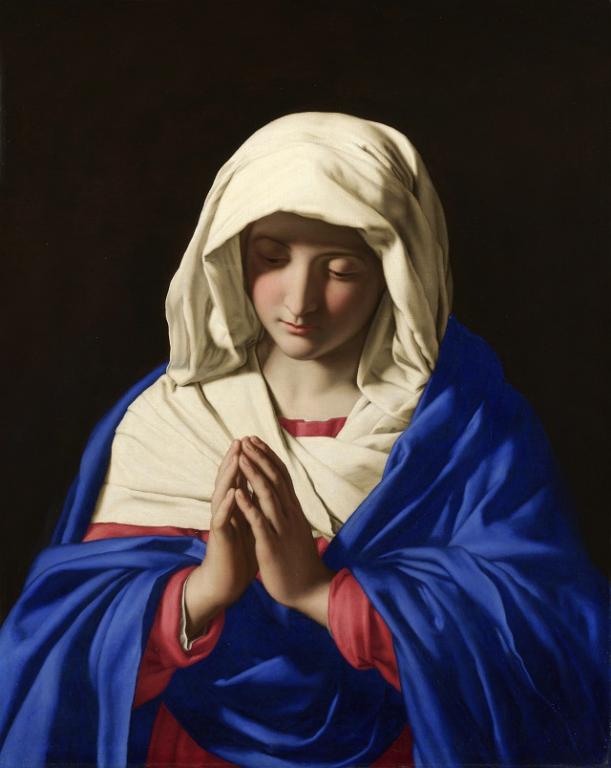
Photo credit: The Virgin in Prayer (bet. 1640 and 1650), by Giovanni Battista Salvi da Sassoferrato (1609-1685) [public domain / Wikimedia Commons]

***
Previous Post

July 15, 2019
Vs. Pasqualucci Re Vatican II #5: LG, UR & "Subsists"
Next Post
July 16, 2019 Vs. Pasqualucci Re Vatican II #6: Dei Verbum & the Bible
Browse Our Archives
Select a Category & Last Things About Me Anti-Catholicism Atheism & Agnosticism Baptism and Sacramentalism Bible and Tradition Blessed Virgin Mary Books by Dave Armstrong C. S. Lewis Calvinism & General Protestantism Catholic Apologetics Catholic Apologists Catholic conversion Catholic converts Christmas Church (Ecclesiology) Church History Conversion and Converts Development of Doctrine Eastern Orthodoxy Ecumenism & Christian Unity Eucharist & Liturgy Fathers of the Church French Translations G. K. Chesterton Hell Hell & Satan Hell & Satan & Last Things Heresies & Comparative Religion Holistic Health Inquisition & Crusades & Scandals James White Jews & Judaism & Old Testament John Calvin John Henry Newman Liberal / Modernist Theology Life Issues Literary Resume Lutheranism Mariology Martin Luther Music Orthodoxy Papacy & Infallibility Personal Page Philosophy & Science Political & Ethical & Moral Issues Protestant Persecution & Intolerance Protestantism Purgatory Purgatory & Penance Romantic & Imaginative Theology Saints & Purgatory & Penance Salvation Salvation & Justification Satan & Last Things Sexuality and Gender Issues Spanish Translations Traditionalism vs. Radical Catholic Reactionaries Traducciones al español / tradução para português Trinitarianism & Christology Uncategorized Videos
Select a Month October 2026 September 2026 August 2026 July 2026 June 2026 May 2026 April 2026 March 2026 February 2026 January 2026 December 2025 November 2025 October 2025 September 2025 August 2025 July 2025 June 2025 May 2025 April 2025 March 2025 February 2025 January 2025 December 2024 November 2024 October 2024 September 2024 August 2024 July 2024 June 2024 May 2024 April 2024 March 2024 February 2024 January 2024 December 2023 November 2023 October 2023 September 2023 August 2023 July 2023 June 2023 May 2023 April 2023 March 2023 February 2023 January 2023 December 2022 November 2022 October 2022 September 2022 August 2022 July 2022 June 2022 May 2022 April 2022 March 2022 February 2022 January 2022 December 2021 November 2021 October 2021 September 2021 August 2021 July 2021 June 2021 May 2021 April 2021 March 2021 February 2021 January 2021 December 2020 November 2020 October 2020 September 2020 August 2020 July 2020 June 2020 May 2020 April 2020 March 2020 February 2020 January 2020 December 2019 November 2019 October 2019 September 2019 August 2019 July 2019 June 2019 May 2019 April 2019 March 2019 February 2019 January 2019 December 2018 November 2018 October 2018 September 2018 August 2018 July 2018 June 2018 May 2018 April 2018 March 2018 February 2018 January 2018 December 2017 November 2017 October 2017 September 2017 August 2017 July 2017 June 2017 May 2017 April 2017 March 2017 February 2017 January 2017 December 2016 November 2016 October 2016 September 2016 August 2016 July 2016 June 2016 May 2016 April 2016 March 2016 February 2016 January 2016 December 2015 November 2015 October 2015 September 2015 August 2015 July 2015 June 2015 May 2015 April 2015 March 2015 February 2015 January 2015 December 2014 November 2014 October 2014 September 2014 August 2014 July 2014 June 2014 April 2014 March 2014 February 2014 January 2014 December 2013 November 2013 October 2013 September 2013 August 2013 July 2013 June 2013 April 2013 March 2013 February 2013 January 2013 December 2012 November 2012 October 2012 September 2012 August 2012 July 2012 June 2012 May 2012 April 2012 March 2012 February 2012 January 2012 December 2011 November 2011 October 2011 September 2011 August 2011 July 2011 June 2011 April 2011 March 2011 February 2011 October 2010 September 2010 August 2010 July 2010 April 2010 March 2010 December 2009 October 2009 August 2009 July 2009 June 2009 May 2009 March 2009 February 2009 October 2008 September 2008 April 2008 March 2008 February 2008 January 2008 December 2007 November 2007 October 2007 May 2007 March 2007 February 2007 January 2007 November 2006 October 2006 September 2006 August 2006 July 2006 June 2006 May 2006 April 2006 March 2006 February 2006 October 2005 June 2005 April 2005 February 2005 July 2004 May 2004 April 2004
Follow Us!
TAKE THE
Religious Wisdom Quiz
Who prayed for rain after a long drought and sent his servant to look seven times?
Select your answer to see how you score.
Elijah Isaiah Samuel Hosea
Books by This Author Books by Dave Armstrong
Related posts from Biblical Evidence for Catholicism

The Mass & Development of Doctrine (vs. Wes...
Biblical Evidence for Catholicism

Miraculous Eucharist (vs. Francois Turretin #4)
Biblical Evidence for Catholicism

God's Presence, the Ark, the Eucharist, & Death
Biblical Evidence for Catholicism
Protestant Eucharistic Objections Fail (Turretin)
Biblical Evidence for Catholicism
TRENDING AT PATHEOS Catholic

I was strolling through the top floor of the brand new Parthenon...

What Does Gêvâh Mean For Kimberley Guifoyle &...
This week, a lot of the news is focused on Kimberly Guilfoyle....

INNER CIRCLE: Profound Mystery (Of Christ In All...
Ephesians 5:31-32 “For this reason, a man will leave his father and...

Do Not Rejoice When Your Enemy Falls: The...
Turning an execution into a public spectacle is a disturbing expression of...

'The Chosen' S6 Trailer: The Passion Gets Very...
Not many watching 'The Chosen' worry about spoilers, but just because they...

The purpose-driven labor priest
A labor activist reads Rick Warren and it gets me wondering about...
view all Catholic blogs
Ad-Free & Subscriber Log-In Subscription Support
- About Us
- 2026 Calendar
- Videos
- Podcasts
- Library of World Religions
- Faith In Media Tracker
- Advertise With Us
- Write for Us
- Privacy Policy
- Terms of Service
- Do Not Sell My Data
- Contact Us
- Radiant Digital
- Manage Newsletter Subscriptions
- Unsubscribe From Notifications
- Sitemap
Copyright 2008-2026, Patheos. All rights reserved.
Subscription Support Ad-Free & Subscriber Log-In
Follow Patheos