
BuddhistCatholicContemplativeEvangelicalGeneral ChristianHinduJewishLatter-day SaintMuslimNew VisionsProgressive Christian
Beliefs
- Buddhist
- Catholic
- Contemplative
- Evangelical
- General Christian
- Hindu
- Jewish
- Latter-day Saint
- More Voices
- Muslim
- New Visions
- Pagan
- Progressive Christian
Topics
- Religion News
- Food and Religion
- Sports and Religion
- Religious Art
- Religious Music and Entertainment
- Religious Events
- History and Religion
- Style and Religion
- Politics and Religion
- Women in Religion
- Recreation Outdoors and Religion
- Business Finance and Religion
- Careers Workplace and Religion
- Education and Religion
- Family Parenting and Religion
- Health Fitness and Religion
- Home and Religion
- Relationships and Religion
- Technology and Religion
- Travel and Religion
Columnists
- Buddhist Columnists
- Business Finance and Religion Columnists
- Careers Workplace and Religion Columnists
- Catholic Columnists
- Contemplative Columnists
- Education and Religion Columnists
- Evangelists Columnists
- Family Parenting and Religion Columnists
- General Christian Columnists
- Health Fitness and Religion Columnists
- Hindu Columnists
- History and Religion Columnists
- Home and Religion Columnists
- Jewish Columnists
- More Voices Columnists
- Latter Day Columnists
- Muslim Columnists
- New Visions Columnists
- Nonreligious Columnists
- Pagan Columnists
- Politics and Religion Columnists
- Progressive Columnists
- Recreation Outdoors and Religion Columnists
- Relationships and Religion Columnists
- Religion News Columnists
- Religious Art Columnists
- Religious Events Columnists
- Religious Music and Entertainment Columnists
- Sports and Religion Columnists
- Style and Religion Columnists
- Technology and Religion Columnists
- Travel and Religion Columnists
- Women in Religion Columnists
Resource Library
- 2026 Calendar
- Library of World Religions
- The 100 Most Holy Places on Earth
- Patheos Answers
- Podcasts
- Videos
- Faith Leaders Database
- Anglican Episcopalian
- Bahai
- Baptist
- Buddhism
- Christianity
- Confucianism
- Eastern Orthodoxy
- Hinduism
- Holiness and Pentecostal
- ISKCON
- Islam
- Judaism
- Lutheran
- Methodist
- The Church of Jesus Christ of Latter-day Saints
- New Age
- Paganism
- Presbytarian and Reformed
- Protestantism
- Religion Behind the Scenes
- Roman Catholic
- Scientology
- Shia Islam
- Sikhism
- Sufism
- Sunni Islam
- Taoism
- Zen
- See all religions
Research Tools
 Ad-Free & Subscriber Log-In Subscription Support
Ad-Free & Subscriber Log-In Subscription Support
Follow Patheos 

- Trending:
- Forgiveness
- |
- Marriage
- |
- Consciousness
- |
- Death Penalty
- |
- Election
- |
- Halloween

-
About
-
Catholic Apologetics
-
Church History
-
Great Apologists
-
Christian Worldview
-
Protestantism & Misc.
- Home
- Catholic
- History and Religion
- Debate: Calling People “Fools” (vs. Dr. Dawn Eden Goldstein)
Debate: Calling People “Fools” (vs. Dr. Dawn Eden Goldstein)
Last updated on: July 29, 2019 at 12:45 pm by Dave Armstrong
Debate: Calling People “Fools” (vs. Dr. Dawn Eden Goldstein) 2019-07-29T12:45:51-04:00 Dave Armstrong
Patheos Explore the world's faith through different perspectives on religion and spirituality! Patheos has the views of the prevalent religions and spiritualities of the world.
From a public thread on my Facebook page. Dawn’s words will be in blue.
*****
I appreciate your theological points very much but refrain from sharing your posts because you use polemic insults such as “blowhard fools.”
That was my strongest language, reserved for a person who richly deserves it (Chris Ferrara). I could give literally scores of examples as to why I think that. He has childishly and unjustly insulted my good friend and your associate, Bob Fastiggi, among countless others. So there is plenty of warrant for use of the term (“fool” being quite biblical) for him. But out of respect for you and your fine work, and taking your point, I’ll remove it from the article.
I also use “reactionaries” but I very meticulously define that elsewhere as a category that goes far beyond traditionalism. I use it precisely to differentiate legitimate traditionalists who are tarred in wrongful association with the reactionaries.
Thanks. If we’re talking about what’s biblical, don’t forget Matthew 5:22.
I don’t forget it, Dawn. I’m glad you brought that up, as I have written about it: twice. The passage has to be interpreted and examined more closely. And when we do that, it turns out that it is not an absolute prohibition: anymore than “turn the other cheek” is (St. Paul didn’t do that at his trial).
Both Jesus and Paul use “fool” several times, and Scripture tells us to imitate them. The word for “fool” in Matthew 5:22 is moros and Jesus used it on two other occasions:
Matthew 23:17, 19 (RSV) You blind fools! [moros] For which is greater, the gold or the temple that has made the gold sacred? . . . [19] You blind men! [moros] For which is greater, the gift or the altar that makes the gift sacred?
Matthew 25:2-3, 8 Five of them were foolish [moros], and five were wise. [3] For when the foolish [moros] took their lamps, they took no oil with them; . . . [8] And the foolish [moros] said to the wise, ‘Give us some of your oil, for our lamps are going out.’
St. Paul used another word usually translated as “fool” at least five times. “Fools” are also referred to 135 times in the Old Testament.
Because of this, I don’t hold the view that use of the word “fool” is absolutely prohibited, and so I use it, but reserve it (usually) for extreme cases. It’s a very biblical word, and we can use it, when justified, just as David, Solomon, Jesus, and Paul did.
Chris Ferrara, for those unfamiliar with him, has severely trashed Vatican II, the ordinary form Mass, Pope St. John Paul II, and derisively refers to orthodox Catholics as “neo-Catholics” (which term he popularized, after Gerry Matatics coined it). Bashing popes is nothing new with him.
That is a biblical “fool” if anyone is.
Jesus and Paul are careful not to use ad hominems. They use the words “fool” or “foolish” to describe types of people (the rich man of the parable who stores up goods is a type, not an actual person) and not to slander individuals. We need to be careful not to cherry-pick verses while ignoring the numerous exhortations to charity and admonitions against misuse of the tongue.
Besides, love your enemy and all that.
The Pharisees were quite real, and Jesus used the term of them. In Paul’s five usages, real men were involved (and a whole church, too):
Galatians 3:1, 3 O foolish Galatians! Who has bewitched you, before whose eyes Jesus Christ was publicly portrayed as crucified? . . . [3] Are you so foolish? Having begun with the Spirit, are you now ending with the flesh?
If the use was absolutely wrong, Jesus couldn’t have done that, nor Paul, and Jesus couldn’t and wouldn’t have used it even in a parable.
Also, given the constant use of “fool” in the wisdom literature, it’s simply impossible to say that we must never use the word. If someone actually is a [biblical] fool, it’s not slander to refer to him as one. It’s the truth. It’s a needed rebuke.
Yeah, I’m all for charity, and I am widely regarded (based on feedback I receive) as a charitable apologist, who refrains from needless personal attacks and insults and simply lays out my case. I’m not perfect, but I can say with assurance that I am not characterized (as a character trait) by being free with slander and insults and “evil speaking.” I’m with you: I condemn that all the time and seek to (imperfectly) model a better way in my demeanor.
Once all the biblical data is taken into consideration, it seems very clear to me that there is indeed a time and a place to use strong language and to issue rebukes, with biblical support. We mustn’t slander, and we must have compelling rationale to do so. I say it is all abundantly there in Chris Ferrara’s case.
It comes down to specific application. Was it justified, in describing him or not? I say it was. You disagree. But I’m saying that if we are allowed to call anyone a fool at all, that he is a prime candidate to be a recipient of it, based on his relentless attacks on Catholic teaching, popes, ecumenical councils, and orthodox Catholics.
I do agree, though, that the description was best left out of my paper, because people not knowing the background would conclude that it was harsh and a “personal attack” (or, possibly that my apologetics writing is habitually characterized by undue polemics, which is untrue).
You just proved my point. Jesus rebuked Pharisees as a group; he did not single out an individual and call him a fool. Likewise, the Wisdom literature refers to types; it singles out no individual for ridicule.
If you say to a group (Pharisees or Galatians): “you are fools” I don’t see any ethical distinction between that and saying it to an individual. If it’s wrong to call an individual that, then it would be even more wrong to classify a whole group as such, no?
St. Paul (like the prophets) does single out individuals for strong rebuke or condemnation:
1 Timothy 1:19-20 (RSV) . . . By rejecting conscience, certain persons have made shipwreck of their faith, [20] among them Hymenae’us and Alexander, whom I have delivered to Satan that they may learn not to blaspheme.
2 Timothy 4:14-15 Alexander the coppersmith did me great harm; the Lord will requite him for his deeds. [15] Beware of him yourself, for he strongly opposed our message.
2 Timothy 2:16-18 Avoid such godless chatter, for it will lead people into more and more ungodliness, [17] and their talk will eat its way like gangrene. Among them are Hymenae’us and Phile’tus, [18] who have swerved from the truth by holding that the resurrection is past already. They are upsetting the faith of some.
1 Corinthians 5:1-5 It is actually reported that there is immorality among you, and of a kind that is not found even among pagans; for a man is living with his father’s wife. [2] And you are arrogant! Ought you not rather to mourn? Let him who has done this be removed from among you. [3] For though absent in body I am present in spirit, and as if present, I have already pronounced judgment [4] in the name of the Lord Jesus on the man who has done such a thing. When you are assembled, and my spirit is present, with the power of our Lord Jesus, [5] you are to deliver this man to Satan for the destruction of the flesh, that his spirit may be saved in the day of the Lord Jesus.
Are you saying that he could not possibly have also called such men “fools”: as he did with the Galatians and as Jesus did with the Pharisees?
Calling a group that holds a particular opinion “fools” makes it clearer that one is condemning an opinion and not a person.
I think there is that aspect, but also it can be seen that when Paul calls the Galatians foolish, or Jesus the Pharisees, they basically mean most in the group, so it is a multiplication of calling one person that; therefore worse. That’s a long way from supposedly not being allowed to call anyone fools or foolish.
My point stands that it is not a good Christian witness to call an individual a name such as fool.
I believe the Bible provides more than enough information to suggest that there are times to do so. It should be relatively rare, but still. If Jesus and Paul did it, what more evidence do we need? Then people say, “you’re not Paul,” etc. Never said I was, but he said that we were to imitate him.
But you’ve shown that Jesus and Paul did not call individuals fools.
And I have been contending that I see no difference. It would be like having five children who all got into some trouble (each one at the same time). So if the parent says to all, “you fools!” that’s ethically the same as saying it to any individual child.
That’s how it is in Matthew 23. 22:41 states: “Now while the Pharisees were gathered together, Jesus asked them a question,” That’s how the encounter started. We don’t know how many there were. It could have been just three or four, for all we know. Sometimes the text says there were just one or two challenging Him.
But why does it matter? He’s still talking to real people, directly; not just using “fool” in a parable. So when He says, “You blind fools” in Matthew 23:17 I don’t see how it makes any difference whatever how many of them there are. If there were three, He was rebuking three; if six, six. What’s the difference?
If this is your main argument for maintaining the point that we can never call anyone a fool, I think it’s a weak stance (biblically speaking), with all due respect. Then I showed how Paul said very strong, rebuking things about named individuals, which is essentially the same thing.
I think because this sort of thing is abused all the time, that many want to throw the baby out with the bathwater. People do abuse and insult so much, that when one makes a legitimate rebuke that is fully warranted, it gets lumped into the verbal abuse that goes on all the time.
St. Paul rebuked particular things about named individuals, but he did not call them a name. When Jesus or Paul speaks of “fools,” it is always in the plural to emphasize that they are criticizing foolish ideas and are not labeling individuals. You are not imitating Paul when you call an individual a fool.
Paul said very harsh things about individuals, as I have shown. He said that Hymenae’us and Alexander were “rejecting conscience” and had “made shipwreck of their faith” and were blaspheming. He said about Hymenae’us and Phile’tus, that they were guilty of “godless chatter” that would “lead people into more and more ungodliness” and that such “talk” would “eat its way like gangrene.”
All of that is much harsher than my simple “blowhard fool.” All “blowhard” means is “a person who blusters and boasts in an unpleasant way.” Big wow. Ferrara does that more than almost anyone I have ever seen in 21 years online. You have to see it to believe it. If you haven’t, then I think you should, to understand why he richly deserves being called that.
Moreover, if you are correct, then it would be permissible if I referred to a group rather than Ferrara personally. So all I would have had to say to be “biblical” and “Pauline” would be, “The Remnant is a bunch of blowhard fools.” I don’t see any distinction there. Now I would be calling an entire group that, rather than just one. I wouldn’t even do that regarding the Remnant. But I have lots of experience with Ferrara, and he is the one trashing the pope and often leading the charge.
Jesus called Herod a “fox” (Lk 13:32). Was that singling out an individual for what you call “ridicule”?
He is making a claim against Herod’s supposed authority to kill him: Herod is a small fry and doesn’t have the ability to carry out his threat. [see related article]
How is that relevant to what we are discussing? The dispute is whether an individuals can be called derogatory names. I have proven that they can, and that Jesus and Paul both did it.
It is relevant. Jesus and Paul criticized individuals’ behavior. The terms they used were very specific and identified attitudes that were problematic. They did not call individuals by generalized, schoolyard names. They did not throw stones at individuals so as to dismiss them and, in effect, poison the well.
“Fool” is one of the terms they used. I don’t “poison the well” with Ferrara. I have engaged in lengthy point-by-point rebuttals of his material: notably regarding the pope’s document on the environment.
His reply was to say that my website (my old Blogspot one) had a low ranking, so that I was not worth his time talking to. That is poisoning the well and ad hominem. He did the same, in his attack against you yourself and Dr. Fastiggi:
The authors know full well that pursuant to Amoris Laetitia (AL) Francis wishes the bishops to admit public adulterers in “second marriages” to the sacraments while continuing their adulterous relations during an ill-defined, open-ended “process of discernment.”
Knowing all of this full well, Fastiggi and Goldstein dishonestly reduce the incontrovertible evidence that Francis has approved and orchestrated a catastrophic practical break with the Magisterium . . .
Having stated their patently dishonest premise, which allows them to ignore reality, Fastiggi and Goldstein then proceed to their false conclusion, which also ignores reality: . . .
. . . Francis . . . is undeniably promoting the heterodox reading of AL they pretend, for purposes of their dishonest argument, he has not approved.
. . . their shifty polemic . . .
. . . the Magisterium that Francis is so clearly acting to subvert.
. . . a wayward Roman Pontiff observes the chaotic scene he himself has created, winking and nodding his approval, which they pretend not to see.
Fastiggi and Goldstein are not defending the Faith. They are defending Francis, no matter what he says or does. But this is only in keeping with the neo-Catholic defense of novelty as paramount. That defense requires them to be legalists and latter-day Pharisees, harping on the law while ignoring—or, if necessary, misrepresenting—the facts. And it is precisely the legalism of latter-day Pharisees that has made possible the auto-demolition of the Church over the past fifty years: Obey without question, for authority has spoken (or so it is claimed). Deny the evidence of reason and even the evidence of your senses if what they tell you interferes with your blind obedience.
Fastiggi and Goldstein are foot soldiers of a Leviathan Church in which the dictates of Hobbes’s “mortal god,” the earthly ruler of the commonwealth, take precedence over the dictates of the Immortal God in heaven and positive law trumps divine law.
Fastiggi and Goldstein do not understand that this is their function in the present state of the Church because the narrative to which they have committed themselves—an unwavering defense of novelty in the name of authority—does not permit them to understand it. They think they are defending the Faith, but in reality they are defending its dissolution.
Dr. Fastiggi showed heroic restraint and charity in his reply. This is one of the many reasons why I admire him so much. But it’s not impermissible to sometimes call someone a “fool”: since Jesus and Paul did, and per all my biblical reasoning above.
I think a lot of people have been hurt by abusive name-calling, and that’s unfortunate. My desire and motivation is not to do that at all. Occasionally (as I understand the biblical view), a strong rebuke is necessary and warranted.
Like everyone else, I’m not perfect in language or behavior. It’s that much more difficult to be in perfect control when engaged in dialogues and debates in the course of apologetics, which can get heated. I try my best to always be charitable in my writings.
You can have the last word. It’s been an honor to dialogue with you, Dawn. Blessed new year to ya!
You are contradicting yourself, as you earlier admitted that Jesus and Paul did not label individuals as fools.
That said, I appreciate your kind words to me, and I’m glad for the heart that you have to defend Catholic teaching.
Also, and sorry to pile on comments, it’s good that you understand that name-calling can be hurtful. I too am not perfect and am trying to make reparation for the years I spent name-calling on blogs and social media.
Fair enough. I said you had the last word. Love & blessings!
Love and blessings to you too! That’s a good last word to have.
***
Addendum (7-29-19):
Jesus portrays “God” calling one person a “fool” in one of His parables:
Luke 12:20 But God said to him, `Fool! This night your soul is required of you; and the things you have prepared, whose will they be?’
***
(originally on 12-17-17)
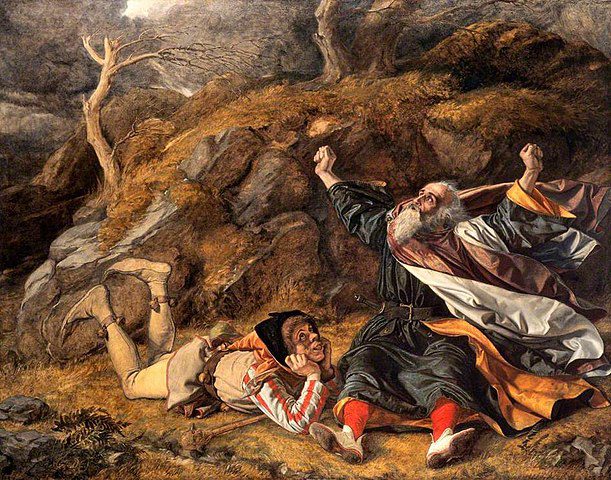
Photo credit: King Lear and the Fool in the Storm (c. 1851), by William Dyce (1806-1864) [public domain / Wikimedia Commons]

***
fool in the Sermon on the Mount
Previous Post

July 29, 2019
Contraception: Chesterton, C. S. Lewis, & Teddy Roosevelt
Next Post

July 30, 2019 Biblical Evidence for Catholic Ecclesiological Claims
Browse Our Archives
Select a Category & Last Things About Me Anti-Catholicism Atheism & Agnosticism Baptism and Sacramentalism Bible and Tradition Blessed Virgin Mary Books by Dave Armstrong C. S. Lewis Calvinism & General Protestantism Catholic Apologetics Catholic Apologists Catholic conversion Catholic converts Christmas Church (Ecclesiology) Church History Conversion and Converts Development of Doctrine Eastern Orthodoxy Ecumenism & Christian Unity Eucharist & Liturgy Fathers of the Church French Translations G. K. Chesterton Hell Hell & Satan Hell & Satan & Last Things Heresies & Comparative Religion Holistic Health Inquisition & Crusades & Scandals James White Jews & Judaism & Old Testament John Calvin John Henry Newman Liberal / Modernist Theology Life Issues Literary Resume Lutheranism Mariology Martin Luther Music Orthodoxy Papacy & Infallibility Personal Page Philosophy & Science Political & Ethical & Moral Issues Protestant Persecution & Intolerance Protestantism Purgatory Purgatory & Penance Romantic & Imaginative Theology Saints & Purgatory & Penance Salvation Salvation & Justification Satan & Last Things Sexuality and Gender Issues Spanish Translations Traditionalism vs. Radical Catholic Reactionaries Traducciones al español / tradução para português Trinitarianism & Christology Uncategorized Videos
Select a Month October 2026 September 2026 August 2026 July 2026 June 2026 May 2026 April 2026 March 2026 February 2026 January 2026 December 2025 November 2025 October 2025 September 2025 August 2025 July 2025 June 2025 May 2025 April 2025 March 2025 February 2025 January 2025 December 2024 November 2024 October 2024 September 2024 August 2024 July 2024 June 2024 May 2024 April 2024 March 2024 February 2024 January 2024 December 2023 November 2023 October 2023 September 2023 August 2023 July 2023 June 2023 May 2023 April 2023 March 2023 February 2023 January 2023 December 2022 November 2022 October 2022 September 2022 August 2022 July 2022 June 2022 May 2022 April 2022 March 2022 February 2022 January 2022 December 2021 November 2021 October 2021 September 2021 August 2021 July 2021 June 2021 May 2021 April 2021 March 2021 February 2021 January 2021 December 2020 November 2020 October 2020 September 2020 August 2020 July 2020 June 2020 May 2020 April 2020 March 2020 February 2020 January 2020 December 2019 November 2019 October 2019 September 2019 August 2019 July 2019 June 2019 May 2019 April 2019 March 2019 February 2019 January 2019 December 2018 November 2018 October 2018 September 2018 August 2018 July 2018 June 2018 May 2018 April 2018 March 2018 February 2018 January 2018 December 2017 November 2017 October 2017 September 2017 August 2017 July 2017 June 2017 May 2017 April 2017 March 2017 February 2017 January 2017 December 2016 November 2016 October 2016 September 2016 August 2016 July 2016 June 2016 May 2016 April 2016 March 2016 February 2016 January 2016 December 2015 November 2015 October 2015 September 2015 August 2015 July 2015 June 2015 May 2015 April 2015 March 2015 February 2015 January 2015 December 2014 November 2014 October 2014 September 2014 August 2014 July 2014 June 2014 April 2014 March 2014 February 2014 January 2014 December 2013 November 2013 October 2013 September 2013 August 2013 July 2013 June 2013 April 2013 March 2013 February 2013 January 2013 December 2012 November 2012 October 2012 September 2012 August 2012 July 2012 June 2012 May 2012 April 2012 March 2012 February 2012 January 2012 December 2011 November 2011 October 2011 September 2011 August 2011 July 2011 June 2011 April 2011 March 2011 February 2011 October 2010 September 2010 August 2010 July 2010 April 2010 March 2010 December 2009 October 2009 August 2009 July 2009 June 2009 May 2009 March 2009 February 2009 October 2008 September 2008 April 2008 March 2008 February 2008 January 2008 December 2007 November 2007 October 2007 May 2007 March 2007 February 2007 January 2007 November 2006 October 2006 September 2006 August 2006 July 2006 June 2006 May 2006 April 2006 March 2006 February 2006 October 2005 June 2005 April 2005 February 2005 July 2004 May 2004 April 2004
Follow Us!
TAKE THE
Religious Wisdom Quiz
Who is traditionally believed to have written the book of Ecclesiastes?
Select your answer to see how you score.
Solomon Isaiah David Ezra
Books by This Author Books by Dave Armstrong
Related posts from Biblical Evidence for Catholicism

Why Wes Huff (and Everyone) Should Be Catholic
Biblical Evidence for Catholicism

Invocation of Saints: Catholic Scholars vs. Me? Nope!
Biblical Evidence for Catholicism

My “Number Articles”: Alphabetized by Topic
Biblical Evidence for Catholicism
Big Plans for Catholic Bible Highlights in 2026!
Biblical Evidence for Catholicism
TRENDING AT PATHEOS Catholic

In "Irreplaceable," our book on vocation and technology, Trevor Sutton and I...

I was strolling through the top floor of the brand new Parthenon...

What Does Gêvâh Mean For Kimberley Guifoyle &...
This week, a lot of the news is focused on Kimberly Guilfoyle....

INNER CIRCLE: Profound Mystery (Of Christ In All...
Ephesians 5:31-32 “For this reason, a man will leave his father and...

Do Not Rejoice When Your Enemy Falls: The...
Turning an execution into a public spectacle is a disturbing expression of...

'The Chosen' S6 Trailer: The Passion Gets Very...
Not many watching 'The Chosen' worry about spoilers, but just because they...
view all Catholic blogs
Ad-Free & Subscriber Log-In Subscription Support
- About Us
- 2026 Calendar
- Videos
- Podcasts
- Library of World Religions
- Faith In Media Tracker
- Advertise With Us
- Write for Us
- Privacy Policy
- Terms of Service
- Do Not Sell My Data
- Contact Us
- Radiant Digital
- Manage Newsletter Subscriptions
- Unsubscribe From Notifications
- Sitemap
Copyright 2008-2026, Patheos. All rights reserved.
Subscription Support Ad-Free & Subscriber Log-In
Follow Patheos