
BuddhistCatholicContemplativeEvangelicalGeneral ChristianHinduJewishLatter-day SaintMuslimNew VisionsProgressive Christian
Beliefs
- Buddhist
- Catholic
- Contemplative
- Evangelical
- General Christian
- Hindu
- Jewish
- Latter-day Saint
- More Voices
- Muslim
- New Visions
- Pagan
- Progressive Christian
Topics
- Religion News
- Food and Religion
- Sports and Religion
- Religious Art
- Religious Music and Entertainment
- Religious Events
- History and Religion
- Style and Religion
- Politics and Religion
- Women in Religion
- Recreation Outdoors and Religion
- Business Finance and Religion
- Careers Workplace and Religion
- Education and Religion
- Family Parenting and Religion
- Health Fitness and Religion
- Home and Religion
- Relationships and Religion
- Technology and Religion
- Travel and Religion
Columnists
- Buddhist Columnists
- Business Finance and Religion Columnists
- Careers Workplace and Religion Columnists
- Catholic Columnists
- Contemplative Columnists
- Education and Religion Columnists
- Evangelists Columnists
- Family Parenting and Religion Columnists
- General Christian Columnists
- Health Fitness and Religion Columnists
- Hindu Columnists
- History and Religion Columnists
- Home and Religion Columnists
- Jewish Columnists
- More Voices Columnists
- Latter Day Columnists
- Muslim Columnists
- New Visions Columnists
- Nonreligious Columnists
- Pagan Columnists
- Politics and Religion Columnists
- Progressive Columnists
- Recreation Outdoors and Religion Columnists
- Relationships and Religion Columnists
- Religion News Columnists
- Religious Art Columnists
- Religious Events Columnists
- Religious Music and Entertainment Columnists
- Sports and Religion Columnists
- Style and Religion Columnists
- Technology and Religion Columnists
- Travel and Religion Columnists
- Women in Religion Columnists
Resource Library
- 2026 Calendar
- Library of World Religions
- The 100 Most Holy Places on Earth
- Patheos Answers
- Podcasts
- Videos
- Faith Leaders Database
- Anglican Episcopalian
- Bahai
- Baptist
- Buddhism
- Christianity
- Confucianism
- Eastern Orthodoxy
- Hinduism
- Holiness and Pentecostal
- ISKCON
- Islam
- Judaism
- Lutheran
- Methodist
- The Church of Jesus Christ of Latter-day Saints
- New Age
- Paganism
- Presbytarian and Reformed
- Protestantism
- Religion Behind the Scenes
- Roman Catholic
- Scientology
- Shia Islam
- Sikhism
- Sufism
- Sunni Islam
- Taoism
- Zen
- See all religions
Research Tools
 Ad-Free & Subscriber Log-In Subscription Support
Ad-Free & Subscriber Log-In Subscription Support
Follow Patheos 

- Trending:
- Forgiveness
- |
- Marriage
- |
- Consciousness
- |
- Death Penalty
- |
- Election
- |
- Halloween

-
About
-
Catholic Apologetics
-
Church History
-
Great Apologists
-
Christian Worldview
-
Protestantism & Misc.
- Home
- Catholic
- History and Religion
- Why I Believe in “Non-Miraculous” Intelligent Design
Why I Believe in “Non-Miraculous” Intelligent Design
Last updated on: June 5, 2026 at 11:54 pm by Dave Armstrong
Why I Believe in “Non-Miraculous” Intelligent Design 2026-06-05T23:54:15-04:00 Dave Armstrong
Patheos Explore the world's faith through different perspectives on religion and spirituality! Patheos has the views of the prevalent religions and spiritualities of the world.
This is a follow-up dialogue and discussion of my paper, Catholics & Origins: Irreducible Complexity or Theistic Evolution? VicqRuiz is a self-described deist who has been a very congenial dialogue / sparring partner for some time now on my blog. His words will be in blue. My position on evolution / creation issues has actually significantly shifted today (I love when that happens!), after listening to the podcast dialogue mentioned in the above paper.
*****
Suppose that a creator built a perfect 1/12 scale model of Victorian London using Legos. Every business, church, and home in exact detail. Every curb and gaslight, every mail box and trash bin.
Now suppose that another creator built just a single Lego. One that could replicate itself, and in such a way that each replicated piece would differ from its parent in just such a way as to be located and shaped so that all the replicated pieces would form the exact same model of London.
Which of the two do you think would be the more impressive, the more praiseworthy work of creation?
If I believed that science had satisfactorily explained the mechanism of evolution: really explained it, as opposed to all the mind games and foolish rationalizations routinely made in almost blind faith, I would say that evolution creating everything (i.e., strictly by evolutionary natural / purely materialistic laws would be the more plausible option.
But because I don’t believe that to be the case at all, I think that Intelligent Design is necessary as a “supplement” so to speak. I refuse to accept a purported “scientific” view that can’t pass muster according to those same rules of science (that it has irrationally given God-like qualities). Materialistic evolution by itself simply can’t explain the origin of either fundamental building-block structures or higher biological structures and organisms.
I was trying to posit a long-term development of life in which God is tweaking genes over the thousands of millennia to produce all the forms of past and present living things.
Because it seems to me that if mutation and natural selection are completely false hypotheses, then in fact God is specifically creating every species that has ever existed, including such apparent dead ends as Hallucigenia, T.rex, and Homo habilis.
I only know that science hasn’t adequately explained the processes, and that a Designer is needed for it to be possible at all. The great philosopher David Hume (yes, you read that right) and Albert Einstein basically argued the same (Hume literally and Einstein in a more vague, pantheistic sense). In other words, it might be very broadly construed as a form of the teleological (design) argument: one of the “classic” theistic proofs.
I think that is the gist of what Dr. Behe is saying:
Admit that science cannot explain everything, and has not explained the mechanism and exact process of evolutionary change.
Admit that it is not absolutely impermissible to dare to mention God as a necessary Designer of natural phenomena that are irreducibly complex. This was common practice before Darwin, and Darwin himself did not exclude God from all consideration with regard to evolution (as I have documented elsewhere). In fact, he was a theist when he wrote Origin of Species.
Your (1) – I don’t have any problem at all admitting that.
Your (2) – It seems to me that the millions of false starts and dead ends, in the history of life from (now – 1 billion) to now, argue at least for a whole lot of randomness if not complete randomness. So if lots of randomness, why not total randomness, at least after the first deistic “winding of the key”.
It seems peculiar that God would create and destroy all those non-sentient species over all that time before finally getting around to the one species made in his own image. Certainly the designer would have put as much effort into such a beautifully engineered package as Velociraptor as he did into the bacterial flagellum – why did he let the former go?
Unless perhaps he was planning for some humans to become “paleontologists” and did not want them sitting around bored stiff for lack of anything to do :-)
Because such randomness cannot explain the history of biological life and the wondrous diversity therein. If you concede that science (i.e., evolutionary biology) “has not explained the mechanism and exact process of evolutionary change” (as you just did), then how is it that you choose to believe with blind faith that these processes happened by purely natural and random processes anyway? You have no clue how or why, but you believe it. That’s blind faith; the classic sociological “true believer”.
I think it is far more rational and consistent to admit that a Designer had some hand in it, or to remain utterly agnostic as to the whole thing. As a deist, you believe that God wound up the clock at the beginning. That’s already vastly different from the dominant pure materialism of today’s science. And it is at least some ground where we can meet and hold some premises in common.
As to the speculation of what God should and shouldn’t have done (a la S. J. Gould), I think (always have) that it’s just plain silly. If God exists and is omnipotent and omniscient, we would never in a million years figure out everything He does (let alone why He does it). Christians believe that many things are revealed in revelation (so that we can know those to the extent of our limited abilities), but the processes and details of creation are not included in that.
Fair enough, see you next time round.
And here I thought the discussion was just starting and getting really interesting and constructive. :-) :-)
Well, I know what we agree on, and I’m okay with what we don’t agree on……
*****
After the above exchange (which I have now edited slightly in my portion because of my change of mind), I listened to the friendly dialogue between Dr. Michae Behe and Dr. Stacy Trasancos (both Catholics). I still agree with Dr. Behe, but I didn’t feel that the two positions were all that far apart. In particular, Dr. Behe stated that Intelligent Design (ID) did not necessarily require additional “intervention” by God after His initial act of creation. I found that interesting because I had thought that ID required that.
All Christians, it seems to me (who believe in the inspiration of revelation: the Bible), have to believe that 1) God created (Genesis, etc.), and 2) that God in some sense “sustains” or “upholds” His creation, according to Hebrews 1:3 (“upholding the universe by his word of power”: RSV) and Acts 17:28 (“In him we live and move and have our being”).
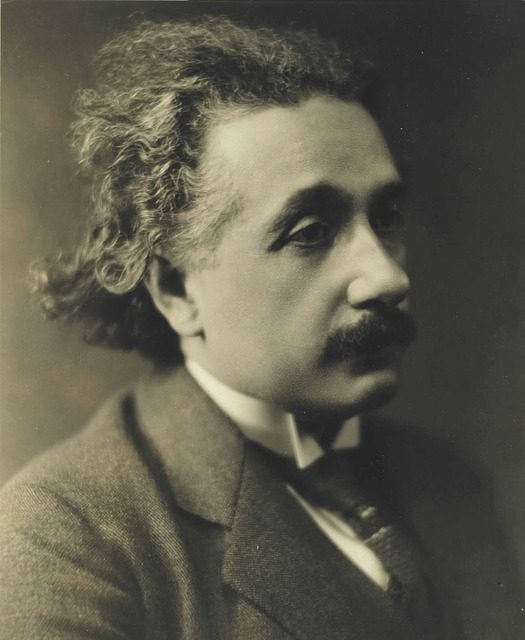
I think this hypothesis of Intelligent Design (better understood by myself now) is more or less compatible with how Einstein described his own views (the main difference being that he was a pantheist, whereas I am a theist, and believe that a theistic God was the Designer). But the common ground is the belief in a non-material or immaterial force or power or spirit, if you will, that profoundly influences the material universe and its creative processes, and which itself seems ultimately beyond purely scientific or empirical analysis (precisely because it is non-material). Einstein expressed it in several interesting ways:
[for all sources, see my paper, Albert Einstein’s “Cosmic Religion”: In His Own Words]
My comprehension of God comes from the deeply felt conviction of a superior intelligence that reveals itself in the knowable world. (1923)
Try and penetrate with our limited means the secrets of nature and you will find that, behind all the discernible concatenations, there remains something subtle, intangible and inexplicable. Veneration for this force beyond anything that we can comprehend is my religion. To that extent I am, in point of fact, religious. (1927)
My religiosity consists of a humble admiration of the infinitely superior spirit that reveals itself in the little that we can comprehend about the knowable world. That deeply emotional conviction of the presence of a superior reasoning power, which is revealed in the incomprehensible universe, forms my idea of God. (1927)
I’m not an atheist and I don’t think I can call myself a pantheist. We are in the position of a little child entering a huge library filled with books in many different languages. The child knows someone must have written those books. It does not know how. The child dimly suspects a mysterious order in the arrangement of the books but doesn’t know what it is. That, it seems to me, is the attitude of even the most intelligent human being toward God. We see a universe marvelously arranged and obeying certain laws, but only dimly understand these laws. Our limited minds cannot grasp the mysterious force that moves the constellations. (1930)
[E]veryone who is seriously involved in the pursuit of science becomes convinced that a spirit is manifest in the laws of the universe — a spirit vastly superior to that of man, and one in the face of which we with our modest powers must feel humble. In this way the pursuit of science leads to a religious feeling of a special sort, . . . (1936)
In view of such harmony in the cosmos which I, with my limited human mind, am able to recognize, there are yet people who say there is no God. But what makes me really angry is that they quote me for support of such views. (1941)
Enough for me the mystery of the eternity of life, and the inkling of the marvellous structure of reality, together with the single-hearted endeavour to comprehend a portion, be it ever so tiny, of the reason that manifests itself in nature. (1949)
My feeling is insofar religious as I am imbued with the consciousness of the insufficiency of the human mind to understand deeply the harmony of the Universe which we try to formulate as “laws of nature.” It is this consciousness and humility I miss in the Freethinker mentality. (1954)
Now, I would ask an atheist: whence comes Einstein’s “deeply felt conviction”? Is it a philosophical reason or the end result of a syllogism? He simply has it. It is an intuitive or instinctive feeling or “knowledge” or “sense of wonder at the incredible, mind-boggling marvels of the universe”. Atheists don’t possess this intuition, but my point is that it is not utterly implausible or unable to be held by even the most rigorous, “non-dogmatic” intellects, such as Einstein and David Hume. And the atheist has to account for that fact somehow, it seems to me.
But in this view, which can be synthesized with Intelligent Design (and is similar in many ways to theistic evolution), God designed or foreordained that complex structures would evolve, and life and consciousness, etc., by some unknown non-material, overarching, guiding principle that transcends science, or concerning which science can give us no clues or answers. He not only created scientific laws that work essentially on their own (hence can be observed and studied scientifically), but also “supervises” or ordains the entire “project”: though not in an interventionist or supernatural / miraculous way. The processes and potentialities were there from the beginning, as a manifestation of His omnipotence and omniscience. It’s just that some of them are supra-scientific.
Science never can and never will explain all of reality to us, including the natural world in all of its complexity. Einstein understood this and expressed it. He (of all people) was intellectually humble and insightful enough to grasp it. Dr Trasancos, in the podcast debate, expressed (among many other things) a view that she later described on my Facebook page as “because science is never complete, do not draw conclusions as if it were all done with discovery.”
Dr. Behe maintained that present-day science is understanding more and more every day about the complexity of very small building-block structures, and that these things are becoming more mysterious and less understood all the time. The more we learn, the more we understand that we don’t know or fully comprehend, and likely won’t figure all this out anytime soon, if ever. That’s not a conclusion of despair; it’s simply intellectual humility: an admission of our inherent limitations on many planes. The universe (so we hold in this view) comes from a Designer infinitely more intelligent than we are. To think that we can figure out every jot and tittle is sheer folly.
In an effort to tie all my newly adopted thinking together (and to form a suitable conclusion to this paper), I thought I’d consult Dr. Michael Behe’s 2007 book, The Edge of Evolution: The Search for the Limits of Darwinism, which I had in my personal library but had not yet read. He offers many helpful thoughts in an eight-page summary of sorts (pp. 228-235; line gaps mean a gap in the text):
Like it or not, a raft of important distinctions intervene between a conclusion of design and identification of a designer.
[I]f one wishes to be academically rigorous, one can’t leap directly from design to a transcendent God. To reach a transcendent God, other, nonscientific arguments have to be made — philosophical and theological arguments.
Here I’m content to “take ‘purposeful designer’ in a very broad sense.”
Darwin’s main contribution to science was to posit a mechanism for the unfolding of life that required no input from any intelligence — random variation and natural selection.
[T]he more science has discovered about the universe, the more deeply fine-tuning is seen to extend . . .
But the assumption that design unavoidably requires “interference” rests mostly on a lack of imagination. There’s no reason that the extended fine-tuning view I am presenting here necessarily requires active meddling with nature any more than the fine-tuning of theistic evolution does. One can think the universe is finely-tuned to any degree and still conceive that “the universe [originated] by a single creative act” and underwent “its natural development by laws implanted in it.” One simply has to envision that the agent who caused the universe was able to specify from the start not only laws, but much more.
[T]he designer took all necessary steps to ensure life. Those who worry about “interference” should relax. The purposeful design of life to any degree is easily compatible with the idea that, after its initiation, the universe unfolded exclusively by the intended playing out of natural laws. The purposeful design of life is also fully compatible with the idea of universal common descent, one important facet of Darwin’s theory. What the purposeful design of life is not compatible with, however, is Darwin’s proposed mechanism of evolution — random variation and natural selection — which sought to explain the development of life explicitly without recourse to guidance or planning by anyone or anything at any time.
I regard design as a completely scientific conclusion.
I count as “scientific” any conclusion that relies heavily and exclusively on detailed physical evidence, plus standard logic.
Reviewing [my book] Darwin’s Black Box in 1996 for Nature, University of Chicago evolutionary biologist Jerry Coyne wrote, “There is no doubt that the pathways described by Behe are dauntingly complex, and their evolution will be hard to unravel . . . We may forever be unable to envisage the first proto-pathways.” If anyone thought it was hard to unravel ten years ago, it’s far worse now.
Darwinism implicitly entails the strong, broad, basic claim that, given enough chances, random mutation and natural selection can build the sorts of complex machinery we see in the cell. Intelligent design implicitly entails an equally strong, broad, basic prediction that random mutation cannot do so.
***
Photo credit: janeb13 (uploaded on 1-29-16): Albert Einstein in 1921 [Pixabay / Pixabay License]
***
Previous Post

June 20, 2019
My (Censored) Amazon Review of Dr. Marshall's "Infiltration"
Next Post

June 21, 2019 Debate: Can Intelligent Design Be "Non-Interventionist"?
Browse Our Archives
Select a Category & Last Things About Me Anti-Catholicism Atheism & Agnosticism Baptism and Sacramentalism Bible and Tradition Blessed Virgin Mary Books by Dave Armstrong C. S. Lewis Calvinism & General Protestantism Catholic Apologetics Catholic Apologists Catholic conversion Catholic converts Christmas Church (Ecclesiology) Church History Conversion and Converts Development of Doctrine Eastern Orthodoxy Ecumenism & Christian Unity Eucharist & Liturgy Fathers of the Church French Translations G. K. Chesterton Hell Hell & Satan Hell & Satan & Last Things Heresies & Comparative Religion Holistic Health Inquisition & Crusades & Scandals James White Jews & Judaism & Old Testament John Calvin John Henry Newman Liberal / Modernist Theology Life Issues Literary Resume Lutheranism Mariology Martin Luther Music Orthodoxy Papacy & Infallibility Personal Page Philosophy & Science Political & Ethical & Moral Issues Protestant Persecution & Intolerance Protestantism Purgatory Purgatory & Penance Romantic & Imaginative Theology Saints & Purgatory & Penance Salvation Salvation & Justification Satan & Last Things Sexuality and Gender Issues Spanish Translations Traditionalism vs. Radical Catholic Reactionaries Traducciones al español / tradução para português Trinitarianism & Christology Uncategorized Videos
Select a Month October 2026 September 2026 August 2026 July 2026 June 2026 May 2026 April 2026 March 2026 February 2026 January 2026 December 2025 November 2025 October 2025 September 2025 August 2025 July 2025 June 2025 May 2025 April 2025 March 2025 February 2025 January 2025 December 2024 November 2024 October 2024 September 2024 August 2024 July 2024 June 2024 May 2024 April 2024 March 2024 February 2024 January 2024 December 2023 November 2023 October 2023 September 2023 August 2023 July 2023 June 2023 May 2023 April 2023 March 2023 February 2023 January 2023 December 2022 November 2022 October 2022 September 2022 August 2022 July 2022 June 2022 May 2022 April 2022 March 2022 February 2022 January 2022 December 2021 November 2021 October 2021 September 2021 August 2021 July 2021 June 2021 May 2021 April 2021 March 2021 February 2021 January 2021 December 2020 November 2020 October 2020 September 2020 August 2020 July 2020 June 2020 May 2020 April 2020 March 2020 February 2020 January 2020 December 2019 November 2019 October 2019 September 2019 August 2019 July 2019 June 2019 May 2019 April 2019 March 2019 February 2019 January 2019 December 2018 November 2018 October 2018 September 2018 August 2018 July 2018 June 2018 May 2018 April 2018 March 2018 February 2018 January 2018 December 2017 November 2017 October 2017 September 2017 August 2017 July 2017 June 2017 May 2017 April 2017 March 2017 February 2017 January 2017 December 2016 November 2016 October 2016 September 2016 August 2016 July 2016 June 2016 May 2016 April 2016 March 2016 February 2016 January 2016 December 2015 November 2015 October 2015 September 2015 August 2015 July 2015 June 2015 May 2015 April 2015 March 2015 February 2015 January 2015 December 2014 November 2014 October 2014 September 2014 August 2014 July 2014 June 2014 April 2014 March 2014 February 2014 January 2014 December 2013 November 2013 October 2013 September 2013 August 2013 July 2013 June 2013 April 2013 March 2013 February 2013 January 2013 December 2012 November 2012 October 2012 September 2012 August 2012 July 2012 June 2012 May 2012 April 2012 March 2012 February 2012 January 2012 December 2011 November 2011 October 2011 September 2011 August 2011 July 2011 June 2011 April 2011 March 2011 February 2011 October 2010 September 2010 August 2010 July 2010 April 2010 March 2010 December 2009 October 2009 August 2009 July 2009 June 2009 May 2009 March 2009 February 2009 October 2008 September 2008 April 2008 March 2008 February 2008 January 2008 December 2007 November 2007 October 2007 May 2007 March 2007 February 2007 January 2007 November 2006 October 2006 September 2006 August 2006 July 2006 June 2006 May 2006 April 2006 March 2006 February 2006 October 2005 June 2005 April 2005 February 2005 July 2004 May 2004 April 2004
Follow Us!
TAKE THE
Religious Wisdom Quiz
Who was King Saul's father?
Select your answer to see how you score.
Job Rehoboam Methuselah Kish
Books by This Author Books by Dave Armstrong
Related posts from Biblical Evidence for Catholicism

God, Modern Physics, & Dark Energy: An Analogy
Biblical Evidence for Catholicism
C. S. Lewis’ Argument for God from Desire
Biblical Evidence for Catholicism

Parting of the Red Sea & Lake Erie...
Biblical Evidence for Catholicism

Deus me curou! (Úlcera, alergias alimentares)
Biblical Evidence for Catholicism
TRENDING AT PATHEOS Catholic

Swimfan: Forgotten Aughts Pleasures
This is a recovery effort. In 2002, My Big Fat Greek Wedding...

Top Three Anti-Catholic Lies About Catholicism
This is my initial transcript for the video, "THE 3 WORST...

Pope Leo Celebrates Mass for Nurses & Docs...
I don't have any idea how he did it, but Pope Leo...

The Sermon on the Mount, Part I: Matthew...
The Sermon on the Mount, Part I (Matthew 4:12-5:12) St. Matthew moves...

What's up from Crossway: Reviewing some of their latest A few weeks...

Janie Learns the Way of the Cross: A...
Teaching children about Jesus' Passion can be challenging. Many parents and educators...
view all Catholic blogs
Ad-Free & Subscriber Log-In Subscription Support
- About Us
- 2026 Calendar
- Videos
- Podcasts
- Library of World Religions
- Faith In Media Tracker
- Advertise With Us
- Write for Us
- Privacy Policy
- Terms of Service
- Do Not Sell My Data
- Contact Us
- Radiant Digital
- Manage Newsletter Subscriptions
- Unsubscribe From Notifications
- Sitemap
Copyright 2008-2026, Patheos. All rights reserved.
Subscription Support Ad-Free & Subscriber Log-In
Follow Patheos