
BuddhistCatholicContemplativeEvangelicalGeneral ChristianHinduJewishLatter-day SaintMuslimNew VisionsProgressive Christian
Beliefs
- Buddhist
- Catholic
- Contemplative
- Evangelical
- General Christian
- Hindu
- Jewish
- Latter-day Saint
- More Voices
- Muslim
- New Visions
- Pagan
- Progressive Christian
Topics
- Religion News
- Food and Religion
- Sports and Religion
- Religious Art
- Religious Music and Entertainment
- Religious Events
- History and Religion
- Style and Religion
- Politics and Religion
- Women in Religion
- Recreation Outdoors and Religion
- Business Finance and Religion
- Careers Workplace and Religion
- Education and Religion
- Family Parenting and Religion
- Health Fitness and Religion
- Home and Religion
- Relationships and Religion
- Technology and Religion
- Travel and Religion
Columnists
- Buddhist Columnists
- Business Finance and Religion Columnists
- Careers Workplace and Religion Columnists
- Catholic Columnists
- Contemplative Columnists
- Education and Religion Columnists
- Evangelists Columnists
- Family Parenting and Religion Columnists
- General Christian Columnists
- Health Fitness and Religion Columnists
- Hindu Columnists
- History and Religion Columnists
- Home and Religion Columnists
- Jewish Columnists
- More Voices Columnists
- Latter Day Columnists
- Muslim Columnists
- New Visions Columnists
- Nonreligious Columnists
- Pagan Columnists
- Politics and Religion Columnists
- Progressive Columnists
- Recreation Outdoors and Religion Columnists
- Relationships and Religion Columnists
- Religion News Columnists
- Religious Art Columnists
- Religious Events Columnists
- Religious Music and Entertainment Columnists
- Sports and Religion Columnists
- Style and Religion Columnists
- Technology and Religion Columnists
- Travel and Religion Columnists
- Women in Religion Columnists
Resource Library
- 2026 Calendar
- Library of World Religions
- The 100 Most Holy Places on Earth
- Patheos Answers
- Podcasts
- Videos
- Faith Leaders Database
- Anglican Episcopalian
- Bahai
- Baptist
- Buddhism
- Christianity
- Confucianism
- Eastern Orthodoxy
- Hinduism
- Holiness and Pentecostal
- ISKCON
- Islam
- Judaism
- Lutheran
- Methodist
- The Church of Jesus Christ of Latter-day Saints
- New Age
- Paganism
- Presbytarian and Reformed
- Protestantism
- Religion Behind the Scenes
- Roman Catholic
- Scientology
- Shia Islam
- Sikhism
- Sufism
- Sunni Islam
- Taoism
- Zen
- See all religions
Research Tools
 Ad-Free & Subscriber Log-In Subscription Support
Ad-Free & Subscriber Log-In Subscription Support
Follow Patheos 

- Trending:
- Forgiveness
- |
- Marriage
- |
- Consciousness
- |
- Death Penalty
- |
- Election
- |
- Halloween

-
About
-
Catholic Apologetics
-
Church History
-
Great Apologists
-
Christian Worldview
-
Protestantism & Misc.
- Home
- Catholic
- History and Religion
- No, Pope Francis Did Not Deny Transubstantiation
No, Pope Francis Did Not Deny Transubstantiation
Last updated on: June 28, 2019 at 5:15 pm by Dave Armstrong
No, Pope Francis Did Not Deny Transubstantiation 2019-06-28T17:15:18-04:00 Dave Armstrong
Patheos Explore the world's faith through different perspectives on religion and spirituality! Patheos has the views of the prevalent religions and spiritualities of the world.
Phenomenological Language in Holy Scripture and in the Addresses of Pope Francis
In an article hosted by Gloria.tv (6-24-19), it was stated:
The Eucharist is “Jesus who becomes bread,” and contains the “entire reality of the Church,” Pope Francis claimed in his June 23 Corpus Christi homily.
He went on alleging that we find in the Eucharist God himself “contained in a piece of bread.” These formulations are profoundly heretical. . . .
The heretical concept pronounced by Francis is called “impanation.” It denies transubstantiation and is usually explained with the wrong statement that “God has become bread.” Transsubstantiation [sic] is the changing of the bread’s substance into the substance of Christ’s body effectuated by the consecration during Mass.
The sedevacantist website, Novus Ordo Watch followed suit (on 6-23-19), even tossing in a dig at yours truly:
Bergoglio’s sermon for Corpus Christi did not just have the wrong emphasis, it was explicitly heretical. . . .
Any child who wants to make his First Holy Communion would not be admitted if this were his understanding of the Eucharist. It is heresy!
The only correct understanding of what happens to the bread and wine when they are consecrated by a priest during Holy Mass is the dogma of Transubstantiation, nothing else. What Bergoglio puts forward in today’s homily is, at best, the Lutheran heresy of Consubstantiation, also called Impanation, . . .
Of course there will not be lacking now Novus Ordo apologists who will try to argue that Francis didn’t mean what he said in a heretical sense. But at this point, only a fool would still be swayed by the constant hermeneutical acrobatics that people like Tim Staples, Jimmy Akin, or Dave Armstrong come up with . . .
It’s not as if Francis were somehow incapable of speaking clearly and in an orthodox fashion. A man who constantly speaks in such a way that heresy is easily and naturally understood from his words, and does not lift a finger to do anything about it — one, in fact, who continually pushes the envelope further and further –, is quite clearly a heretic.
Here are the relevant highlights of the homily in question, from Zenit:
In the presence of the Eucharist, Jesus who becomes bread, this simple bread that contains the entire reality of the Church, . . .
The Eucharist teaches us this: for there we find God himself contained in a piece of bread.
[Y]ou have the Eucharist, bread for the journey, the bread of Jesus. Tonight too, we will be nourished by his body given up for us.
The jaded interpretation of his words seen in the two (reactionary and sedevacantist) articles above is refuted in Pope Francis’ Angelus Address on the same day (Feast of Corpus Christi):
This miracle — very important, so much so that it is recounted by all the Evangelists — manifests the Messiah’s power and, at the same time, His compassion: Jesus has compassion for the people. That prodigious gesture not only remains as one of the great signs of Jesus’ public life, but it anticipates what would later be, at the end, the memorial of His sacrifice, namely, the Eucharist, Sacrament of the His Body and of His Blood given for the salvation of the world. . . .
The feast of Corpus Domini invites us every year to renew the wonder and joy for this stupendous gift of the Lord, which is the Eucharist. Let us receive it with gratitude, not in a passive, habitual way. We must not get used to the Eucharist and go to Communion out of habit: no! Every time we approach the altar to receive the Eucharist, we must truly renew our “Amen” to the Body of Christ. When the priest says to us “the Body of Christ,” we say “Amen,” but it must be an “Amen” that comes from the heart, with conviction. It is Jesus, it is Jesus who has saved me; it is Jesus who comes to give me the strength to live. It is Jesus, Jesus alive, but we must not get used to it: it must be every time as if it were our First Communion. . . .
May Our Lady help us to follow Jesus with faith and love, whom we adore in the Eucharist.
We know without question that Pope Francis believes in transubstantiation, from many other utterances:
There are other hungers- for love, for immortality for life, for affection, for being cared, for forgiveness, for mercy. This hunger can be satiated only by the bread that comes from above. Jesus himself is the living bread that gives life to the world (cf. Jn 6:51). His body offered for our sake on the cross, his blood shed for the pardon of the sins of humanity is made available to us in the bread and wine to the Eucharist transformed in the consecration.
But the Eucharist does not end with the partaking of the bread and blood of the Lord. It leads us to solidarity with others. The communion with the Lord is necessarily a communion with our fellow brothers and sisters. And therefore the one who is fed and nourished by the very body and blood of Christ cannot remain unaffected when he sees his brothers suffering want and hunger. (Homily for the Feast of Corpus Christi, 5-30-13)
Therefore the Eucharistic Celebration is much more than simple banquet: it is exactly the memorial of Jesus’ Paschal Sacrifice, the mystery at the centre of salvation. “Memorial” does not simply mean a remembrance, a mere memory; it means that every time we celebrate this Sacrament we participate in the mystery of the passion, death and resurrection of Christ. The Eucharist is the summit of God’s saving action: the Lord Jesus, by becoming bread broken for us, pours upon us all of his mercy and his love, so as to renew our hearts, our lives and our way of relating with him and with the brethren. . . . the bread that is the Body of Jesus Christ who saves us, forgives us, unites us to the Father. (General Audience, 2-5-14)
Jesus underlines that he has not come into this world to give something, but to give himself, his life, as nourishment for those who have faith in Him. . . . Every time that we participate in Holy Mass and we are nourished by the Body of Christ, the presence of Jesus and of the Holy Spirit acts in us, shaping our hearts, communicating an interior disposition to us that translates into conduct according to the Gospel. (Angelus for the Feast of Corpus Christi, 6-22-14)
In the Eucharist Jesus does not give just any bread, but the bread of eternal life, he gives Himself, offering Himself to the Father out of love for us. (Angelus, 8-13-14)
The Eucharist is Jesus who gives himself entirely to us. To nourish ourselves with him and abide in him through Holy Communion, if we do it with faith, transforms our life into a gift to God and to our brothers… eating him, we become like him. . . . [the Eucharist] is not a private prayer or a beautiful spiritual experience . . . it is a memorial, namely, a gesture that actualizes and makes present the event of the death and resurrection of Jesus: the bread is truly his Body given, the wine is truly is Blood poured out. (Angelus, 8-16-15; Catholic News Agency)
It’s not just a memory, no, it’s more: It’s making present what happened twenty centuries ago. . . . This is Mass: entering in this Passion, Death, Resurrection, and Ascension of Jesus, and when we go to Mass, it is as if we go to Calvary. Now imagine if we went to Calvary—using our imagination—in that moment, knowing that that man there is Jesus. Would we dare to chit-chat, take pictures, make a little scene? No! Because it’s Jesus! We would surely be in silence, in tears, and in the joy of being saved… Mass is experiencing Calvary, it’s not a show. (General Audience, Crux, 11-22-17)
It continues to be a breathtaking phenomenon, how the dumbfounded, relentless enemies of this pope can’t undertake the slightest labor to simply check and see what the pope believes about a given topic, by doing a search. Is this impossible for them? Have they not heard of the Holy See website and its searching capabilities? Are they unaware of Google? It’s astonishing.
So why does Pope Francis often seem to equate “bread” (after consecration) with Jesus’ Body? He doesn’t say the more precise and literal “what was once bread” or “what has the appearance of bread” or “what continues to have the accidents of bread and wine”. I contend that he’s simply using phenomenological language. We do so all the time by saying, “the sun goes down” or “the sun rises.”
It’s everyday language that refers to appearance rather than essence. We know that He believes in transubstantiation because he refers to partaking of the Body and Blood in several of his homilies and other talks. He combines this orthodox belief with the language of appearance. And so he says, “the bread is truly his Body given, the wine is truly is Blood poured out” (8-16-15).
Is it impermissible (or heretical) to speak in that way? I should think not, seeing that our Lord Jesus and the Gospel writers and St. Paul did so. Jesus still referred to the consecrated and transformed former bread as “bread”:
John 6:50-51, 58 This is the bread which comes down from heaven, that a man may eat of it and not die. [51] I am the living bread which came down from heaven; if any one eats of this bread, he will live for ever; and the bread which I shall give for the life of the world is my flesh.” . . . [58] This is the bread which came down from heaven, not such as the fathers ate and died; he who eats this bread will live for ever.”
The Gospel writers refer to the consecrated / transubstantiated element as “bread” too:
Matthew 26:26 Now as they were eating, Jesus took bread, and blessed, and broke it, and gave it to the disciples and said, “Take, eat; this is my body.”
Mark 14:22 And as they were eating, he took bread, and blessed, and broke it, and gave it to them, and said, “Take; this is my body.”
Luke 22:19 And he took bread, and when he had given thanks he broke it and gave it to them, saying, “This is my body which is given for you. Do this in remembrance of me.”
Here is St. Paul doing the same thing:
1 Corinthians 10:16-17 . . . The bread which we break, is it not a participation in the body of Christ? [17] Because there is one bread, we who are many are one body, for we all partake of the one bread.
1 Corinthians 11:23-29 For I received from the Lord what I also delivered to you, that the Lord Jesus on the night when he was betrayed took bread, [24] and when he had given thanks, he broke it, and said, “This is my body which is for you. Do this in remembrance of me.” [25] In the same way also the cup, after supper, saying, “This cup is the new covenant in my blood. Do this, as often as you drink it, in remembrance of me.” [26] For as often as you eat this bread and drink the cup, you proclaim the Lord’s death until he comes. [27] Whoever, therefore, eats the bread or drinks the cup of the Lord in an unworthy manner will be guilty of profaning the body and blood of the Lord. [28] Let a man examine himself, and so eat of the bread and drink of the cup. [29] For any one who eats and drinks without discerning the body eats and drinks judgment upon himself.
Thus, Pope Francis is using the language of Jesus, Paul, Matthew, Mark, and Luke. If he is wrong and is supposedly a eucharistic heretic, so are they. Since that is ridiculous, the accusation collapses in a heap.
Pope Leo XIII, in Providentissimus Deus (18 Nov. 1893) stated:
Ordinary speech primarily and properly describes what comes under the senses; and somewhat in the same way the sacred writers-as the Angelic Doctor also reminds us – “went by what sensibly appeared,” or put down what God, speaking to men, signified, in the way men could understand and were accustomed to.
Or we could cite the Pontifical Biblical Commission, “Concerning the Historical Character of the First Three Chapters of Genesis” (30 June 1909):
V: Must each and every word and phrase occurring in the aforesaid chapters always and necessarily be understood in its literal sense, so that it is never lawful to deviate from it, even when it appears obvious that the diction is employed in an applied sense, either metaphorical or anthropomorphical, and either reason forbids the retention or necessity imposes the abandonment of the literal sense? Answer: In the negative.
It’s not as though Pope Francis was the only one, either (besides Bible writers and Jesus) to ever do this. For example, Pope St. John Paul II, in his encyclical letter Ecclesia de Eucharistia (4-17-03), referred to “Eucharistic Bread” twice (18, 21), and “consecrated bread and wine” (59). He also cited three examples of Church fathers writing in similar fashion:
For what is the bread? It is the body of Christ. And what do those who receive it become? The Body of Christ – not many bodies but one body. For as bread is completely one, though made of up many grains of wheat, and these, albeit unseen, remain nonetheless present, in such a way that their difference is not apparent since they have been made a perfect whole, so too are we mutually joined to one another and together united with Christ (St. John Chrysostom, sec. 23 in the encyclical)
Do not see – Saint Cyril of Jerusalem exhorts – in the bread and wine merely natural elements, because the Lord has expressly said that they are his body and his blood: faith assures you of this, though your senses suggest otherwise. (St. Cyril of Jerusalem, sec. 15)
He called the bread his living body and he filled it with himself and his Spirit. (St. Ephrem, 17)
The same pope referred to the “bread of salvation” (6-10-04, on the Feast of Corpus Christi). Pope Benedict XVI mentioned the “Eucharistic Bread” (12-22-05).
Pope Leo XIII, in his encyclical Quod Anniversarius (1 April 1888) observed:
As to the faithful, We strenuously exhort them after Sacramental confession devoutly to partake of the Bread of Angels for the benefit of the souls in purgatory.
Ven. Pope Pius XII, in his encyclical Mystici Corporis Christi (29 June 1943), wrote:
Through Holy Orders men are set aside and consecrated to God, to offer the Sacrifice of the Eucharistic Victim, to nourish the flock of the faithful with the Bread of Angels and the food of doctrine, to guide them in the way of God’s commandments and counsels and to strengthen them with all other supernatural helps. (20)
Likewise, Pope Pius XI, in his encyclical Ad Catholici Sacerdotii (20 Dec. 1935):
Then, as soon as he is able to recognize and value the Bread of Angels, the priest gives It to him, the living and life-giving Food come down from Heaven.
Many more examples could surely be found, but my point is more than adequately established by now.
Here’s another angle on it, though: Jesus was omniscient, and so He knew that in 2019, there would be sedevacantist and reactionary extremists making out that Pope Francis denied transubstantiation because he used the same sort of language that He, the Apostle Paul, and the evangelists had used, as recorded in inspired revelation. And indeed, Protestants (and atheists) could have and have in fact made the same sorts of arguments against transubstantiation, by noting that the Bible refers to consecrated bread as still “bread.”
But He didn’t change the way He talked. He didn’t speak like a Thomist or systematic theologian. But His words and that of the others in the Bible are just as likely to be misunderstood as Pope Francis’ identical language has been. He didn’t consider that enough reason to use different language Himself, or to bring about different language used by the other Scripture writers and apostles.
Case closed. What’s good enough for Jesus is good enough for me, and for Pope Francis, and it should be for anyone else who professes the Catholic faith.
If these extremist critics would think and research just a little bit before they make their usual lightning-quick accusations of heresy (and/or sheer theological incompetence) against the Holy Father, these silly disputes would not have to waste any of our time at all. But since they so often don’t, we apologists (who still believe in honoring popes and defending them against scurrilous accusations) are here to help the faithful understand how ludicrous are a vast number of accusations against Pope Francis. Happy to help . . .
***
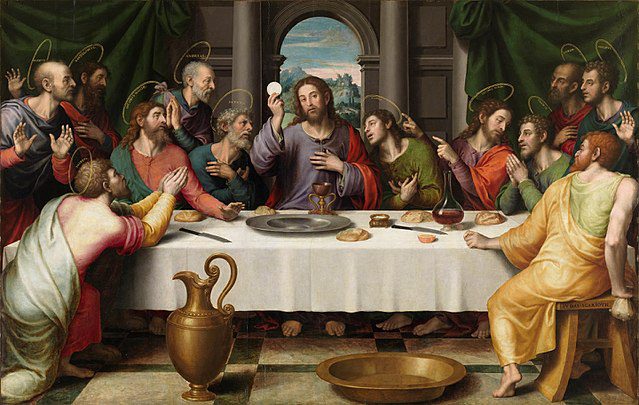
Photo credit: The Last Supper (c. 1562), by Juan de Juanes (c. 1507-1579) [public domain / Wikimedia Commons]

***
Pope Francis & transubstantiation
Previous Post
June 25, 2019
Taylor Marshall's Courageous "Responses" to His Critics
Next Post

June 26, 2019 Reply to Anthony Toohey Re: His Deconversion (Part II)
Browse Our Archives
Select a Category & Last Things About Me Anti-Catholicism Atheism & Agnosticism Baptism and Sacramentalism Bible and Tradition Blessed Virgin Mary Books by Dave Armstrong C. S. Lewis Calvinism & General Protestantism Catholic Apologetics Catholic Apologists Catholic conversion Catholic converts Christmas Church (Ecclesiology) Church History Conversion and Converts Development of Doctrine Eastern Orthodoxy Ecumenism & Christian Unity Eucharist & Liturgy Fathers of the Church French Translations G. K. Chesterton Hell Hell & Satan Hell & Satan & Last Things Heresies & Comparative Religion Holistic Health Inquisition & Crusades & Scandals James White Jews & Judaism & Old Testament John Calvin John Henry Newman Liberal / Modernist Theology Life Issues Literary Resume Lutheranism Mariology Martin Luther Music Orthodoxy Papacy & Infallibility Personal Page Philosophy & Science Political & Ethical & Moral Issues Protestant Persecution & Intolerance Protestantism Purgatory Purgatory & Penance Romantic & Imaginative Theology Saints & Purgatory & Penance Salvation Salvation & Justification Satan & Last Things Sexuality and Gender Issues Spanish Translations Traditionalism vs. Radical Catholic Reactionaries Traducciones al español / tradução para português Trinitarianism & Christology Uncategorized Videos
Select a Month October 2026 September 2026 August 2026 July 2026 June 2026 May 2026 April 2026 March 2026 February 2026 January 2026 December 2025 November 2025 October 2025 September 2025 August 2025 July 2025 June 2025 May 2025 April 2025 March 2025 February 2025 January 2025 December 2024 November 2024 October 2024 September 2024 August 2024 July 2024 June 2024 May 2024 April 2024 March 2024 February 2024 January 2024 December 2023 November 2023 October 2023 September 2023 August 2023 July 2023 June 2023 May 2023 April 2023 March 2023 February 2023 January 2023 December 2022 November 2022 October 2022 September 2022 August 2022 July 2022 June 2022 May 2022 April 2022 March 2022 February 2022 January 2022 December 2021 November 2021 October 2021 September 2021 August 2021 July 2021 June 2021 May 2021 April 2021 March 2021 February 2021 January 2021 December 2020 November 2020 October 2020 September 2020 August 2020 July 2020 June 2020 May 2020 April 2020 March 2020 February 2020 January 2020 December 2019 November 2019 October 2019 September 2019 August 2019 July 2019 June 2019 May 2019 April 2019 March 2019 February 2019 January 2019 December 2018 November 2018 October 2018 September 2018 August 2018 July 2018 June 2018 May 2018 April 2018 March 2018 February 2018 January 2018 December 2017 November 2017 October 2017 September 2017 August 2017 July 2017 June 2017 May 2017 April 2017 March 2017 February 2017 January 2017 December 2016 November 2016 October 2016 September 2016 August 2016 July 2016 June 2016 May 2016 April 2016 March 2016 February 2016 January 2016 December 2015 November 2015 October 2015 September 2015 August 2015 July 2015 June 2015 May 2015 April 2015 March 2015 February 2015 January 2015 December 2014 November 2014 October 2014 September 2014 August 2014 July 2014 June 2014 April 2014 March 2014 February 2014 January 2014 December 2013 November 2013 October 2013 September 2013 August 2013 July 2013 June 2013 April 2013 March 2013 February 2013 January 2013 December 2012 November 2012 October 2012 September 2012 August 2012 July 2012 June 2012 May 2012 April 2012 March 2012 February 2012 January 2012 December 2011 November 2011 October 2011 September 2011 August 2011 July 2011 June 2011 April 2011 March 2011 February 2011 October 2010 September 2010 August 2010 July 2010 April 2010 March 2010 December 2009 October 2009 August 2009 July 2009 June 2009 May 2009 March 2009 February 2009 October 2008 September 2008 April 2008 March 2008 February 2008 January 2008 December 2007 November 2007 October 2007 May 2007 March 2007 February 2007 January 2007 November 2006 October 2006 September 2006 August 2006 July 2006 June 2006 May 2006 April 2006 March 2006 February 2006 October 2005 June 2005 April 2005 February 2005 July 2004 May 2004 April 2004
Follow Us!
TAKE THE
Religious Wisdom Quiz
What famous cathedral is in Paris, known for its flying buttresses and rose windows?
Select your answer to see how you score.
Notre Dame St. Paul's St. Peter's Canterbury
Books by This Author Books by Dave Armstrong
Related posts from Biblical Evidence for Catholicism

Top Ten Anti-Catholic Lies (#10-7)
Biblical Evidence for Catholicism

Was Peter "Any Old" Apostle? 10 Anti-Papal Arguments
Biblical Evidence for Catholicism

11 Protestant Objections to Papal Authority Debunked
Biblical Evidence for Catholicism

The Mass & Development of Doctrine (vs. Wes...
Biblical Evidence for Catholicism
TRENDING AT PATHEOS Catholic

In "Irreplaceable," our book on vocation and technology, Trevor Sutton and I...

I was strolling through the top floor of the brand new Parthenon...

What Does Gêvâh Mean For Kimberley Guifoyle &...
This week, a lot of the news is focused on Kimberly Guilfoyle....

INNER CIRCLE: Profound Mystery (Of Christ In All...
Ephesians 5:31-32 “For this reason, a man will leave his father and...

Do Not Rejoice When Your Enemy Falls: The...
Turning an execution into a public spectacle is a disturbing expression of...

'The Chosen' S6 Trailer: The Passion Gets Very...
Not many watching 'The Chosen' worry about spoilers, but just because they...
view all Catholic blogs
Ad-Free & Subscriber Log-In Subscription Support
- About Us
- 2026 Calendar
- Videos
- Podcasts
- Library of World Religions
- Faith In Media Tracker
- Advertise With Us
- Write for Us
- Privacy Policy
- Terms of Service
- Do Not Sell My Data
- Contact Us
- Radiant Digital
- Manage Newsletter Subscriptions
- Unsubscribe From Notifications
- Sitemap
Copyright 2008-2026, Patheos. All rights reserved.
Subscription Support Ad-Free & Subscriber Log-In
Follow Patheos