
BuddhistCatholicContemplativeEvangelicalGeneral ChristianHinduJewishLatter-day SaintMuslimNew VisionsProgressive Christian
Beliefs
- Buddhist
- Catholic
- Contemplative
- Evangelical
- General Christian
- Hindu
- Jewish
- Latter-day Saint
- More Voices
- Muslim
- New Visions
- Pagan
- Progressive Christian
Topics
- Religion News
- Food and Religion
- Sports and Religion
- Religious Art
- Religious Music and Entertainment
- Religious Events
- History and Religion
- Style and Religion
- Politics and Religion
- Women in Religion
- Recreation Outdoors and Religion
- Business Finance and Religion
- Careers Workplace and Religion
- Education and Religion
- Family Parenting and Religion
- Health Fitness and Religion
- Home and Religion
- Relationships and Religion
- Technology and Religion
- Travel and Religion
Columnists
- Buddhist Columnists
- Business Finance and Religion Columnists
- Careers Workplace and Religion Columnists
- Catholic Columnists
- Contemplative Columnists
- Education and Religion Columnists
- Evangelists Columnists
- Family Parenting and Religion Columnists
- General Christian Columnists
- Health Fitness and Religion Columnists
- Hindu Columnists
- History and Religion Columnists
- Home and Religion Columnists
- Jewish Columnists
- More Voices Columnists
- Latter Day Columnists
- Muslim Columnists
- New Visions Columnists
- Nonreligious Columnists
- Pagan Columnists
- Politics and Religion Columnists
- Progressive Columnists
- Recreation Outdoors and Religion Columnists
- Relationships and Religion Columnists
- Religion News Columnists
- Religious Art Columnists
- Religious Events Columnists
- Religious Music and Entertainment Columnists
- Sports and Religion Columnists
- Style and Religion Columnists
- Technology and Religion Columnists
- Travel and Religion Columnists
- Women in Religion Columnists
Resource Library
- 2026 Calendar
- Library of World Religions
- The 100 Most Holy Places on Earth
- Patheos Answers
- Podcasts
- Videos
- Faith Leaders Database
- Anglican Episcopalian
- Bahai
- Baptist
- Buddhism
- Christianity
- Confucianism
- Eastern Orthodoxy
- Hinduism
- Holiness and Pentecostal
- ISKCON
- Islam
- Judaism
- Lutheran
- Methodist
- The Church of Jesus Christ of Latter-day Saints
- New Age
- Paganism
- Presbytarian and Reformed
- Protestantism
- Religion Behind the Scenes
- Roman Catholic
- Scientology
- Shia Islam
- Sikhism
- Sufism
- Sunni Islam
- Taoism
- Zen
- See all religions
Research Tools
 Ad-Free & Subscriber Log-In Subscription Support
Ad-Free & Subscriber Log-In Subscription Support
Follow Patheos 

- Trending:
- Forgiveness
- |
- Marriage
- |
- Consciousness
- |
- Death Penalty
- |
- Election
- |
- Halloween

-
About
-
Catholic Apologetics
-
Church History
-
Great Apologists
-
Christian Worldview
-
Protestantism & Misc.
- Home
- Catholic
- History and Religion
- My Respect for Protestants / Catholic Ecumenical Principles
My Respect for Protestants / Catholic Ecumenical Principles
Last updated on: June 6, 2026 at 12:39 am by Dave Armstrong
My Respect for Protestants / Catholic Ecumenical Principles 2026-06-06T00:39:32-04:00 Dave Armstrong
Patheos Explore the world's faith through different perspectives on religion and spirituality! Patheos has the views of the prevalent religions and spiritualities of the world.
Some people, after reading my apologetic writings, particularly in debate with Protestants, have concluded that perhaps I don’t respect Protestants or consider them sincere. Nothing could be further from the truth. To acknowledge these very characteristics is exactly what ecumenism is about — what it presupposes right from the outset. I am careful throughout my writings to assert my great love and respect for my Protestant brethren. Even if I don’t state this where I could do so, I assure readers that it is always my assumption and opinion and state of mind.
Just because I may criticize (at times even excoriate) Martin Luther, John Calvin, the Protestant Reformation, or Protestant theology in general or in particulars, does not mean that I have negatively judged any individual person. That doesn’t follow at all. I can’t know a person’s heart. How I view them individually as a Christian and disciple of Jesus is a quite different matter than disagreements as to theology.
I conducted an ecumenical discussion group at my house for four years. Near the end of that time, I did a survey, in which none of the Protestants or Orthodox (when asked) said that they had been offended in all that time. I think this speaks volumes, and I am very gratified by it. Certainly if I had been anti-Protestant, it would have come out in that survey.
Likewise, an evangelical Protestant who has since become a Catholic, read my conversion story in Surprised by Truth and picked me out of the eleven whose stories were included, to call on the phone, because (as she told me) she sensed I was not anti-Protestant at all (and this, in a story which recounts how I converted from Protestantism to Catholicism!). That indicates, I think, how highly I regard ecumenism and respectful fellowship, charity, and unity among Christians (based on John 17 and many other biblical exhortations).
Any impression that I am “anti-Protestant” in any way, shape, or form, concerns me very much, and I want to make sure this issue is cleared up. Criticism of ideas and certain beliefs is not intended at all to be personal or “hostile” criticism. I try my utmost to refrain from judging persons and hearts. I have had mine wrongly judged on several occasions and know first-hand how painful that is. I always strive to judge ideas but not people, sins but not the sinners. I’m sure I’ve failed at times like we all do, but that is my constant goal nonetheless.
I greatly admire and respect conservative, orthodox Protestantism. I once was an evangelical Protestant, and praise God for that experience, which was exceedingly beneficial to my spiritual advancement and theological education. I now consider myself an evangelical Catholic. None of my writings are intended as an attack on the personal integrity of any individual. I do strongly criticize the ideas of the Protestant Founders, however, because they were public figures who made momentous claims, so that they ought to be held accountable for their actions and effect on Christianity. I take pains to carefully distinguish between the person and their ideas.
Catholics can benefit greatly from much of Protestantism. I hope to show that the converse is also true. My goal is to build bridges of understanding among Christians of all stripes, who are brothers in Christ (John 17:20-23). Catholics believe that the fullness of apostolic Christianity resides in their Church, but this does not at all mean that great, profound amounts of truth and goodness are not to be found in other Christian communions as well. All validly baptized Christians are our brothers and sisters in Christ, and ought to be accorded the proper amount of respect befitting that status, as well as charity at all times.
Anyone who has spent any amount of time at my extensive website, Biblical Evidence for Catholicism can easily, readily observe, I believe, my respect for Protestantism, by perusing the hundreds of Protestant links I provide. I think it is commonly understood online that a link (like a standard reference citation in a book) does not necessarily imply across-the-board agreement. I choose my links according to a substantial commonality with Catholic doctrine, on whatever subject the link is categorized under.
For example, a Protestant apologist or theologian defending the Trinity or the Resurrection of Christ, or presenting philosophical arguments for the existence of God or angels or the devil or heaven and hell (i.e., an evangelical Protestant who upholds traditional Christian teaching in these areas), will offer virtually nothing a Catholic would disagree with.
So why shouldn’t a Catholic utilize sites where we have common ground with our separated brethren, over against our secular, pagan culture? As Catholics, we are called upon to be ecumenical. We have no choice. Evangelicals have been doing a great job in the last generation, in the area of general Christian apologetics. Catholics are just now getting into that again. So I cherish and am thankful and grateful for all the excellent, helpful, worthwhile non-Catholic efforts which agree with Catholic and Christian theology and orthodoxy.
Many Catholic converts wrote excellent books and articles before they converted, which are used by Catholics all the time, because they are orthodox and eloquent: Newman, Chesterton, Thomas Howard, and Malcolm Muggeridge come to mind immediately. Other lifelong Protestants, like C. S. Lewis, and (to some extent) John Wesley, are very close to Catholicism in spirit and doctrine. In a strict, non-ecumenical point of view, on the other hand, a John Henry Newman sermon from 1839, no matter how brilliant and orthodox, would be considered “unorthodox,” as would a Lewis essay on miracles, etc. Very few Catholic apologists (and I know scores of them) would agree with that approach. Truth is truth, wherever it is found, and our Protestant and Orthodox brethren have a lot of it, despite their many errors.
We need to stand with fellow Christians wherever we find common ground, so that we can affect our culture with the gospel of Jesus Christ, and not be defeated by a “divide and conquer” strategy. Whether it’s trinitarianism, the bodily Resurrection of Jesus, the inspiration of the Bible, or an opposition to homosexual acts, radical “unisex” feminism, pornography, physician-assisted suicide, abortion, or whatever, we have much in common, and we are called to rejoice in the truths that bind us.
Much truth can be found in, for instance, C. S. Lewis’s writing (he remains my own favorite author), as in the writing of many Protestant (not to mention Orthodox) writers, clergymen, and apologists. Catholics are free to acknowledge, and rejoice in, truth. We are sharp enough (or should be) to discern the errors.
Should a Catholic refuse to read Cardinal Newman’s Essay on the Development of Christian Doctrine? After all, it was written in 1845 when the Venerable Cardinal was still an Anglican. Or should we look down our noses at the even earlier Parochial and Plain Sermons, from the 1830s: widely considered the most elegant sermons in the English language? Of course not. A hundred times no . . .
Most Catholics love and appreciate G. K. Chesterton. But should they eschew his classic work Orthodoxy, simply because it was written in 1908, some 14 years before Chesterton became a Catholic? No. Likewise, Malcolm Muggeridge was only a Catholic for the last eight years of his life (from 1982 to 1990)! Chesterton was only formally Catholic for the last fourteen years of his life (I’ve already been a member of the Catholic Church more than ten years myself!).
Muggeridge himself rejoiced in truth wherever he found it. In one of his last books, written as a Catholic, about his conversion, Confessions of a Twentieth-Century Pilgrim, he cites approvingly many non-Catholics (as he had always done in his writing), such as: William Blake (pp. 17, 45, 49, 69), Thomas Traherne (p. 20), John Milton (p. 35), John Donne (pp. 45, 145), Simone Weil (pp. 44, 51-52), George Herbert (pp. 74, 103-104), Alexander Solzhenitsyn — one of his great heroes (pp. 75, 116-117), Nicholas Berdyaev (p. 88), Fyodor Dostoevsky (p. 98), Jonathan Swift (p. 145), Dietrich Bonhoeffer (p. 146), and Dr. Johnson (p. 148).
Concerning C. S. Lewis, what possible objection (apart from perhaps minor disagreements) would a Catholic have to works such as The Chronicles of Narnia or, say, The Problem of Pain, or Miracles, or The Screwtape Letters, or The Four Loves? Lewis had many Catholic friends in his inner circle – such as J. R. R. Tolkien (the author of Lord of the Rings). Many other Catholics are Lewis scholars and experts (Thomas Howard, Peter Kreeft, Walter Hooper).
Would any educated Catholic who knew their faith argue that Hilaire Belloc shouldn’t have been best friends with G. K. Chesterton, or cite him as an influence, until the latter converted? Or that this friendship and admiration somehow proves his lack of orthodoxy? I trust that readers can see the sheer silliness of this “guilt-by-association” sort of “reasoning.” It breaks down almost immediately upon examination.
It is true that C. S. Lewis rejected Catholicism, and even had (so it seems) a stubborn prejudice against it (one explanation advanced for that is his having been raised in Belfast – J. R. R. Tolkien has stated that Lewis actually admitted this prejudice to him in a private conversation). This doesn’t mean, however, that he didn’t accept many beliefs which we hold (indeed, this was in fact the case), or that his work is worthless. Lewis was highly influenced by Chesterton (he cited The Everlasting Man as perhaps the most influential book he ever read). Chesterton was arguably the preeminent Christian popular apologist in the first third of the century, right before Lewis hit the scene.
No properly-catechized Catholic denies that a non-Catholic will have error mixed in with his views. It is a matter of degree. Yet such a person might express himself on particular matters in an orthodox sense, and more eloquently than a Catholic. I think — again -– of Newman’s Anglican sermons in particular. John Wesley preached many sermons which would be of great benefit to Catholics, as he possessed almost identical beliefs with regard to things like sanctification, regenerative baptism, the perpetual virginity of Mary, Christology, etc.
Even anti-Catholic preachers like Charles Spurgeon or (today) John MacArthur, have many fine and beneficial insights to offer, for the discerning and careful Catholic reader or radio listener. Truth remains truth, even if it is surrounded by erroneous propositions and statements. We have reason to believe, for example, that the early Church was influenced by Jewish liturgics and sacred architecture. Does that mean that the early Church was therefore Jewish, or compromised, because it was influenced by a non-Christian religious group?
This applies to the New Testament also. It was clearly profoundly influenced by the Old Testament and “Jewishness” (just look at all the quotations), yet no one in their right mind claims that this is a compromise, or improper, because it is recognized that influences can be developed further, with some elements retained, and others rejected.
Likewise with C. S. Lewis’s influence on myself. Could Lewis somehow cease to remain an influence on my thinking simply because I took a different ecclesiological path than he did? The entire argument is silly and insubstantial, and works only for someone who has presupposed an anti-ecumenical, quasi-Feeneyite mindset in the first place.
Ecumenism is a great emphasis in the Catholic Church today, especially with Pope John Paul II, and one stressed by Vatican II and the last several popes. What is ecumenism if not attempting to find common ground with our non-Catholic Christian brethren? Internet links are a very concrete way to do that, where there is commonality and agreement. My perspective is completely orthodox and proper within a Catholic framework.
There is far more good in conservative, traditional Protestant writings than bad. We are in the world; we ought to learn to interact with our theological opponents – not avoid them like the plague or pretend they are not there. We can’t do an end run around the Church’s desire for ecumenism and cooperation where possible. Error is all around us; we are told, that 70% of Catholics disbelieve in the Real Presence, and that 70-80% contracept. These are matters of infallibly defined dogmas and objective mortal sin. So the error is in our midst as well — though not on the level of official teaching, of course.
I have been accused, in particular, of “bashing” or “disliking” or even “hating” Calvinist, or Reformed Protestants. This occurs because I have written quite vigorously (as part of what I would describe as my “apologetic duty”) in response to virulently anti-Catholic factions within Calvinism. But this, too, is an inaccurate appraisal of my beliefs.
Actually, I have a rather high view of Calvinism and many Calvinists. I state this in several places on my website. I intensely dislike certain beliefs or strands of Calvinism (particularly supralapsarianism) — as I oppose all error –, but other aspects I highly admire: the scholarly approach, the more historically-oriented view, the retention of sacramentalism, the appreciation for Covenant theology, a superior ecclesiology to many evangelicals, a concern for self-consistency, a high view of the majesty and Providence of God, an exceptional and praiseworthy interest in theology and apologetics, the Lordship salvation view, emphasis on cultural and political aspects of Christianity and Jesus as Lord of all of life, etc., etc.
Francis Schaeffer was and is a huge influence on me, as were Charles Colson, J. I. Packer, G. C. Berkouwer and many other Calvinists. I often listen to R. C. Sproul on the radio and receive much benefit from him (I think he is a wonderful teacher). I have Internet acquaintances who attend John Piper’s church. I visited a Calvinist pastor and his wife in another state in 1997. I have other Calvinist pastor friends. Many cordial debates with Calvinists are posted on my site. I could go on and on.
It is quite possible to seek to understand something better even if one largely disagrees with it (at least in the sense that it is not superior to Catholicism). Otherwise I couldn’t have ever converted to Catholicism. I used to think it was much inferior to evangelicalism (though I never hated Catholicism either), but I actually took the time to learn more about it, and I was persuaded.
That is my attitude towards Protestantism in general. I continue to admire it, and believe that Catholics can learn much from it, for the simple reason that it possesses much Christian and biblical truth, and because individual Protestants (or even denominations) often excel (especially in practice) at particular aspects of the Christian life or theology (e.g., Bible study, prayer, outreach, teen ministry, fellowship) in a way that puts Catholics to shame.
I hasten to add that all of the foregoing would also apply in a general way to my view towards the Orthodox Church, in fact, even more so, as there is much more substantial agreement between Orthodoxy and Catholicism than between Protestantism and Catholicism. I presuppose this at all times, even while issuing strong critiques on individual issues on my website and in my conventional published writings.
The Christian apologist (of whatever stripe), by nature, writes about disagreements; he critiques, and defends and expounds upon what he sincerely and deeply believes are the “superior” views of his own party. But it is incorrect and improper to conclude from this obvious fact, that any given apologist totally lacks all humility, or “hates” or wishes to “bash” personally someone of a different persuasion, or an entire group.
There is a right way to disagree and a wrong way. We are to love at all times, but there are also occasions when we must disagree, in principle. The latter is not exclusive of the former, and indeed, it ought to always incorporate it, if we are to conduct ourselves in a manner worthy of a disciple of Jesus Christ. We all fall frequently, of course, but the biblical guidelines for handling disagreements (doctrinal or otherwise) are clear and straightforward.
Ephesians 4:15-15 (RSV) Rather, speaking the truth in love, we are to grow up in every way into him who is the head, who is Christ, from whom the whole body, joined and knit together by every joint with which it is supplied, when each part is working properly, makes bodily growth and upbuilds itself in love.
Addendum (8 January 2003)
Examples on my website of my respect for, and agreement with various aspects of Protestant apologetics and theology are endless, and found at every turn, from my General Apologetics page, to hundreds of Protestant links throughout, to the numerous Protestant links about the cosmological and teleological arguments (e.g., William Lane Craig, whom I am quite fond of), to my C. S. Lewis page (the 2nd or 3rd largest on the Internet, and very highly-regarded, judging by letters received — the evangelical magazine Christianity Today regularly recommends it when they have an article about Lewis), to Wesley and Anglican links, the Romantic and Imaginative Theology page, to my Ecumenism page, the Heresies and Comparative Religion page, which includes many links to Protestant cult-fighters (a class I used to be part of myself in the early 80s)
There are also pro-life articles and links, lots of Protestant links on the Bible, articles on the Trinity, Protestant links against theological liberalism; many many positive letters received from Protestants, recorded on my site; two books of generic Christian apologetics (utilizing mostly Protestant references): Mere Christian Apologetics and Christian Worldview vs. Postmodernism, and my book, The Quotable Wesley (published by Protestant publisher Beacon Hill Press). I’ve spent literally many hundreds of hours on these parts of my website, and in promotion of ecumenism.
***
(originally from 2001; addendum from 1-8-03)
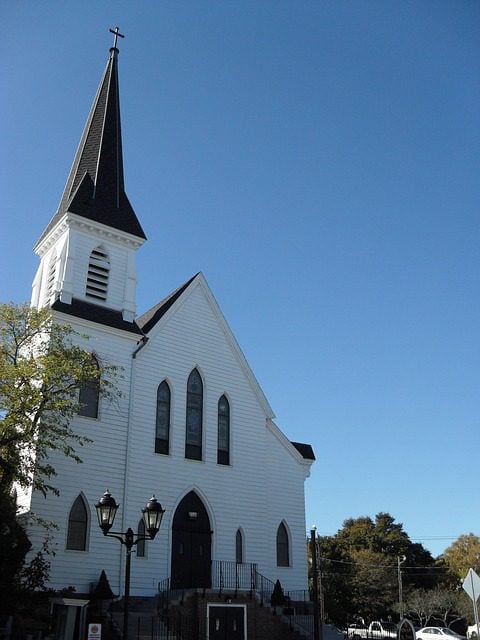
Photo credit: donwhite84 (1-8-09) New England Protestant church [Pixabay / Pixabay License]
***
Calvinism & General Protestantism
Previous Post

June 9, 2019
C. S. Lewis' Views on Christian Unity & Ecumenism
Next Post

June 10, 2019 "Postconciliar" Reply to Peter Kwasniewski & John Lamont
Browse Our Archives
Select a Category & Last Things About Me Anti-Catholicism Atheism & Agnosticism Baptism and Sacramentalism Bible and Tradition Blessed Virgin Mary Books by Dave Armstrong C. S. Lewis Calvinism & General Protestantism Catholic Apologetics Catholic Apologists Catholic conversion Catholic converts Christmas Church (Ecclesiology) Church History Conversion and Converts Development of Doctrine Eastern Orthodoxy Ecumenism & Christian Unity Eucharist & Liturgy Fathers of the Church French Translations G. K. Chesterton Hell Hell & Satan Hell & Satan & Last Things Heresies & Comparative Religion Holistic Health Inquisition & Crusades & Scandals James White Jews & Judaism & Old Testament John Calvin John Henry Newman Liberal / Modernist Theology Life Issues Literary Resume Lutheranism Mariology Martin Luther Music Orthodoxy Papacy & Infallibility Personal Page Philosophy & Science Political & Ethical & Moral Issues Protestant Persecution & Intolerance Protestantism Purgatory Purgatory & Penance Romantic & Imaginative Theology Saints & Purgatory & Penance Salvation Salvation & Justification Satan & Last Things Sexuality and Gender Issues Spanish Translations Traditionalism vs. Radical Catholic Reactionaries Traducciones al español / tradução para português Trinitarianism & Christology Uncategorized Videos
Select a Month October 2026 September 2026 August 2026 July 2026 June 2026 May 2026 April 2026 March 2026 February 2026 January 2026 December 2025 November 2025 October 2025 September 2025 August 2025 July 2025 June 2025 May 2025 April 2025 March 2025 February 2025 January 2025 December 2024 November 2024 October 2024 September 2024 August 2024 July 2024 June 2024 May 2024 April 2024 March 2024 February 2024 January 2024 December 2023 November 2023 October 2023 September 2023 August 2023 July 2023 June 2023 May 2023 April 2023 March 2023 February 2023 January 2023 December 2022 November 2022 October 2022 September 2022 August 2022 July 2022 June 2022 May 2022 April 2022 March 2022 February 2022 January 2022 December 2021 November 2021 October 2021 September 2021 August 2021 July 2021 June 2021 May 2021 April 2021 March 2021 February 2021 January 2021 December 2020 November 2020 October 2020 September 2020 August 2020 July 2020 June 2020 May 2020 April 2020 March 2020 February 2020 January 2020 December 2019 November 2019 October 2019 September 2019 August 2019 July 2019 June 2019 May 2019 April 2019 March 2019 February 2019 January 2019 December 2018 November 2018 October 2018 September 2018 August 2018 July 2018 June 2018 May 2018 April 2018 March 2018 February 2018 January 2018 December 2017 November 2017 October 2017 September 2017 August 2017 July 2017 June 2017 May 2017 April 2017 March 2017 February 2017 January 2017 December 2016 November 2016 October 2016 September 2016 August 2016 July 2016 June 2016 May 2016 April 2016 March 2016 February 2016 January 2016 December 2015 November 2015 October 2015 September 2015 August 2015 July 2015 June 2015 May 2015 April 2015 March 2015 February 2015 January 2015 December 2014 November 2014 October 2014 September 2014 August 2014 July 2014 June 2014 April 2014 March 2014 February 2014 January 2014 December 2013 November 2013 October 2013 September 2013 August 2013 July 2013 June 2013 April 2013 March 2013 February 2013 January 2013 December 2012 November 2012 October 2012 September 2012 August 2012 July 2012 June 2012 May 2012 April 2012 March 2012 February 2012 January 2012 December 2011 November 2011 October 2011 September 2011 August 2011 July 2011 June 2011 April 2011 March 2011 February 2011 October 2010 September 2010 August 2010 July 2010 April 2010 March 2010 December 2009 October 2009 August 2009 July 2009 June 2009 May 2009 March 2009 February 2009 October 2008 September 2008 April 2008 March 2008 February 2008 January 2008 December 2007 November 2007 October 2007 May 2007 March 2007 February 2007 January 2007 November 2006 October 2006 September 2006 August 2006 July 2006 June 2006 May 2006 April 2006 March 2006 February 2006 October 2005 June 2005 April 2005 February 2005 July 2004 May 2004 April 2004
Follow Us!
TAKE THE
Religious Wisdom Quiz
Which book of the Bible contains the most direct prophecies about the Messiah?
Select your answer to see how you score.
Micah Isaiah Zechariah Psalms
Books by This Author Books by Dave Armstrong
Related posts from Biblical Evidence for Catholicism

On Protestant Explanations of Catholic Conversion
Biblical Evidence for Catholicism

Protestant Confessions & "Ever-Virgin" Mary
Biblical Evidence for Catholicism

A Few "Worst" & "Best" Arguments vs. Protestantism
Biblical Evidence for Catholicism
Reply to Anglican Sean Luke on Denominationalism
Biblical Evidence for Catholicism
TRENDING AT PATHEOS Catholic

The Sermon on the Mount, Part I: Matthew...
The Sermon on the Mount, Part I (Matthew 4:12-5:12) St. Matthew moves...

What's up from Crossway: Reviewing some of their latest A few weeks...

Janie Learns the Way of the Cross: A...
Teaching children about Jesus' Passion can be challenging. Many parents and educators...

Looking For Good Catholic Writing - October 2026
He alone extends the heavens, and he walks upon the waves of...

In "Irreplaceable," our book on vocation and technology, Trevor Sutton and I...

I was strolling through the top floor of the brand new Parthenon...
view all Catholic blogs
Ad-Free & Subscriber Log-In Subscription Support
- About Us
- 2026 Calendar
- Videos
- Podcasts
- Library of World Religions
- Faith In Media Tracker
- Advertise With Us
- Write for Us
- Privacy Policy
- Terms of Service
- Do Not Sell My Data
- Contact Us
- Radiant Digital
- Manage Newsletter Subscriptions
- Unsubscribe From Notifications
- Sitemap
Copyright 2008-2026, Patheos. All rights reserved.
Subscription Support Ad-Free & Subscriber Log-In
Follow Patheos