
BuddhistCatholicContemplativeEvangelicalGeneral ChristianHinduJewishLatter-day SaintMuslimNew VisionsProgressive Christian
Beliefs
- Buddhist
- Catholic
- Contemplative
- Evangelical
- General Christian
- Hindu
- Jewish
- Latter-day Saint
- More Voices
- Muslim
- New Visions
- Pagan
- Progressive Christian
Topics
- Religion News
- Food and Religion
- Sports and Religion
- Religious Art
- Religious Music and Entertainment
- Religious Events
- History and Religion
- Style and Religion
- Politics and Religion
- Women in Religion
- Recreation Outdoors and Religion
- Business Finance and Religion
- Careers Workplace and Religion
- Education and Religion
- Family Parenting and Religion
- Health Fitness and Religion
- Home and Religion
- Relationships and Religion
- Technology and Religion
- Travel and Religion
Columnists
- Buddhist Columnists
- Business Finance and Religion Columnists
- Careers Workplace and Religion Columnists
- Catholic Columnists
- Contemplative Columnists
- Education and Religion Columnists
- Evangelists Columnists
- Family Parenting and Religion Columnists
- General Christian Columnists
- Health Fitness and Religion Columnists
- Hindu Columnists
- History and Religion Columnists
- Home and Religion Columnists
- Jewish Columnists
- More Voices Columnists
- Latter Day Columnists
- Muslim Columnists
- New Visions Columnists
- Nonreligious Columnists
- Pagan Columnists
- Politics and Religion Columnists
- Progressive Columnists
- Recreation Outdoors and Religion Columnists
- Relationships and Religion Columnists
- Religion News Columnists
- Religious Art Columnists
- Religious Events Columnists
- Religious Music and Entertainment Columnists
- Sports and Religion Columnists
- Style and Religion Columnists
- Technology and Religion Columnists
- Travel and Religion Columnists
- Women in Religion Columnists
Resource Library
- 2026 Calendar
- Library of World Religions
- The 100 Most Holy Places on Earth
- Patheos Answers
- Podcasts
- Videos
- Faith Leaders Database
- Anglican Episcopalian
- Bahai
- Baptist
- Buddhism
- Christianity
- Confucianism
- Eastern Orthodoxy
- Hinduism
- Holiness and Pentecostal
- ISKCON
- Islam
- Judaism
- Lutheran
- Methodist
- The Church of Jesus Christ of Latter-day Saints
- New Age
- Paganism
- Presbytarian and Reformed
- Protestantism
- Religion Behind the Scenes
- Roman Catholic
- Scientology
- Shia Islam
- Sikhism
- Sufism
- Sunni Islam
- Taoism
- Zen
- See all religions
Research Tools
 Ad-Free & Subscriber Log-In Subscription Support
Ad-Free & Subscriber Log-In Subscription Support
Follow Patheos 

- Trending:
- Forgiveness
- |
- Marriage
- |
- Consciousness
- |
- Death Penalty
- |
- Election
- |
- Halloween

-
About
-
Catholic Apologetics
-
Church History
-
Great Apologists
-
Christian Worldview
-
Protestantism & Misc.
- Home
- Catholic
- History and Religion
- Transubstantiation: A Philosophical & Rational Defense
Transubstantiation: A Philosophical & Rational Defense
Last updated on: June 6, 2026 at 12:39 am by Dave Armstrong
Transubstantiation: A Philosophical & Rational Defense 2026-06-06T00:39:12-04:00 Dave Armstrong
Patheos Explore the world's faith through different perspectives on religion and spirituality! Patheos has the views of the prevalent religions and spiritualities of the world.
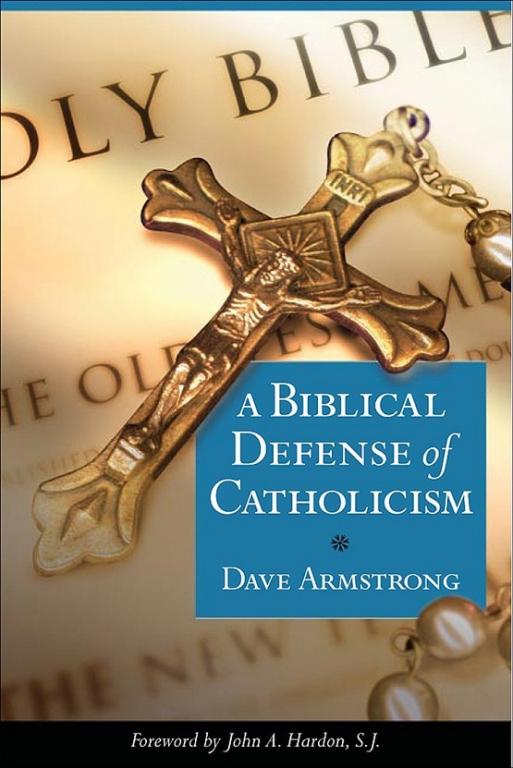
From my book, A Biblical Defense of Catholicism, completed in 1996 and published by Sophia Institute Press, in 2003; pp. 80-83. The book is available for $2.99 in several e-book formats.
*****
The daunting word transubstantiation is easily understood when broken down: trans means “change.” Therefore, the term is defined literally as the process of change of substance. The Catholic Church, in seeking to understand the Real Presence, a doctrine delivered directly by our Lord and St. Paul, gradually developed an explanation as to the exact nature of this miraculous and mysterious transformation.
Contrary to the common misconception, transubstantiation is not dependent upon Aristotelian philosophy, since some notion of the concept goes back to the earliest days of the Church, when Aristotle’s philosophy was not known. The eastern Fathers, before the sixth century, used the Greek expression metaousiosis, or “change of being,” which is essentially the same idea.
The Church did, however, draw upon prevalent philosophical categories, such as substance and accidents. In all ages, Christians have sought to defend Christianity by means of philosophy and human learning (wherever the individual intellectual categories utilized were consistent with Christian Faith). St. Paul, for instance, did this in his sermon on Mars Hill in Athens, where he made reference to pagan poets and philosophers (Acts 17:22-31). St. Augustine incorporated elements of Platonic thought into his theology, and St. Thomas Aquinas synthesized Aristotle and Christianity into a unified, consistent system of Christian thought (Scholasticism or Thomism).
Transubstantiation is predicated upon the distinction between two sorts of change: accidental change occurs when nonessential outward properties are transformed in some fashion. Thus, water can take on the properties of a solid (ice) or of a gas (steam), while remaining chemically the same. A substantial change, on the other hand, produces something else altogether. An example of this is the metabolism of food, which becomes part of our bodies as a result of chemical and biological processes initiated by digestion. In our everyday experience, a change of substance is always accompanied by a corresponding transition of accidents, or properties.
But in the Eucharist — a supernatural transformation — substantial change occurs without accidental alteration. Thus, the properties of bread and wine continue after consecration, but their essence and substance cease to exist, replaced by the substance of the true and actual Body and Blood of Christ. It is this disjunction from the natural laws of physics which causes many to stumble (see John 6:60-69). The following chart may be helpful for understanding different types of change:
A Comparison of Accidental and Substantial Change
Type of change Example Accidents (appearance) Substance (essence) Natural Accidental Water to ice or steam Changed Same Natural Substantial Metabolism of food Changed Changed Supernatural Accidental Miracles of the loaves (Matt. 14:19) Changed (quantity) Same Supernatural Substantial Transubstantiation Same Change
*
Transubstantiation is difficult for the natural mind (especially with its modern excessively skeptical bent) to grasp and clearly requires a great deal of faith. Yet many aspects of Christianity that conservative, Evangelical, orthodox Christians have no difficulty believing transcend reason and must ultimately be accepted on faith, such as the Incarnation (in which a helpless infant in Bethlehem is God!), the Resurrection, the omniscience of God, the paradox of grace versus free will, eternity, the union of the human and divine natures in Christ (the Hypostatic Union), the Fall of Man and Original Sin, and the Virgin Birth, among many other beliefs. Transubstantiation may be considered beyond reason, yet it is not opposed to reason; suprarational, but not irrational, much like Christian theology in general.
If one accepts the fact that God became Man, then it cannot consistently be deemed impossible (as many casually assume) for him to become truly and really present under the appearances of bread and wine. Jesus, after his Resurrection, could apparently walk through walls while remaining in his physical (glorified) body (John 20:26-27). How, then, can the Real Presence reasonably be regarded as intrinsically implausible by supernaturalist Christians?
Likewise, much of the objection to this doctrine seems to arise out of a pitting of matter against spirit, or, more specifically, an a priori hostility toward the idea that grace can be conveyed through matter (which notion is the basis of sacramentalism). This is exceedingly curious, since precisely this concept is fundamental to the Incarnation of our Lord Jesus. If God did not take on matter and human flesh, no one would have been saved. Such a prejudice is neither logical (given belief in the miraculous and Christian precepts) nor scriptural, as we shall see.
Cardinal Newman, whom very few would accuse of being unreasonable or credulous, had this to say about the “difficulties” of transubstantiation:
People say that the doctrine of Transubstantiation is difficult to believe. . . . It is difficult, impossible to imagine, I grant — but how is it difficult to believe? . . . For myself, I cannot indeed prove it, I cannot tell how it is; but I say, “Why should it not be? What’s to hinder it? What do I know of substance or matter? Just as much as the greatest philosophers, and that is nothing at all.” . . . And, in like manner . . . the doctrine of the Trinity in Unity. What do I know of the Essence of the Divine Being? I know that my abstract idea of three is simply incompatible with my idea of one; but when I come to the question of concrete fact, I have no means of proving that there is not a sense in which one and three can equally be predicated of the Incommunicable God. (Apologia Pro Vita Sua [Garden City, New York: Doubleday Image, 1956; originally 1864], 318. Newman’s Apologia is his religious autobiography)
Once one realizes that transubstantiation is a miracle of God, any thought of impossibility vanishes, since God is omnipotent and the sovereign Lord over all creation (Matt. 19:26; Phil. 3:20-21; Heb. 1:3). If mere men can change accidental properties without changing substance (for example, turning iron into molten liquid or even vapor), then God is certainly able to change substance without outward transmutation.
Therefore, having disposed of these weak philosophical objections, we can proceed to examine the clear and indisputable biblical data that reveal to us that God does in fact perform (through the agency of priests) the supernatural act of transubstantiation.
***
Previous Post

May 19, 2019
Debate: Do Liberal Social Policies Lessen Abortion & Poverty?
Next Post

May 20, 2019 Mary's Immaculate Conception: Dialogue w Episcopalian
Browse Our Archives
Select a Category & Last Things About Me Anti-Catholicism Atheism & Agnosticism Baptism and Sacramentalism Bible and Tradition Blessed Virgin Mary Books by Dave Armstrong C. S. Lewis Calvinism & General Protestantism Catholic Apologetics Catholic Apologists Catholic conversion Catholic converts Christmas Church (Ecclesiology) Church History Conversion and Converts Development of Doctrine Eastern Orthodoxy Ecumenism & Christian Unity Eucharist & Liturgy Fathers of the Church French Translations G. K. Chesterton Hell Hell & Satan Hell & Satan & Last Things Heresies & Comparative Religion Holistic Health Inquisition & Crusades & Scandals James White Jews & Judaism & Old Testament John Calvin John Henry Newman Liberal / Modernist Theology Life Issues Literary Resume Lutheranism Mariology Martin Luther Music Orthodoxy Papacy & Infallibility Personal Page Philosophy & Science Political & Ethical & Moral Issues Protestant Persecution & Intolerance Protestantism Purgatory Purgatory & Penance Romantic & Imaginative Theology Saints & Purgatory & Penance Salvation Salvation & Justification Satan & Last Things Sexuality and Gender Issues Spanish Translations Traditionalism vs. Radical Catholic Reactionaries Traducciones al español / tradução para português Trinitarianism & Christology Uncategorized Videos
Select a Month October 2026 September 2026 August 2026 July 2026 June 2026 May 2026 April 2026 March 2026 February 2026 January 2026 December 2025 November 2025 October 2025 September 2025 August 2025 July 2025 June 2025 May 2025 April 2025 March 2025 February 2025 January 2025 December 2024 November 2024 October 2024 September 2024 August 2024 July 2024 June 2024 May 2024 April 2024 March 2024 February 2024 January 2024 December 2023 November 2023 October 2023 September 2023 August 2023 July 2023 June 2023 May 2023 April 2023 March 2023 February 2023 January 2023 December 2022 November 2022 October 2022 September 2022 August 2022 July 2022 June 2022 May 2022 April 2022 March 2022 February 2022 January 2022 December 2021 November 2021 October 2021 September 2021 August 2021 July 2021 June 2021 May 2021 April 2021 March 2021 February 2021 January 2021 December 2020 November 2020 October 2020 September 2020 August 2020 July 2020 June 2020 May 2020 April 2020 March 2020 February 2020 January 2020 December 2019 November 2019 October 2019 September 2019 August 2019 July 2019 June 2019 May 2019 April 2019 March 2019 February 2019 January 2019 December 2018 November 2018 October 2018 September 2018 August 2018 July 2018 June 2018 May 2018 April 2018 March 2018 February 2018 January 2018 December 2017 November 2017 October 2017 September 2017 August 2017 July 2017 June 2017 May 2017 April 2017 March 2017 February 2017 January 2017 December 2016 November 2016 October 2016 September 2016 August 2016 July 2016 June 2016 May 2016 April 2016 March 2016 February 2016 January 2016 December 2015 November 2015 October 2015 September 2015 August 2015 July 2015 June 2015 May 2015 April 2015 March 2015 February 2015 January 2015 December 2014 November 2014 October 2014 September 2014 August 2014 July 2014 June 2014 April 2014 March 2014 February 2014 January 2014 December 2013 November 2013 October 2013 September 2013 August 2013 July 2013 June 2013 April 2013 March 2013 February 2013 January 2013 December 2012 November 2012 October 2012 September 2012 August 2012 July 2012 June 2012 May 2012 April 2012 March 2012 February 2012 January 2012 December 2011 November 2011 October 2011 September 2011 August 2011 July 2011 June 2011 April 2011 March 2011 February 2011 October 2010 September 2010 August 2010 July 2010 April 2010 March 2010 December 2009 October 2009 August 2009 July 2009 June 2009 May 2009 March 2009 February 2009 October 2008 September 2008 April 2008 March 2008 February 2008 January 2008 December 2007 November 2007 October 2007 May 2007 March 2007 February 2007 January 2007 November 2006 October 2006 September 2006 August 2006 July 2006 June 2006 May 2006 April 2006 March 2006 February 2006 October 2005 June 2005 April 2005 February 2005 July 2004 May 2004 April 2004
Follow Us!
TAKE THE
Religious Wisdom Quiz
According to 1 John, what does perfect love do?
Select your answer to see how you score.
Never fails Covers a multitude of sins Drives out fear Fulfills all the law
Books by This Author Books by Dave Armstrong
Related posts from Biblical Evidence for Catholicism

Three More Anti-Catholic Lies About Catholicism (#6-4)
Biblical Evidence for Catholicism

Top Ten Anti-Catholic Lies (#10-7)
Biblical Evidence for Catholicism

The Mass & Development of Doctrine (vs. Wes...
Biblical Evidence for Catholicism

Miraculous Eucharist (vs. Francois Turretin #4)
Biblical Evidence for Catholicism
TRENDING AT PATHEOS Catholic

The Sermon on the Mount, Part I: Matthew...
The Sermon on the Mount, Part I (Matthew 4:12-5:12) St. Matthew moves...

What's up from Crossway: Reviewing some of their latest A few weeks...

Janie Learns the Way of the Cross: A...
Teaching children about Jesus' Passion can be challenging. Many parents and educators...

Looking For Good Catholic Writing - October 2026
He alone extends the heavens, and he walks upon the waves of...

In "Irreplaceable," our book on vocation and technology, Trevor Sutton and I...

I was strolling through the top floor of the brand new Parthenon...
view all Catholic blogs
Ad-Free & Subscriber Log-In Subscription Support
- About Us
- 2026 Calendar
- Videos
- Podcasts
- Library of World Religions
- Faith In Media Tracker
- Advertise With Us
- Write for Us
- Privacy Policy
- Terms of Service
- Do Not Sell My Data
- Contact Us
- Radiant Digital
- Manage Newsletter Subscriptions
- Unsubscribe From Notifications
- Sitemap
Copyright 2008-2026, Patheos. All rights reserved.
Subscription Support Ad-Free & Subscriber Log-In
Follow Patheos