
BuddhistCatholicContemplativeEvangelicalGeneral ChristianHinduJewishLatter-day SaintMuslimNew VisionsProgressive Christian
Beliefs
- Buddhist
- Catholic
- Contemplative
- Evangelical
- General Christian
- Hindu
- Jewish
- Latter-day Saint
- More Voices
- Muslim
- New Visions
- Pagan
- Progressive Christian
Topics
- Religion News
- Food and Religion
- Sports and Religion
- Religious Art
- Religious Music and Entertainment
- Religious Events
- History and Religion
- Style and Religion
- Politics and Religion
- Women in Religion
- Recreation Outdoors and Religion
- Business Finance and Religion
- Careers Workplace and Religion
- Education and Religion
- Family Parenting and Religion
- Health Fitness and Religion
- Home and Religion
- Relationships and Religion
- Technology and Religion
- Travel and Religion
Columnists
- Buddhist Columnists
- Business Finance and Religion Columnists
- Careers Workplace and Religion Columnists
- Catholic Columnists
- Contemplative Columnists
- Education and Religion Columnists
- Evangelists Columnists
- Family Parenting and Religion Columnists
- General Christian Columnists
- Health Fitness and Religion Columnists
- Hindu Columnists
- History and Religion Columnists
- Home and Religion Columnists
- Jewish Columnists
- More Voices Columnists
- Latter Day Columnists
- Muslim Columnists
- New Visions Columnists
- Nonreligious Columnists
- Pagan Columnists
- Politics and Religion Columnists
- Progressive Columnists
- Recreation Outdoors and Religion Columnists
- Relationships and Religion Columnists
- Religion News Columnists
- Religious Art Columnists
- Religious Events Columnists
- Religious Music and Entertainment Columnists
- Sports and Religion Columnists
- Style and Religion Columnists
- Technology and Religion Columnists
- Travel and Religion Columnists
- Women in Religion Columnists
Resource Library
- 2026 Calendar
- Library of World Religions
- The 100 Most Holy Places on Earth
- Patheos Answers
- Podcasts
- Videos
- Faith Leaders Database
- Anglican Episcopalian
- Bahai
- Baptist
- Buddhism
- Christianity
- Confucianism
- Eastern Orthodoxy
- Hinduism
- Holiness and Pentecostal
- ISKCON
- Islam
- Judaism
- Lutheran
- Methodist
- The Church of Jesus Christ of Latter-day Saints
- New Age
- Paganism
- Presbytarian and Reformed
- Protestantism
- Religion Behind the Scenes
- Roman Catholic
- Scientology
- Shia Islam
- Sikhism
- Sufism
- Sunni Islam
- Taoism
- Zen
- See all religions
Research Tools
 Ad-Free & Subscriber Log-In Subscription Support
Ad-Free & Subscriber Log-In Subscription Support
Follow Patheos 

- Trending:
- Forgiveness
- |
- Marriage
- |
- Consciousness
- |
- Death Penalty
- |
- Election
- |
- Halloween

-
About
-
Catholic Apologetics
-
Church History
-
Great Apologists
-
Christian Worldview
-
Protestantism & Misc.
- Home
- Catholic
- History and Religion
- The Unanswered Prayers of Jesus & Our Free Will
The Unanswered Prayers of Jesus & Our Free Will
Last updated on: May 1, 2019 at 11:54 am by Dave Armstrong
The Unanswered Prayers of Jesus & Our Free Will 2019-05-01T11:54:42-04:00 Dave Armstrong
Patheos Explore the world's faith through different perspectives on religion and spirituality! Patheos has the views of the prevalent religions and spiritualities of the world.
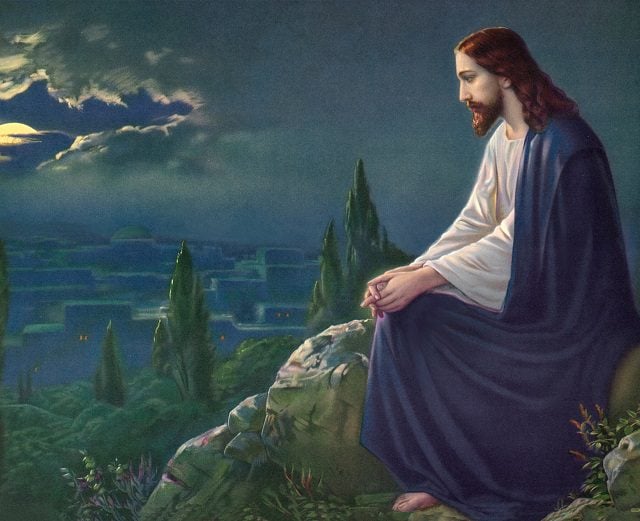
A Reformed Baptist (Calvinist) argued that if Christ in fact died for all men, rather than the elect only (as Calvinists hold), this would result in His interceding in heaven as high priest for those He knows (in His omniscience and perfect foreknowledge) will reject Him and go to hell.
It would then follow that His intercession failed, or (if there is any difference) was unanswered — an unthinkable state of affairs for God.
The reply to this is, I think, simple: yes, Christ’s intercession failed, in the cases of those who went to hell, because human free will trumps even God’s will (by God’s own design). Hence, Calvinism denies free will as well (in effect, futilely to try to overcome this difficulty).
Once that goes, then whatever Jesus prays for in terms of men would inevitably happen, and that is what creates the intended supposed “dilemma” for the person who holds to universal atonement (as virtually all Christians besides Calvinists do).
God allows things to happen that go against His perfect will. The devil’s (and demons’) own fall from grace is an example. I imagine that Jesus, who is eternal, prayed to the Father for Lucifer at one time, since he was God’s greatest creation. The fall of man is another (most Calvinists no longer being Supralapsarian — which means believing that God preordained the Fall of man — though I have argued that Calvin himself was).
Jesus chose Judas to be His disciple. He prayed for him, no doubt, as He did for all the other disciples, but Judas’s free will couldn’t be overcome (lest it not be free will at all).
Here are two examples from Scripture of Jesus’ willing one thing (and in one case, praying for it), and men willing another thing, and (guess what?) the rebellious will prevails:
Matthew 23:37 O Jerusalem, Jerusalem, killing the prophets and stoning those who are sent to you! How often would I have gathered your children together as a hen gathers her brood under her wings, and you would not! (cf. Luke 13:34)
Jesus prayed specifically that His followers “may be one, even as we [He and the Father] are one” (John 17:11) and “that they may all be one; even as thou, Father, art in me, and I in thee” (John 17:21), and again, “one even as we are one, I in them and thou in me, that they may become perfectly one” (John 17:22-23).
Clearly, Christians fall far short (abominably short) of what Jesus intended for this prayer (again, out of our free will to sin and not follow His desires and commands), so it is equally plainly a failed prayer.
Jesus prayed that His disciples would be one. We’re not. We will be one in heaven, but not on earth. His overall providence doesn’t fail, because it incorporates within itself our free-will responses, including rejections of His perfect will. But individual prayers fail if their aim is not met: even for Jesus.
Likewise, God can’t do some things, even though He is omnipotent. They have to be logically possible. For example, He can’t make a square circle or make two plus two equal five. He can’t obliterate Himself out of existence or make Himself noneternal.
This is what lies behind the old atheist challenge: “Can God make a rock so heavy that He couldn’t lift it?” He cannot do so; not because He is not omnipotent (able to do all that is possible to do), but because no weight is too heavy for Him to “lift”: therefore there is no such rock that He can create. It’s logical impossibility; not a disproof of His omnipotence. But the atheist is counting on us not to recognize the necessary distinctions (or, more likely, he does not grasp them himself).
Jesus prayed, “My Father, if it be possible, let this cup pass from me; nevertheless, not as I will, but as thou wilt” (Matt. 26:39). But it wasn’t possible, because some things aren’t possible even for God. In this instance it wasn’t possible for Jesus to avoid the Passion.
2 Peter 3:9 The Lord is not slow about his promise as some count slowness, but is forbearing toward you, not wishing that any should perish, but that all should reach repentance.
But we know that not all reach repentance. Damned folks go to hell. We know that for sure because Scripture mentions it in several places (see, e.g., Matt. 5:22; 10:28; Matt. 23:33; 25:41).
Therefore, God’s desire, which for Him is the same as a prayer because He knows all at once, is not fulfilled in its goal (the salvation of all). It can’t be, given human free will, which He allowed to be present. God gives all men sufficient grace to be saved, but that can be rejected and is, in fact, by the reprobate.
Some try to argue that Jesus’ prayer for Christian unity in John 17 is answered in heaven, but the context (which has nothing to do with perfection in heaven, but rather, life in this world, with all its problems) utterly rules that out as an explanation:
John 17:11 And now I am no more in the world, but they are in the world, and I am coming to thee. Holy Father, keep them in thy name, which thou hast given me, that they may be one, even as we are one.
John 17:15 I do not pray that thou shouldst take them out of the world, but that thou shouldst keep them from the evil one.
John 17:17 Sanctify them in the truth; thy word is truth.
No more sanctification takes place in heaven.
John 17:18 As thou didst send me into the world, so I have sent them into the world.
In each case, the context is in the world.
John 17:2 that they may all be one; even as thou, Father, art in me, and I in thee, that they also may be in us, so that the world may believe that thou hast sent me.
John 17:23 I in them and thou in me, that they may become perfectly one, so that the world may know that thou hast sent me and hast loved them even as thou hast loved me.
The previous two passages can’t possibly apply to the afterlife, because they have to do with witness. If they are one in the world, the world will believe in Jesus as a result of observing them.
We thus conclude from the previous passages:
Can God will one thing without its coming to pass? Matthew 23:37 shows that this can indeed happen. So does 2 Peter 3:9, where God desires that none perish, yet many do and go to hell.
Can something that Jesus prays for not happen? John 17 shows this, and the Calvinist’s exegesis is utterly implausible and takes no account of the entire repeated context, which has to do with the world, not the final state.
There are some things that even God can’t do. He can’t force a person to believe with his free will opposed, because the two notions are incompatible. But He can give everyone enough grace to be saved, and they have it in order to cooperate with their free will.
God doesn’t predestine people to hell, though (only to heaven). That is Calvinist heresy. And so the people in hell run counter to God’s desire (in Scripture) that none perish.
It was virtually impossible for Jesus’ prayer in John 17 to have been realized, given human sin. By allowing human free will, God allows into the universe sins that are not in accord with His perfect will. And He can’t make a man with free will unfree by forcing him to be good and righteous and nonrebellious.
***
(originally from 2015)
Photo credit: Christ on the Mount of Olives, by Josef August Untersberger, aka Giovanni (1864-1933) [public domain / Wikimedia Commons]

***
Previous Post

April 30, 2019
"Optional" Confirmation Class & Mass for Teenagers?
Next Post
May 1, 2019 Biblical Idolatry: Authentic & Counterfeit Conceptions
Browse Our Archives
Select a Category & Last Things About Me Anti-Catholicism Atheism & Agnosticism Baptism and Sacramentalism Bible and Tradition Blessed Virgin Mary Books by Dave Armstrong C. S. Lewis Calvinism & General Protestantism Catholic Apologetics Catholic Apologists Catholic conversion Catholic converts Christmas Church (Ecclesiology) Church History Conversion and Converts Development of Doctrine Eastern Orthodoxy Ecumenism & Christian Unity Eucharist & Liturgy Fathers of the Church French Translations G. K. Chesterton Hell Hell & Satan Hell & Satan & Last Things Heresies & Comparative Religion Holistic Health Inquisition & Crusades & Scandals James White Jews & Judaism & Old Testament John Calvin John Henry Newman Liberal / Modernist Theology Life Issues Literary Resume Lutheranism Mariology Martin Luther Music Orthodoxy Papacy & Infallibility Personal Page Philosophy & Science Political & Ethical & Moral Issues Protestant Persecution & Intolerance Protestantism Purgatory Purgatory & Penance Romantic & Imaginative Theology Saints & Purgatory & Penance Salvation Salvation & Justification Satan & Last Things Sexuality and Gender Issues Spanish Translations Traditionalism vs. Radical Catholic Reactionaries Traducciones al español / tradução para português Trinitarianism & Christology Uncategorized Videos
Select a Month October 2026 September 2026 August 2026 July 2026 June 2026 May 2026 April 2026 March 2026 February 2026 January 2026 December 2025 November 2025 October 2025 September 2025 August 2025 July 2025 June 2025 May 2025 April 2025 March 2025 February 2025 January 2025 December 2024 November 2024 October 2024 September 2024 August 2024 July 2024 June 2024 May 2024 April 2024 March 2024 February 2024 January 2024 December 2023 November 2023 October 2023 September 2023 August 2023 July 2023 June 2023 May 2023 April 2023 March 2023 February 2023 January 2023 December 2022 November 2022 October 2022 September 2022 August 2022 July 2022 June 2022 May 2022 April 2022 March 2022 February 2022 January 2022 December 2021 November 2021 October 2021 September 2021 August 2021 July 2021 June 2021 May 2021 April 2021 March 2021 February 2021 January 2021 December 2020 November 2020 October 2020 September 2020 August 2020 July 2020 June 2020 May 2020 April 2020 March 2020 February 2020 January 2020 December 2019 November 2019 October 2019 September 2019 August 2019 July 2019 June 2019 May 2019 April 2019 March 2019 February 2019 January 2019 December 2018 November 2018 October 2018 September 2018 August 2018 July 2018 June 2018 May 2018 April 2018 March 2018 February 2018 January 2018 December 2017 November 2017 October 2017 September 2017 August 2017 July 2017 June 2017 May 2017 April 2017 March 2017 February 2017 January 2017 December 2016 November 2016 October 2016 September 2016 August 2016 July 2016 June 2016 May 2016 April 2016 March 2016 February 2016 January 2016 December 2015 November 2015 October 2015 September 2015 August 2015 July 2015 June 2015 May 2015 April 2015 March 2015 February 2015 January 2015 December 2014 November 2014 October 2014 September 2014 August 2014 July 2014 June 2014 April 2014 March 2014 February 2014 January 2014 December 2013 November 2013 October 2013 September 2013 August 2013 July 2013 June 2013 April 2013 March 2013 February 2013 January 2013 December 2012 November 2012 October 2012 September 2012 August 2012 July 2012 June 2012 May 2012 April 2012 March 2012 February 2012 January 2012 December 2011 November 2011 October 2011 September 2011 August 2011 July 2011 June 2011 April 2011 March 2011 February 2011 October 2010 September 2010 August 2010 July 2010 April 2010 March 2010 December 2009 October 2009 August 2009 July 2009 June 2009 May 2009 March 2009 February 2009 October 2008 September 2008 April 2008 March 2008 February 2008 January 2008 December 2007 November 2007 October 2007 May 2007 March 2007 February 2007 January 2007 November 2006 October 2006 September 2006 August 2006 July 2006 June 2006 May 2006 April 2006 March 2006 February 2006 October 2005 June 2005 April 2005 February 2005 July 2004 May 2004 April 2004
Follow Us!
TAKE THE
Religious Wisdom Quiz
Who asked Jesus, "What is truth?"
Select your answer to see how you score.
Caiaphas Pilate Nicodemus Herod
Books by This Author Books by Dave Armstrong
Related posts from Biblical Evidence for Catholicism

Bible & Catholicism on Mortal Sin (vs. John...
Biblical Evidence for Catholicism

Dialogue on Eternal Security / Absolute Assurance
Biblical Evidence for Catholicism

"Faith Alone" Dialogue with a Calvinist
Biblical Evidence for Catholicism

Exegesis of 75 NT Faith [Alone?] & Works...
Biblical Evidence for Catholicism
TRENDING AT PATHEOS Catholic

I was strolling through the top floor of the brand new Parthenon...

What Does Gêvâh Mean For Kimberley Guifoyle &...
This week, a lot of the news is focused on Kimberly Guilfoyle....

INNER CIRCLE: Profound Mystery (Of Christ In All...
Ephesians 5:31-32 “For this reason, a man will leave his father and...

Do Not Rejoice When Your Enemy Falls: The...
Turning an execution into a public spectacle is a disturbing expression of...

'The Chosen' S6 Trailer: The Passion Gets Very...
Not many watching 'The Chosen' worry about spoilers, but just because they...

The purpose-driven labor priest
A labor activist reads Rick Warren and it gets me wondering about...
view all Catholic blogs
Ad-Free & Subscriber Log-In Subscription Support
- About Us
- 2026 Calendar
- Videos
- Podcasts
- Library of World Religions
- Faith In Media Tracker
- Advertise With Us
- Write for Us
- Privacy Policy
- Terms of Service
- Do Not Sell My Data
- Contact Us
- Radiant Digital
- Manage Newsletter Subscriptions
- Unsubscribe From Notifications
- Sitemap
Copyright 2008-2026, Patheos. All rights reserved.
Subscription Support Ad-Free & Subscriber Log-In
Follow Patheos