
BuddhistCatholicContemplativeEvangelicalGeneral ChristianHinduJewishLatter-day SaintMuslimNew VisionsProgressive Christian
Beliefs
- Buddhist
- Catholic
- Contemplative
- Evangelical
- General Christian
- Hindu
- Jewish
- Latter-day Saint
- More Voices
- Muslim
- New Visions
- Pagan
- Progressive Christian
Topics
- Religion News
- Food and Religion
- Sports and Religion
- Religious Art
- Religious Music and Entertainment
- Religious Events
- History and Religion
- Style and Religion
- Politics and Religion
- Women in Religion
- Recreation Outdoors and Religion
- Business Finance and Religion
- Careers Workplace and Religion
- Education and Religion
- Family Parenting and Religion
- Health Fitness and Religion
- Home and Religion
- Relationships and Religion
- Technology and Religion
- Travel and Religion
Columnists
- Buddhist Columnists
- Business Finance and Religion Columnists
- Careers Workplace and Religion Columnists
- Catholic Columnists
- Contemplative Columnists
- Education and Religion Columnists
- Evangelists Columnists
- Family Parenting and Religion Columnists
- General Christian Columnists
- Health Fitness and Religion Columnists
- Hindu Columnists
- History and Religion Columnists
- Home and Religion Columnists
- Jewish Columnists
- More Voices Columnists
- Latter Day Columnists
- Muslim Columnists
- New Visions Columnists
- Nonreligious Columnists
- Pagan Columnists
- Politics and Religion Columnists
- Progressive Columnists
- Recreation Outdoors and Religion Columnists
- Relationships and Religion Columnists
- Religion News Columnists
- Religious Art Columnists
- Religious Events Columnists
- Religious Music and Entertainment Columnists
- Sports and Religion Columnists
- Style and Religion Columnists
- Technology and Religion Columnists
- Travel and Religion Columnists
- Women in Religion Columnists
Resource Library
- 2026 Calendar
- Library of World Religions
- The 100 Most Holy Places on Earth
- Patheos Answers
- Podcasts
- Videos
- Faith Leaders Database
- Anglican Episcopalian
- Bahai
- Baptist
- Buddhism
- Christianity
- Confucianism
- Eastern Orthodoxy
- Hinduism
- Holiness and Pentecostal
- ISKCON
- Islam
- Judaism
- Lutheran
- Methodist
- The Church of Jesus Christ of Latter-day Saints
- New Age
- Paganism
- Presbytarian and Reformed
- Protestantism
- Religion Behind the Scenes
- Roman Catholic
- Scientology
- Shia Islam
- Sikhism
- Sufism
- Sunni Islam
- Taoism
- Zen
- See all religions
Research Tools
 Ad-Free & Subscriber Log-In Subscription Support
Ad-Free & Subscriber Log-In Subscription Support
Follow Patheos 

- Trending:
- Forgiveness
- |
- Marriage
- |
- Consciousness
- |
- Death Penalty
- |
- Election
- |
- Halloween

-
About
-
Catholic Apologetics
-
Church History
-
Great Apologists
-
Christian Worldview
-
Protestantism & Misc.
- Home
- Catholic
- History and Religion
- Pascal, Kreeft, & Kierkegaard on Persuasion & Apologetics
Pascal, Kreeft, & Kierkegaard on Persuasion & Apologetics
Last updated on: May 14, 2019 at 8:00 pm by Dave Armstrong
Pascal, Kreeft, & Kierkegaard on Persuasion & Apologetics 2019-05-14T20:00:43-04:00 Dave Armstrong
Patheos Explore the world's faith through different perspectives on religion and spirituality! Patheos has the views of the prevalent religions and spiritualities of the world.
From Peter Kreeft’s book: Christianity For Modern Pagans: Pascal’s Pensees, San Francisco: Ignatius Press, 1993.
*
For cutting-and-pasting purposes, I will be using the online e-text of the Pensees, translated by W.F. Trotter, whereas Kreeft used the (Penguin) Krailsheimer translation. With that understood, otherwise, I’ll be utilizing direct quotes from the Kreeft book, with pages indicated. Pascal citations will be in blue; Kierkegaard’s words will be in green. Plain black words are Kreeft’s.
*****
111. Inconstancy. We think we are playing on ordinary organs when playing upon man. Men are organs, it is true, but, odd, changeable, variable with pipes not arranged in proper order. Those who only know how to play on ordinary organs will not produce harmonies on these. We must know where [the keys] are.
Unless the apologist creates internal silence in his reader, unless he produces somehow that precious moment of sudden, standstill shock, his apologetics is only chatter or scholarship, not power . . .
Knowing how to create this silence through words is like knowing how to touch a wild animal to quiet it . . .
You need to know and love both the student and the subject, both psychology and theology. Few know both as Pascal does. (p. 36)
336. The reason of effects. We must keep our thought secret, and judge everything by it, while talking like the people.
[Krailsheimer, #91: One must have deeper motives and judge everything accordingly, but go on talking like an ordinary person.]
Kierkegaard defined his spy mission this way: to smuggle Christianity back into Christendom (that is, our nominally Christian but really post-Christian society).
Kierkegaard seems to have learned his method, which he calls “indirect communication”, from Pascal. Pascal uses the equivalent of Kierkegaard’s pseudonyms for the same end, namely, to speak from within the opposite point of view, that of alienated, skeptical modern man, rather than speaking only from the passionate, committed point of view of the Christian believer. This is his “cover”. (p. 37)
420. If he exalt himself, I humble him; if he humble himself, I exalt him; and I always contradict him, till he understands that he is an incomprehensible monster.
This is exactly what Jesus did . . . Why did he do this? For Truth. To teach them who they really were: neither angels nor beasts, neither Heavenly nor Hellish, neither sages nor fools, but both . . .
Pascal . . . goes on contradicting us, bothering us, bugging us, until we understand the truth about ourselves. And the truth about ourselves is that we are a mystery, not a problem; a monster, not a puzzle; a living self-contradiction who needs to be contradicted if he is to understand himself.
Like Socrates and Jesus, Pascal does not leave us at rest . . . (pp. 37-38)
9. When we wish to correct with advantage and to show another that he errs, we must notice from what side he views the matter, for on that side it is usually true, and admit that truth to him, but reveal to him the side on which it is false. He is satisfied with that, for he sees that he was not mistaken and that he only failed to see all sides. Now, no one is offended at not seeing everything; but one does not like to be mistaken, and that perhaps arises from the fact that man naturally cannot see everything, and that naturally he cannot err in the side he looks at, since the perceptions of our senses are always true.
Compare what Pascal says here with what Kierkegaard says in The Point of View:
An illusion can never be destroyed directly, and only by indirect means can it be radically removed . . . That is, one must approach from behind the person who is under an illusion . . .A direct attack only strengthens a person in his illusion and at the same time, embitters him. There is nothing that requires such gentle handling as an illusion, if one wishes to dispel it. If anything prompts the perspective captive to set his will in opposition, all is lost . . . This is what is achieved by the indirect method which, loving and serving the truth, arranges everything dialectically for the prospective captive, and then shyly withdraws (for love is always shy), so as not to witness the admission which he makes to himself alone before God — that he has lived hitherto in an illusion.. . . If real success is to attend the effort to bring a man to a definite position, one must first of all take pains to find him where he is and begin there. This is the secret of the art of helping others. . . .
In order to help another effectively I must understand more than he — yet first of all surely I must understand what he understands . . . all true effort to help begins with self-humiliation: the helper must first humble himself under him he would help, and therewith must understand that to help does not mean to be a sovereign but to be a servant, that to help does not mean to be ambitious but to be patient, that to help means to endure for the time being the imputation that one is in the wrong and does not understand what the other understands.
Your prospective captive’s point of view, or world view, is of first importance because it is the hidden premise behind all his arguments.
It is of first importance not only logically but also psychologically, personally. it is more important to the person than what he explicitly says and argues about, because it is the conviction held so close to his heart that he feels he does not need to argue for it, only to assume it.
We find Jesus constantly responding to the other’s point of view rather than to his words: for example, Matthew 19:3-9,16-22; 21:23-27; 22:15-46; John 8:2-11.
What Kierkegaard describes above is also exactly Socrates’ method. Kierkegaard and Pascal apply it to Christianity.
A happy corollary of the last part of this pensee is that everyone sees some truth. Therefore we can learn some truth from every one and every philosophy, even those most disastrously in error . . .
St. Thomas is constantly applying this principle in the Summa. Nearly every answer to every objection takes the form of distinguishing two points of view, or two meanings of a term, and admitting that the objection is right from one point of view (a less adequate one) but wrong from another.
For Aquinas, this consisted mainly in distinguishing two meanings of a term, two logical points of view or horizons of meaning — two different world views. . . .
The apologist must read between the lines and see his opponent’s point of view, for the same reason a general must know the opposing army’s camp and supply lines. In both cases I want to know “where you’re coming from”. For philosophy, unlike science, does not go forward to discover new empirical truths, but backward to illuminate where arguments come from. Science builds skyscrapers, philosophy inspects foundations. (pp. 39-42)
10. People are generally better persuaded [Krailsheimer: “convinced more easily”] by the reasons which they have themselves discovered than by those which have come into the mind of others.
Therefore it is a more effective apologetic strategy to get your opponent to discover the truth for himself than for you to give it to him . . . How is this to be done? We have just seen Pascal’s answer: indirect communication, spying, looking at things from your opponent’s point of view and drawing out the consequences of his premises. In other words, the Socratic method. (p. 42)
***
(originally 9-2-05)
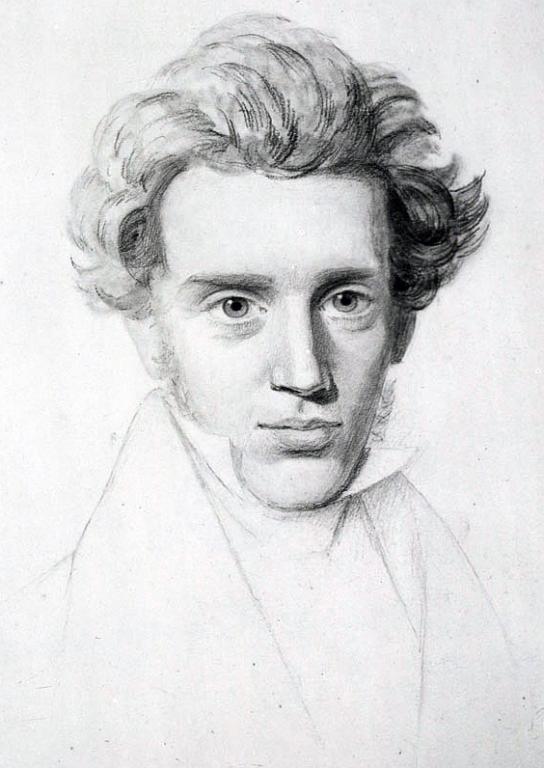
Photo credit: portrait of Danish philosopher Søren Kierkegaard (1813-1855), c. 1840 [public domain / Wikipedia]

***
Previous Post

May 14, 2019
Calvinist Origin of Luther's (?) "Snow-Covered Dunghill"?
Next Post

May 15, 2019 Dialogue: Pro-Life White Guys & Anti-Southern Prejudice
Browse Our Archives
Select a Category & Last Things About Me Anti-Catholicism Atheism & Agnosticism Baptism and Sacramentalism Bible and Tradition Blessed Virgin Mary Books by Dave Armstrong C. S. Lewis Calvinism & General Protestantism Catholic Apologetics Catholic Apologists Catholic conversion Catholic converts Christmas Church (Ecclesiology) Church History Conversion and Converts Development of Doctrine Eastern Orthodoxy Ecumenism & Christian Unity Eucharist & Liturgy Fathers of the Church French Translations G. K. Chesterton Hell Hell & Satan Hell & Satan & Last Things Heresies & Comparative Religion Holistic Health Inquisition & Crusades & Scandals James White Jews & Judaism & Old Testament John Calvin John Henry Newman Liberal / Modernist Theology Life Issues Literary Resume Lutheranism Mariology Martin Luther Music Orthodoxy Papacy & Infallibility Personal Page Philosophy & Science Political & Ethical & Moral Issues Protestant Persecution & Intolerance Protestantism Purgatory Purgatory & Penance Romantic & Imaginative Theology Saints & Purgatory & Penance Salvation Salvation & Justification Satan & Last Things Sexuality and Gender Issues Spanish Translations Traditionalism vs. Radical Catholic Reactionaries Traducciones al español / tradução para português Trinitarianism & Christology Uncategorized Videos
Select a Month October 2026 September 2026 August 2026 July 2026 June 2026 May 2026 April 2026 March 2026 February 2026 January 2026 December 2025 November 2025 October 2025 September 2025 August 2025 July 2025 June 2025 May 2025 April 2025 March 2025 February 2025 January 2025 December 2024 November 2024 October 2024 September 2024 August 2024 July 2024 June 2024 May 2024 April 2024 March 2024 February 2024 January 2024 December 2023 November 2023 October 2023 September 2023 August 2023 July 2023 June 2023 May 2023 April 2023 March 2023 February 2023 January 2023 December 2022 November 2022 October 2022 September 2022 August 2022 July 2022 June 2022 May 2022 April 2022 March 2022 February 2022 January 2022 December 2021 November 2021 October 2021 September 2021 August 2021 July 2021 June 2021 May 2021 April 2021 March 2021 February 2021 January 2021 December 2020 November 2020 October 2020 September 2020 August 2020 July 2020 June 2020 May 2020 April 2020 March 2020 February 2020 January 2020 December 2019 November 2019 October 2019 September 2019 August 2019 July 2019 June 2019 May 2019 April 2019 March 2019 February 2019 January 2019 December 2018 November 2018 October 2018 September 2018 August 2018 July 2018 June 2018 May 2018 April 2018 March 2018 February 2018 January 2018 December 2017 November 2017 October 2017 September 2017 August 2017 July 2017 June 2017 May 2017 April 2017 March 2017 February 2017 January 2017 December 2016 November 2016 October 2016 September 2016 August 2016 July 2016 June 2016 May 2016 April 2016 March 2016 February 2016 January 2016 December 2015 November 2015 October 2015 September 2015 August 2015 July 2015 June 2015 May 2015 April 2015 March 2015 February 2015 January 2015 December 2014 November 2014 October 2014 September 2014 August 2014 July 2014 June 2014 April 2014 March 2014 February 2014 January 2014 December 2013 November 2013 October 2013 September 2013 August 2013 July 2013 June 2013 April 2013 March 2013 February 2013 January 2013 December 2012 November 2012 October 2012 September 2012 August 2012 July 2012 June 2012 May 2012 April 2012 March 2012 February 2012 January 2012 December 2011 November 2011 October 2011 September 2011 August 2011 July 2011 June 2011 April 2011 March 2011 February 2011 October 2010 September 2010 August 2010 July 2010 April 2010 March 2010 December 2009 October 2009 August 2009 July 2009 June 2009 May 2009 March 2009 February 2009 October 2008 September 2008 April 2008 March 2008 February 2008 January 2008 December 2007 November 2007 October 2007 May 2007 March 2007 February 2007 January 2007 November 2006 October 2006 September 2006 August 2006 July 2006 June 2006 May 2006 April 2006 March 2006 February 2006 October 2005 June 2005 April 2005 February 2005 July 2004 May 2004 April 2004
Follow Us!
TAKE THE
Religious Wisdom Quiz
I am twelve stones taken from a riverbed and set up as a memorial to a miraculous crossing. What am I?
Select your answer to see how you score.
Altar stones The memorial stones The Stones of remembrance Bethel
Books by This Author Books by Dave Armstrong
Related posts from Biblical Evidence for Catholicism

Why Wes Huff (and Everyone) Should Be Catholic
Biblical Evidence for Catholicism

Invocation of Saints: Catholic Scholars vs. Me? Nope!
Biblical Evidence for Catholicism

My “Number Articles”: Alphabetized by Topic
Biblical Evidence for Catholicism

General Debate on Christianity with an Atheist
Biblical Evidence for Catholicism
TRENDING AT PATHEOS Catholic

The Sermon on the Mount, Part I: Matthew...
The Sermon on the Mount, Part I (Matthew 4:12-5:12) St. Matthew moves...

What's up from Crossway: Reviewing some of their latest A few weeks...

Janie Learns the Way of the Cross: A...
Teaching children about Jesus' Passion can be challenging. Many parents and educators...

Looking For Good Catholic Writing - October 2026
He alone extends the heavens, and he walks upon the waves of...

In "Irreplaceable," our book on vocation and technology, Trevor Sutton and I...

I was strolling through the top floor of the brand new Parthenon...
view all Catholic blogs
Ad-Free & Subscriber Log-In Subscription Support
- About Us
- 2026 Calendar
- Videos
- Podcasts
- Library of World Religions
- Faith In Media Tracker
- Advertise With Us
- Write for Us
- Privacy Policy
- Terms of Service
- Do Not Sell My Data
- Contact Us
- Radiant Digital
- Manage Newsletter Subscriptions
- Unsubscribe From Notifications
- Sitemap
Copyright 2008-2026, Patheos. All rights reserved.
Subscription Support Ad-Free & Subscriber Log-In
Follow Patheos