
BuddhistCatholicContemplativeEvangelicalGeneral ChristianHinduJewishLatter-day SaintMuslimNew VisionsProgressive Christian
Beliefs
- Buddhist
- Catholic
- Contemplative
- Evangelical
- General Christian
- Hindu
- Jewish
- Latter-day Saint
- More Voices
- Muslim
- New Visions
- Pagan
- Progressive Christian
Topics
- Religion News
- Food and Religion
- Sports and Religion
- Religious Art
- Religious Music and Entertainment
- Religious Events
- History and Religion
- Style and Religion
- Politics and Religion
- Women in Religion
- Recreation Outdoors and Religion
- Business Finance and Religion
- Careers Workplace and Religion
- Education and Religion
- Family Parenting and Religion
- Health Fitness and Religion
- Home and Religion
- Relationships and Religion
- Technology and Religion
- Travel and Religion
Columnists
- Buddhist Columnists
- Business Finance and Religion Columnists
- Careers Workplace and Religion Columnists
- Catholic Columnists
- Contemplative Columnists
- Education and Religion Columnists
- Evangelists Columnists
- Family Parenting and Religion Columnists
- General Christian Columnists
- Health Fitness and Religion Columnists
- Hindu Columnists
- History and Religion Columnists
- Home and Religion Columnists
- Jewish Columnists
- More Voices Columnists
- Latter Day Columnists
- Muslim Columnists
- New Visions Columnists
- Nonreligious Columnists
- Pagan Columnists
- Politics and Religion Columnists
- Progressive Columnists
- Recreation Outdoors and Religion Columnists
- Relationships and Religion Columnists
- Religion News Columnists
- Religious Art Columnists
- Religious Events Columnists
- Religious Music and Entertainment Columnists
- Sports and Religion Columnists
- Style and Religion Columnists
- Technology and Religion Columnists
- Travel and Religion Columnists
- Women in Religion Columnists
Resource Library
- 2026 Calendar
- Library of World Religions
- The 100 Most Holy Places on Earth
- Patheos Answers
- Podcasts
- Videos
- Faith Leaders Database
- Anglican Episcopalian
- Bahai
- Baptist
- Buddhism
- Christianity
- Confucianism
- Eastern Orthodoxy
- Hinduism
- Holiness and Pentecostal
- ISKCON
- Islam
- Judaism
- Lutheran
- Methodist
- The Church of Jesus Christ of Latter-day Saints
- New Age
- Paganism
- Presbytarian and Reformed
- Protestantism
- Religion Behind the Scenes
- Roman Catholic
- Scientology
- Shia Islam
- Sikhism
- Sufism
- Sunni Islam
- Taoism
- Zen
- See all religions
Research Tools
 Ad-Free & Subscriber Log-In Subscription Support
Ad-Free & Subscriber Log-In Subscription Support
Follow Patheos 

- Trending:
- Forgiveness
- |
- Marriage
- |
- Consciousness
- |
- Death Penalty
- |
- Election
- |
- Halloween

-
About
-
Catholic Apologetics
-
Church History
-
Great Apologists
-
Christian Worldview
-
Protestantism & Misc.
- Home
- Catholic
- History and Religion
- Nuclear Bombings of Japan: Justified by “Double Effect”?
Nuclear Bombings of Japan: Justified by “Double Effect”?
Last updated on: May 22, 2019 at 12:02 pm by Dave Armstrong
Nuclear Bombings of Japan: Justified by “Double Effect”? 2019-05-22T12:02:49-04:00 Dave Armstrong
Patheos Explore the world's faith through different perspectives on religion and spirituality! Patheos has the views of the prevalent religions and spiritualities of the world.
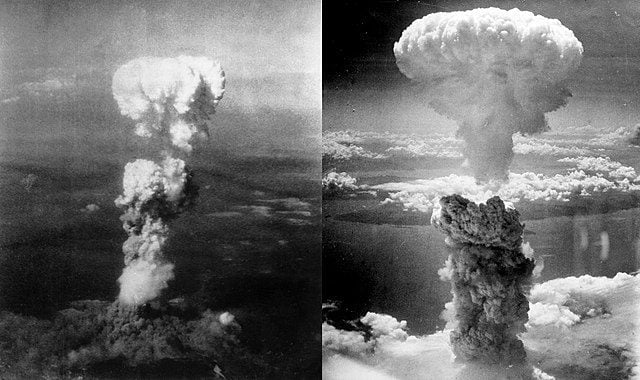
Hiroshima and Nagasaki fail the Catholic test of “double effect” because they involved the killing of over 200,000 civilian noncombatants. Such an act is condemned in traditional just war criteria which forbids deliberate targeting of such non-military populations. The exceedingly weak counter-argument given by proponents is that these cities had military installations (President Truman absurdly referred to the city of Hiroshima as a “military base”). These were the targets, so we are told, not the civilian population; therefore the dreadful result of killing them was not willed and is supposedly covered under the “protection” of the principle under consideration.
I have contended that such a justification is ludicrous and an example of rationalizing special pleading of the worst kind. It simply can’t be sustained, given nuclear technology, even if relatively unknown at the time. If we grant this “lessening of culpability due to ignorance” for Hiroshima, we still could not do so for Nagasaki, since it was then known what would happen.
Furthermore, the target areas (the centers of both cities) and the knowledge that the effect of the bombs spread outwardly from ground zero to cover a known area of a particular estimated size, and the obvious fact that cities contain citizens and population (read: people, persons, human beings; read, “including many elderly men, women, and children”), make it quite implausible (I think, virtually impossible) to maintain that those who ordered such a strike were targeting only military installations and not also people.
Moreover, terror bombing or carpet bombing of cities with known effects had already occurred (particularly in Dresden, Germany and in Tokyo). It is equally absurd to argue that those strikes were not intended to target populations as well as military production facilities, bases, etc. This being the case, and the immediate precedent, it is difficult to make an argument that somehow Hiroshima and Nagasaki were instances of a strike wholly different in nature and intent from Dresden and Tokyo.
If indeed only the military targets were in mind, then why drop these horrific weapons on the center of the city? Was that the way to take out the most military targets? I have read that the bulk of these targets were on the outer peripheries of the city, not in the center. If the goal was to minimize civilian casualties, is not the center of the city the very worst selection for this end? The intent was clearly to kill as many people as possible along with taking out whatever military targets were there. Of course, those who do such an evil thing will maximize the military significance and minimize the human cost, but the facts remain what they are and cannot, in my opinion, be gotten over.
To sum up, then:
Deliberately killing civilians in wartime is wrong.
The bombings of Hiroshima and Nagasaki did that (to the tune of 200,000 + casualties).
It cannot plausibly be maintained that this was a non-intended effect of a moral good (taking out military installations) because of the nature of the weapon, where it was targeted, and immediate historical precedent.
Therefore, it was an evil act, since contrary to Catholic just war criteria, and inability of justification by this criterion of double effect.
Conclusion: the bombings violate double effect by being morally bad and not at all indifferent.
I think it is impossible and ludicrous to maintain that 200,000 deaths as a result of a bomb of mostly-known proportions and effects were not “willed,” but merely “permitted”. How can one drop such a weapon and claim to not know that such a result in human cost would happen? As I stated previously, one can’t simply play word games and act as if the magic words “military target” wrap up all the difficulties of this cynical, downright malicious (from the standpoint of the victims) reasoning.
The second sentence is also quite applicable and damaging to the proponents’ position, thought not fatal in and of itself, due to the nature of probabilistic or contingent or theoretical calculations of what would happen in the future. As many high military figures felt at the time (Eisenhower, MacArthur, Nimitz, Halsey, Carter Clarke: who was in charge of the radio intelligence summations; also former President Hoover, etc.), surrender could have been achieved by the end of 1945 without recourse to such horrible measures. There was certainly enough opinion and evidence along these lines for us to have at least more seriously considered such an option, in accord with this principle.
Or else, I suppose proponents could simply argue that all these military experts were ignorant, misguided, acting on emotions alone (as if the pro-bombing crowd did not have a large amount of emotions clouding their reasoning, too), or that they only reported their supposed feelings anachronistically, and after the fact (due to the Cold War, the second-guessing of hindsight, etc.). Some people seem to consider themselves able (as a non-military and non-academic persons), 60 years after the fact, to better make such judgments than folks like Eisenhower and MacArthur. Is that not exceptionally presumptuous?
If we grant that President Truman acted in good faith, with good motives (as I freely do), then we must also grant that those opposed to the decision at the time were equally in good faith, with roughly equal the information needed to make the decision one way or the other. This was not a unanimous consensus at the time, however one wishes to slant or spin it. In other words, many thought that we could achieve the good end without the bad effect of what the bomb in fact caused. it was a viable option; therefore it should have been seriously considered and (I say) chosen as the more moral option of the two.
The good end desired (the surrender and thus the end of the wanton slaughters of the Japanese army and suicides even of Japanese civilians) was promptly achieved. So far so good. The good effect was also produced by the action; yet it was also produced by the bad effect of the action (the mass killings convinced the Japanese of the futility of continuing). Thus, this would seem to suggest that Hiroshima and Nagasaki do not meet this particular just war criterion.
And thus we arrive at the crux of the matter: the previous state of affairs being true; therefore a good end was achieved by a bad means, and this is not allowed in Catholic moral theology. Therefore, the bombings are unjustifiable once again, on this separate and distinct ground. If, to speak theoretically, somehow we had had the technology then to wipe out 200,000 Japanese soldiers, and very few civilians as unintended “collateral damage,” then the act would have been quite acceptable by these standards. But since the dead were some 95% civilians, the rationale doesn’t wash (as that is the very opposite ration of what should be for this to be a moral act). It was, therefore, an evil act. And one must not commit evil, even for the achievement of a great good. Such is not Christian ethical thought. Period.
As in the previous example, it cannot be reasonably argued that the bombings were morally good or neutral acts themselves. The double effect principle itself rules out using a bad, evil, immoral act for the purpose of producing good effects, no matter how good the effects may be. A good effect indeed was produced (the surrender), but the means to achieve it were evil. Therefore, they are not justifiable. Evil effects were willed by means of inherently evil acts.
I freely grant the good intentions and good faith of those who disagree with me on this. But I cannot agree with their moral logic. In my opinion, it violates traditional just war criteria, the specific principle of double effect, and also the standards of the larger natural law, whereby it is instinctively known by virtually everyone that deliberate killing of women and children (in wartime as well as outside of it) is inherently wrong.
It’s been argued that one might obliterate the civilian / soldier distinction in a militaristic society like wartime Japan, with its suicides and maniacal tendencies, etc. But how could a three-month-old baby be part of that, or a senile old woman, or a mentally ill man, etc.? Even if we were to grant that (which would take some doing), there would still be many exceptions to the rule. The bombings, therefore, would still have to be judged as immoral, since they involved the killing (and I am not averse to using the word “murder” after having established the ethical reasoning chain above) of many “innocents” in terms of the war.
This is a far different scenario from a smart bomb taking out a munitions factory (the intent), with part of the shell skidding off to a house a mile away and burning it and its inhabitants (not the intent at all). That is tragic but justifiable. Dropping a nuclear bomb into the center of a heavily-populated city is not.
***
Gar Alperovitz noted the following facts:
Brigadier Gen. Carter W. Clarke, the officer in charge of preparing MAGIC intercepted cable summaries in 1945, stated in a 1959 interview:
we brought them [the Japanese] down to an abject surrender through the accelerated sinking of their merchant marine and hunger alone, and when we didn’t need to do it, and we knew we didn’t need to do it, and they knew that we knew we didn’t need to do it, we used them as an experiment for two atomic bombs.” (See p. 359, Chapter 28)
Perhaps the Japanese would not have surrendered very soon after August 1945 without the bombs. Everyone must speculate and there can be no sure answer (as in all “what if?” historical inquiries).
I have simply shown that many high-placed military figures at the time did not favor the bombings, and indeed felt that surrender would occur without it. They know a lot more about this than lay observers, sitting in armchairs, 60 years later, which is why I keep appealing to them.
On the other hand, ultimately, my judgment on this isn’t based on utilitarian, pragmatic calculations as to whether Japan would surrender or not. I think the bombings were intrinsically immoral because of the numbers of civilian casualties involved. Therefore, they could have no ethical justification, period (not even on a secular absolutist basis), no matter how good the perceived or probable end might be.
No one could have not known this (the high casualties of noncombatants), and I have provided some strong evidence that indeed it was known at the time, and that even proponents of the bomb cannot get over that fact. Cities of multiple thousands of inhabitants are somehow thought to be “military targets” and the unintended civilian casualties as secondary to the destruction of some military plants (as if this justifies the wholesale slaughter). I find it absolutely outrageous. I understand the reasoning (as I used to hold it myself) and do not cast aspersions upon the motivations of proponents, but I cannot support the thing itself, because I don’t find the rationales offered to be based on Catholic just war principles.
I find this position as outrageous as the following analogy (to use the example of my own city, which I know something about):
In the Detroit metro area is Willow Run Airport. In that area, many bombers were manufactured by Ford Motor Company, and played a key role in the air war (my father, incidentally, flew 24 missions over Germany as a top gunner in the Canadian / Royal Air Force, and I have always been very proud of that part of his life). We also have military bases (of what relative importance I know not).
But say for the sake of argument that these bases were very important, along with the Willow Run facilities which were undeniably very important. By the reasoning of some proponents of these bombings (and alas, Truman’s), one could detonate an atomic bomb halfway between Willow Run and Selfridge Air Force Base, which location would be approximately in the very center of Detroit proper. By this incomprehensible reasoning, Detroit (a city of 2 million in the WWII era) is a “military base.” Therefore, to strike at its center (as in the examples of Hiroshima and Nagasaki) is to strike military targets; therefore, not intending to kill civilians (who just happen to unfortunately be there). Their deaths are justifiable by the principle of double effect.
So say that, roughly a third of the inhabitants of metro Detroit (including my mother and her parents at that time, and possibly my father’s parents) would be killed (approximately the ratio at Hiroshima and Nagasaki, without doing the exact math). This would amount to some 670,000 deaths. But these are all “collateral damage” because, after all, they were not the “targets”: Willow Run and Selfridge were.
It’s double effect, you see. If 200,000 can be killed by this absurd moralistic rationalization, why not 670,000? Just as if one abortion is legal (the intrinsically immoral taking of an innocent life), why not 1.5 million a year? Once that line is crossed there is no end. This is why the Catholic Church opposes it from the outset, on principle, and in accord with basic principles of justice inherent in the natural law, known to all conscientious men. I think the analogy above is quite apt and that it shows once again the moral absurdity of such a position.
As for Truman’s subjective culpability, I make no judgment on that. I believe that he was in an extremely difficult situation, and that we must allow for that, and that God certainly will, in His infinite wisdom. I am not about condemning individual motivations in this discussion.
I understand quite well, I think, the honorable motivations and intentions of those who disagree with me on this (again, having once held the same position myself, as is so often the case). I simply disagree that the position can be harmonized with Catholic moral principles. America decided in its carpet bombing policies, to abandon just war criteria. The reasoning was that one must oppose total war by total war. This is immoral and indefensible. Understandable in those incredible circumstances, sure, but ethically indefensible . . .
Such an analogy as mine above is intended as a reductio ad absurdum (one of my favorite rhetorical techniques in dialogue). It is incumbent upon bomb proponents to reply to that, in order to show that what it suggests is false; viz., that the analogy does not prove the absurdity of that which it seeks to overcome in the reductio.
Furthermore (and this is a crucial point in understanding my approach) I cited many prominent Catholics (and at least one very prominent Anglican layman), in my initial article, for the following reasons:
Because they (in most cases) know more about the issue than I do.
To show that this position is indeed the Catholic mainstream one, not some fringe or “left-wing” or quasi-pacifist position.
To reiterate that a Catholic’s opinions on such momentous ethical and socio-political issues are formed within the matrix and framework of Catholic community and the magisterium (as opposed to pure private judgment) , even if the issue is not technically one of dogma and non-negotiable. Catholics may differ, but they are still Catholics, who must form such opinions of conscience and ethical principle in light of the Church’s teaching and guidance. If one, therefore, shows little outward sign of doing so, then one must be guided towards the proper sources that he has been overlooking in forming his opinions. And so I am presently providing that service.
I’m not brash enough to think that my own bald opinion on such a momentous matter is enough to persuade or carry any weight with anyone. Therefore, I cite scholars and leading figures in the Church. There is nothing wrong in citing people who have more knowledge and expertise on a subject.
One can distinguish between:
- Making a strong assertion about some Catholic teaching as a matter of one’s own opinion.
and:
- Making out that this opinion is dogmatic Catholic teaching with regard to the particular under consideration and that no one can possibly disagree.
Karl Keating wrote:
The atomic bombings of Nagasaki and Hiroshima, like the fire bombings of Dresden and other German cities, cannot be squared with Catholic moral principles because the bombings deliberately targeted non-combatants.
I think this can easily be interpreted as an instance of #1 and not #2. Perhaps it could have been worded better (as is usually the case with almost all writing), but I don’t think he was being “dogmatic”. The same applies to the Catholic Answers Guide. To state one’s opinion (even if strongly held) that a certain Catholic principle was violated in Instance X is not the same as asserting that one’s opinion on the matter is itself magisterial and unable to be dissented against without being a lousy Catholic.
We are talking about bombs detonated over the center of cities with multiple thousands of people. To say that this was not a deliberate targeting of civilians as well as military materials is absurd. By this reasoning we could explode a bomb over Baghdad or some other Iraqi city if a significant number of terrorists resided within, and simply say that we were targeting the terrorists, and had no intention of killing anyone else.
***
(originally 8-28-05 and 9-5-05)
Photo credit: left: nuclear bombing of Hiroshima (8-6-45), taken by George R. Caron / bombing of Nagasaki (8-9-45), taken by Charles Levy [public domain / Wikimedia Commons]

***
Previous Post

May 21, 2019
Were the Waldenses a Species of Primitive "Protestants?"
Next Post

May 22, 2019 Nuclear Bombing of Japan vs. Just War Ethics (Part II)
Browse Our Archives
Select a Category & Last Things About Me Anti-Catholicism Atheism & Agnosticism Baptism and Sacramentalism Bible and Tradition Blessed Virgin Mary Books by Dave Armstrong C. S. Lewis Calvinism & General Protestantism Catholic Apologetics Catholic Apologists Catholic conversion Catholic converts Christmas Church (Ecclesiology) Church History Conversion and Converts Development of Doctrine Eastern Orthodoxy Ecumenism & Christian Unity Eucharist & Liturgy Fathers of the Church French Translations G. K. Chesterton Hell Hell & Satan Hell & Satan & Last Things Heresies & Comparative Religion Holistic Health Inquisition & Crusades & Scandals James White Jews & Judaism & Old Testament John Calvin John Henry Newman Liberal / Modernist Theology Life Issues Literary Resume Lutheranism Mariology Martin Luther Music Orthodoxy Papacy & Infallibility Personal Page Philosophy & Science Political & Ethical & Moral Issues Protestant Persecution & Intolerance Protestantism Purgatory Purgatory & Penance Romantic & Imaginative Theology Saints & Purgatory & Penance Salvation Salvation & Justification Satan & Last Things Sexuality and Gender Issues Spanish Translations Traditionalism vs. Radical Catholic Reactionaries Traducciones al español / tradução para português Trinitarianism & Christology Uncategorized Videos
Select a Month October 2026 September 2026 August 2026 July 2026 June 2026 May 2026 April 2026 March 2026 February 2026 January 2026 December 2025 November 2025 October 2025 September 2025 August 2025 July 2025 June 2025 May 2025 April 2025 March 2025 February 2025 January 2025 December 2024 November 2024 October 2024 September 2024 August 2024 July 2024 June 2024 May 2024 April 2024 March 2024 February 2024 January 2024 December 2023 November 2023 October 2023 September 2023 August 2023 July 2023 June 2023 May 2023 April 2023 March 2023 February 2023 January 2023 December 2022 November 2022 October 2022 September 2022 August 2022 July 2022 June 2022 May 2022 April 2022 March 2022 February 2022 January 2022 December 2021 November 2021 October 2021 September 2021 August 2021 July 2021 June 2021 May 2021 April 2021 March 2021 February 2021 January 2021 December 2020 November 2020 October 2020 September 2020 August 2020 July 2020 June 2020 May 2020 April 2020 March 2020 February 2020 January 2020 December 2019 November 2019 October 2019 September 2019 August 2019 July 2019 June 2019 May 2019 April 2019 March 2019 February 2019 January 2019 December 2018 November 2018 October 2018 September 2018 August 2018 July 2018 June 2018 May 2018 April 2018 March 2018 February 2018 January 2018 December 2017 November 2017 October 2017 September 2017 August 2017 July 2017 June 2017 May 2017 April 2017 March 2017 February 2017 January 2017 December 2016 November 2016 October 2016 September 2016 August 2016 July 2016 June 2016 May 2016 April 2016 March 2016 February 2016 January 2016 December 2015 November 2015 October 2015 September 2015 August 2015 July 2015 June 2015 May 2015 April 2015 March 2015 February 2015 January 2015 December 2014 November 2014 October 2014 September 2014 August 2014 July 2014 June 2014 April 2014 March 2014 February 2014 January 2014 December 2013 November 2013 October 2013 September 2013 August 2013 July 2013 June 2013 April 2013 March 2013 February 2013 January 2013 December 2012 November 2012 October 2012 September 2012 August 2012 July 2012 June 2012 May 2012 April 2012 March 2012 February 2012 January 2012 December 2011 November 2011 October 2011 September 2011 August 2011 July 2011 June 2011 April 2011 March 2011 February 2011 October 2010 September 2010 August 2010 July 2010 April 2010 March 2010 December 2009 October 2009 August 2009 July 2009 June 2009 May 2009 March 2009 February 2009 October 2008 September 2008 April 2008 March 2008 February 2008 January 2008 December 2007 November 2007 October 2007 May 2007 March 2007 February 2007 January 2007 November 2006 October 2006 September 2006 August 2006 July 2006 June 2006 May 2006 April 2006 March 2006 February 2006 October 2005 June 2005 April 2005 February 2005 July 2004 May 2004 April 2004
Follow Us!
TAKE THE
Religious Wisdom Quiz
What was Paul’s profession before becoming an apostle?
Select your answer to see how you score.
Tentmaker Tax Collector Fisherman Carpenter
Books by This Author Books by Dave Armstrong
Related posts from Biblical Evidence for Catholicism

Foreword: "Ignorance of Things Divine" (Andrew Mioni)
Biblical Evidence for Catholicism

Is the Onan Story About Contraception?
Biblical Evidence for Catholicism

Pedro Gabriel's Masterful "Heresy Disguised as Tradition"
Biblical Evidence for Catholicism

Post-Vatican II "Liberal" Popes
Biblical Evidence for Catholicism
TRENDING AT PATHEOS Catholic

I was strolling through the top floor of the brand new Parthenon...

What Does Gêvâh Mean For Kimberley Guifoyle &...
This week, a lot of the news is focused on Kimberly Guilfoyle....

INNER CIRCLE: Profound Mystery (Of Christ In All...
Ephesians 5:31-32 “For this reason, a man will leave his father and...

Do Not Rejoice When Your Enemy Falls: The...
Turning an execution into a public spectacle is a disturbing expression of...

'The Chosen' S6 Trailer: The Passion Gets Very...
Not many watching 'The Chosen' worry about spoilers, but just because they...

The purpose-driven labor priest
A labor activist reads Rick Warren and it gets me wondering about...
view all Catholic blogs
Ad-Free & Subscriber Log-In Subscription Support
- About Us
- 2026 Calendar
- Videos
- Podcasts
- Library of World Religions
- Faith In Media Tracker
- Advertise With Us
- Write for Us
- Privacy Policy
- Terms of Service
- Do Not Sell My Data
- Contact Us
- Radiant Digital
- Manage Newsletter Subscriptions
- Unsubscribe From Notifications
- Sitemap
Copyright 2008-2026, Patheos. All rights reserved.
Subscription Support Ad-Free & Subscriber Log-In
Follow Patheos