
BuddhistCatholicContemplativeEvangelicalGeneral ChristianHinduJewishLatter-day SaintMuslimNew VisionsProgressive Christian
Beliefs
- Buddhist
- Catholic
- Contemplative
- Evangelical
- General Christian
- Hindu
- Jewish
- Latter-day Saint
- More Voices
- Muslim
- New Visions
- Pagan
- Progressive Christian
Topics
- Religion News
- Food and Religion
- Sports and Religion
- Religious Art
- Religious Music and Entertainment
- Religious Events
- History and Religion
- Style and Religion
- Politics and Religion
- Women in Religion
- Recreation Outdoors and Religion
- Business Finance and Religion
- Careers Workplace and Religion
- Education and Religion
- Family Parenting and Religion
- Health Fitness and Religion
- Home and Religion
- Relationships and Religion
- Technology and Religion
- Travel and Religion
Columnists
- Buddhist Columnists
- Business Finance and Religion Columnists
- Careers Workplace and Religion Columnists
- Catholic Columnists
- Contemplative Columnists
- Education and Religion Columnists
- Evangelists Columnists
- Family Parenting and Religion Columnists
- General Christian Columnists
- Health Fitness and Religion Columnists
- Hindu Columnists
- History and Religion Columnists
- Home and Religion Columnists
- Jewish Columnists
- More Voices Columnists
- Latter Day Columnists
- Muslim Columnists
- New Visions Columnists
- Nonreligious Columnists
- Pagan Columnists
- Politics and Religion Columnists
- Progressive Columnists
- Recreation Outdoors and Religion Columnists
- Relationships and Religion Columnists
- Religion News Columnists
- Religious Art Columnists
- Religious Events Columnists
- Religious Music and Entertainment Columnists
- Sports and Religion Columnists
- Style and Religion Columnists
- Technology and Religion Columnists
- Travel and Religion Columnists
- Women in Religion Columnists
Resource Library
- 2026 Calendar
- Library of World Religions
- The 100 Most Holy Places on Earth
- Patheos Answers
- Podcasts
- Videos
- Faith Leaders Database
- Anglican Episcopalian
- Bahai
- Baptist
- Buddhism
- Christianity
- Confucianism
- Eastern Orthodoxy
- Hinduism
- Holiness and Pentecostal
- ISKCON
- Islam
- Judaism
- Lutheran
- Methodist
- The Church of Jesus Christ of Latter-day Saints
- New Age
- Paganism
- Presbytarian and Reformed
- Protestantism
- Religion Behind the Scenes
- Roman Catholic
- Scientology
- Shia Islam
- Sikhism
- Sufism
- Sunni Islam
- Taoism
- Zen
- See all religions
Research Tools
 Ad-Free & Subscriber Log-In Subscription Support
Ad-Free & Subscriber Log-In Subscription Support
Follow Patheos 

- Trending:
- Forgiveness
- |
- Marriage
- |
- Consciousness
- |
- Death Penalty
- |
- Election
- |
- Halloween

-
About
-
Catholic Apologetics
-
Church History
-
Great Apologists
-
Christian Worldview
-
Protestantism & Misc.
- Home
- Catholic
- History and Religion
- Dr. Echeverria: Francis Wants Development, Not Revolution
Dr. Echeverria: Francis Wants Development, Not Revolution
Last updated on: June 6, 2026 at 12:39 am by Dave Armstrong
Dr. Echeverria: Francis Wants Development, Not Revolution 2026-06-06T00:39:33-04:00 Dave Armstrong
Patheos Explore the world's faith through different perspectives on religion and spirituality! Patheos has the views of the prevalent religions and spiritualities of the world.
Dr. Eduardo J. Echeverria is Professor of Philosophy and Systematic Theology in the Graduate School of Theology at Sacred Heart Major Seminary in Detroit. He obtained his Licentiate in Sacred Theology from the Pontifical University of St. Thomas Aquinas (Angelicum) in Rome, and a doctorate in philosophy from the Vrije Universiteit, Amsterdam, the Netherlands.
On 15 May 2019, the second revised edition of his 2015 book, Pope Francis: The Legacy of Vatican II was published: expanding it from 237 pages to 456.
This is not a full-fledged review. I would simply like to highlight one major point, as indicated by my title. I do enthusiastically recommend the book. I have the first edition, and I’m sure the revision is wonderfully insightful as well.
*****
I was personally heartened to read the following assessment in the Preface:
Pope Francis has been created in the image of many one-sided receptions of his thought by both liberal and traditional Catholics. Both sides of this reception share the view that Pope Francis’s novelty is best represented by words like break, rupture, and indeed, revolution. Of course they differ in their assessment of his novelty; the former embrace it, and the latter reject it. . . .
[T]he narrative that has taken hold in the mind of many people is, indeed, false . . . it is clear from Francis’s own theological writings that his theological thinking is fully coherent with the teachings of Vatican II and that of his two immediate predecessors. (p. xiii, xvi in the first edition, as throughout)
I say I am heartened, because this is essentially the same sentiment I expressed in my 2014 book, Pope Francis Explained, in both the Introduction and Afterword:
It seems that everyone wants to make the pope (like they often do with God Himself) into their own image. Those outside the Church do this in proportion to how “contra-Catholic” or secular they are: up to and including atheists; as well as dissenting modernists and theological liberals within the Church (the “cafeteria” / pick and choose types).
These all want him to be so-called “progressive” and are more than willing to project this attribute onto him, in a huge campaign of wishful thinking, if in fact it is not there. . . .
On the other end of the scale, the radical Catholic reactionaries, on the extreme right on the Catholic ecclesiological spectrum and a hair’s breadth away from schism, exaggerate new popes’ differences (if any) from previous popes, and become needlessly alarmed that the Church is revising or transforming itself; going to pot because of the new “liberal” pope. . . .
Thus, we have a scenario whereby folks on both the “left” and the “right” of the theological spectrum massively misinterpret what a new pope says and does. I aim to show both factions the errors and illusions of their ways. (pp. 5-6)
The truth is that he is perfectly orthodox, but merely striking in style and presentation, which is a lot like Jesus and Paul. (p. 126)
To this end, I have collected no less than 353 articles, explaining this very thing: that Pope Francis is no heterodox liberal or dissident or revolutionary; and have written 128 of my own along the same lines. Among these are two collections that helpfully document the orthodoxy of Pope Francis on many different issues:
Documentation: Pope Francis is Orthodox, Pro-Tradition and Against Modernism (Dan Marcum, Catholic Answers Forum, 1-9-15)
Pope Francis On . . . [31 different issues] (Mark Mallett, The Now Word, 4-24-18)
Dr. Echeverria repeatedly stresses in his book that this pope’s supposed innovations or novelties are in fact, examples of legitimate Newmanian and Lérinian development of doctrine. For example:
In Evangelii gaudium, Pope Francis . . . [states]:
The Church … needs to grow in her interpretation of the revealed word and in her understanding of the truth …. Within the Church countless issues are being studied and reflected upon with great freedom. Differing currents of thought in philosophy, theology and pastoral practice, if open to being reconciled by the Spirit in respect and love, can enable the Church to grow, since all of them help to express more clearly the immense riches of God’s word. For those who long for a monolithic body of doctrine guarded by all and leaving no room for nuance [in expression], this might appear as undesirable and leading to confusion. But such variety [of expression] serves to bring out and develop different facets of the inexhaustible riches of the Gospel. [no. 40]
This is not doctrinal relativism. Francis makes clear that “we constantly seek ways of expressing unchanging truths in a language which brings out their abiding newness.” He explains: “At any rate, religions refine certain expressions [of the truth] with time, even though it is a slow process because of the sacred bond that we have with the received inheritance … the received revelation” [On Heaven and Earth, 26-27]. Let’s be clear that Bergoglio is affirming here a growth of human understanding, its refinement, maturation, and development of the dogmas of the Christian religion. Notwithstanding Bergoglio’s affirmation that “we grow in the understanding of the truth” [A Big Heart Open to God, 62], truth itself is, he says, unchangeable.
In that interview, Pope Francis cites a passage from the Commonitórium primum of the fifth century monk Vincent of Lérins (died c. 445): “Thus even the dogma of the Christian religion must proceed from these laws. It progresses, solidifying with years, growing over time, deepening with age.” Pope Francis continues in this interview:
St. Vincent of Lérins makes a comparison between the biological development of man and the transmission from one era to another of the deposit of faith, which grows and is strengthened with time. Here, human self-understanding changes with time and so also human consciousness deepens. …So we grow in the understanding of the truth. (pp. 39-41; footnote information is bracketed and included)
I should note (being a huge follower of Cardinal Newman myself, and editor of three books of his quotations), that St. Vincent of Lérins was the primary patristic inspiration for his own classic work, Essay on the Development of Christian Doctrine. Arguably, Newman was consciously developing what St. Vincent had begun. The Commonitórium was, in fact, the predominant and by far the most explicit example of an analysis of development of doctrine in the Church fathers.
Hence, Blessed Cardinal Newman stated in a letter to Lord Acton, dated 19 July 1862: “As to development of doctrine and action in the Church I should hold to Vincentius’s account of it, who compares it to bodily growth . . .” Likewise, Newman wrote to William Froude on 29 April 1879:
[T]hough we maintain the fact of a Revelation as a first principle, as firmly as you can hold that nature has its laws, yet, when the matter of the Revelation [given] comes to be considered, very little is set down as the original doctrine which alone is de fide, and within which the revealed truth lies and is limited. As Newton’s theory is the development of the laws of motion and the first principles of geometry, so the corpus of Catholic doctrine is the outcome of Apostolic preaching. That corpus is the slow working out of conclusions by means of meditation, prayer, analytical thought, argument, controversy, through a thousand minds, through eighteen centuries and the whole of Europe. There has been a continual process in operation of correction, refinement, adjustment, revision, enucleation, etc., and this from the earliest times, as recognised by Vincent of Lerins.
Although some legitimate traditionalists and many radical Catholic reactionaries seem to often grossly misunderstand legitimate development of doctrine as heretical “evolution of dogma” (just as they often wrongly collapse authentic ecumenism into indifferentism), it was one of their heroes, Pope St. Pius X, who made a strong defense of Cardinal Newman’s orthodoxy. In a letter from Pope St. Pius X to Bishop O’Dwyer in 1908, the saint-pope wrote:
[T]he writings of Cardinal Newman, far from being in disagreement with Our Encyclical Letter Pascendi, are very much in harmony with it . . . Regarding the large number of books of great importance and influence which he wrote as a Catholic, it is hardly necessary to exonerate them from any connection with this present heresy. . . . nothing can be found to bring any suspicion about his faith. . . . what the Modernists do is to falsely and deceitfully take those words out of the whole context of what he meant to say and twist them to suit their own meaning. We therefore congratulate you for having, through your knowledge of all his writings, brilliantly vindicated the memory of this eminently upright and wise man from injustice . . .
Now that it is established that St. Vincent of Lérins lies behind Cardinal Newman’s exposition of doctrinal development, and that Pope St. Pius X explicitly endorsed the latter, and that Pope Francis is utilizing the same reasoning from St. Vincent (and will canonize Blessed Cardinal Newman, probably this year), we see that it’s all perfectly orthodox. What he advocates is not heretical liberal evolution of dogma, but rather, orthodox Lérinian / Newmanian development of doctrine. Dr. Echeverria elaborates at length on this motif in his article, “Pope Francis, the Lérinian legacy of Vatican II, and capital punishment” (The Catholic World Report, 10-15-17):
Francis does not hold the truth itself to be variable with time and place, but only the formulations, namely, “the forms for expressing truth … in order to develop and deepen the Church’s teaching” (A Big Heart Open to God, 63). Indeed, he aligns himself with John Paul II making clear that it is the expression—not the truth—that changes: “Let us never forget that ‘the expression of truth can take different forms. The renewal of these forms of expression becomes necessary for the sake of transmitting to the people of today the Gospel message in its unchanging meaning’ [Ut Unum Sint, no. 19]” (Evangelii gaudium, no. 42). Elsewhere he adds, “It [the task of evangelization] constantly seeks to communicate more effectively the truth of the Gospel in a specific context, without renouncing the truth, the goodness and the light which it can bring” (Evangelii gaudium, no. 45, emphasis added).
Thus, the greatest danger, according to Pope Francis, is that even “with the holy intent of communicating the truth about God and humanity” we may “hold fast to a formulation while failing to convey its substance.” As I argued in my book, Pope Francis and the Legacy of Vatican II, I think we need to understand that he is a man of the Lérinian legacy of Pope John XXIII.
In particular, Vincent’s point about the nature of development is supported by a distinction he insists on between progress and change, the import of which is not lost on Francis who, like Vincent, compares the transmission of faith with the biological development of man. Hence, development must be organic and homogeneous. Vincent writes: “But it [progress of religion] must be such as may be truly a progress of the faith, not a change; for when each several thing is improved in itself, that is progress; but when a thing is turned out of one thing into another, that is change.” In other words, the import here of this distinction is that (as Guarino notes) “‘development’ can never mean a substantial transformation, a change in the very essence of a church teaching. The theologian of Lérins very carefully balances growth and preservation.”
Vincent distinguishes between “progress” and “change.” Regarding the former, he understands the development of faith as progress that is organic and homogeneous and occurring within the boundaries of the dogma. In other words, the faith remains identical with itself in its progress. He distinguishes this idea of development from another in which an understanding of faith’s development involves “a thing [being] turned out of one thing into another, that is, of change.” The point here is made clear by Vincent: progress in understanding may result in new modes of expression, but such expressions are authentic and legitimate only if they keep the same meaning and the same judgment [eodem sensu eademque sententia]. In other words, the same datum of faith is said in different ways. In short, truth is unchangeable, development of dogma is not a development of truth, or a change in Church teaching, but a development in the Church’s understanding of the truth.
Pope Francis affirms a legitimate diversity of theological formulations of unchanging truth, but is mindful that the diversity must be consistent, complimentary, and commensurable with the truth. He says, “We need to listen to and complement one another in our partial reception of reality and the Gospel” (Evangelii gaudium, no. 40n44).
Cardinal Gerhard Ludwig Müller applied Newmanian reasoning on development of dogma to Pope Francis and specifically Amoris Laetitia in his article, “Development, or Corruption?” (First Things, 2-20-18). He observed:
Newman’s arguments are indeed worth considering. They will help us understand the sort of development that is possible in the matters touched upon by Amoris Laetitia. . . .
The criteria that Newman unfolds are useful, then, to disclose how we should read Pope Francis’s apostolic exhortation Amoris Laetitia. The first two criteria are “preservation of type” and “continuity of principles.” They are meant precisely to ensure the stability of the faith’s foundational structure. These principles and types prevent us from speaking of a “paradigm shift” regarding the form of the Church’s being and of her presence in the world. Now chapter VIII of Amoris Laetitia has been the object of contradictory interpretations. When in this context some speak of a paradigm shift, this seems to be a relapse into a modernist and subjectivist way of interpreting the Catholic faith.
Bottom line: I submit that the misunderstandings of Pope Francis and his teaching often amount to a failure to grasp the nature of authentic development of doctrine: that he is assuming and actively applying. This is perhaps Dr. Echeverria’s central thesis in his book: that is, Pope Francis is drawing upon St. Vincent of Lérins (who presented sort of an “ancient version” of Newman’s development of doctrine).
This is then misunderstood as an attempt by the Holy Father to change unchanging dogma. It’s not true. The sooner the many critics of this pope understand these crucial matters and necessary distinctions, the better.
This is why Dr. Echeverria’s book (now in its revised form) is so important and needed in this time of confusion. It can help folks become less confused and conflicted about this pope and to relax, and accept that all is well, and that God is in control, in His providence, as always. Pope Francis isn’t perfect and has many flaws, as we all do. He’s a human being. But he is orthodox.
***
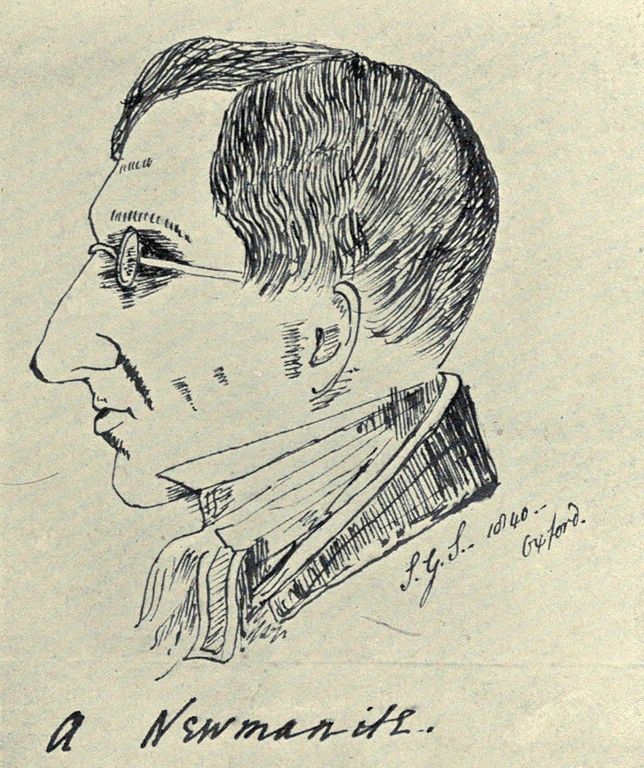
Photo credit: An Oxford caricature of John Henry Newman (1840) [public domain / Wikimedia Commons]

***
Pope Francis: The Legacy of Vatican II
Previous Post

May 27, 2019
Dialogue with Atheist: Are Christians "Unscientific"?
Next Post

May 28, 2019 Do I Think Popes Can Never be Criticized for Any Reason? Nope.
Browse Our Archives
Select a Category & Last Things About Me Anti-Catholicism Atheism & Agnosticism Baptism and Sacramentalism Bible and Tradition Blessed Virgin Mary Books by Dave Armstrong C. S. Lewis Calvinism & General Protestantism Catholic Apologetics Catholic Apologists Catholic conversion Catholic converts Christmas Church (Ecclesiology) Church History Conversion and Converts Development of Doctrine Eastern Orthodoxy Ecumenism & Christian Unity Eucharist & Liturgy Fathers of the Church French Translations G. K. Chesterton Hell Hell & Satan Hell & Satan & Last Things Heresies & Comparative Religion Holistic Health Inquisition & Crusades & Scandals James White Jews & Judaism & Old Testament John Calvin John Henry Newman Liberal / Modernist Theology Life Issues Literary Resume Lutheranism Mariology Martin Luther Music Orthodoxy Papacy & Infallibility Personal Page Philosophy & Science Political & Ethical & Moral Issues Protestant Persecution & Intolerance Protestantism Purgatory Purgatory & Penance Romantic & Imaginative Theology Saints & Purgatory & Penance Salvation Salvation & Justification Satan & Last Things Sexuality and Gender Issues Spanish Translations Traditionalism vs. Radical Catholic Reactionaries Traducciones al español / tradução para português Trinitarianism & Christology Uncategorized Videos
Select a Month October 2026 September 2026 August 2026 July 2026 June 2026 May 2026 April 2026 March 2026 February 2026 January 2026 December 2025 November 2025 October 2025 September 2025 August 2025 July 2025 June 2025 May 2025 April 2025 March 2025 February 2025 January 2025 December 2024 November 2024 October 2024 September 2024 August 2024 July 2024 June 2024 May 2024 April 2024 March 2024 February 2024 January 2024 December 2023 November 2023 October 2023 September 2023 August 2023 July 2023 June 2023 May 2023 April 2023 March 2023 February 2023 January 2023 December 2022 November 2022 October 2022 September 2022 August 2022 July 2022 June 2022 May 2022 April 2022 March 2022 February 2022 January 2022 December 2021 November 2021 October 2021 September 2021 August 2021 July 2021 June 2021 May 2021 April 2021 March 2021 February 2021 January 2021 December 2020 November 2020 October 2020 September 2020 August 2020 July 2020 June 2020 May 2020 April 2020 March 2020 February 2020 January 2020 December 2019 November 2019 October 2019 September 2019 August 2019 July 2019 June 2019 May 2019 April 2019 March 2019 February 2019 January 2019 December 2018 November 2018 October 2018 September 2018 August 2018 July 2018 June 2018 May 2018 April 2018 March 2018 February 2018 January 2018 December 2017 November 2017 October 2017 September 2017 August 2017 July 2017 June 2017 May 2017 April 2017 March 2017 February 2017 January 2017 December 2016 November 2016 October 2016 September 2016 August 2016 July 2016 June 2016 May 2016 April 2016 March 2016 February 2016 January 2016 December 2015 November 2015 October 2015 September 2015 August 2015 July 2015 June 2015 May 2015 April 2015 March 2015 February 2015 January 2015 December 2014 November 2014 October 2014 September 2014 August 2014 July 2014 June 2014 April 2014 March 2014 February 2014 January 2014 December 2013 November 2013 October 2013 September 2013 August 2013 July 2013 June 2013 April 2013 March 2013 February 2013 January 2013 December 2012 November 2012 October 2012 September 2012 August 2012 July 2012 June 2012 May 2012 April 2012 March 2012 February 2012 January 2012 December 2011 November 2011 October 2011 September 2011 August 2011 July 2011 June 2011 April 2011 March 2011 February 2011 October 2010 September 2010 August 2010 July 2010 April 2010 March 2010 December 2009 October 2009 August 2009 July 2009 June 2009 May 2009 March 2009 February 2009 October 2008 September 2008 April 2008 March 2008 February 2008 January 2008 December 2007 November 2007 October 2007 May 2007 March 2007 February 2007 January 2007 November 2006 October 2006 September 2006 August 2006 July 2006 June 2006 May 2006 April 2006 March 2006 February 2006 October 2005 June 2005 April 2005 February 2005 July 2004 May 2004 April 2004
Follow Us!
TAKE THE
Religious Wisdom Quiz
What book of the Bible comes after Genesis?
Select your answer to see how you score.
Deuteronomy Exodus Leviticus Numbers
Books by This Author Books by Dave Armstrong
Related posts from Biblical Evidence for Catholicism

Was Peter "Any Old" Apostle? 10 Anti-Papal Arguments
Biblical Evidence for Catholicism

11 Protestant Objections to Papal Authority Debunked
Biblical Evidence for Catholicism

The Mass & Development of Doctrine (vs. Wes...
Biblical Evidence for Catholicism

Matthew 16 & the Papacy (vs. Patrick O'Brien)
Biblical Evidence for Catholicism
TRENDING AT PATHEOS Catholic

In "Irreplaceable," our book on vocation and technology, Trevor Sutton and I...

I was strolling through the top floor of the brand new Parthenon...

What Does Gêvâh Mean For Kimberley Guifoyle &...
This week, a lot of the news is focused on Kimberly Guilfoyle....

INNER CIRCLE: Profound Mystery (Of Christ In All...
Ephesians 5:31-32 “For this reason, a man will leave his father and...

Do Not Rejoice When Your Enemy Falls: The...
Turning an execution into a public spectacle is a disturbing expression of...

'The Chosen' S6 Trailer: The Passion Gets Very...
Not many watching 'The Chosen' worry about spoilers, but just because they...
view all Catholic blogs
Ad-Free & Subscriber Log-In Subscription Support
- About Us
- 2026 Calendar
- Videos
- Podcasts
- Library of World Religions
- Faith In Media Tracker
- Advertise With Us
- Write for Us
- Privacy Policy
- Terms of Service
- Do Not Sell My Data
- Contact Us
- Radiant Digital
- Manage Newsletter Subscriptions
- Unsubscribe From Notifications
- Sitemap
Copyright 2008-2026, Patheos. All rights reserved.
Subscription Support Ad-Free & Subscriber Log-In
Follow Patheos