
BuddhistCatholicContemplativeEvangelicalGeneral ChristianHinduJewishLatter-day SaintMuslimNew VisionsProgressive Christian
Beliefs
- Buddhist
- Catholic
- Contemplative
- Evangelical
- General Christian
- Hindu
- Jewish
- Latter-day Saint
- More Voices
- Muslim
- New Visions
- Pagan
- Progressive Christian
Topics
- Religion News
- Food and Religion
- Sports and Religion
- Religious Art
- Religious Music and Entertainment
- Religious Events
- History and Religion
- Style and Religion
- Politics and Religion
- Women in Religion
- Recreation Outdoors and Religion
- Business Finance and Religion
- Careers Workplace and Religion
- Education and Religion
- Family Parenting and Religion
- Health Fitness and Religion
- Home and Religion
- Relationships and Religion
- Technology and Religion
- Travel and Religion
Columnists
- Buddhist Columnists
- Business Finance and Religion Columnists
- Careers Workplace and Religion Columnists
- Catholic Columnists
- Contemplative Columnists
- Education and Religion Columnists
- Evangelists Columnists
- Family Parenting and Religion Columnists
- General Christian Columnists
- Health Fitness and Religion Columnists
- Hindu Columnists
- History and Religion Columnists
- Home and Religion Columnists
- Jewish Columnists
- More Voices Columnists
- Latter Day Columnists
- Muslim Columnists
- New Visions Columnists
- Nonreligious Columnists
- Pagan Columnists
- Politics and Religion Columnists
- Progressive Columnists
- Recreation Outdoors and Religion Columnists
- Relationships and Religion Columnists
- Religion News Columnists
- Religious Art Columnists
- Religious Events Columnists
- Religious Music and Entertainment Columnists
- Sports and Religion Columnists
- Style and Religion Columnists
- Technology and Religion Columnists
- Travel and Religion Columnists
- Women in Religion Columnists
Resource Library
- 2026 Calendar
- Library of World Religions
- The 100 Most Holy Places on Earth
- Patheos Answers
- Podcasts
- Videos
- Faith Leaders Database
- Anglican Episcopalian
- Bahai
- Baptist
- Buddhism
- Christianity
- Confucianism
- Eastern Orthodoxy
- Hinduism
- Holiness and Pentecostal
- ISKCON
- Islam
- Judaism
- Lutheran
- Methodist
- The Church of Jesus Christ of Latter-day Saints
- New Age
- Paganism
- Presbytarian and Reformed
- Protestantism
- Religion Behind the Scenes
- Roman Catholic
- Scientology
- Shia Islam
- Sikhism
- Sufism
- Sunni Islam
- Taoism
- Zen
- See all religions
Research Tools
 Ad-Free & Subscriber Log-In Subscription Support
Ad-Free & Subscriber Log-In Subscription Support
Follow Patheos 

- Trending:
- Forgiveness
- |
- Marriage
- |
- Consciousness
- |
- Death Penalty
- |
- Election
- |
- Halloween

-
About
-
Catholic Apologetics
-
Church History
-
Great Apologists
-
Christian Worldview
-
Protestantism & Misc.
- Home
- Catholic
- History and Religion
- Baptism of Entire Households in the NT (Infant Baptism)
Baptism of Entire Households in the NT (Infant Baptism)
Last updated on: June 6, 2026 at 12:39 am by Dave Armstrong
Baptism of Entire Households in the NT (Infant Baptism) 2026-06-06T00:39:12-04:00 Dave Armstrong
Patheos Explore the world's faith through different perspectives on religion and spirituality! Patheos has the views of the prevalent religions and spiritualities of the world.
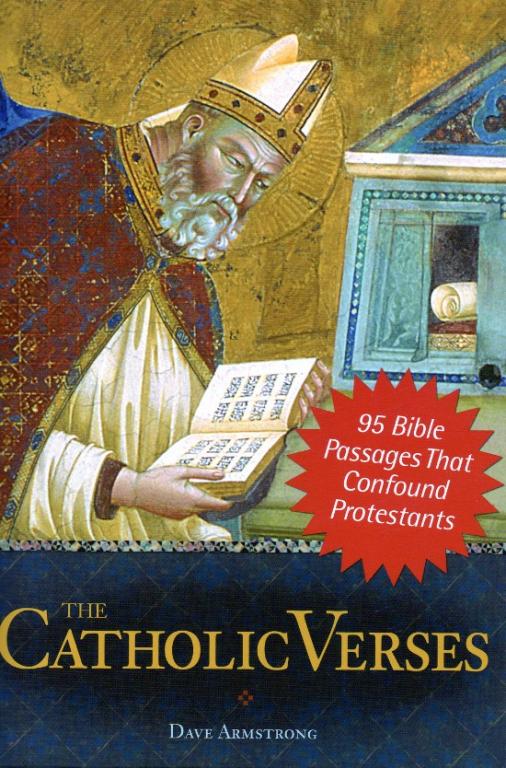
[from my 2004 book, pictured above (see purchase and other information), pp. 97-102]
*****
Acts 16:15 (RSV) “And when she was baptized, with her household, she besought us, saying, ‘If you have judged me to be faithful to the Lord, come to my house and stay.’ And she prevailed upon us” [cf. 18:18].
Acts 16:33 “And he took them the same hour of the night, and washed their wounds, and he was baptized at once, with all his family.”
1 Corinthians 1:16 “I did baptize also the household of Stephanas.”
Catholics (and other advocates of infant baptism) do not claim that these verses prove that the Bible teaches infant baptism. However, a straightforward reading of them suggests that children were likely baptized along with the household or family of which they were a part. Thus, these verses pose a difficulty for Protestants who oppose infant baptism and must be explained differently.
In Acts 16:15, we read, “She was baptized, with her household.” The fact that the verse says household rather than simply husband is a clear indication of others being involved. Now, who are the members of a household? In that time and culture, it probably would have included parents and maybe grandparents, as well as siblings or cousins. And almost always it would also include children.
Extended families are not so common in our culture, but they usually still do (even in our somewhat antilife culture) include children. What’s more, many biblical passages connect household and children (Gen. 18:19, 31:41, 36:6, 47:12; Num. 18:11; 1 Chron. 10:6; Matt. 19:29; 1 Tim. 3:12).
Elsewhere in the Bible, entire households are referred to as being saved (Luke 19:9; Acts 11:14, 16:31). To be saved, one does not necessarily have to be aware of what is happening. For example, say a person was born with a severe brain defect and eventually died without ever having been capable of rational thought or communication. Is that person damned simply because of being unable to believe? I think not.
Most Protestants agree with Catholics that God’s mercy must extend to those who do not yet know or understand the gospel, or else all aborted babies, children who die at a young age, or before the age of reason, and so forth would go to hell (since they either cannot know or not properly understand the gospel). Therefore, to be saved is not necessarily to understand fully either the gospel or the means of grace by which one is saved (and Catholics, Orthodox, and most Protestants include baptism as a crucial factor in this salvation).
Furthermore, St. Paul in Colossians 2:11-13 makes a connection between baptism and circumcision. Israel was the church before Christ (Acts 7:38; Rom. 9:4). Circumcision, given to boys eight days old, was the seal of the covenant God made with Abraham, which applies to us also (Gal. 3:14, 29). It was a sign of repentance and future faith (Rom. 4:11).
Infants were just as much a part of the covenant as adults (Gen. 17:7; Deut. 29:10-12; cf. Matt. 19:14). Likewise, baptism is the seal of the New Covenant in Christ. It signifies cleansing from sin, just as circumcision did (Deut. 10:16, 30:6; Jer. 4:4, 9:25; Rom. 2:28-9; Phil. 3:3).
John Calvin made these arguments, as did Presbyterian theologian Charles Hodge (1797-1878), and these are some of the reasons Presbyterians and the majority of Protestants throughout history have accepted infant baptism (although they differ on whether it regenerates). But Baptists and others today who believe in adult baptism think that baptism has to be performed after a person has made an informed, educated decision to embrace the gospel of Jesus Christ and be born again.
Baptism then serves as a symbol of the faith and regeneration, rather than as a cause of it. With those presuppositions, infant baptism makes no sense whatsoever, because the infant does not know what is going on, and the knowing is crucial to baptism’s purpose, in this conception.
Advocates of this view, then, must explain how these verses pertain to adults but not children. Thus, Augustus Strong (1836-1921), a prominent Baptist theologian, writes about the general issue:
[T]he passages held to imply infant baptism contain, when fairly interpreted, no reference to such a practice. . . . From Acts 16:15, cf. 40, and Acts 16:33, cf. 34, Neander says that we cannot infer infant baptism. For 1 Cor. 16:15 shows that the whole family of Stephanus, baptized by Paul, were adults (1 Cor. 1:16). It is impossible to suppose a whole heathen household baptized upon the faith of its head (Systematic Theology, Westwood, New Jersey: Fleming H. Revell Co., 1907, 951).
But the impossibility resides only in the heads of those who have decided beforehand that the practice is somehow impossible because of prior dogma that does not permit it.
Strong argues that the household of Stephanus consisted only of adults, based on 1 Corinthians 16:15, which calls them converts. But the next verse, by very strong implication, refers to them also as men. Does this mean that Stephanus had no wife, or was a widower with children all past the “age of reason” — able to become disciples and to be baptized on their own? Not necessarily, for it assumes that the language is all-inclusive when it may not be.
Biblical language is often not as precise and “scientific” as modern language. We know that households could certainly include children. And even if we were to grant Strong’s contention about this one family, it would not prove at all that every such family referred to as being baptized did not have children, or that the children were not also baptized. Nor does even the word convert necessarily imply an adult, any more than a “saved” person does (Luke 19:9; Acts 11:14, 16:31).
The biblical case for infant baptism is an argument from plausibility or antecedent probability. The deductions made lead one to conclude that a certain state of affairs is probable, more or less, but not absolutely proven. These deductive steps with regard to infant baptism are as follows:
- All agree that the Bible refers to entire households being baptized.
- It is reasonable to assume that most households (especially in the ancient world) would include children.
- The Bible specifically places children within the parameters of those persons included in a household (if this commonsense assumption even needs to be asserted), at least eight times (see earlier).
- Therefore, it is quite likely that baptisms of entire households would include baptisms of children, at least in some cases, if not in all.
- It is quite unlikely that baptisms of entire households (granting the premise that the households can and usually do include children) would never include children.
- Therefore, infants (in the greatest likelihood) were baptized.
- In which case, infant baptism is sanctioned in Scripture, by apostolic example.
A. T. Robertson, a Baptist whom many consider the greatest New Testament Greek scholar of his time, commented on Acts 16:15:
Who constituted her “household”? The term oikos, originally means the building as below, “into my house” and then it includes the inmates of a house. There is nothing here to show whether Lydia’s “household” went beyond “the women” employed by her who, like her, had heard the preaching of Paul and had believed. . . . In the household baptisms (Cornelius, Lydia, the jailor, Crispus) one sees “infants” or not according to his predilections or preferences (Word Pictures in the New Testament. 6 volumes, Nashville: Broadman Press, 1930, vol. 3, 253).
Robertson’s last statement is undeniably true, and it harmonizes with what I have always believed about the systematic theological assumptions that we all (legitimately, properly) bring to the text, no matter what brand of Christian we are. Thinking itself requires premises and foundational assumptions, and so does biblical exegesis and hermeneutics (interpretation of biblical passages).
Nevertheless, there are stronger probabilities and weaker probabilities. It is a sliding scale. I firmly believe that it is very probable that in this instance, infant baptisms occurred.
Yet I continue to think that if we could make ourselves as “untheological” as humanly possible for a moment, if we could pretend we were from another planet or had never seen a Bible, and look at the two competing cases, we would conclude that the infant-baptism argument is far more plausible. I and those in my camp are certainly not without bias, just as Robertson honestly notes, but in my opinion the logic can hold up on its own.
As for Robertson’s argument concerning the makeup of Lydia’s household, it may or may not be successful. Reasonable men can certainly differ. I do not find it very persuasive, although it is interesting and has some worth. In any event, it is also based on probability, just as Strong’s argument was, and does not rule out other households that were different.
In no way, then, is it decisive for the adult-baptism position. Critics of infant baptism like to point out that the Bible never specifically commands us to baptize infants. But neither does it tell us that we should baptize only adults, or those past the age of reason who can make their own “personal commitment” to Christ.
These kinds of discussions in theology and apologetics are fun and enjoyable (while at the same time serious) precisely because in some areas the biblical evidence is not airtight and involves speculation. As the Christian Church reflected through the centuries, the overwhelming consensus, even among the great majority of Protestants, came to be that infant baptism was God’s will, and strongly implied in Holy Scripture.
It means something when such consensus has been reached, and we cannot so easily dismiss it. God may communicate his truth to me personally, but he has also done so to millions of other Christians throughout nearly two thousand years. That being the case, views that have garnered “majority support” need at least to be considered respectfully and carefully.
This is not to imply that the majority is always right, but rather, simply to note that Christian tradition is important, allowing for what G. K. Chesterton called “the democracy of the dead.”
***
(originally from 2004)
***
doctrinal development of baptism
Previous Post

May 10, 2019
Dialogue: Christian Witness, Trump, & Prudential Voting
Next Post
May 13, 2019 Salvation: By Grace Alone, Not Faith Alone or Works
Browse Our Archives
Select a Category & Last Things About Me Anti-Catholicism Atheism & Agnosticism Baptism and Sacramentalism Bible and Tradition Blessed Virgin Mary Books by Dave Armstrong C. S. Lewis Calvinism & General Protestantism Catholic Apologetics Catholic Apologists Catholic conversion Catholic converts Christmas Church (Ecclesiology) Church History Conversion and Converts Development of Doctrine Eastern Orthodoxy Ecumenism & Christian Unity Eucharist & Liturgy Fathers of the Church French Translations G. K. Chesterton Hell Hell & Satan Hell & Satan & Last Things Heresies & Comparative Religion Holistic Health Inquisition & Crusades & Scandals James White Jews & Judaism & Old Testament John Calvin John Henry Newman Liberal / Modernist Theology Life Issues Literary Resume Lutheranism Mariology Martin Luther Music Orthodoxy Papacy & Infallibility Personal Page Philosophy & Science Political & Ethical & Moral Issues Protestant Persecution & Intolerance Protestantism Purgatory Purgatory & Penance Romantic & Imaginative Theology Saints & Purgatory & Penance Salvation Salvation & Justification Satan & Last Things Sexuality and Gender Issues Spanish Translations Traditionalism vs. Radical Catholic Reactionaries Traducciones al español / tradução para português Trinitarianism & Christology Uncategorized Videos
Select a Month October 2026 September 2026 August 2026 July 2026 June 2026 May 2026 April 2026 March 2026 February 2026 January 2026 December 2025 November 2025 October 2025 September 2025 August 2025 July 2025 June 2025 May 2025 April 2025 March 2025 February 2025 January 2025 December 2024 November 2024 October 2024 September 2024 August 2024 July 2024 June 2024 May 2024 April 2024 March 2024 February 2024 January 2024 December 2023 November 2023 October 2023 September 2023 August 2023 July 2023 June 2023 May 2023 April 2023 March 2023 February 2023 January 2023 December 2022 November 2022 October 2022 September 2022 August 2022 July 2022 June 2022 May 2022 April 2022 March 2022 February 2022 January 2022 December 2021 November 2021 October 2021 September 2021 August 2021 July 2021 June 2021 May 2021 April 2021 March 2021 February 2021 January 2021 December 2020 November 2020 October 2020 September 2020 August 2020 July 2020 June 2020 May 2020 April 2020 March 2020 February 2020 January 2020 December 2019 November 2019 October 2019 September 2019 August 2019 July 2019 June 2019 May 2019 April 2019 March 2019 February 2019 January 2019 December 2018 November 2018 October 2018 September 2018 August 2018 July 2018 June 2018 May 2018 April 2018 March 2018 February 2018 January 2018 December 2017 November 2017 October 2017 September 2017 August 2017 July 2017 June 2017 May 2017 April 2017 March 2017 February 2017 January 2017 December 2016 November 2016 October 2016 September 2016 August 2016 July 2016 June 2016 May 2016 April 2016 March 2016 February 2016 January 2016 December 2015 November 2015 October 2015 September 2015 August 2015 July 2015 June 2015 May 2015 April 2015 March 2015 February 2015 January 2015 December 2014 November 2014 October 2014 September 2014 August 2014 July 2014 June 2014 April 2014 March 2014 February 2014 January 2014 December 2013 November 2013 October 2013 September 2013 August 2013 July 2013 June 2013 April 2013 March 2013 February 2013 January 2013 December 2012 November 2012 October 2012 September 2012 August 2012 July 2012 June 2012 May 2012 April 2012 March 2012 February 2012 January 2012 December 2011 November 2011 October 2011 September 2011 August 2011 July 2011 June 2011 April 2011 March 2011 February 2011 October 2010 September 2010 August 2010 July 2010 April 2010 March 2010 December 2009 October 2009 August 2009 July 2009 June 2009 May 2009 March 2009 February 2009 October 2008 September 2008 April 2008 March 2008 February 2008 January 2008 December 2007 November 2007 October 2007 May 2007 March 2007 February 2007 January 2007 November 2006 October 2006 September 2006 August 2006 July 2006 June 2006 May 2006 April 2006 March 2006 February 2006 October 2005 June 2005 April 2005 February 2005 July 2004 May 2004 April 2004
Follow Us!
TAKE THE
Religious Wisdom Quiz
What did Isaiah say about Egypt's future in his oracles?
Select your answer to see how you score.
It would conquer Israel It would be conquered It would prosper It would rule Persia
Books by This Author Books by Dave Armstrong
Related posts from Biblical Evidence for Catholicism

A Few "Worst" & "Best" Arguments vs. Protestantism
Biblical Evidence for Catholicism

"Baptism" & Romans 10 (Engwer's Silly Word Games)
Biblical Evidence for Catholicism

50 Biblical Disproofs of "Evident Clearness" of the...
Biblical Evidence for Catholicism

Perspicuity & Denominationalism (vs. Javier Perdomo)
Biblical Evidence for Catholicism
TRENDING AT PATHEOS Catholic

In "Irreplaceable," our book on vocation and technology, Trevor Sutton and I...

I was strolling through the top floor of the brand new Parthenon...

What Does Gêvâh Mean For Kimberley Guifoyle &...
This week, a lot of the news is focused on Kimberly Guilfoyle....

INNER CIRCLE: Profound Mystery (Of Christ In All...
Ephesians 5:31-32 “For this reason, a man will leave his father and...

Do Not Rejoice When Your Enemy Falls: The...
Turning an execution into a public spectacle is a disturbing expression of...

'The Chosen' S6 Trailer: The Passion Gets Very...
Not many watching 'The Chosen' worry about spoilers, but just because they...
view all Catholic blogs
Ad-Free & Subscriber Log-In Subscription Support
- About Us
- 2026 Calendar
- Videos
- Podcasts
- Library of World Religions
- Faith In Media Tracker
- Advertise With Us
- Write for Us
- Privacy Policy
- Terms of Service
- Do Not Sell My Data
- Contact Us
- Radiant Digital
- Manage Newsletter Subscriptions
- Unsubscribe From Notifications
- Sitemap
Copyright 2008-2026, Patheos. All rights reserved.
Subscription Support Ad-Free & Subscriber Log-In
Follow Patheos