
BuddhistCatholicContemplativeEvangelicalGeneral ChristianHinduJewishLatter-day SaintMuslimNew VisionsProgressive Christian
Beliefs
- Buddhist
- Catholic
- Contemplative
- Evangelical
- General Christian
- Hindu
- Jewish
- Latter-day Saint
- More Voices
- Muslim
- New Visions
- Pagan
- Progressive Christian
Topics
- Religion News
- Food and Religion
- Sports and Religion
- Religious Art
- Religious Music and Entertainment
- Religious Events
- History and Religion
- Style and Religion
- Politics and Religion
- Women in Religion
- Recreation Outdoors and Religion
- Business Finance and Religion
- Careers Workplace and Religion
- Education and Religion
- Family Parenting and Religion
- Health Fitness and Religion
- Home and Religion
- Relationships and Religion
- Technology and Religion
- Travel and Religion
Columnists
- Buddhist Columnists
- Business Finance and Religion Columnists
- Careers Workplace and Religion Columnists
- Catholic Columnists
- Contemplative Columnists
- Education and Religion Columnists
- Evangelists Columnists
- Family Parenting and Religion Columnists
- General Christian Columnists
- Health Fitness and Religion Columnists
- Hindu Columnists
- History and Religion Columnists
- Home and Religion Columnists
- Jewish Columnists
- More Voices Columnists
- Latter Day Columnists
- Muslim Columnists
- New Visions Columnists
- Nonreligious Columnists
- Pagan Columnists
- Politics and Religion Columnists
- Progressive Columnists
- Recreation Outdoors and Religion Columnists
- Relationships and Religion Columnists
- Religion News Columnists
- Religious Art Columnists
- Religious Events Columnists
- Religious Music and Entertainment Columnists
- Sports and Religion Columnists
- Style and Religion Columnists
- Technology and Religion Columnists
- Travel and Religion Columnists
- Women in Religion Columnists
Resource Library
- 2026 Calendar
- Library of World Religions
- The 100 Most Holy Places on Earth
- Patheos Answers
- Podcasts
- Videos
- Faith Leaders Database
- Anglican Episcopalian
- Bahai
- Baptist
- Buddhism
- Christianity
- Confucianism
- Eastern Orthodoxy
- Hinduism
- Holiness and Pentecostal
- ISKCON
- Islam
- Judaism
- Lutheran
- Methodist
- The Church of Jesus Christ of Latter-day Saints
- New Age
- Paganism
- Presbytarian and Reformed
- Protestantism
- Religion Behind the Scenes
- Roman Catholic
- Scientology
- Shia Islam
- Sikhism
- Sufism
- Sunni Islam
- Taoism
- Zen
- See all religions
Research Tools
 Ad-Free & Subscriber Log-In Subscription Support
Ad-Free & Subscriber Log-In Subscription Support
Follow Patheos 

- Trending:
- Forgiveness
- |
- Marriage
- |
- Consciousness
- |
- Death Penalty
- |
- Election
- |
- Halloween

-
About
-
Catholic Apologetics
-
Church History
-
Great Apologists
-
Christian Worldview
-
Protestantism & Misc.
- Home
- Catholic
- History and Religion
- Purgatory: My Biblical Defense of its Doctrinal Development
Purgatory: My Biblical Defense of its Doctrinal Development
Last updated on: June 6, 2026 at 12:38 am by Dave Armstrong
Purgatory: My Biblical Defense of its Doctrinal Development 2026-06-06T00:38:33-04:00 Dave Armstrong
Patheos Explore the world's faith through different perspectives on religion and spirituality! Patheos has the views of the prevalent religions and spiritualities of the world.
[drawn from various articles and books of mine, as a summary]
*****
The bulk of Newman’s extraordinary work is devoted to the exposition of a series of analogies, showing conclusively that the Protestant static conception of the Church (both historically and theologically) is incoherent and false. He argues, for example, that notions of suffering, or “vague forms of the doctrine of Purgatory,” were universally accepted, by and large, in the first four centuries of the Church, whereas, the same cannot be said for the doctrine of original sin, which is agreed upon by Protestants and Catholics.
Protestants falsely argue that purgatory is a later corruption, but it was present early on and merely developed. Original sin, however, was equally if not more so, subject to development. One cannot have it both ways. If purgatory is unacceptable on grounds of its having undergone development, then original sin must be rejected with it. Contrariwise, if original sin is accepted notwithstanding its own development, then so must purgatory be accepted. [“Development of Doctrine: A Corruption of Biblical Teaching?”: published in The Catholic Answer, Sep. / Oct. 1995]
The Jews offered atonement and prayer for their deceased brethren, who had clearly violated Mosaic Law. Such a practice presupposes purgatory, since those in heaven wouldn’t need any help, and those in hell are beyond it. The Jewish people, therefore, believed in prayer for the dead (whether or not this book is scriptural; Protestants deny that it is). [A Biblical Defense of Catholicism, May 1996]
Here I gave the precise reason why some semblance of purgatory must have been presupposed. For the Reformed tradition, as well as for most Protestants, save a few like C. S. Lewis or John Wesley, there is no third state after death (after Christ’s death and resurrection and ascension). Only heaven and hell exist, and it is useless and meaningless to pray for souls in either, as I argued in the passage.
Therefore, the question is, why did the Jews “pray for the dead” and “make atonement for the dead” as the passage in 2 Maccabees states? They did because they assumed that the dead were still in some sort of state in which they could be aided by intercessory prayer. And that can only be a third state besides heaven and hell. This is what the people whose practice is described must have believed. It doesn’t require a fully developed notion of purgatory; only an intermediate state of some sort besides heaven and hell: a place where they can still be helped by prayer on their behalf.
An argument could be made (over against this scenario) for retroactive prayer (since God is outside of time and can quite arguably apply and answer prayers regardless of whether a person is dead) — even Martin Luther held to something like this. That leaves only some kind of third state as an explanation of prayer for the dead as historical Jewish practice.
That I was not holding that biblical descriptions evidence purgatory in its developed dogmatic form, was made very clear in my later commentary in this book on Luke 16:19-31 (Lazarus and the rich man) and three related passages:
At the very least, these passages prove that there can and does exist a third, intermediate state after death besides heaven and hell. Thus, purgatory is not a priori unthinkable from a biblical perspective (as many Protestants casually assume). True, the Hebrew Sheol is not identical to purgatory (both righteous and unrighteous go there), but it is nevertheless strikingly similar.
***
Like “the Holy Trinity,” “purgatory” is a term not occurring in Scripture, but the reality it refers to is implied by scriptural truths. [The Catholic Answer Bible, 2002]
Authority in the early Church was developing just as the biblical canon and Christology and Mariology and purgatory and prayers for the dead and original sin and everything else were developing. [1-10-04]
Of course we won’t find a fully developed medieval conception of purgatory [in 1 Cor 3], but it is foolish to expect that anyway, just as it would be to expect to find full Chalcedonian Christology and trinitarianism in all its glorious nuanced complexity. That is true of all doctrines, so why should purgatory be an exception? [3-3-07]
I habitually either qualify or presuppose doctrinal development or make clear in context that I am not claiming that Scripture “proves” a full-blown doctrine of purgatory. Hence, I used to have a paper up, entitled, “50 Bible Passages On Purgatory and Analogous Processes”.
The very title shows that I was not maintaining that each passage was explicit, and that there were analogies of process that suggested the concept of purgatory.
The Bible indeed provides much evidence or indication of purgatory. I collected 25 passages in A Biblical Defense of Catholicism, complete with massive support of Church fathers, who certainly believed that purgatory was in mind in these passages. But that is different from a position that would deny any development occurred. “Evidence” is not used in this sense to mean “absolute proof.”
A hundred times in my writings, I’ve stated that the Catholic notion of “biblical evidence” is not absolute proof, but rather, consistency and harmony with Scripture and a given doctrine, including implicit and indirect, deductive indications. Here are some of the numerous examples:
As to Tertullian seeking to ground all doctrine in Scripture, or harmonious with Scripture (meaning that there may not always be explicit proofs, as Chemnitz himself later concedes with regard to, e.g., infant baptism) we have no disagreement. Catholics believe the same. (8-29-07)
The tradition of man here is sola Scriptura and the silly notion that absolutely everything Christians believe must be explicitly laid out in the Bible. There is no Bible passage that says that, so it is a tradition of man if there ever was one. Nor is there any passage that lists the books of the Bible. The canon is an extrabiblical doctrine and tradition that requires Church authority to accept. But all Catholic doctrine is completely consistent and harmonious with Scripture. . . . Now you show us where the Bible teaches that every truth has to specifically be backed up by a Bible proof text. I’ll save you the trouble. You can’t do it. (3-19-11)
This is how we ultimately know what is true: it will be harmonious with Scripture, and it will also be a tenet that the Church has always held, in kernel or more fully developed through time. (7-19-08)
Our Tradition must always be in accord with Scripture, and cannot contradict it. . . .It is all harmonious with it, and it is all found there in kernel form or more explicitly (material sufficiency of Scripture). It cannot all be found there whole and entire, as the Protestant inconsistently and unrealistically expects. But that is sola Scriptura, which we reject. (1-11-99)
Nevertheless, not every doctrine has to rest solely on Scripture. All doctrines need to be harmonious with, and not contradictory to, Scripture (which is a notion distinct from sola Scriptura). Another way to look at this difference is to realize that when a Protestant uses the terms unbiblical or extrabiblical, he usually means “not found in Scripture.” When Catholics, however, use those terms, we mean “not explicitly in Scripture, yet not contrary to it, and fully consistent with it (as all true doctrines must be).” (Introduction to The Catholic Verses, 2004, p. xvi)
What I was doing there was stating Catholic dogma, which is entirely consistent or harmonious with that passage; not necessarily entirely drawn from it alone, as if every jot and tittle of Catholic ecclesiology is present in 1 Timothy 3:15. Of course it is not. But there is also doctrinal development, and there is a mountain of related scriptural data that we incorporate . . . (3-23-10)
I believe this of all biblical / theological doctrines; therefore purgatory is included.
***
(originally 9-20-11)
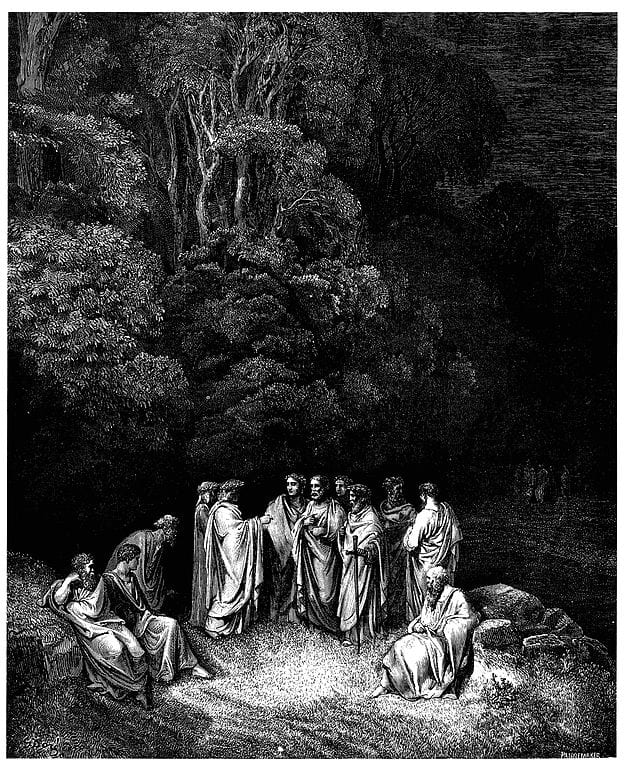
Photo credit: illustration to Dante’s Inferno. Plate XII: Canto IV (1857), by Gustave Doré (1832-1883) [public domain / Wikimedia Commons]

***
Previous Post

February 17, 2019
C. S. Lewis on Inevitable Development of Doctrine
Next Post

February 18, 2019 "Faith Alone" & Salvation: Dialogue w Lutheran Pastor
Browse Our Archives
Select a Category & Last Things About Me Anti-Catholicism Atheism & Agnosticism Baptism and Sacramentalism Bible and Tradition Blessed Virgin Mary Books by Dave Armstrong C. S. Lewis Calvinism & General Protestantism Catholic Apologetics Catholic Apologists Catholic conversion Catholic converts Christmas Church (Ecclesiology) Church History Conversion and Converts Development of Doctrine Eastern Orthodoxy Ecumenism & Christian Unity Eucharist & Liturgy Fathers of the Church French Translations G. K. Chesterton Hell Hell & Satan Hell & Satan & Last Things Heresies & Comparative Religion Holistic Health Inquisition & Crusades & Scandals James White Jews & Judaism & Old Testament John Calvin John Henry Newman Liberal / Modernist Theology Life Issues Literary Resume Lutheranism Mariology Martin Luther Music Orthodoxy Papacy & Infallibility Personal Page Philosophy & Science Political & Ethical & Moral Issues Protestant Persecution & Intolerance Protestantism Purgatory Purgatory & Penance Romantic & Imaginative Theology Saints & Purgatory & Penance Salvation Salvation & Justification Satan & Last Things Sexuality and Gender Issues Spanish Translations Traditionalism vs. Radical Catholic Reactionaries Traducciones al español / tradução para português Trinitarianism & Christology Uncategorized Videos
Select a Month October 2026 September 2026 August 2026 July 2026 June 2026 May 2026 April 2026 March 2026 February 2026 January 2026 December 2025 November 2025 October 2025 September 2025 August 2025 July 2025 June 2025 May 2025 April 2025 March 2025 February 2025 January 2025 December 2024 November 2024 October 2024 September 2024 August 2024 July 2024 June 2024 May 2024 April 2024 March 2024 February 2024 January 2024 December 2023 November 2023 October 2023 September 2023 August 2023 July 2023 June 2023 May 2023 April 2023 March 2023 February 2023 January 2023 December 2022 November 2022 October 2022 September 2022 August 2022 July 2022 June 2022 May 2022 April 2022 March 2022 February 2022 January 2022 December 2021 November 2021 October 2021 September 2021 August 2021 July 2021 June 2021 May 2021 April 2021 March 2021 February 2021 January 2021 December 2020 November 2020 October 2020 September 2020 August 2020 July 2020 June 2020 May 2020 April 2020 March 2020 February 2020 January 2020 December 2019 November 2019 October 2019 September 2019 August 2019 July 2019 June 2019 May 2019 April 2019 March 2019 February 2019 January 2019 December 2018 November 2018 October 2018 September 2018 August 2018 July 2018 June 2018 May 2018 April 2018 March 2018 February 2018 January 2018 December 2017 November 2017 October 2017 September 2017 August 2017 July 2017 June 2017 May 2017 April 2017 March 2017 February 2017 January 2017 December 2016 November 2016 October 2016 September 2016 August 2016 July 2016 June 2016 May 2016 April 2016 March 2016 February 2016 January 2016 December 2015 November 2015 October 2015 September 2015 August 2015 July 2015 June 2015 May 2015 April 2015 March 2015 February 2015 January 2015 December 2014 November 2014 October 2014 September 2014 August 2014 July 2014 June 2014 April 2014 March 2014 February 2014 January 2014 December 2013 November 2013 October 2013 September 2013 August 2013 July 2013 June 2013 April 2013 March 2013 February 2013 January 2013 December 2012 November 2012 October 2012 September 2012 August 2012 July 2012 June 2012 May 2012 April 2012 March 2012 February 2012 January 2012 December 2011 November 2011 October 2011 September 2011 August 2011 July 2011 June 2011 April 2011 March 2011 February 2011 October 2010 September 2010 August 2010 July 2010 April 2010 March 2010 December 2009 October 2009 August 2009 July 2009 June 2009 May 2009 March 2009 February 2009 October 2008 September 2008 April 2008 March 2008 February 2008 January 2008 December 2007 November 2007 October 2007 May 2007 March 2007 February 2007 January 2007 November 2006 October 2006 September 2006 August 2006 July 2006 June 2006 May 2006 April 2006 March 2006 February 2006 October 2005 June 2005 April 2005 February 2005 July 2004 May 2004 April 2004
Follow Us!
TAKE THE
Religious Wisdom Quiz
What famous cathedral is in Paris, known for its flying buttresses and rose windows?
Select your answer to see how you score.
Notre Dame St. Paul's St. Peter's Canterbury
Books by This Author Books by Dave Armstrong
Related posts from Biblical Evidence for Catholicism

Bible & Catholicism on Mortal Sin (vs. John...
Biblical Evidence for Catholicism

Does Catholic Intercession of Saints Require Omniscience?
Biblical Evidence for Catholicism

Eternal Hell: Biblical? 25 Verses Say So
Biblical Evidence for Catholicism

Capabilities of Heavenly Saints: Protestant Commentaries
Biblical Evidence for Catholicism
TRENDING AT PATHEOS Catholic

In "Irreplaceable," our book on vocation and technology, Trevor Sutton and I...

I was strolling through the top floor of the brand new Parthenon...

What Does Gêvâh Mean For Kimberley Guifoyle &...
This week, a lot of the news is focused on Kimberly Guilfoyle....

INNER CIRCLE: Profound Mystery (Of Christ In All...
Ephesians 5:31-32 “For this reason, a man will leave his father and...

Do Not Rejoice When Your Enemy Falls: The...
Turning an execution into a public spectacle is a disturbing expression of...

'The Chosen' S6 Trailer: The Passion Gets Very...
Not many watching 'The Chosen' worry about spoilers, but just because they...
view all Catholic blogs
Ad-Free & Subscriber Log-In Subscription Support
- About Us
- 2026 Calendar
- Videos
- Podcasts
- Library of World Religions
- Faith In Media Tracker
- Advertise With Us
- Write for Us
- Privacy Policy
- Terms of Service
- Do Not Sell My Data
- Contact Us
- Radiant Digital
- Manage Newsletter Subscriptions
- Unsubscribe From Notifications
- Sitemap
Copyright 2008-2026, Patheos. All rights reserved.
Subscription Support Ad-Free & Subscriber Log-In
Follow Patheos