
BuddhistCatholicContemplativeEvangelicalGeneral ChristianHinduJewishLatter-day SaintMuslimNew VisionsProgressive Christian
Beliefs
- Buddhist
- Catholic
- Contemplative
- Evangelical
- General Christian
- Hindu
- Jewish
- Latter-day Saint
- More Voices
- Muslim
- New Visions
- Pagan
- Progressive Christian
Topics
- Religion News
- Food and Religion
- Sports and Religion
- Religious Art
- Religious Music and Entertainment
- Religious Events
- History and Religion
- Style and Religion
- Politics and Religion
- Women in Religion
- Recreation Outdoors and Religion
- Business Finance and Religion
- Careers Workplace and Religion
- Education and Religion
- Family Parenting and Religion
- Health Fitness and Religion
- Home and Religion
- Relationships and Religion
- Technology and Religion
- Travel and Religion
Columnists
- Buddhist Columnists
- Business Finance and Religion Columnists
- Careers Workplace and Religion Columnists
- Catholic Columnists
- Contemplative Columnists
- Education and Religion Columnists
- Evangelists Columnists
- Family Parenting and Religion Columnists
- General Christian Columnists
- Health Fitness and Religion Columnists
- Hindu Columnists
- History and Religion Columnists
- Home and Religion Columnists
- Jewish Columnists
- More Voices Columnists
- Latter Day Columnists
- Muslim Columnists
- New Visions Columnists
- Nonreligious Columnists
- Pagan Columnists
- Politics and Religion Columnists
- Progressive Columnists
- Recreation Outdoors and Religion Columnists
- Relationships and Religion Columnists
- Religion News Columnists
- Religious Art Columnists
- Religious Events Columnists
- Religious Music and Entertainment Columnists
- Sports and Religion Columnists
- Style and Religion Columnists
- Technology and Religion Columnists
- Travel and Religion Columnists
- Women in Religion Columnists
Resource Library
- 2026 Calendar
- Library of World Religions
- The 100 Most Holy Places on Earth
- Patheos Answers
- Podcasts
- Videos
- Faith Leaders Database
- Anglican Episcopalian
- Bahai
- Baptist
- Buddhism
- Christianity
- Confucianism
- Eastern Orthodoxy
- Hinduism
- Holiness and Pentecostal
- ISKCON
- Islam
- Judaism
- Lutheran
- Methodist
- The Church of Jesus Christ of Latter-day Saints
- New Age
- Paganism
- Presbytarian and Reformed
- Protestantism
- Religion Behind the Scenes
- Roman Catholic
- Scientology
- Shia Islam
- Sikhism
- Sufism
- Sunni Islam
- Taoism
- Zen
- See all religions
Research Tools
 Ad-Free & Subscriber Log-In Subscription Support
Follow Patheos 

- Trending:
- Advent
- |
- Forgiveness
- |
- Thanksgiving
- |
- Election
- |
- Seasonal Holidays
- |
- Marriage

-
About
-
Catholic Apologetics
-
Church History
-
Great Apologists
-
Christian Worldview
-
Protestantism & Misc.
- Home
- Catholic
- History and Religion
- Romans 2-4 & “Works of the Law”: Patristic Interpretation
Romans 2-4 & “Works of the Law”: Patristic Interpretation
Last updated on: September 4, 2018 at 3:15 pm by Dave Armstrong
Romans 2-4 & “Works of the Law”: Patristic Interpretation 2018-09-04T15:15:56-04:00 Dave Armstrong
Patheos Explore the world's faith through different perspectives on religion and spirituality! Patheos has the views of the prevalent religions and spiritualities of the world.
[patristic citations in blue]
*****
We are not intrinsically sinners. We were originally created without sin; baptism removes the penalties of original sin, and we will be sinless again if we make it to heaven. Righteousness comes only from God, and He transforms us, and we cooperate with him to become more holy all the time.
Grace is always primary and initial. As soon as we accept that grace we can then cooperate with it to do good works bathed in grace, and these works (and none other) are meritorious. At every Mass, Catholics examine themselves, confess their sins (venial) and acknowledge their unworthiness to receive Christ in the Eucharist, but for His grace.
The Law and the Gospel are not opposed to each other. Jesus and Paul taught that the Law by itself never saved anyone — it was always faith and grace. But that is not the same thing as saying that Law is antithetical to the Gospel. That was Luther’s error (one of many) and it is simply unbiblical. Matthew 5:17-20 is sufficient in itself to nail this point down. Salvation is a lifelong process, free will does cooperate after the initial pure act of grace by God. It can’t be otherwise.
Works alone (i.e., Pelagianism) is equally as unbiblical as faith alone. We believe in faith + works as two blades of a pair of scissors, or two sides of one coin. They can’t possibly be separated, or you can’t have either one. There is no such thing as a “scissor” with one blade. It can’t function that way.
Works, alone, in the sense of self-produced works considered as separate from God’s enabling grace, cannot save us The Law cannot save anyone without faith and grace, nor can internally generated works without faith and grace. I will now cite the Fathers, in their commentary on Romans 4.
Ancient Christian Commentary (general editor Thomas C. Oden, Downers Grove, Illinois: InterVarsity Press, 1998 – ):
Romans 4:2
Let no one think that someone who has faith enough to be justified and to have glory before God can at the same time have unrighteousness dwelling in him as well. For faith cannot coexist with unbelief, nor can righteousness with wickedness, just as light and darkness cannot live together. [Origen, Commentary on Romans]
Romans 4:4
Paul was speaking here of the way wages are given. But God gave by grace, because he gave to sinners so that by faith they might live justly, that is, do good works. Thus the good works which we do after we have received grace are not to be attributed to us but rather to him who has justified us by his grace. [St. Augustine, On Romans 21]
Romans 4:5
The root of righteousness does not spring from works; rather, the fruit of works grows from the root of righteousness, viz., by that root of righteousness by which God brings righteousness to the one whom he has accepted apart from works. [Origen, Commentary on Romans]
God makes the ungodly man godly, in order that he might persevere in this godliness and righteousness. For a man is justified in order that he might be just, not so that he might think it is all right to go on sinning. [St. Augustine, On Romans 22]
Paul, in Romans 3:28, separates faith from “works of the law,” which is different from works per se. Paul was saying that the Jews were not saved by the OT Law, but by faith all along. But that does not mean the Law is of no effect, or therefore null and void, as he points out in 3:31 (cf. Jesus’ statement in Matt 5:17-20). Likewise, when he goes on to contrast Abraham’s faith and “works” in chapter 4, he continues to refer to the Old Testament Law, not works in general (see, e.g., 4: 10, 13-16).
Now I’ll cite the Fathers in their comments on Romans 2-3 as well:
Ancient Christian Commentary:
Romans 2:2
The deeds of both a good and an evil man pass away, but they shape and construct the mind of the doer according to their respective quality and leave it either good or bad and accordingly destined to receive either punishment or rewards. [Origen, Commentary on Romans]
Romans 2:5
Now let us consider what is meant by the just judgment of God, in which he will reward each one according to his works. First of all we must reject the heretics who say that souls are good or evil by nature and maintain instead that God will reward each one according to his deeds and not according to his nature. Second, believers are to be instructed not to think that it is enough merely to believe [lacking fruit]; they ought to realize that the just judgment of God will reward each one according to his works. [Origen, Commentary on Romans]
Romans 2:7
God has given that which is good, and those who do it will receive glory and honor because they have done good when they had it in their power not to do so. But those who do not do it will receive the just judgment of God, because they did not do good when they had it in their power to do so. [St. Irenaeus, Against Heresies, 4.37.1]
Here Paul stirs up those who had fallen away during the persecutions and shows that it is not right to trust in faith only. For God’s tribunal will demand deeds as well. [St. John Chrysostom, Homilies on Romans 5]
Therefore, those who seek eternal life are not merely those who believe correctly but those who live correctly as well. [Ambrosiaster, Commentary on Paul’s Epistles]
Well-doing is for a time, but the reward is eternal . . . Paul wanted to show that there are many rewards for those who are good. [Theodoret, Interpretation of Romans]
Romans 2:10
Therefore I do not think it can be doubted that someone who deserves to be condemned because of his evil deeds will also be considered worthy of the reward of good works if he does something good [he then cites 2 Cor 5:10]. [Origen, Commentary on Romans]
It is on works that punishment and reward depend, not on circumcision and uncircumcision . . . For in this passage it is the Jews that he is mainly opposing. [St. John Chrysostom, Homilies on Romans 5]
Romans 2:11
Paul says that Jews differed from Gentiles, not in their actions but in their persons only. But it is not for this reason that one is honored and the other disgraced. It is from their works that honor or disgrace will come. [St. John Chrysostom, Homilies on Romans 5]
Romans 2:12
By ‘law’ he means the law of Moses, to which the Jews are bound although they do not believe. The Gentiles are also under the judgment of the natural law, but only insofar as they have chosen not to attach themselves to it. [Ambrosiaster, Commentary on Paul’s Epistles]
Romans 2:13
What benefit is it if, while listening each day, we neglect to practice what we hear? Hence I beseech you, let us be zealous in practicing those very deeds (by no other way, in fact, is it possible to be saved) so that we may also wash away our sins and be granted the Lord’s lovingkindness at his own hands, thanks to the grace and mercy of our Lord Jesus Christ. [St. John Chrysostom, Homilies on Genesis 47.18]
Romans 2:14
When Paul is challenging the pride of Judaism, he is careful not to appear to be condemning the law as such. On the contrary, by extolling the law and showing its greatness he makes good his whole position. [St. John Chrysostom, Homilies on Romans 5]
Romans 2:25
If the containment of evil which circumcision signifies is not matched by works of faith, it is regarded as a form of wickedness. Even in the church, if someone is ‘circumcised’ by the grace of baptism and then becomes a transgressor of the law of Christ, the circumcision of baptism is reckoned to him as uncircumcision, because ‘faith without works is dead’. [Origen, Commentary on Romans]
Romans 2:29
Paul sets aside everything which is merely of the body. For the circumcision is external, and so are the sabbaths, the sacrifices and the purifications . . . The Gentile who does right is more praiseworthy than the Jew who breaks the law. When this is agreed upon, the circumcision of the flesh must be set aside, and the need for a good life is everywhere demonstrated. [St. John Chrysostom, Homilies on Romans 6]
This means that the law should be understood according to the Spirit, and not according to what the letter says. [St. Augustine, On Romans 11]
Romans 3:10
I think that here the apostle is saying that no one has done good in the sense that no one has brought goodness to perfection and completion.
[Origen, Commentary on Romans]
Romans 3:20
Once more Paul jumps on the law but this time with restraint, for what he says is an accusation not against the law but against the negligence of the covenant people. [St. John Chrysostom, Homilies on Romans 7]
Some think that statements like this are an attack on the law. But they must be read very carefully, so that neither is the law condemned by the apostle nor is free will taken away from man . . . The law is good because it forbids what ought to be forbidden and requires what ought to be required. But when anyone thinks he can fulfill the law in his own strength and not through the grace of his Deliverer, this presumption does him no good but rather harms him so much that he is seized by an even stronger desire to sin and by his sins ends up as a transgressor. [St. Augustine, On Romans 13-18]
Romans 3:21
The apostle mentions many different kinds of law in this epistle, and only the most attentive reader will be able to detect when he is shifting from one to another . . . Do not be surprised that the word ‘law’ is used here in two different senses! . . .
Moreover, there is a way to tell which meaning of the word ‘law’ is intended. The Greek language uses articles in front of proper names. Thus when the law of Moses is intended, the article is used, but when the natural law is meant, the article is omitted. [Origen, Commentary on Romans]
For when the law held them guilty, the righteousness of God forgave them and did so apart from the law so that until the law was brought to bear God forgave them their sin. And lest someone think that this was done against the law, Paul added that the righteousness of God had a witness in the Law and the Prophets, which means that the law itself had said that in the future someone would come who would save mankind. But it was not allowed for the law to forgive sin. [Ambrosiaster, Commentary on Paul’s Epistles]
Paul does not say that the righteousness of God has been ‘given’ but that it has been ‘manifested,’ thus destroying the accusation that it is something new. For what is manifested is old but previously concealed. He reinforces this point by going on to mention that the Law and the Prophets had foretold it. [St. John Chrysostom, Homilies on Romans 7]
The righteousness of God is not manifested outside the law, since in that case it could not have been witnessed to in the law. It is a righteousness of God apart from the law because God confers it on the believer through the Spirit of grace without the help of the law. [St. Augustine, The Spirit and the Letter 15]
Romans 3:22
How could Paul have promised glory, honor and peace to the good works of the Gentiles apart from the grace of the gospel? Because there otherwise is no acceptance of persons with God. And because it is not the hearers but the doers of the law who are justified, he argues that all, whether Jew or Gentile, shall alike have salvation in the gospel. [St. Augustine, The Spirit and the Letter 44]
Romans 3:28
Paul says that a Gentile can be sure that he is justified by faith without doing the works of the law, e.g., circumcision or new moons or the veneration of the sabbath. [Ambrosiaster, Commentary on Paul’s Epistles]
Paul did not say ‘we hold’ because he was himself uncertain. He said it in order to counter those who concluded from this that anyone who wished to could be justified simply by willing faith. Note carefully that Paul does not say simply ‘without the law,’ as if we could just perform virtue by wanting to, nor do we do the works of the law by force. We do them because we have been led to do them by Christ. [Theodore of Mopsuestia, Pauline Commentary From the Greek Church]
Paul says this because we cannot be justified by the works of the law but only by faith. [Pseudo-Constantius, The Holy Letter of St. Paul to the Romans]
This must not be understood in such a way as to say that a man who has received faith and continues to live is righteous, even though he leads a wicked life. [St. Augustine, Questions 76.1]
Romans 3:31
The Lord himself said ‘I have not come to abolish the law but to fulfill it.’ None of the saints nor even the Lord himself has destroyed the law. Rather its glory, which is temporal and transient, has been destroyed and replaced by a glory which is eternal and permanent. [Origen, Commentary on Romans]
Paul says that the law is not nullified by faith but fulfilled . . . . . [Ambrosiaster, Commentary on Paul’s Epistles]
[B]y freedom of choice comes the love of righteousness; by the love of righteousness comes the working of the law. Thus, as the law is not made void but established by faith, since faith obtains the grace whereby the law may be fulfilled, so freedom of choice is not made void but established by grace, since grace heals the will whereby righteousness may freely be loved. [St. Augustine, The Spirit and the Letter 52]
As for Paul’s usage of “works of the law” in a technical sense, referring primarily to the Jews (i.e., ones who misunderstood the essence of the Law, not all), I cite The International Standard Bible Encyclopedia (ed. James Orr, Grand Rapids, Michigan: Eerdmans, 1939/1956, rep. 1974, vol. 5, “Works,” p. 3105):
‘Works’ is used by Paul and James, in a special sense, as denoting (with Paul) those legal performances by means of which men sought to be accepted by God, in contradistinction to that faith in Christ through which the sinner is justified apart from all legal works (Rom 3:27; 4:2,6, etc.; Gal 2:16; 3:2,5,10) . . . Judgment is according to ‘works’ (Mt 16:27 . . . Rom 2:6, 1 Pet 1:17, etc.), the new life being therein evidenced. A contrast between ‘faith’ and ‘good works’ is never drawn in the NT. [W.L. Walker – Congregational Minister]
The determination of when this meaning of the “works of the law” occurs is fairly easily obtained by consulting context. If we examine the passages mentioned above in this vein, we can readily see the suggested technical sense by looking at surrounding indications of the Mosaic Law (i.e., relied upon over against grace and faith, which was always wrong and improper at any time; see, e.g., Romans 2:28, 10:1-4; Gal 6:13). For instance:
Romans 3:27-29: “circumcised” mentioned in v.30; mention of Jews and Gentiles in v.29; “the law” referred to twice in v.31. Paul states there that – far from “overthrowing” the law by faith -, we, rather, “uphold” it (cf. 9:30-33)
Romans 4:2: “the flesh” mentioned in v.1, in reference to Abraham; circumcision referred to in vss. 9-12. In 4:13 he states that the Abrahamic covenant came not through the law but through “the righteousness of faith” (cf. 4:14-16; 6:14-15).
Galatians 2:16: Paul rebukes Peter for his “Judaizing” actions in 2:11-12
***
(originally 2-16-01)
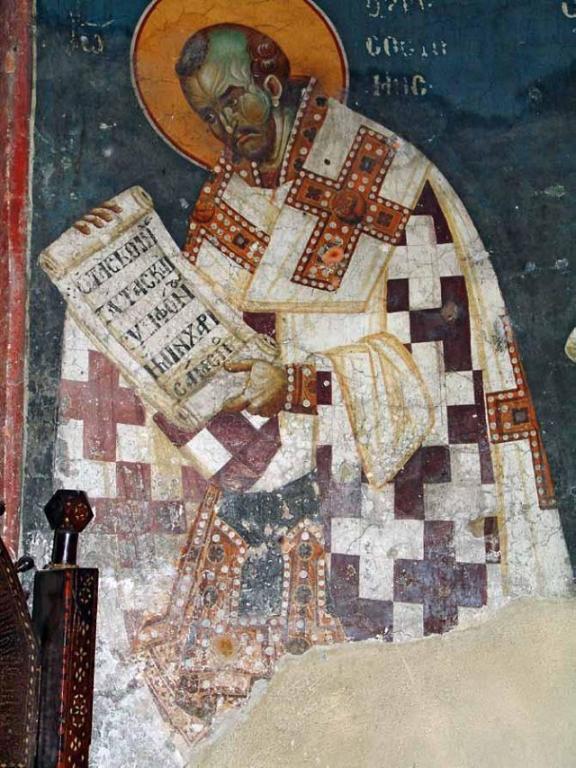
Photo credit: Fresco of St. John Chrysostom, lower register of sanctuary in Church of the Theotokos Peribleptos in Ohrid, Macedonia (13th century) [public domain / Wikimedia Commons]

***
Previous Post

September 3, 2018
Comparative Soteriology (Salvation): A Handy Chart
Next Post

September 4, 2018 On the Abp. Vigano-Pope Francis Crisis, Ten Days In
Browse Our Archives
Select a Category & Last Things About Me Anti-Catholicism Atheism & Agnosticism Baptism and Sacramentalism Bible and Tradition Blessed Virgin Mary Books by Dave Armstrong C. S. Lewis Calvinism & General Protestantism Catholic Apologetics Catholic Apologists Catholic conversion Catholic converts Christmas Church (Ecclesiology) Church History Conversion and Converts Development of Doctrine Eastern Orthodoxy Ecumenism & Christian Unity Eucharist & Liturgy Fathers of the Church French Translations G. K. Chesterton Hell Hell & Satan Hell & Satan & Last Things Heresies & Comparative Religion Holistic Health Inquisition & Crusades & Scandals James White Jews & Judaism & Old Testament John Calvin John Henry Newman Liberal / Modernist Theology Life Issues Literary Resume Lutheranism Mariology Martin Luther Music Orthodoxy Papacy & Infallibility Personal Page Philosophy & Science Political & Ethical & Moral Issues Protestant Persecution & Intolerance Protestantism Purgatory Purgatory & Penance Romantic & Imaginative Theology Saints & Purgatory & Penance Salvation Salvation & Justification Satan & Last Things Sexuality and Gender Issues Spanish Translations Traditionalism vs. Radical Catholic Reactionaries Traducciones al español / tradução para português Trinitarianism & Christology Uncategorized Videos
Select a Month November 2026 October 2026 September 2026 August 2026 July 2026 June 2026 May 2026 April 2026 March 2026 February 2026 January 2026 December 2025 November 2025 October 2025 September 2025 August 2025 July 2025 June 2025 May 2025 April 2025 March 2025 February 2025 January 2025 December 2024 November 2024 October 2024 September 2024 August 2024 July 2024 June 2024 May 2024 April 2024 March 2024 February 2024 January 2024 December 2023 November 2023 October 2023 September 2023 August 2023 July 2023 June 2023 May 2023 April 2023 March 2023 February 2023 January 2023 December 2022 November 2022 October 2022 September 2022 August 2022 July 2022 June 2022 May 2022 April 2022 March 2022 February 2022 January 2022 December 2021 November 2021 October 2021 September 2021 August 2021 July 2021 June 2021 May 2021 April 2021 March 2021 February 2021 January 2021 December 2020 November 2020 October 2020 September 2020 August 2020 July 2020 June 2020 May 2020 April 2020 March 2020 February 2020 January 2020 December 2019 November 2019 October 2019 September 2019 August 2019 July 2019 June 2019 May 2019 April 2019 March 2019 February 2019 January 2019 December 2018 November 2018 October 2018 September 2018 August 2018 July 2018 June 2018 May 2018 April 2018 March 2018 February 2018 January 2018 December 2017 November 2017 October 2017 September 2017 August 2017 July 2017 June 2017 May 2017 April 2017 March 2017 February 2017 January 2017 December 2016 November 2016 October 2016 September 2016 August 2016 July 2016 June 2016 May 2016 April 2016 March 2016 February 2016 January 2016 December 2015 November 2015 October 2015 September 2015 August 2015 July 2015 June 2015 May 2015 April 2015 March 2015 February 2015 January 2015 December 2014 November 2014 October 2014 September 2014 August 2014 July 2014 June 2014 April 2014 March 2014 February 2014 January 2014 December 2013 November 2013 October 2013 September 2013 August 2013 July 2013 June 2013 April 2013 March 2013 February 2013 January 2013 December 2012 November 2012 October 2012 September 2012 August 2012 July 2012 June 2012 May 2012 April 2012 March 2012 February 2012 January 2012 December 2011 November 2011 October 2011 September 2011 August 2011 July 2011 June 2011 April 2011 March 2011 February 2011 October 2010 September 2010 August 2010 July 2010 April 2010 March 2010 December 2009 October 2009 August 2009 July 2009 June 2009 May 2009 March 2009 February 2009 October 2008 September 2008 April 2008 March 2008 February 2008 January 2008 December 2007 November 2007 October 2007 May 2007 March 2007 February 2007 January 2007 November 2006 October 2006 September 2006 August 2006 July 2006 June 2006 May 2006 April 2006 March 2006 February 2006 October 2005 June 2005 April 2005 February 2005 July 2004 May 2004 April 2004
Follow Us!
TAKE THE
Religious Wisdom Quiz
According to Isaiah 53, how would the Messiah be treated by people?
Select your answer to see how you score.
Worshiped and adored Feared and honored Despised and rejected Ignored and forgotten
Books by This Author Books by Dave Armstrong
Related posts from Biblical Evidence for Catholicism
Filioque & Twelve Eastern Church Fathers
Biblical Evidence for Catholicism

Bible & Catholicism on Mortal Sin (vs. John...
Biblical Evidence for Catholicism

Dialogue on Eternal Security / Absolute Assurance
Biblical Evidence for Catholicism

"Faith Alone" Dialogue with a Calvinist
Biblical Evidence for Catholicism
TRENDING AT PATHEOS Catholic

Will Islam become the world's biggest religion by 2035? Congo will replace...

The resilience of the Christian faith in the english speaking world of...

An Advent Calendar, and a Tree full of...
I've spent the weekend deeply invested in internet drama about a $150...

How to Have Financial Transparency in Marriage
Despite the fact that financial issues and money problems are the number...
The Healing Power of Forgiveness in Marriage
Learning how to give and accept apologies are essential ingredients of a...

The West's Christian Moral Inheritance: A Legacy Denied
Whether we like it or not, our environment matters, shaping us both...
view all Catholic blogs
Ad-Free & Subscriber Log-In Subscription Support
- About Us
- 2026 Calendar
- Videos
- Podcasts
- Library of World Religions
- Faith In Media Tracker
- Advertise With Us
- Write for Us
- Privacy Policy
- Terms of Service
- Do Not Sell My Data
- Contact Us
- Radiant Digital
- Manage Newsletter Subscriptions
- Unsubscribe From Notifications
- Sitemap
Copyright 2008-2026, Patheos. All rights reserved.
Subscription Support Ad-Free & Subscriber Log-In
Follow Patheos