
BuddhistCatholicContemplativeEvangelicalGeneral ChristianHinduJewishLatter-day SaintMuslimNew VisionsProgressive Christian
Beliefs
- Buddhist
- Catholic
- Contemplative
- Evangelical
- General Christian
- Hindu
- Jewish
- Latter-day Saint
- More Voices
- Muslim
- New Visions
- Pagan
- Progressive Christian
Topics
- Religion News
- Food and Religion
- Sports and Religion
- Religious Art
- Religious Music and Entertainment
- Religious Events
- History and Religion
- Style and Religion
- Politics and Religion
- Women in Religion
- Recreation Outdoors and Religion
- Business Finance and Religion
- Careers Workplace and Religion
- Education and Religion
- Family Parenting and Religion
- Health Fitness and Religion
- Home and Religion
- Relationships and Religion
- Technology and Religion
- Travel and Religion
Columnists
- Buddhist Columnists
- Business Finance and Religion Columnists
- Careers Workplace and Religion Columnists
- Catholic Columnists
- Contemplative Columnists
- Education and Religion Columnists
- Evangelists Columnists
- Family Parenting and Religion Columnists
- General Christian Columnists
- Health Fitness and Religion Columnists
- Hindu Columnists
- History and Religion Columnists
- Home and Religion Columnists
- Jewish Columnists
- More Voices Columnists
- Latter Day Columnists
- Muslim Columnists
- New Visions Columnists
- Nonreligious Columnists
- Pagan Columnists
- Politics and Religion Columnists
- Progressive Columnists
- Recreation Outdoors and Religion Columnists
- Relationships and Religion Columnists
- Religion News Columnists
- Religious Art Columnists
- Religious Events Columnists
- Religious Music and Entertainment Columnists
- Sports and Religion Columnists
- Style and Religion Columnists
- Technology and Religion Columnists
- Travel and Religion Columnists
- Women in Religion Columnists
Resource Library
- 2026 Calendar
- Library of World Religions
- The 100 Most Holy Places on Earth
- Patheos Answers
- Podcasts
- Videos
- Faith Leaders Database
- Anglican Episcopalian
- Bahai
- Baptist
- Buddhism
- Christianity
- Confucianism
- Eastern Orthodoxy
- Hinduism
- Holiness and Pentecostal
- ISKCON
- Islam
- Judaism
- Lutheran
- Methodist
- The Church of Jesus Christ of Latter-day Saints
- New Age
- Paganism
- Presbytarian and Reformed
- Protestantism
- Religion Behind the Scenes
- Roman Catholic
- Scientology
- Shia Islam
- Sikhism
- Sufism
- Sunni Islam
- Taoism
- Zen
- See all religions
Research Tools
 Ad-Free & Subscriber Log-In Subscription Support
Follow Patheos 

- Trending:
- Advent
- |
- Forgiveness
- |
- Thanksgiving
- |
- Election
- |
- Seasonal Holidays
- |
- Marriage

-
About
-
Catholic Apologetics
-
Church History
-
Great Apologists
-
Christian Worldview
-
Protestantism & Misc.
- Home
- Catholic
- History and Religion
- Faith Alone: Development of Church Fathers & St. Augustine?
Faith Alone: Development of Church Fathers & St. Augustine?
Last updated on: September 7, 2018 at 7:44 pm by Dave Armstrong
Faith Alone: Development of Church Fathers & St. Augustine? 2018-09-07T19:44:08-04:00 Dave Armstrong
Patheos Explore the world's faith through different perspectives on religion and spirituality! Patheos has the views of the prevalent religions and spiritualities of the world.
Heresy can only be defined as the apostles and Church Fathers defined it, according to the ancient principle of apostolic succession. In a nutshell, heresy is that which has not been passed down from the beginning, from the apostles and our Lord Jesus. If something is novel and cannot be traced back, it is heresy, and to be utterly rejected, according to St. Paul in particular. All other definitions are ultimately circular:
X What is heresy?
Y That which is false and wrong according to the Bible (i.e., as interpreted by Calvin/Luther/whomever)
X And where do they get their authority to state that?
Y From God, but they would trace their beliefs to the early Fathers, particularly St. Augustine.
X But Catholics also trace their beliefs from St. Augustine. Who is correct?
Y If you look at Augustine’s teachings, you will find that the Reformed are his true legatees.
Applying this oft-stated Protestant principle, I then appeal to Protestant scholars Alister McGrath and Norman Geisler, with regard to the historical basis of sola fide (faith alone and extrinsic, imputed justification), one of the pillars of the Protestant Reformation:
Whereas Augustine taught that the sinner is made righteous in justification, Melanchthon taught that he is counted as righteous or pronounced to be righteous. For Augustine, ‘justifying righteousness’ is imparted; for Melanchthon, it is imputed in the sense of being declared or pronounced to be righteous. Melanchthon drew a sharp distinction between the event of being declared righteous and the process of being made righteous, designating the former ‘justification’ and the latter ‘sanctification’ or ‘regeneration.’ For Augustine, these were simply different aspects of the same thing . . .
The importance of this development lies in the fact that it marks a complete break with the teaching of the church up to that point. From the time of Augustine onwards, justification had always been understood to refer to both the event of being declared righteous and the process of being made righteous. . . .
The Council of Trent . . . reaffirmed the views of Augustine on the nature of justification . . . the concept of forensic justification actually represents a development in Luther’s thought . . . .
Trent maintained the medieval tradition, stretching back to Augustine, which saw justification as comprising both an event and a process . . . (Reformation Thought: An Introduction, 2nd edition, Grand Rapids, Michigan: Baker Book House, 1993, 108-109, 115; emphasis in original)
This spectacularly confirms that sola fide was a novelty and corruption, and that infused, intrinsic justification was the ongoing tradition, and that of St. Augustine, supposedly the great forerunner of Luther’s “faith alone.” Norman Geisler makes the exact same point:
For Augustine, justification included both the beginnings of one’s righteousness before God and its subsequent perfection — the event and the process. What later became the Reformation concept of ‘sanctification’ then is effectively subsumed under the aegis of justification. Although he believed that God initiated the salvation process, it is incorrect to say that Augustine held to the concept of ‘forensic’ justification. This understanding of justification is a later development of the Reformation . . .
Before Luther, the standard Augustinian position on justification stressed intrinsic justification. Intrinsic justification argues that the believer is made righteous by God’s grace, as compared to extrinsic justification, by which a sinner is forensically declared righteous (at best, a subterranean strain in pre-Reformation Christendom). With Luther the situation changed dramatically . . .
. . . one can be saved without believing that imputed righteousness (or forensic justification) is an essential part of the true gospel. Otherwise, few people were saved between the time of the apostle Paul and the Reformation, since scarcely anyone taught imputed righteousness (or forensic justification) during that period! . . . . . (Roman Catholics and Evangelicals: Agreements and Differences, with Ralph E. MacKenzie, Grand Rapids, Michigan: Baker Book House, 1995, 502, 85, 222; emphasis in original)
Much the same demonstration can be made with regard to sola Scriptura and other Protestant distinctives. To summarize, then: the only (biblical, logical) way to determine heresy and orthodoxy is the historical criterion of apostolic succession. Any other method is circular, with no way to resolve competing claims.
Sola fide cannot be a legitimate development, because it is different in essence from infused justification. If some Reformed Protestants claim that our view is Pelagianism or a false gospel of works, etc. because of its difference from the Reformed extrinsic, forensic, external, imputed righteousness, then how can their view be said to be merely a “development” of ours, via Augustine and others?
A development cannot proceed from an entirely false view to a true one, or change in its essence. This violates the very definition of development, on any coherent theological view of what the word means. It is not simply random evolution or change, but consistent change: consistent with what has come before it, not radically divergent.
That would be like saying that orthodox Chalcedon trinitarianism could have “developed” from Arianism, Sabellianism, or Monophysitism. Therefore, sola fide must be considered as a corruption of Augustinian (and patristic) soteriology, because it is entirely novel in essential aspects, as my two Protestant citations showed.
St. Augustine rejected double predestination, perseverance, imputed justification, and accepted free will, sacramentalism, baptismal regeneration, the Real Presence of the Eucharist, the sacrifice of the Mass, the central authoritative roles of the Church and Tradition, as well as Scripture, the papacy, purgatory, penance, intercession of the saints, an exalted role of Mary, and human merit. In other words, he was a good Catholic. As if this were some amazing revelation . . . .
How, then, can a Reformed Protestant claim on the one hand that his views are descended from St. Augustine, yet on the other hand assert that Catholics are heretics, Pelagians, and adherents of a false, idolatrous gospel, for believing the same sort of things that St. Augustine also held? If I am a heretic and not a Christian, then neither was Augustine. If he was one, then so am I.
Without too much trouble, one can find Catholic distinctives in St. Augustine’s classic, The City of God. For example, the great Doctor appears to be talking about purgatory in XX, 25-26 (“. . . at the judgment those who are worthy of such purification are to be purified even by fire; and after that there will be found in all the saints no sin at all . . . “). Cf. XXI, 13.
He clearly rejects the Lutheran/Calvinist “bondage of the will” (V, 10 and XII, 7). He teaches the sacrifice of the Mass and the Real Presence of Christ in the Eucharist (X, 5, 20; XXI, 25), baptismal regeneration (XIII, 7; XX, 6), development of doctrine (XVI, 2), authoritative Tradition (XVIII, 38), and prayers for the dead (XX, 9; XXI, 24).
How is it “outside” of God’s working to simply reject His working? This is absolutely illogical and nonsensical. How does a prisoner’s refusal to accept a governor’s pardon somehow make the pardon null and void, or change the essence of the fact that the governor does all: all pardon comes from him, but a free agent can reject it if he so chooses? This is what Augustine states in City of God, V, 10:
It does not follow, because God foreknew what would in the future be in our will, that there is nothing in the power of our will.
He doesn’t create a false dichotomy, which is so characteristic of Protestant thought. He accepts the paradox and mystery (not contradiction) of divine sovereignty and human will, as Scripture also does.
Let me put it in capital letters: (in Catholic, Tridentine teaching) GOD DOES THE ENTIRE WORK OF GRACE AND JUSTIFICATION. MAN MERELY GOES ALONG WITH IT, OR REJECTS IT. Even merit is God rewarding His own gifts, as Augustine accurately puts it. God’s grace is always primary and initiatory. Once one is walking in that grace, there is merit, yes, but it must also be understood as ultimately initiated and entirely caused by God.
***
(originally 11-24-00)
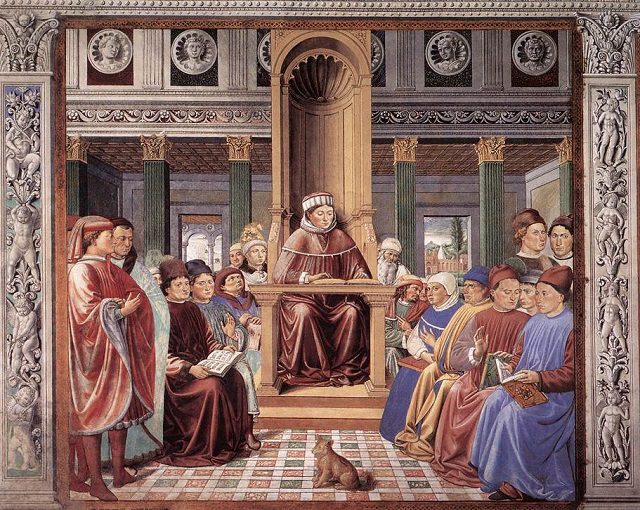
Photo credit: St Augustine Teaching in Rome (1465), by Benozzo Gozzoli (c. 1421-1497) [public domain / Wikimedia Commons]

***
Church fathers & justification
Previous Post

September 7, 2018
More Biblical Evidence on Honoring Political Rulers
Next Post
September 8, 2018 John Wesley (Founder of Methodism), Denied "Faith Alone"?
Browse Our Archives
Select a Category & Last Things About Me Anti-Catholicism Atheism & Agnosticism Baptism and Sacramentalism Bible and Tradition Blessed Virgin Mary Books by Dave Armstrong C. S. Lewis Calvinism & General Protestantism Catholic Apologetics Catholic Apologists Catholic conversion Catholic converts Christmas Church (Ecclesiology) Church History Conversion and Converts Development of Doctrine Eastern Orthodoxy Ecumenism & Christian Unity Eucharist & Liturgy Fathers of the Church French Translations G. K. Chesterton Hell Hell & Satan Hell & Satan & Last Things Heresies & Comparative Religion Holistic Health Inquisition & Crusades & Scandals James White Jews & Judaism & Old Testament John Calvin John Henry Newman Liberal / Modernist Theology Life Issues Literary Resume Lutheranism Mariology Martin Luther Music Orthodoxy Papacy & Infallibility Personal Page Philosophy & Science Political & Ethical & Moral Issues Protestant Persecution & Intolerance Protestantism Purgatory Purgatory & Penance Romantic & Imaginative Theology Saints & Purgatory & Penance Salvation Salvation & Justification Satan & Last Things Sexuality and Gender Issues Spanish Translations Traditionalism vs. Radical Catholic Reactionaries Traducciones al español / tradução para português Trinitarianism & Christology Uncategorized Videos
Select a Month November 2026 October 2026 September 2026 August 2026 July 2026 June 2026 May 2026 April 2026 March 2026 February 2026 January 2026 December 2025 November 2025 October 2025 September 2025 August 2025 July 2025 June 2025 May 2025 April 2025 March 2025 February 2025 January 2025 December 2024 November 2024 October 2024 September 2024 August 2024 July 2024 June 2024 May 2024 April 2024 March 2024 February 2024 January 2024 December 2023 November 2023 October 2023 September 2023 August 2023 July 2023 June 2023 May 2023 April 2023 March 2023 February 2023 January 2023 December 2022 November 2022 October 2022 September 2022 August 2022 July 2022 June 2022 May 2022 April 2022 March 2022 February 2022 January 2022 December 2021 November 2021 October 2021 September 2021 August 2021 July 2021 June 2021 May 2021 April 2021 March 2021 February 2021 January 2021 December 2020 November 2020 October 2020 September 2020 August 2020 July 2020 June 2020 May 2020 April 2020 March 2020 February 2020 January 2020 December 2019 November 2019 October 2019 September 2019 August 2019 July 2019 June 2019 May 2019 April 2019 March 2019 February 2019 January 2019 December 2018 November 2018 October 2018 September 2018 August 2018 July 2018 June 2018 May 2018 April 2018 March 2018 February 2018 January 2018 December 2017 November 2017 October 2017 September 2017 August 2017 July 2017 June 2017 May 2017 April 2017 March 2017 February 2017 January 2017 December 2016 November 2016 October 2016 September 2016 August 2016 July 2016 June 2016 May 2016 April 2016 March 2016 February 2016 January 2016 December 2015 November 2015 October 2015 September 2015 August 2015 July 2015 June 2015 May 2015 April 2015 March 2015 February 2015 January 2015 December 2014 November 2014 October 2014 September 2014 August 2014 July 2014 June 2014 April 2014 March 2014 February 2014 January 2014 December 2013 November 2013 October 2013 September 2013 August 2013 July 2013 June 2013 April 2013 March 2013 February 2013 January 2013 December 2012 November 2012 October 2012 September 2012 August 2012 July 2012 June 2012 May 2012 April 2012 March 2012 February 2012 January 2012 December 2011 November 2011 October 2011 September 2011 August 2011 July 2011 June 2011 April 2011 March 2011 February 2011 October 2010 September 2010 August 2010 July 2010 April 2010 March 2010 December 2009 October 2009 August 2009 July 2009 June 2009 May 2009 March 2009 February 2009 October 2008 September 2008 April 2008 March 2008 February 2008 January 2008 December 2007 November 2007 October 2007 May 2007 March 2007 February 2007 January 2007 November 2006 October 2006 September 2006 August 2006 July 2006 June 2006 May 2006 April 2006 March 2006 February 2006 October 2005 June 2005 April 2005 February 2005 July 2004 May 2004 April 2004
Follow Us!
TAKE THE
Religious Wisdom Quiz
What mountain was the site of Elijah's showdown with Baal's prophets?
Select your answer to see how you score.
Mount Hermon Mount Carmel Mount Sinai Mount Tabor
Books by This Author Books by Dave Armstrong
Related posts from Biblical Evidence for Catholicism
Filioque & Twelve Eastern Church Fathers
Biblical Evidence for Catholicism

Bible & Catholicism on Mortal Sin (vs. John...
Biblical Evidence for Catholicism
Dialogue on Eternal Security / Absolute Assurance
Biblical Evidence for Catholicism
"Faith Alone" Dialogue with a Calvinist
Biblical Evidence for Catholicism
TRENDING AT PATHEOS Catholic

Smart people saying smart things (11.24.26)
Please take time to listen to Perry Bacon, Sarah Posner, Adam Serwer,...

The Contingency of Our Technology
Last week we were hit with a raft of massive technology outages....

In 1939, President Franklin D. Roosevelt moved Thanksgiving from November 30 to...

Reasons for Restraint: Ricardo Gonzalez, Florida and Dec...
The Morning of January 3 I begin with the dead. On the...

I published this column for Thanksgiving 2012 in the Deseret News....

For many years, Catholicism has been caught up in division over the...
view all Catholic blogs
Ad-Free & Subscriber Log-In Subscription Support
- About Us
- 2026 Calendar
- Videos
- Podcasts
- Library of World Religions
- Faith In Media Tracker
- Advertise With Us
- Write for Us
- Privacy Policy
- Terms of Service
- Do Not Sell My Data
- Contact Us
- Radiant Digital
- Manage Newsletter Subscriptions
- Unsubscribe From Notifications
- Sitemap
Copyright 2008-2026, Patheos, part of the Radiant Digital network of media brands. All rights reserved.
Subscription Support Ad-Free & Subscriber Log-In
Follow Patheos