
BuddhistCatholicContemplativeEvangelicalGeneral ChristianHinduJewishLatter-day SaintMuslimNew VisionsProgressive Christian
Beliefs
- Buddhist
- Catholic
- Contemplative
- Evangelical
- General Christian
- Hindu
- Jewish
- Latter-day Saint
- More Voices
- Muslim
- New Visions
- Pagan
- Progressive Christian
Topics
- Religion News
- Food and Religion
- Sports and Religion
- Religious Art
- Religious Music and Entertainment
- Religious Events
- History and Religion
- Style and Religion
- Politics and Religion
- Women in Religion
- Recreation Outdoors and Religion
- Business Finance and Religion
- Careers Workplace and Religion
- Education and Religion
- Family Parenting and Religion
- Health Fitness and Religion
- Home and Religion
- Relationships and Religion
- Technology and Religion
- Travel and Religion
Columnists
- Buddhist Columnists
- Business Finance and Religion Columnists
- Careers Workplace and Religion Columnists
- Catholic Columnists
- Contemplative Columnists
- Education and Religion Columnists
- Evangelists Columnists
- Family Parenting and Religion Columnists
- General Christian Columnists
- Health Fitness and Religion Columnists
- Hindu Columnists
- History and Religion Columnists
- Home and Religion Columnists
- Jewish Columnists
- More Voices Columnists
- Latter Day Columnists
- Muslim Columnists
- New Visions Columnists
- Nonreligious Columnists
- Pagan Columnists
- Politics and Religion Columnists
- Progressive Columnists
- Recreation Outdoors and Religion Columnists
- Relationships and Religion Columnists
- Religion News Columnists
- Religious Art Columnists
- Religious Events Columnists
- Religious Music and Entertainment Columnists
- Sports and Religion Columnists
- Style and Religion Columnists
- Technology and Religion Columnists
- Travel and Religion Columnists
- Women in Religion Columnists
Resource Library
- 2026 Calendar
- Library of World Religions
- The 100 Most Holy Places on Earth
- Patheos Answers
- Podcasts
- Videos
- Faith Leaders Database
- Anglican Episcopalian
- Bahai
- Baptist
- Buddhism
- Christianity
- Confucianism
- Eastern Orthodoxy
- Hinduism
- Holiness and Pentecostal
- ISKCON
- Islam
- Judaism
- Lutheran
- Methodist
- The Church of Jesus Christ of Latter-day Saints
- New Age
- Paganism
- Presbytarian and Reformed
- Protestantism
- Religion Behind the Scenes
- Roman Catholic
- Scientology
- Shia Islam
- Sikhism
- Sufism
- Sunni Islam
- Taoism
- Zen
- See all religions
Research Tools
 Ad-Free & Subscriber Log-In Subscription Support
Follow Patheos 

- Trending:
- Advent
- |
- Forgiveness
- |
- Thanksgiving
- |
- Election
- |
- Seasonal Holidays
- |
- Marriage

-
About
-
Catholic Apologetics
-
Church History
-
Great Apologists
-
Christian Worldview
-
Protestantism & Misc.
- Home
- Catholic
- History and Religion
- Calvinist Total Depravity vs. Catholic Concupiscence
Calvinist Total Depravity vs. Catholic Concupiscence
Last updated on: June 6, 2026 at 12:36 am by Dave Armstrong
Calvinist Total Depravity vs. Catholic Concupiscence 2026-06-06T00:36:22-04:00 Dave Armstrong
Patheos Explore the world's faith through different perspectives on religion and spirituality! Patheos has the views of the prevalent religions and spiritualities of the world.
I think an orthodox “Reformation” Calvinist would agree with the definition of Total Depravity in The Oxford Dictionary of the Christian Church (edited by F. L. Cross, rev. 1983, 1387) — with which I also agree:
[T]he extreme wretchedness of man’s condition as the result of the Fall. It emphasizes the belief that this result was not a mere loss or deprivation of a supernatural endowment possessed by unfallen man, but a radical corruption or deprivation of his whole nature, so that apart from Christ he can do nothing whatever pleasing to God. Even his reason has been radically vitiated, so that acc. to Calvinism, all natural knowledge of God (such as obtains in the system of St. Thomas Aquinas is held to be impossible.
For the purpose of clarifying differences between Protestant and Catholic conceptions of the Fall, I shall cite Louis Bouyer, former Lutheran, and author of a penetrating analysis of Protestantism as a system of belief, The Spirit and Forms of Protestantism (New York: Meridian Books, 1955, translated by A. V. Littledale):
Even the idea of the Word of God creating what he says by the act of saying it . . . would be enough to show that God makes just whom he ‘declares just’, even if he were not so beforehand, by the very fact of his declaration, so the opposition set up is without meaning . . . .
The God of Calvinism and Barthism, it seems, keeps all his greatness only if his creatures return to nothingness. The God of the Bible, on the contrary, shows his greatness in snatching them from it, not only, as St. John says, ‘that we are called, but really are, the sons of God.’ (Jn 3:1) . . .
It was apparently impossible for Protestant theology [i.e., in its initial and original Calvinist form] . . . to agree that God could put something in man that became in fact his own, and that at the same time the gift remained the possession of the giver . . . it would seem as if man could only belong to him in ceasing to have a distinct existence, in being annihilated . . .
If the grace of God is such, only on condition that it gives nothing real; if man who believes, by saving faith, is in no way changed from what he was before believing . . .; if God can only be affirmed by silencing his creature, if he acts only in annihilating it . . .- what is condemned is not man’s presumptuous way to God, but God’s way of mercy to man.
This, and this alone, is the ultimate reproach which the Church levels at the Protestant system . . . The Word of God categorically proclaims a grace that is a real gift; a justification by faith that makes man really just . . . he is the living God who gives life . . .
For both Erasmus and Luther, to say that God and man act together in justification must mean that their joint action is analogous to that of two men drawing the same load. Consequently, the more one does, the less the other; whence, for Luther, realising anew that grace does everything in salvation, it follows of necessity that man does nothing . . .
On the other hand, for St. Bernard and the whole authentic tradition, in one sense God does all, and in another man must do all, for he has to make everything his own; but he cannot – he can do absolutely nothing valid for salvation, except in complete dependence on grace. This view, we must say, must have appeared absolutely unimaginable to both Erasmus and Luther. It is so, in fact, so long as one cannot conceive a world other than that of nominalism, as was the case for them both . . .
The true theological position, wholly consonant with revelation, is that man is himself only as he recognises his radical dependence on the Creator; but this does not mean that creation is a fiction, legal or otherwise, but the most authentic of all realities. Man saved is therefore man restored by faith to the consciousness of that absolute dependence, and so recovering his life at the very source. It may seem strange, but it is undeniable that in the whole course of this unhappy controversy [i.e., Luther vs. Erasmus] this view does not seem to have occurred to either of the protagonists. There lies the whole tragedy of Protestantism. (pp. 148, 151-152, 156-157)
Ludwig Ott wrote, concerning the Fall, in his Fundamentals of Catholic Dogma (Rockford, Illinois: TAN Books, 1974 [orig. 1952], translated by Patrick Lynch):
- The Reformers . . . admitted the reality of original sin, but misunderstood its essence its operation, since they regarded it as identical with concupiscence which corrupts completely human nature . . .
-
- Original Sin does not consist, as the Reformers . . . taught, in ‘The habitual concupiscence, which remains, even in the baptised, a true and proper sin, but is no longer reckoned for punishment.’ The Council of Trent teaches that through Baptism everything is taken away which is a true and proper sin, and that the concupiscence which remains behind after Baptism for the moral proving is called sin in an improper sense only. That sin remains in man, even if it is not reckoned for punishment, is irreconcilable with the Pauline teaching of Justification as an inner transformation and renewal . . .
-
- The wounding of nature must not be conceived, with the Reformers and the Jansenists, as the complete corruption of human nature. In the condition of Original Sin, man possesses the ability of knowing natural religious truths and of performing natural morally good actions . . . Man, with his natural power of cognition, can with certainty know the existence of God. The Council of Trent teaches that free will was not lost or extinguished by the fall of Adam. (pp. 108, 110, 112-113)
In other words, in Catholic theology man is not “totally depraved,” does not have an essential “sin nature,” and possesses a free will.
The contrasting classic (i.e., Calvinist) Protestant, evangelical viewpoint on the Fall is observed in the writing of Charles Hodge, the Presbyterian theologian, in his Systematic Theology:
The Semi-Pelagian [note how he falsely and inaccurately describes the Catholic view] doctrine . . . admits the powers of man to have been weakened by the fall of the race, but denies that he lost all ability to perform what is spiritually good . . . The Augustinian or Protestant doctrine [St. Augustine was more Protestant than Catholic???] . . . teaches that such is the nature of inherent, hereditary depravity that men since the fall are utterly unable to turn themselves unto God or to do anything truly good in his sight . . .
This want of power of spiritual discernment arises from the corruption of our whole nature, by which the reason or understanding is blinded, and the taste and feelings are perverted. As this state of mind is innate, as it is a state or condition of our nature, it lies below the will and is beyond its power, controlling both our affections and our volitions. (abridged version, edited by Edward N. Gross, Grand Rapids, Michigan: Baker Book House, 1988, 308, emphasis added)
I think all these excerpts are consistent with each other, and accurately summarize the classic Protestant “Reformed” position (as seen in Calvin’s Institutes and Luther’s Bondage of the Will) on the Fall: viz., that it is a corruption of man’s entire nature, including reason, leaving him with a “sin nature”.
Related Reading:
Biblical Evidence for Original Sin [6-26-02]
*
Dialogue: Double Predestination, Total Depravity, & Limited Atonement [4-14-10]
*
*
Total Depravity & the Evil of the Non-Elect (vs. John Calvin) [10-12-12]
*
St. Augustine, Calvin, & Calvinists Regarding Total Depravity [1-7-14]
*
Group Discussion on Eastern vs. Western Conceptions of Original Sin (with Eastern Catholics and Orthodox) (+ discussion on a second continuing Facebook thread) [Facebook, 6-28-14]
*
Is God Alone Holy, According to Scripture? Or Can We Be Too? [5-3-17]
*
My book: Biblical Catholic Salvation: “Faith Working Through Love” (Oct. 2010, 187p) [available for only $2.99 in e-book format]
*
My book: A Biblical Critique of Calvinism (Oct. 2012, 178p) [available for only $2.99 in e-book format]
***
(originally 1996)
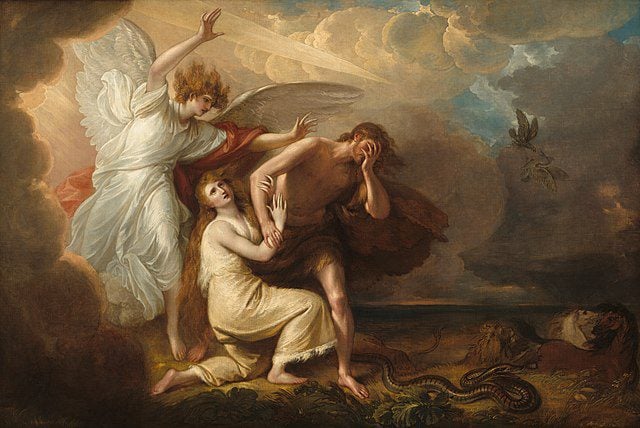
Photo credit: The Expulsion of Adam and Eve from Paradise (1791), by Benjamin West (1738-1820) [public domain / Wikimedia Commons]

***
Calvinism & General Protestantism
Previous Post

September 11, 2018
Catholic Teaching: Predestination of the Elect (Ludwig Ott)
Next Post
September 12, 2018 Dialogue on God's Middle Knowledge & Foreknowledge
Browse Our Archives
Select a Category & Last Things About Me Anti-Catholicism Atheism & Agnosticism Baptism and Sacramentalism Bible and Tradition Blessed Virgin Mary Books by Dave Armstrong C. S. Lewis Calvinism & General Protestantism Catholic Apologetics Catholic Apologists Catholic conversion Catholic converts Christmas Church (Ecclesiology) Church History Conversion and Converts Development of Doctrine Eastern Orthodoxy Ecumenism & Christian Unity Eucharist & Liturgy Fathers of the Church French Translations G. K. Chesterton Hell Hell & Satan Hell & Satan & Last Things Heresies & Comparative Religion Holistic Health Inquisition & Crusades & Scandals James White Jews & Judaism & Old Testament John Calvin John Henry Newman Liberal / Modernist Theology Life Issues Literary Resume Lutheranism Mariology Martin Luther Music Orthodoxy Papacy & Infallibility Personal Page Philosophy & Science Political & Ethical & Moral Issues Protestant Persecution & Intolerance Protestantism Purgatory Purgatory & Penance Romantic & Imaginative Theology Saints & Purgatory & Penance Salvation Salvation & Justification Satan & Last Things Sexuality and Gender Issues Spanish Translations Traditionalism vs. Radical Catholic Reactionaries Traducciones al español / tradução para português Trinitarianism & Christology Uncategorized Videos
Select a Month November 2026 October 2026 September 2026 August 2026 July 2026 June 2026 May 2026 April 2026 March 2026 February 2026 January 2026 December 2025 November 2025 October 2025 September 2025 August 2025 July 2025 June 2025 May 2025 April 2025 March 2025 February 2025 January 2025 December 2024 November 2024 October 2024 September 2024 August 2024 July 2024 June 2024 May 2024 April 2024 March 2024 February 2024 January 2024 December 2023 November 2023 October 2023 September 2023 August 2023 July 2023 June 2023 May 2023 April 2023 March 2023 February 2023 January 2023 December 2022 November 2022 October 2022 September 2022 August 2022 July 2022 June 2022 May 2022 April 2022 March 2022 February 2022 January 2022 December 2021 November 2021 October 2021 September 2021 August 2021 July 2021 June 2021 May 2021 April 2021 March 2021 February 2021 January 2021 December 2020 November 2020 October 2020 September 2020 August 2020 July 2020 June 2020 May 2020 April 2020 March 2020 February 2020 January 2020 December 2019 November 2019 October 2019 September 2019 August 2019 July 2019 June 2019 May 2019 April 2019 March 2019 February 2019 January 2019 December 2018 November 2018 October 2018 September 2018 August 2018 July 2018 June 2018 May 2018 April 2018 March 2018 February 2018 January 2018 December 2017 November 2017 October 2017 September 2017 August 2017 July 2017 June 2017 May 2017 April 2017 March 2017 February 2017 January 2017 December 2016 November 2016 October 2016 September 2016 August 2016 July 2016 June 2016 May 2016 April 2016 March 2016 February 2016 January 2016 December 2015 November 2015 October 2015 September 2015 August 2015 July 2015 June 2015 May 2015 April 2015 March 2015 February 2015 January 2015 December 2014 November 2014 October 2014 September 2014 August 2014 July 2014 June 2014 April 2014 March 2014 February 2014 January 2014 December 2013 November 2013 October 2013 September 2013 August 2013 July 2013 June 2013 April 2013 March 2013 February 2013 January 2013 December 2012 November 2012 October 2012 September 2012 August 2012 July 2012 June 2012 May 2012 April 2012 March 2012 February 2012 January 2012 December 2011 November 2011 October 2011 September 2011 August 2011 July 2011 June 2011 April 2011 March 2011 February 2011 October 2010 September 2010 August 2010 July 2010 April 2010 March 2010 December 2009 October 2009 August 2009 July 2009 June 2009 May 2009 March 2009 February 2009 October 2008 September 2008 April 2008 March 2008 February 2008 January 2008 December 2007 November 2007 October 2007 May 2007 March 2007 February 2007 January 2007 November 2006 October 2006 September 2006 August 2006 July 2006 June 2006 May 2006 April 2006 March 2006 February 2006 October 2005 June 2005 April 2005 February 2005 July 2004 May 2004 April 2004
Follow Us!
TAKE THE
Religious Wisdom Quiz
What does "Bethesda" mean?
Select your answer to see how you score.
House of wind House of mercy House of olives House of bread
Books by This Author Books by Dave Armstrong
Related posts from Biblical Evidence for Catholicism
Denominationalism: 50 Biblical Condemnations
Biblical Evidence for Catholicism
On Protestant Explanations of Catholic Conversion
Biblical Evidence for Catholicism

Bible & Catholicism on Mortal Sin (vs. John...
Biblical Evidence for Catholicism
Dialogue on Eternal Security / Absolute Assurance
Biblical Evidence for Catholicism
TRENDING AT PATHEOS Catholic

Smart people saying smart things (11.24.26)
Please take time to listen to Perry Bacon, Sarah Posner, Adam Serwer,...

The Contingency of Our Technology
Last week we were hit with a raft of massive technology outages....

In 1939, President Franklin D. Roosevelt moved Thanksgiving from November 30 to...

Reasons for Restraint: Ricardo Gonzalez, Florida and Dec...
The Morning of January 3 I begin with the dead. On the...

I published this column for Thanksgiving 2012 in the Deseret News....

For many years, Catholicism has been caught up in division over the...
view all Catholic blogs
Ad-Free & Subscriber Log-In Subscription Support
- About Us
- 2026 Calendar
- Videos
- Podcasts
- Library of World Religions
- Faith In Media Tracker
- Advertise With Us
- Write for Us
- Privacy Policy
- Terms of Service
- Do Not Sell My Data
- Contact Us
- Radiant Digital
- Manage Newsletter Subscriptions
- Unsubscribe From Notifications
- Sitemap
Copyright 2008-2026, Patheos, part of the Radiant Digital network of media brands. All rights reserved.
Subscription Support Ad-Free & Subscriber Log-In
Follow Patheos