
BuddhistCatholicContemplativeEvangelicalGeneral ChristianHinduJewishLatter-day SaintMuslimNew VisionsProgressive Christian
Beliefs
- Buddhist
- Catholic
- Contemplative
- Evangelical
- General Christian
- Hindu
- Jewish
- Latter-day Saint
- More Voices
- Muslim
- New Visions
- Pagan
- Progressive Christian
Topics
- Religion News
- Food and Religion
- Sports and Religion
- Religious Art
- Religious Music and Entertainment
- Religious Events
- History and Religion
- Style and Religion
- Politics and Religion
- Women in Religion
- Recreation Outdoors and Religion
- Business Finance and Religion
- Careers Workplace and Religion
- Education and Religion
- Family Parenting and Religion
- Health Fitness and Religion
- Home and Religion
- Relationships and Religion
- Technology and Religion
- Travel and Religion
Columnists
- Buddhist Columnists
- Business Finance and Religion Columnists
- Careers Workplace and Religion Columnists
- Catholic Columnists
- Contemplative Columnists
- Education and Religion Columnists
- Evangelists Columnists
- Family Parenting and Religion Columnists
- General Christian Columnists
- Health Fitness and Religion Columnists
- Hindu Columnists
- History and Religion Columnists
- Home and Religion Columnists
- Jewish Columnists
- More Voices Columnists
- Latter Day Columnists
- Muslim Columnists
- New Visions Columnists
- Nonreligious Columnists
- Pagan Columnists
- Politics and Religion Columnists
- Progressive Columnists
- Recreation Outdoors and Religion Columnists
- Relationships and Religion Columnists
- Religion News Columnists
- Religious Art Columnists
- Religious Events Columnists
- Religious Music and Entertainment Columnists
- Sports and Religion Columnists
- Style and Religion Columnists
- Technology and Religion Columnists
- Travel and Religion Columnists
- Women in Religion Columnists
Resource Library
- 2026 Calendar
- Library of World Religions
- The 100 Most Holy Places on Earth
- Patheos Answers
- Podcasts
- Videos
- Faith Leaders Database
- Anglican Episcopalian
- Bahai
- Baptist
- Buddhism
- Christianity
- Confucianism
- Eastern Orthodoxy
- Hinduism
- Holiness and Pentecostal
- ISKCON
- Islam
- Judaism
- Lutheran
- Methodist
- The Church of Jesus Christ of Latter-day Saints
- New Age
- Paganism
- Presbytarian and Reformed
- Protestantism
- Religion Behind the Scenes
- Roman Catholic
- Scientology
- Shia Islam
- Sikhism
- Sufism
- Sunni Islam
- Taoism
- Zen
- See all religions
Research Tools
 Ad-Free & Subscriber Log-In Subscription Support
Ad-Free & Subscriber Log-In Subscription Support
Follow Patheos 

- Trending:
- Forgiveness
- |
- Marriage
- |
- Consciousness
- |
- Death Penalty
- |
- Election
- |
- Halloween

-
About
-
Catholic Apologetics
-
Church History
-
Great Apologists
-
Christian Worldview
-
Protestantism & Misc.
- Home
- Catholic
- History and Religion
- Calvinist Total Depravity: Does Romans 1 Apply to All Men?
Calvinist Total Depravity: Does Romans 1 Apply to All Men?
Last updated on: September 21, 2018 at 4:26 pm by Dave Armstrong
Calvinist Total Depravity: Does Romans 1 Apply to All Men? 2018-09-21T16:26:21-04:00 Dave Armstrong
Patheos Explore the world's faith through different perspectives on religion and spirituality! Patheos has the views of the prevalent religions and spiritualities of the world.
*****
For background, see my paper, Total Depravity: Reply to James White: Calvinism and Romans 3:10-11 (“None is Righteous . . . No One Seeks For God”)
* * * * *
The paper above dealt with Romans 3 and also Romans 2. The former was dealt with at great length, including an examination of the OT texts that Paul cited. The treatment of Romans 2 was shorter, and so I shall cite it here:
Paul doesn’t teach, in context, that absolutely all unregenerated men know that God exist but deny Him anyway, for in the very next chapter (and the chapter right before our text under consideration): Romans 2, he talks about “righteous” people who can do “good” and who are capable of “well-doing” even without the Law, let alone the gospel of Jesus Christ:
6: For he will render to every man according to his works:
7: to those who by patience in well-doing seek for glory and honor and immortality, he will give eternal life;10 . . . glory and honor and peace for every one who does good, the Jew first and also the Greek.
13: For it is not the hearers of the law who are righteous before God, but the doers of the law who will be justified.
14: When Gentiles who have not the law do by nature what the law requires, they are a law to themselves, even though they do not have the law.
15: They show that what the law requires is written on their hearts, while their conscience also bears witness and their conflicting thoughts accuse or perhaps excuse them
16: on that day when, according to my gospel, God judges the secrets of men by Christ Jesus.26: So, if a man who is uncircumcised keeps the precepts of the law, will not his uncircumcision be regarded as circumcision?
27: Then those who are physically uncircumcised but keep the law will condemn you who have the written code and circumcision but break the law.How fascinating. All of this is about Gentiles who don’t even have the law. They haven’t heard the gospel at all. The New Testament has not yet been out together. They (obviously) don’t yet have the benefit of Romans itself. Paul never says that they have heard the gospel. James White would probably say they are unregenerate, since he seems to think (from what I can tell) that one must hear the gospel and accept it in order to be regenerated and justified. These people have not that advantage at all. Therefore, according to White, they could not possibly be capable of any spiritually good thing. Yet look at all the words Paul uses to describe them:
. . . by patience in well-doing . . . [receive] eternal life; . . . every one who does good, the Jew first and also the Greek. For it is not the hearers of the law who are righteous before God, but the doers of the law who will be justified. . . . do by nature what the law requires, . . . what the law requires is written on their hearts, . . . a man who is uncircumcised keeps the precepts of the law, . . . those who are physically uncircumcised but keep the law . . .”
Needless to say, this doesn’t fit very well at all with White’s [Calvinist] theology.
Romans 2 and 3 are the immediate context of Romans 1. One discovers that they do not teach Calvinist theology at all, when closely examined (nor does the famous Romans 9, for that matter). Nuances and qualifications are present that mitigate against the Calvinist application of descriptions to all men whatsoever. Calvinists usually choose to ignore or rationalize away passages that don’t fit into their man-made schema.
Once we approach Romans 1 (actually Romans 1:18-32 and the conclusion of this “unit of thought”: up through 2:10), we have to determine if it, too, makes such qualifications (thus undercutting the Calvinist “co-opting” of the passage) or if it teaches that all men fall prey to the characteristics described therein. Here is the entire passage (RSV):
[18] For the wrath of God is revealed from heaven against all ungodliness and wickedness of men who by their wickedness suppress the truth.
[19] For what can be known about God is plain to them, because God has shown it to them.
[20] Ever since the creation of the world his invisible nature, namely, his eternal power and deity, has been clearly perceived in the things that have been made. So they are without excuse;
[21] for although they knew God they did not honor him as God or give thanks to him, but they became futile in their thinking and their senseless minds were darkened.
[22] Claiming to be wise, they became fools,
[23] and exchanged the glory of the immortal God for images resembling mortal man or birds or animals or reptiles.
[24] Therefore God gave them up in the lusts of their hearts to impurity, to the dishonoring of their bodies among themselves,
[25] because they exchanged the truth about God for a lie and worshiped and served the creature rather than the Creator, who is blessed for ever! Amen.
[26] For this reason God gave them up to dishonorable passions. Their women exchanged natural relations for unnatural,
[27] and the men likewise gave up natural relations with women and were consumed with passion for one another, men committing shameless acts with men and receiving in their own persons the due penalty for their error.
[28] And since they did not see fit to acknowledge God, God gave them up to a base mind and to improper conduct.
[29] They were filled with all manner of wickedness, evil, covetousness, malice. Full of envy, murder, strife, deceit, malignity, they are gossips,
[30] slanderers, haters of God, insolent, haughty, boastful, inventors of evil, disobedient to parents,
[31] foolish, faithless, heartless, ruthless.
[32] Though they know God’s decree that those who do such things deserve to die, they not only do them but approve those who practice them
[1] Therefore you have no excuse, O man, whoever you are, when you judge another; for in passing judgment upon him you condemn yourself, because you, the judge, are doing the very same things.
[2] We know that the judgment of God rightly falls upon those who do such things.
[3] Do you suppose, O man, that when you judge those who do such things and yet do them yourself, you will escape the judgment of God?
[4] Or do you presume upon the riches of his kindness and forbearance and patience? Do you not know that God’s kindness is meant to lead you to repentance?
[5] But by your hard and impenitent heart you are storing up wrath for yourself on the day of wrath when God’s righteous judgment will be revealed.
[6] For he will render to every man according to his works:
[7] to those who by patience in well-doing seek for glory and honor and immortality, he will give eternal life;
[8] but for those who are factious and do not obey the truth, but obey wickedness, there will be wrath and fury.
[9] There will be tribulation and distress for every human being who does evil, the Jew first and also the Greek,
[10] but glory and honor and peace for every one who does good, the Jew first and also the Greek.
John Calvin, in his Commentaries (verse 18 of this passage), wrote (emphases added):
And he brings, as the first proof of condemnation, the fact, — that though the structure of the world, and the most beautiful arrangement of the elements, ought to have induced man to glorify God, yet no one discharged his proper duty: it hence appears that all were guilty of sacrilege, and of wicked and abominable ingratitude.
. . . And then, all the impiety of men is to be taken, by a figure in language, as meaning “the impiety of all men,” or, the impiety of which all men are guilty.
Calvin provides a remarkable example of eisegesis (reading into Scripture something that isn’t there) and of illogical thinking, in the last sentence. To illustrate the logical sleight-of-hand, suppose we use a similar example, following the language of the RSV, which Calvin, in effect, modifies in the following fashion:
Real Bible
The wrath of God is revealed from heaven against all ungodliness and wickedness of men who by their wickedness suppress the truth.
Calvin’s Calvinist Tradition of Men Eisegeted Version
The wrath of God is revealed from heaven against ungodliness and wickedness of all men, all of whom by their wickedness suppress the truth.
See how the meaning changes? Now, for our analogy, picture four young siblings who were left alone for a minute in one of their rooms. Their father comes back, only to find a fairly expensive lamp broken. In fact, it was broken by two of them, when they were wrestling and bumped into the lamp. When asked who did the dirty deed, all denied having done it. Thus, two of them were lying and two were telling the truth. Let’s do an analogy to the above passage:
The wrath of the father is revealed against all lamp-breaking and mischievousness of [the particular] children who by their wickedness suppress the truth.
The wrath of the father is revealed against lamp-breaking and mischievousness of all his children who by their wickedness suppress the truth.
The first is a true statement with regard to these children: two of whom were guilty and two of whom were not. The second is a falsehood because it presupposes that all four children were guilty, when in fact, only two were. I know how Calvinists think and reason. They will immediately object that I have smuggled in a false view that not all men are fallen (as exemplified by the two innocent children). But that was not the intention of the analogy.
Besides the fact that Catholics and Arminian Protestants agree with Calvinists that all men are fallen (as far as that goes) and that no one is “innocent” (with the lone exception among creatures, of Mary, and that by a special supernatural act of prevention from God, lest she inevitably be fallen too), the goal of the analogy was to illustrate how changing the syntactical structure or grammar of a passage can massively change its meaning.
Calvin is clearly engaging in circular reasoning and eisegesis. He came to Romans 1 with his theology already in place, and he read into it to make it teach accordingly. But what he does is not in the text itself. Why this is can be examined in several other ways. I shall contend in due course that it is impossible to interpret this passage in its entirety (i.e., the cited portion above) in accordance with the Calvinist view that it applies to all men. And it’s not all that difficult to prove this, in context.
Remember, as we go through this exposition, that for Calvin and Calvinists, the passage is referring to the mass of unregenerate, fallen men: the entire human race, since we are all guilty and fallen. The latter clause is denied by virtually no Christian communion (with a few exceptions; e.g., Zwingli, and the Church[es] of Christ denomination). But being fallen and doing particular sinful acts of wickedness are two different things.
The first argument one could put forth is so elegantly simple (though a bit subtle) that it could easily be overlooked (and Calvinists, with their logically circular presuppositional epistemology, are notorious for doing just that):
If Paul is referring to fallen man en masse, then he must be referring to all men after Adam and Eve (including the fallen Adam and Eve), since they all would be in this totally depraved, fallen state after the first human couple.
In other words, the passage cannot describe post-Adam and Eve man as having been in one state and then having descended into the fallen state (i.e., the totally depraved state of Calvinism’s fancy), because that was already a fait accompli. That sad progression of events had already occurred.
The task remains, then, to determine whether the passage suggests any progression, which is impossible by the nature of things, if it is supposed that it is referring to fallen man throughout, or whether it is discussing something other than man’s fallenness (i.e., particular acts of wickedness and tendencies of many men, but not all men, as fallen, depraved creatures).
I agree with the Calvinist that all men indeed know that God exists (though this knowledge is sometimes very buried in subconscious layers). I have argued this in many papers. That is indeed a statement that can apply to all men, without exception. Verse 20 is such a generalized statement, and can be properly interpreted in this way, I think. With verse 21, however, Paul starts discussing actual, particular acts:
for although they knew God they did not honor him as God or give thanks to him, but they became futile in their thinking and their senseless minds were darkened.
Now, is this true of absolutely all men (fallen man)? It seems to me that if this is about fallen man per se, then it couldn’t be about post-Adam and Eve man, because we see a progression into fallenness. “Senseless minds” being “darkened” sounds exactly like the depravity that the Calvinist asserts of all fallen men. So it is a vicious logical circle, because this text is talking about human beings who would already have fallen, as descendants of Adam and Eve. Therefore they can’t fall again. If one falls into a pit that one can’t possibly get out of, then likewise it is impossible to again fall into it. One is already there, and for good.
How do we know that? It’s rather simple:
Verse 23 says that they worshiped images (idolatry). Adam and Eve didn’t do this.
Verses 26 and 27 describe homosexual acts. That doesn’t apply to Adam and Eve, either, and in fact, was impossible because it requires two men or two women!
v. 28: “And since they did not see fit to acknowledge God, God gave them up to a base mind and to improper conduct.” This also reads (for a Calvinist) like a description of total depravity. Calvin seems to strongly imply this in his commentary:
There is an evident comparison to be observed in these words, by which is strikingly set forth the just relation between sin and punishment. As they chose not to continue in the knowledge of God, which alone guides our minds to true wisdom, the Lord gave them a perverted mind, which can choose nothing that is right.
It is the inability to choose anything that is right which is precisely the hallmark of unregenerate, fallen man. They already had this characteristic, as part of the fallen human race. Therefore, it makes no sense for the text to describe post-fallen man as falling. Ergo: the text must not be referring to fallen man en masse (as if all men do these things), but to examples of widespread wickedness and actual sin, not original. Again, it is very simple, yet somewhat subtle as well.
Therefore, the passage cannot be about fallen man because it gives illustrations of “falling” that make no sense if the passage is supposedly about fallen man. If these people are already fallen, they can’t be described as falling again. Calvin (still for v. 28) qualifies slightly, so as to make sense of the text and achieve some semblance of logical non-circularity:
As he had hitherto referred only to one instance of abomination, which prevailed indeed among many, but was not common to all, he begins here to enumerate vices from which none could be found free: for though every vice, as it has been said, did not appear in each individual, yet all were guilty of some vices, so that every one might separately be accused of manifest depravity.
V. 29: “Full of envy, murder, strife, deceit, malignity, they are gossips,” This has to be after Adam and Eve, since the first murder was Cain killing Abel, after the fall.
V. 30: “disobedient to parents”. Adam and Eve had no parents.
A second argument proceeds as follows:
Assume for the sake of argument that Romans is about fallen man en masse.
The Calvinist argument will contend that Paul switches back to talking to the Roman Christians in Romans 2 (at some point in that chapter).
But the phrase “O Man” of 2:1 implies a continuation of the generalizations about sinful man, as seen in the use of “men” (1:18) and the general “they” and “them” (referring back to this [fallen or example of a wicked] “man”) throughout Romans 1.
2:2 and 2:3 speak of judgment of the same “O Man” (2:3). So these two verses are still talking about fallen, unregenerate man.
Yet 2:4 states: “Do you not know that God’s kindness is meant to lead you to repentance?”
According to Calvinism, the unregenerate, totally depraved man, who is spoken of as being judged in 2:2-3 is never intended by God to repent unto salvation, because of their belief in Limited Atonement: Jesus died only for the elect, and only they have been chosen by God from the foundation of the world. The others are inexorably damned by God’s foreordained choice of not electing them to salvation. Therefore, 2:4 would be a contradiction to what came immediately before and after. “Repentance” should not be applied to these unregenerate, wicked men at all. It is meaningless in the Calvinist paradigm. It’s another “Catholic verse”!
V. 5 reiterates that the non-elect, unregenerate man was being discussed in 2:1-4: “But by your hard and impenitent heart you are storing up wrath for yourself on the day of wrath when God’s righteous judgment will be revealed.”
Paul then goes on to explain that people are judged in the end by their works (I have found no less than 50 such passages, to the exclusion of “faith alone”), so that the ones described earlier who committed all these evil deeds, are obviously among the damned, according to the thrust of the entire passage here considered. So, why, then, “repentance” used in reference to them, in verse 2:4, when this is a meaningless concept for the damned, according to Calvinism and Limited Atonement?
Therefore, we conclude the contrary: that the passage is not about fallen man or unregenerate man alone, but about a generalized catalogue of human sins, with the “moral” being that those who commit such sins and do not cease will tend to be the ones who are damned in the end.
A third argument is a lexical one concerning the Greek word ago (lead) from Romans 2:4: “Do you not know that God’s kindness is meant to lead you to repentance?” This is Strong’s word #71. Thayer’s Greek-English Lexicon describes it in this particular usage: “to lead, guide, direct: Jn x. 16.” God is leading the person to repent and be saved. According to Calvinism, such leading is inexorable. That is the “U” in TULIP: unconditional election. If God wants to lead someone, they will be saved, and if God wants to pass over the next person, they will be damned. That’s all there is to it. The Amplified Bible brings out the shades of meaning inherent in this passage:
Or are you [so blind as to] trifle with and presume upon and despise and underestimate the wealth of His kindness and forbearance and long-suffering patience? Are you unmindful or actually ignorant [of the fact] that God’s kindness is intended to lead you to repent (to change your mind and inner man to accept God’s will)?
So here is the Apostle Paul speaking hypothetically to the damned, fallen “man” and bringing up the notion of being led to repentance. Why, if there is no chance whatsoever of this person being saved? It doesn’t fit. It’s a square peg in a round hole. The Calvinist God doesn’t “talk” like this to the damned. In the very next verse Paul goes right back to saying they will be damned. But Thayer compares the use here of ago, to John 10:16:
And I have other sheep, that are not of this fold; I must bring (ago) them also, and they will heed my voice. So there shall be one flock, one shepherd.
This is more like Calvinism! God “brings” them and they come; no doubt about it. Calvinists love John 10:14, too, because this is talking about the elect: “I am the good shepherd; I know my own and my own know me.” But Romans 2:4 is just stuck in the middle of all this fallen man gloom and doom. God is unable to lead these sinners by His kindness, to repentance. It makes no sense: not within the tradition-of-men paradigm of Calvinism. Therefore, the Calvinist interpretation of this passage, as exemplified by John Calvin’s exegesis (if one can give it that worthy title), is implausible and incoherent, on the three grounds I have laid out.
The triumphant Romans 8:14 is another use of ago:
Romans 8:14-16 For all who are led by the Spirit of God are sons of God. For you did not receive the spirit of slavery to fall back into fear, but you have received the spirit of sonship. When we cry, “Abba! Father!” it is the Spirit himself bearing witness with our spirit that we are children of God, (cf. also Heb 2:10: “bringing”)
Election! Catholics don’t deny election itself, or even predestination of the elect; we only deny predestination of the damned, and the notion that any human cooperation whatsoever (derisively called synergism by Calvinists) is somehow Pelagian and a detraction from the glory of God.
The entire passage thus considered doesn’t coherently fit into a Calvinist paradigm at all, but it is perfectly consistent with a scenario not dealing with fallen man en masse, but rather, the sins of men that we can observe, with the final damnation of those who do not repent (back to 2:4 again!). God hasn’t predestined anyone to damnation. It is their choice. God gives grace enough for any man to be saved a million times over. But some reject this grace, just as the fallen angels did, even though they were with God, and so they are damned.
I think these arguments are not absolutely airtight (I already have in my mind some possible ways they could be defeated), but I think I am onto something fruitful, which could be refined and developed with more thought and study. It’s a preliminary argument, as far as I am concerned. But it has great potential, in my opinion.
***
(originally 4-10-08)
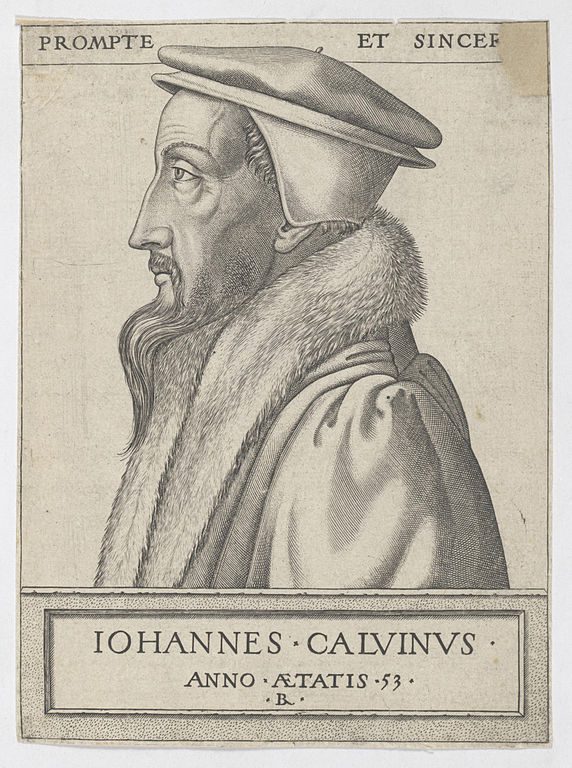
Photo credit: John Calvin at Fifty-Three Years Old (1562), engraving by René Boyvin (1525?-1598?) [public domain / Wikimedia Commons]

***
Calvinism & General Protestantism
Previous Post

September 21, 2018
Dialogue with a Hostile, Anti-Christian Gay Activist
Next Post
September 22, 2018 2nd Council of Orange: "Sola Gratia" vs. Total Depravity
Browse Our Archives
Select a Category & Last Things About Me Anti-Catholicism Atheism & Agnosticism Baptism and Sacramentalism Bible and Tradition Blessed Virgin Mary Books by Dave Armstrong C. S. Lewis Calvinism & General Protestantism Catholic Apologetics Catholic Apologists Catholic conversion Catholic converts Christmas Church (Ecclesiology) Church History Conversion and Converts Development of Doctrine Eastern Orthodoxy Ecumenism & Christian Unity Eucharist & Liturgy Fathers of the Church French Translations G. K. Chesterton Hell Hell & Satan Hell & Satan & Last Things Heresies & Comparative Religion Holistic Health Inquisition & Crusades & Scandals James White Jews & Judaism & Old Testament John Calvin John Henry Newman Liberal / Modernist Theology Life Issues Literary Resume Lutheranism Mariology Martin Luther Music Orthodoxy Papacy & Infallibility Personal Page Philosophy & Science Political & Ethical & Moral Issues Protestant Persecution & Intolerance Protestantism Purgatory Purgatory & Penance Romantic & Imaginative Theology Saints & Purgatory & Penance Salvation Salvation & Justification Satan & Last Things Sexuality and Gender Issues Spanish Translations Traditionalism vs. Radical Catholic Reactionaries Traducciones al español / tradução para português Trinitarianism & Christology Uncategorized Videos
Select a Month October 2026 September 2026 August 2026 July 2026 June 2026 May 2026 April 2026 March 2026 February 2026 January 2026 December 2025 November 2025 October 2025 September 2025 August 2025 July 2025 June 2025 May 2025 April 2025 March 2025 February 2025 January 2025 December 2024 November 2024 October 2024 September 2024 August 2024 July 2024 June 2024 May 2024 April 2024 March 2024 February 2024 January 2024 December 2023 November 2023 October 2023 September 2023 August 2023 July 2023 June 2023 May 2023 April 2023 March 2023 February 2023 January 2023 December 2022 November 2022 October 2022 September 2022 August 2022 July 2022 June 2022 May 2022 April 2022 March 2022 February 2022 January 2022 December 2021 November 2021 October 2021 September 2021 August 2021 July 2021 June 2021 May 2021 April 2021 March 2021 February 2021 January 2021 December 2020 November 2020 October 2020 September 2020 August 2020 July 2020 June 2020 May 2020 April 2020 March 2020 February 2020 January 2020 December 2019 November 2019 October 2019 September 2019 August 2019 July 2019 June 2019 May 2019 April 2019 March 2019 February 2019 January 2019 December 2018 November 2018 October 2018 September 2018 August 2018 July 2018 June 2018 May 2018 April 2018 March 2018 February 2018 January 2018 December 2017 November 2017 October 2017 September 2017 August 2017 July 2017 June 2017 May 2017 April 2017 March 2017 February 2017 January 2017 December 2016 November 2016 October 2016 September 2016 August 2016 July 2016 June 2016 May 2016 April 2016 March 2016 February 2016 January 2016 December 2015 November 2015 October 2015 September 2015 August 2015 July 2015 June 2015 May 2015 April 2015 March 2015 February 2015 January 2015 December 2014 November 2014 October 2014 September 2014 August 2014 July 2014 June 2014 April 2014 March 2014 February 2014 January 2014 December 2013 November 2013 October 2013 September 2013 August 2013 July 2013 June 2013 April 2013 March 2013 February 2013 January 2013 December 2012 November 2012 October 2012 September 2012 August 2012 July 2012 June 2012 May 2012 April 2012 March 2012 February 2012 January 2012 December 2011 November 2011 October 2011 September 2011 August 2011 July 2011 June 2011 April 2011 March 2011 February 2011 October 2010 September 2010 August 2010 July 2010 April 2010 March 2010 December 2009 October 2009 August 2009 July 2009 June 2009 May 2009 March 2009 February 2009 October 2008 September 2008 April 2008 March 2008 February 2008 January 2008 December 2007 November 2007 October 2007 May 2007 March 2007 February 2007 January 2007 November 2006 October 2006 September 2006 August 2006 July 2006 June 2006 May 2006 April 2006 March 2006 February 2006 October 2005 June 2005 April 2005 February 2005 July 2004 May 2004 April 2004
Follow Us!
TAKE THE
Religious Wisdom Quiz
Who had a colorful coat from his father?
Select your answer to see how you score.
David Daniel Isaac Joseph
Books by This Author Books by Dave Armstrong
Related posts from Biblical Evidence for Catholicism

On Protestant Explanations of Catholic Conversion
Biblical Evidence for Catholicism

Bible & Catholicism on Mortal Sin (vs. John...
Biblical Evidence for Catholicism

Dialogue on Eternal Security / Absolute Assurance
Biblical Evidence for Catholicism

Protestant Confessions & "Ever-Virgin" Mary
Biblical Evidence for Catholicism
TRENDING AT PATHEOS Catholic

Pope Leo Celebrates Mass for Nurses & Docs...
I don't have any idea how he did it, but Pope Leo...

The Sermon on the Mount, Part I: Matthew...
The Sermon on the Mount, Part I (Matthew 4:12-5:12) St. Matthew moves...

What's up from Crossway: Reviewing some of their latest A few weeks...

Janie Learns the Way of the Cross: A...
Teaching children about Jesus' Passion can be challenging. Many parents and educators...

Looking For Good Catholic Writing - October 2026
He alone extends the heavens, and he walks upon the waves of...

In "Irreplaceable," our book on vocation and technology, Trevor Sutton and I...
view all Catholic blogs
Ad-Free & Subscriber Log-In Subscription Support
- About Us
- 2026 Calendar
- Videos
- Podcasts
- Library of World Religions
- Faith In Media Tracker
- Advertise With Us
- Write for Us
- Privacy Policy
- Terms of Service
- Do Not Sell My Data
- Contact Us
- Radiant Digital
- Manage Newsletter Subscriptions
- Unsubscribe From Notifications
- Sitemap
Copyright 2008-2026, Patheos. All rights reserved.
Subscription Support Ad-Free & Subscriber Log-In
Follow Patheos