
BuddhistCatholicContemplativeEvangelicalGeneral ChristianHinduJewishLatter-day SaintMuslimNew VisionsProgressive Christian
Beliefs
- Buddhist
- Catholic
- Contemplative
- Evangelical
- General Christian
- Hindu
- Jewish
- Latter-day Saint
- More Voices
- Muslim
- New Visions
- Pagan
- Progressive Christian
Topics
- Religion News
- Food and Religion
- Sports and Religion
- Religious Art
- Religious Music and Entertainment
- Religious Events
- History and Religion
- Style and Religion
- Politics and Religion
- Women in Religion
- Recreation Outdoors and Religion
- Business Finance and Religion
- Careers Workplace and Religion
- Education and Religion
- Family Parenting and Religion
- Health Fitness and Religion
- Home and Religion
- Relationships and Religion
- Technology and Religion
- Travel and Religion
Columnists
- Buddhist Columnists
- Business Finance and Religion Columnists
- Careers Workplace and Religion Columnists
- Catholic Columnists
- Contemplative Columnists
- Education and Religion Columnists
- Evangelists Columnists
- Family Parenting and Religion Columnists
- General Christian Columnists
- Health Fitness and Religion Columnists
- Hindu Columnists
- History and Religion Columnists
- Home and Religion Columnists
- Jewish Columnists
- More Voices Columnists
- Latter Day Columnists
- Muslim Columnists
- New Visions Columnists
- Nonreligious Columnists
- Pagan Columnists
- Politics and Religion Columnists
- Progressive Columnists
- Recreation Outdoors and Religion Columnists
- Relationships and Religion Columnists
- Religion News Columnists
- Religious Art Columnists
- Religious Events Columnists
- Religious Music and Entertainment Columnists
- Sports and Religion Columnists
- Style and Religion Columnists
- Technology and Religion Columnists
- Travel and Religion Columnists
- Women in Religion Columnists
Resource Library
- 2026 Calendar
- Library of World Religions
- The 100 Most Holy Places on Earth
- Patheos Answers
- Podcasts
- Videos
- Faith Leaders Database
- Anglican Episcopalian
- Bahai
- Baptist
- Buddhism
- Christianity
- Confucianism
- Eastern Orthodoxy
- Hinduism
- Holiness and Pentecostal
- ISKCON
- Islam
- Judaism
- Lutheran
- Methodist
- The Church of Jesus Christ of Latter-day Saints
- New Age
- Paganism
- Presbytarian and Reformed
- Protestantism
- Religion Behind the Scenes
- Roman Catholic
- Scientology
- Shia Islam
- Sikhism
- Sufism
- Sunni Islam
- Taoism
- Zen
- See all religions
Research Tools
 Ad-Free & Subscriber Log-In Subscription Support
Ad-Free & Subscriber Log-In Subscription Support
Follow Patheos 

- Trending:
- Forgiveness
- |
- Marriage
- |
- Consciousness
- |
- Death Penalty
- |
- Election
- |
- Halloween

-
About
-
Catholic Apologetics
-
Church History
-
Great Apologists
-
Christian Worldview
-
Protestantism & Misc.
- Home
- Catholic
- History and Religion
- Reply on Reasons for the Sunday Mass Obligation
Reply on Reasons for the Sunday Mass Obligation
Last updated on: July 2, 2018 at 12:14 pm by Dave Armstrong
Reply on Reasons for the Sunday Mass Obligation 2018-07-02T12:14:27-04:00 Dave Armstrong
Patheos Explore the world's faith through different perspectives on religion and spirituality! Patheos has the views of the prevalent religions and spiritualities of the world.
Taylor D. Barrett is a Catholic, who commented underneath an article of mine on this topic. This is my response. His words will be in blue.
*****
Enjoy the blog,
Thanks!
but this one always gets me. Coming from a Protestant Evangelical background, the Sunday Obligation just seems to extraordinarily legalistic. Reading St. John Chrysostom’s commentary on Galatians 5 right now, where he comments that Christ profits you nothing if you get circumcised because getting circumcised means you fear the law and do not trust grace, and if you do not trust grace you cannot benefit from it. Now, of course, in context the Law is the Mosaic Law.
Yes; that is the important thing to note there. We are no longer bound to the entire Mosaic Law. It doesn’t follow, however, that we are bound to no rules or laws or “regulations” at all.
But I fight the idea that there is a spiritual principle here, that if you’re trying to do some good thing out of fear that you will not be saved if you don’t, then you are not trusting grace. Therefore, doing the good deed of going to Mass on Sunday out of fear that you won’t be saved if you don’t could be seen as a lack of trust in grace, and if that’s the case, then such a posture would make Christ of no effect in our lives.
I would deny the premise and note that it seems to me that most serious Catholics are not going to Mass every Sunday in abject fear of mortal sin or losing their salvation (i.e., as their primary or main reason), but rather, because they love it; they want to go, and understand the joy and necessity of regular assembly with other believers and receiving Our Lord in the Holy Eucharist, which gives us all sort of power and sustenance to face the trials and challenges of life.
I agree that if a person is only going because it’s required, out of some foolish sense of legalism-only, that it would be improper and blameworthy, and would definitely be indicative of a dim understanding of what the Catholic Christian life is about. On the other hand, they deserve credit for at least going in the first place, rather than not going at all. More on that below . . .
Now, I realize the response to this is probably that we must avoid sin out of fear we will not be saved, and therefore, there is not some general principle about not doing things out of fear we won’t be saved. But it seems to me there is a difference between avoiding doing evil in order to remain in grace and thinking one must do good in order to be saved. I guess the only response would be that in the case of circumcision, the Law has been fulfilled and is not a requirement, so therefore, trying to obey it is a contradiction of the Gospel which fulfilled it…. while, in regards the Sunday obligation, to miss without reason would be to deliberately forsake an opportunity for communion with Christ, which could definitely be seen as an evil action: although I would probably classify it more as foolish and/or lazy rather than evil/sinful .
Though some would probably question if there is any difference between those categories, I think there is some difference between neglecting what’s good and deliberately doing what’s evil. At least, a degree of difference. Anyways, I am trying to fully embrace the grace of God and trust in Him completely for the free gift of mercy and salvation that comes to us through faith, but these “hang-ups” seem to get in the way. Or maybe I am just deceived on the issue and there is absolutely nothing contradictory about believing in the Sunday obligation as a potential mortal sin and completely trusting in the free gift of grace for salvation. May Christ help me. Amen.
I think you are hitting upon the main point at the end: “there is absolutely nothing contradictory about believing in the Sunday obligation as a potential mortal sin and completely trusting in the free gift of grace for salvation.” That’s a true statement. We can all fall into legalism (or the opposite error of license and antinomianism): being human and sinful. But as we advance in the Christian life we have to progress beyond that.
I think you’re approaching it in the wrong way; from a flawed perspective. The Mass obligation is not about rules, but about “spiritual normalcy” or “spiritual bare minimum obligations.” The Christian needs to worship with fellow believers, as a good and helpful thing:
Hebrews 10:24-25 (RSV) and let us consider how to stir up one another to love and good works, [25] not neglecting to meet together, as is the habit of some, but encouraging one another, and all the more as you see the Day drawing near. (“classic” KJV rendering: “Not forsaking the assembling of ourselves together”)
Acts 20:7 On the first day of the week, when we were gathered together to break bread, . . .
Acts 12:12 When he realized this, he went to the house of Mary, the mother of John whose other name was Mark, where many were gathered together and were praying.
Acts 13:44 The next sabbath almost the whole city gathered together to hear the word of God.
Acts 14:27 And when they arrived, they gathered the church together and declared all that God had done with them, and how he had opened a door of faith to the Gentiles. (cf. 15:6, 30)
Psalm 102:22 when peoples gather together, and kingdoms, to worship the LORD.
It’s fundamental to Christianity (and its precursor, Judaism) to gather together to worship the Lord, and to engage in liturgy, rite, and ritual. It’s plain in Scripture that this is a good and worthy and spiritually helpful thing.
All the Church is saying is that it is so important that it should be made obligatory for the Catholic who has voluntarily submitted to the authority of the Church. We make things mandatory because of their importance. If you want to get married, you have to do it the proper way, by the rules, and in front of the Church community. You don’t just run off and proclaim yourselves married, because the traditional ritual is supposedly “legalistic” and implies a mere fear of losing salvation if someone doesn’t do it.
No! We do it the right way because that’s how the Church has determined that it ought to be done. No one is going through a wedding ceremony thinking that they would be guilty of mortal sin if they hadn’t done it (in this case, fornication); rather, they are joyfully experiencing it, in all its glorious meaning and significance. It’s the same with the Mass.
Those who are spiritually weak and in an elementary stage of learning may think it is a drudgery to drag themselves out of bed every Sunday to attend because, well, they “have” to. Those who have advanced and understand the faith beyond a primitive stage will joyfully, voluntarily do it.
But the law and the obligation is there for those who are weak, because human nature requires rules before it can properly understand a willing and voluntary spirit, because something is good to do. That’s why we have lots of rules for children, because they are too young to make wise choices. The older they get, the less rules are necessary, or else they “self-supervise.”
It seems to me that you may be struggling with scrupulosity. Just a hunch . . . but if not, that does account for many struggles among those who have that tendency: with the whole aspect of “legalism” and rules and commitments, etc.: wondering whether we are condemned and whether God is constantly “after” us. That’s not how biblical or Catholic faith works. It’s simply one particular psychological outlook that brings about such anxiety, rather than the essence of how rules and laws function in a religious context.
The following related remarks of mine were written in January 2008. They were in response to the comments of a Protestant seriously considering Catholicism. First I had written:
Like many Catholic things, this is widely misunderstood as yet another legalistic burden, whereas Church attendance ought to be seen as a privilege and joy, and as an extension of the OT Sabbath principle.
I think it’s one of those things that Protestants object to that show they have too much time on their hands, along with. e.g., crucifixes: “those goofy Catholics are meditating on Jesus dying for us???!!! We can’t have that!” Carping on and on about compulsory church attendance seems to me to be another huge non-issue.
This person took issue with my characterization and stated that legalism was indeed a serious problem to address and that “there is a difference between doing something because we are told and doing something because it’s a response of love ” and “my response to the Mass is first an act of love and faith. If it’s simply an obligation, then my heart has not found it’s hope. It is a ritual with no meaning other than a symbol.” I replied in turn:
I agree with virtually all of what you wrote.
The thing I would note in this regard is that not all Christians, by a long shot, are motivated out of sheer love for the Lord and desire to please Him and to lead a saintly life. In fact, I would argue that this lamentable deficiency is true most of the time for everyone, no matter how pious or devout. We tend to “coast” in our spiritual life and not to make a positive effort to be all that we can be, so to speak.
The Church in her wisdom, recognizes this, and so makes something compulsory, lest this tendency to laxity cause many to not attend church. Is that a good thing all in all or a bad one? Is it a “net gain”? Of course it is good. It’s better to have someone be in Church, even though they are not perfectly motivated from the heart and soul, than not to be there, and sitting at home watching the Sunday morning news shows.
It’s another “both/and” scenario: I don’t have to disagree with you about the ideals of the Christian life: wholehearted service to God and completely pure motivation: doing everything for the right reasons, by God’s grace. I also don’t have to quibble with the Church’s wisdom in requiring church attendance, for the sake of those Christians who are merely “coasting” in their spiritual life, going through the motions without much heart or interior motivation.
Both are good. We all should strive for the ideal, and pray for God’s grace to achieve it, but we should also be glad that many a Joe Q. Catholic is in the pews even though he is there because he has to be there, not because he wants to be. God in His mercy accepts millions of His followers (at the “spiritual milk” stage) as they are, warts and all.
Related reading:
Why Is It a Mortal sin to Miss Mass? (Fr. Ray Ryland, This Rock, July 2000)
Forget Mass? Not a Mortal Sin (Karl Keating, This Rock, Nov. 2003)
FAQ About Sunday Obligation: Not Going to Mass (Catholic Doors Ministries)
Sunday Obligation (Jimmy Akin)
Fulfilling the Sunday Obligation on Saturday [+ Part Two] (Jimmy Akin)
***
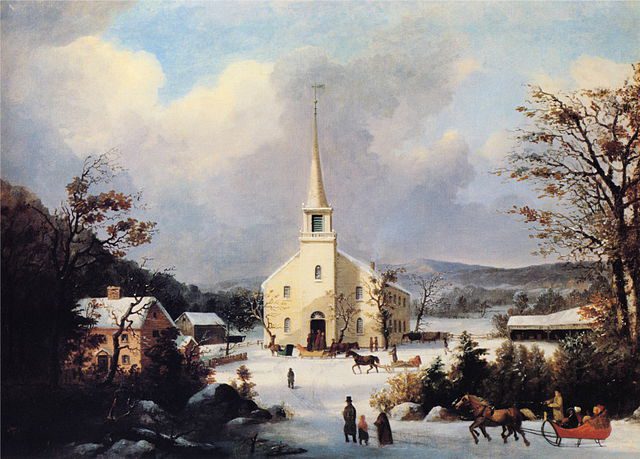
Photo credit: Going to Church (1853), by George Henry Durrie (1820-1863) [public domain / Wikimedia Commons]

***
Previous Post

June 25, 2018
Reply to a Condescending Agnostic Re Science
Next Post

June 26, 2018 Thought Experiments w an Atheist About God / No God
Browse Our Archives
Select a Category & Last Things About Me Anti-Catholicism Atheism & Agnosticism Baptism and Sacramentalism Bible and Tradition Blessed Virgin Mary Books by Dave Armstrong C. S. Lewis Calvinism & General Protestantism Catholic Apologetics Catholic Apologists Catholic conversion Catholic converts Christmas Church (Ecclesiology) Church History Conversion and Converts Development of Doctrine Eastern Orthodoxy Ecumenism & Christian Unity Eucharist & Liturgy Fathers of the Church French Translations G. K. Chesterton Hell Hell & Satan Hell & Satan & Last Things Heresies & Comparative Religion Holistic Health Inquisition & Crusades & Scandals James White Jews & Judaism & Old Testament John Calvin John Henry Newman Liberal / Modernist Theology Life Issues Literary Resume Lutheranism Mariology Martin Luther Music Orthodoxy Papacy & Infallibility Personal Page Philosophy & Science Political & Ethical & Moral Issues Protestant Persecution & Intolerance Protestantism Purgatory Purgatory & Penance Romantic & Imaginative Theology Saints & Purgatory & Penance Salvation Salvation & Justification Satan & Last Things Sexuality and Gender Issues Spanish Translations Traditionalism vs. Radical Catholic Reactionaries Traducciones al español / tradução para português Trinitarianism & Christology Uncategorized Videos
Select a Month October 2026 September 2026 August 2026 July 2026 June 2026 May 2026 April 2026 March 2026 February 2026 January 2026 December 2025 November 2025 October 2025 September 2025 August 2025 July 2025 June 2025 May 2025 April 2025 March 2025 February 2025 January 2025 December 2024 November 2024 October 2024 September 2024 August 2024 July 2024 June 2024 May 2024 April 2024 March 2024 February 2024 January 2024 December 2023 November 2023 October 2023 September 2023 August 2023 July 2023 June 2023 May 2023 April 2023 March 2023 February 2023 January 2023 December 2022 November 2022 October 2022 September 2022 August 2022 July 2022 June 2022 May 2022 April 2022 March 2022 February 2022 January 2022 December 2021 November 2021 October 2021 September 2021 August 2021 July 2021 June 2021 May 2021 April 2021 March 2021 February 2021 January 2021 December 2020 November 2020 October 2020 September 2020 August 2020 July 2020 June 2020 May 2020 April 2020 March 2020 February 2020 January 2020 December 2019 November 2019 October 2019 September 2019 August 2019 July 2019 June 2019 May 2019 April 2019 March 2019 February 2019 January 2019 December 2018 November 2018 October 2018 September 2018 August 2018 July 2018 June 2018 May 2018 April 2018 March 2018 February 2018 January 2018 December 2017 November 2017 October 2017 September 2017 August 2017 July 2017 June 2017 May 2017 April 2017 March 2017 February 2017 January 2017 December 2016 November 2016 October 2016 September 2016 August 2016 July 2016 June 2016 May 2016 April 2016 March 2016 February 2016 January 2016 December 2015 November 2015 October 2015 September 2015 August 2015 July 2015 June 2015 May 2015 April 2015 March 2015 February 2015 January 2015 December 2014 November 2014 October 2014 September 2014 August 2014 July 2014 June 2014 April 2014 March 2014 February 2014 January 2014 December 2013 November 2013 October 2013 September 2013 August 2013 July 2013 June 2013 April 2013 March 2013 February 2013 January 2013 December 2012 November 2012 October 2012 September 2012 August 2012 July 2012 June 2012 May 2012 April 2012 March 2012 February 2012 January 2012 December 2011 November 2011 October 2011 September 2011 August 2011 July 2011 June 2011 April 2011 March 2011 February 2011 October 2010 September 2010 August 2010 July 2010 April 2010 March 2010 December 2009 October 2009 August 2009 July 2009 June 2009 May 2009 March 2009 February 2009 October 2008 September 2008 April 2008 March 2008 February 2008 January 2008 December 2007 November 2007 October 2007 May 2007 March 2007 February 2007 January 2007 November 2006 October 2006 September 2006 August 2006 July 2006 June 2006 May 2006 April 2006 March 2006 February 2006 October 2005 June 2005 April 2005 February 2005 July 2004 May 2004 April 2004
Follow Us!
TAKE THE
Religious Wisdom Quiz
Who fell out of a window and was restored to life by Paul?
Select your answer to see how you score.
Silas Barnabas Eutychus Timothy
Books by This Author Books by Dave Armstrong
Related posts from Biblical Evidence for Catholicism

The Mass & Development of Doctrine (vs. Wes...
Biblical Evidence for Catholicism

Miraculous Eucharist (vs. Francois Turretin #4)
Biblical Evidence for Catholicism

God's Presence, the Ark, the Eucharist, & Death
Biblical Evidence for Catholicism
Protestant Eucharistic Objections Fail (Turretin)
Biblical Evidence for Catholicism
TRENDING AT PATHEOS Catholic

In "Irreplaceable," our book on vocation and technology, Trevor Sutton and I...

I was strolling through the top floor of the brand new Parthenon...

What Does Gêvâh Mean For Kimberley Guifoyle &...
This week, a lot of the news is focused on Kimberly Guilfoyle....

INNER CIRCLE: Profound Mystery (Of Christ In All...
Ephesians 5:31-32 “For this reason, a man will leave his father and...

Do Not Rejoice When Your Enemy Falls: The...
Turning an execution into a public spectacle is a disturbing expression of...

'The Chosen' S6 Trailer: The Passion Gets Very...
Not many watching 'The Chosen' worry about spoilers, but just because they...
view all Catholic blogs
Ad-Free & Subscriber Log-In Subscription Support
- About Us
- 2026 Calendar
- Videos
- Podcasts
- Library of World Religions
- Faith In Media Tracker
- Advertise With Us
- Write for Us
- Privacy Policy
- Terms of Service
- Do Not Sell My Data
- Contact Us
- Radiant Digital
- Manage Newsletter Subscriptions
- Unsubscribe From Notifications
- Sitemap
Copyright 2008-2026, Patheos. All rights reserved.
Subscription Support Ad-Free & Subscriber Log-In
Follow Patheos