
BuddhistCatholicContemplativeEvangelicalGeneral ChristianHinduJewishLatter-day SaintMuslimNew VisionsProgressive Christian
Beliefs
- Buddhist
- Catholic
- Contemplative
- Evangelical
- General Christian
- Hindu
- Jewish
- Latter-day Saint
- More Voices
- Muslim
- New Visions
- Pagan
- Progressive Christian
Topics
- Religion News
- Food and Religion
- Sports and Religion
- Religious Art
- Religious Music and Entertainment
- Religious Events
- History and Religion
- Style and Religion
- Politics and Religion
- Women in Religion
- Recreation Outdoors and Religion
- Business Finance and Religion
- Careers Workplace and Religion
- Education and Religion
- Family Parenting and Religion
- Health Fitness and Religion
- Home and Religion
- Relationships and Religion
- Technology and Religion
- Travel and Religion
Columnists
- Buddhist Columnists
- Business Finance and Religion Columnists
- Careers Workplace and Religion Columnists
- Catholic Columnists
- Contemplative Columnists
- Education and Religion Columnists
- Evangelists Columnists
- Family Parenting and Religion Columnists
- General Christian Columnists
- Health Fitness and Religion Columnists
- Hindu Columnists
- History and Religion Columnists
- Home and Religion Columnists
- Jewish Columnists
- More Voices Columnists
- Latter Day Columnists
- Muslim Columnists
- New Visions Columnists
- Nonreligious Columnists
- Pagan Columnists
- Politics and Religion Columnists
- Progressive Columnists
- Recreation Outdoors and Religion Columnists
- Relationships and Religion Columnists
- Religion News Columnists
- Religious Art Columnists
- Religious Events Columnists
- Religious Music and Entertainment Columnists
- Sports and Religion Columnists
- Style and Religion Columnists
- Technology and Religion Columnists
- Travel and Religion Columnists
- Women in Religion Columnists
Resource Library
- 2026 Calendar
- Library of World Religions
- The 100 Most Holy Places on Earth
- Patheos Answers
- Podcasts
- Videos
- Faith Leaders Database
- Anglican Episcopalian
- Bahai
- Baptist
- Buddhism
- Christianity
- Confucianism
- Eastern Orthodoxy
- Hinduism
- Holiness and Pentecostal
- ISKCON
- Islam
- Judaism
- Lutheran
- Methodist
- The Church of Jesus Christ of Latter-day Saints
- New Age
- Paganism
- Presbytarian and Reformed
- Protestantism
- Religion Behind the Scenes
- Roman Catholic
- Scientology
- Shia Islam
- Sikhism
- Sufism
- Sunni Islam
- Taoism
- Zen
- See all religions
Research Tools
 Ad-Free & Subscriber Log-In Subscription Support
Ad-Free & Subscriber Log-In Subscription Support
Follow Patheos 

- Trending:
- Forgiveness
- |
- Marriage
- |
- Consciousness
- |
- Death Penalty
- |
- Election
- |
- Halloween

-
About
-
Catholic Apologetics
-
Church History
-
Great Apologists
-
Christian Worldview
-
Protestantism & Misc.
- Home
- Catholic
- History and Religion
- Keating & “The Francis Feud”: Six Errors Documented
Keating & “The Francis Feud”: Six Errors Documented
Last updated on: June 6, 2026 at 12:35 am by Dave Armstrong
Keating & “The Francis Feud”: Six Errors Documented 2026-06-06T00:35:44-04:00 Dave Armstrong
Patheos Explore the world's faith through different perspectives on religion and spirituality! Patheos has the views of the prevalent religions and spiritualities of the world.
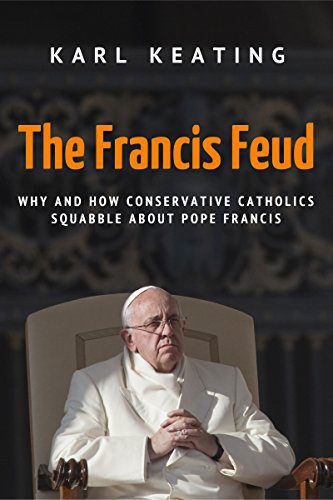
I have to temporarily suspend my policy of not writing about the pope, because now we have a book by well-known and respected apologist and Catholic author, Karl Keating (whom I have greatly admired for 28 years and always call “the father of modern Catholic apologetics”) taking me to task (I’m literally mentioned / critiqued about 99 times) for defending the pope and analyzing those whom I think are greatly at fault in their treatment of him. It’s a strange world we live in.
Karl has also said very nice things about my work (e.g., “He’s done much good for thousands of people”; “You’ve done yeoman work over the decades”), wanted to hire me to work for Catholic Answers in 2011 (he asked me in person at their office; I declined because we were taking care of my elderly mother in Michigan), even raised money for me in 2013, and published one of my books with Catholic Answers. I’ve been published in Catholic Answers Magazine seven times [one / two / three / four / five / six / seven], and have appeared on Catholic Answers Live twice [listen here: one / two].
I’ve also defended Catholic Answers many times when it was attacked: including when Michael Voris went after Keating because of his salary of $250,000 (public information). I don’t think any of that was mentioned, though he did say some nice words about my apologetics in the book (which I appreciate). But it’s not like I have no working association with the apostolate that he founded. I have all kinds of connections with it: going back all the way to 1993, when CA published my conversion story. We’re not antagonists; we’re colleagues. Tim Staples graciously wrote about me:
Every so often, I recommend great apostolates, websites, etc. And I am very careful to recommend only the very best that are entirely Catholic and in union with the Church. Dave Armstrong’s Biblical Evidence for Catholicism site is one of those.
I guess in a way it’s a compliment that he thought my critiques in this regard were of such importance that he had to spend pages and pages on them in his book. Maybe a lot of folks will follow the links provided and read them in their entirety. And hopefully they will comprehend what I am contending for better than Karl has.
I bought the book last night and was able to heavily skim the (considerable) parts devoted to me, and I don’t see any terrible “bum raps” to speak of. Although I could easily disagree with a hundred little things (I have neither time nor desire to do that), he did take pains to try to present my positions fairly and to cite me at great length and provide links, if readers seek more context. That’s way more than almost all dialogical opponents of mine (in cases of substantial disagreement) do. That said, there are just a few things that beg to be addressed:
1) Do I think that papal criticism will inexorably descend to sedevacantism (the slippery slope)? Karl stated:
Armstrong has speculated that papal critics such as Phil Lawler and Ross Douthat will end up as sedevacantists, but that speculation is without warrant.
I haven’t even classified two of the three papal critics with books (Lawler and Douthat) as “radical Catholic reactionaries.” I have classified Sire as that, because he is far more extreme than the other two. Keating appears to have gotten this false notion from one of my statements in one of our dialogues on Phil Lawler, posted on my website. I wrote (italics and bolding added presently):
As one who is personally familiar with the trajectory of people like Robert Sungenis and Gerry Matatics (former employee of Catholic Answers), it’s remarkable to me that you don’t see any of these warning signs. Time will tell, won’t it? Lawler’s not a reactionary now, but he may yet be. And if he ends up there, I called it, and warned people that it was coming, just as I warned people like Mario Derksen in 2000 that he was on the road to possible schism (he shortly thereafter became a sedevacantist, like Matatics). The reactionaries themselves think he is on the road, and so do I. I could be wrong, of course. I hope I am. But his book will do great damage whether he descends to full-fledged reactionary status or not.
As can readily be seen, I think, sedevacantism was merely mentioned in passing, as a relevant fact about one person. The essential point being made was that various people have become reactionaries (see my definition). Indeed, Karl wrote in his book about one such odyssey: the sad case of Louie Verrecchio, who used to be an ardent defender of Vatican II. That’s all I’m saying about Lawler. I see two of the four signs in him that are my criteria for categorizing someone as a reactionary. So he may go that route. I have not — if memory serves — said he would for sure, even become a reactionary (and I don’t believe that now, as I write), let alone adopt the far worse error of sedevacantism. If I were a betting man, I would bet against that happening (by a wide margin).
2) Do I call every papal critic a “pope basher“? Karl wrote in one of our dialogues:
It looks as though you’re saying that people you label as “pope bashers” (a category that seems to include just about everyone who criticizes the pope, including Phil Lawler, Carl Olson, Ross Douthat, and others) have taken up their positions or have worked up their criticisms chiefly due to their own sins.
If this is what you mean, then your position is like that of the SJWs [“social justice warriors”] that Rod Dreher so often writes about: people who think that those who disagree with them not just are wrong but are wrong because they are bad people.
If this isn’t what you mean, then you need to be far more careful in how you express yourself.
I worry about the totalizing tone of more and more of your writing.
And again in the book under consideration:
[W]hen defending Francis he commonly has resorted to tossing around labels and even to name calling. The most common epithet has been “pope basher,” his term for those who display criticism of Francis. . . .
[H]e applies the term to just about anyone who criticizes the pope, including not just authors Henry Sire, Phil Lawler, and Ross Douthat but to others who have disagreed with Armstrong online.
My position as regards this accusation was made crystal-clear in the same article of mine from just six weeks ago:
I’m not saying they are “bad people” at all. I’m saying they are good people who believe in a thing that is wrong. That is one of the deep tragedies of this whole mess we are in now. There are all kinds of reasons besides sin that people come to believe in erroneous things.
Note that I was referring to “non-reactionary folks” who oppose the pope to one degree or another. That means that Lawler and Douthat and [Carl] Olson and yourself were all included in that appraisal, since I have classified none of you as “reactionary.” I have only classified the extremist Henry Sire that way (and I explained exactly why, documenting his own views at length), and folks like Steve Skojec and Chris Ferrara and Louie Verrecchio (who also appears to be sedevacantist or nearly so).
In the same article, I precisely explained that I make distinctions among papal critics. I wrote: “Today we are blessed with both pope bashers (the usual suspect reactionaries and also non-reactionaries like Phil Lawler and Ross Douthat), and non-reactionary ‘papal nitpickers.’ Carl is in the latter category.”
That is a distinction: the very one that you are calling for (I’d also say that you are in the nitpicker category). I went on in the article to distinguish the categories of nitpickers and bashers several times. No one could possibly miss my meaning or intent.
3) Do I lump virtually everyone who prefers the Extraordinary Form Mass (aka Tridentine / Old) into the class of folks who “bash” or “blast” the Ordinary Form? Karl writes:
To him, people who prefer the old rite don’t have mere reservations about the new rite. They “blast” it. Some people indeed “blast” it, at least in certain Traditionalist quarters. But not everyone — perhaps not most people — who find fault with the Ordinary Form ought to be accused of “blasting” it.
This is not the case at all. He seems unaware that I have attended Latin Mass (though the Ordinary Form) at a very reverent and liturgically traditional parish (since 1991), and occasionally the EF as well (I did a few Christmases ago). The parish I attended until about a year ago in Detroit (St. Joseph), was one of the few that offered the EF: at least for some of the Masses.
I’ve repeatedly noted that I have no problem whatever with liturgical preference one way or the other (see many articles along these lines on my Eucharist / Liturgy web page). I always say, “worship and let worship.” I only have a problem with those who do bash the OF in no uncertain terms, causing divisiveness and ill will. I’ve never ever said nor implied nor thought that all or even most who attend the EF Mass do that. But some assuredly do, and create a false dichotomy that the Church condemns.
I’ve been an advocate for Catholics having a wider availability of the Old Mass ever since my conversion in 1990 (I attended an EF in 1991; we had to go across the river from Detroit to Windsor, Ontario to find one then). I was thus publicly in favor of what Pope Benedict proclaimed in 2007, 17 years before he made it “official Church policy.” If that’s not “pro-Old Mass” I don’t know what is. So he’s dead wrong in this respect and it is a very odd criticism indeed. I consider myself very close to a traditionalist position.
We see a pattern by now: it’s broad-brushing and not reading what I write carefully enough, so that he misses nuances and complexities and qualifications and clarifications. Sad to say, this has been a tendency of Karl’s in many of the relatively infrequent dialogues we have engaged in. I find myself quite often correcting him about something or other in my thought or writing, because he doesn’t grasp it, or (unwillingly, of course) misrepresents what I have argued.
And so he does it again in his book, which is unfortunate for him, because now I am pointing it out, and I think it reveals him to be rather sloppy in his research. One must be accurate. I think once one reads my side of things, the true picture looks very different indeed.
4) Karl makes claims about what Phil Lawler supposedly did not claim or insinuate (i.e., [what else?!] that I was supposedly warring against straw men at times: such as about the hell controversies). Karl’s take and interpretation of Lawler is by no means unarguable: based on plain language, logic, and common sense.
Regarding the doctrine of hell, Keating writes in the book, “there is no indication that Lawler thinks Francis is heterodox on the point.” Rather, Karl says that Lawler merely “bemoans the confusion” and “faults the pope for carelessness.”
Well, that is certainly not the whole picture. It’s not in his book, but note what Lawler stated in his article, “Confusion—now about hell—is the hallmark of this pontificate” (3-29-18; italics in original):
Then again, maybe the quotations were accurate. In 2015, Scalfari made a similar report that the Pope had denied the reality of hell. If that report was inaccurate, why didn’t Pope Francis correct him in subsequent conversations, so that he would not make the same error again? For that matter, why doesn’t the Pontiff issue a statement of his own, right now, affirming that he does believe in hell? . . .
Pope Francis cannot deny the existence of hell without directly contradicting the teaching of the Church. But he can create confusion, and he has done so once again. Did he deny, or at least question, the existence of hell? We don’t know.
Countless thousands of puzzled people have now heard that the Pope believes there is no hell. Maybe he was misquoted; maybe he had intended a different message.
Plainly, Lawler is saying over and over that at the very least it may be the case that the pope denies hell. It’s a live option in his mind. He didn’t flat-out deny that possibility and restrict himself solely to the “confusion” / weird Scalfari pseudo-“quotations” issue. To make out that he is doing the latter simply is not accurate, and misrepresents what Lawler has done in this instance and several others (that I have critiqued).
Now, how did Phil Lawler express the same issue regarding hell in his book? It was in precisely the same ambiguous / cynical / ambivalent mode. He wrote: “This time Francis—at least as interpreted by his favorite interviewer—appeared to cast doubt on the existence of hell”. Keating and Lawler will highlight the fact that he qualified it. Yes, he did, but the damage is still done; that’s my point. People will see “appeared to cast doubt on the existence of hell” and not “at least as interpreted by his favorite interviewer.” Lawler then cited the 93-year-old atheist Scalfari’s “citations” of the pope, that really aren’t that, and let it hang.
As I pointed out in my withering critique of this, it’s irresponsible to treat anyone that way, let alone the pope. If there is doubt, then by all means, clear it up for the reader. That’s why I said that I had to do his work for him (by citing many clear statements from Pope Francis, strongly asserting the doctrine of eternal hellfire). Lawler should have done that, if he was trying to do responsible, educational, orthodox, conscientious Catholic journalism, and not merely sensationalistic rumormongering.
A responsible journalist is not cynically selective and incomplete like that. Rather, he will point out all the facts; for example (as I did), that Scalfari also has reported that Pope Francis denies the existence of heaven and purgatory as well as hell. I verified that from papal critic Sandro Magister. Scalfari lives in a fantasy land.
But Lawler won’t do that because, as we know from his Introduction, he believes that Pope Francis is deliberately seeking to subvert Catholic tradition and doctrine. He wrote there, that Pope Francis is (allegedly):
. . . leading the Church away from the ancient sources of the Faith. . . . a source of division. . . . radical nature of the program that he is relentlessly advancing. . . . encouraged beliefs and practices that are incompatible with the prior teachings of the Church. If that complaint is justified, he has violated the sacred trust that is given to Peter’s successors. . . . a Roman pontiff who disregarded so easily what the Church has always taught and believed and practiced on such bedrock issues as the nature of marriage and of the Eucharist . . . a danger to the Faith . . .
Obviously, hell would be one of those matters that he is supposedly “messing around” with. Context in interpretation involves not just the immediate surrounding paragraphs, but also what the writer has stated elsewhere in the book. Keating is content to ignore that. I am not.
Yet another (third) time, Lawler cast doubt on Pope Francis’ actual view on hell (as opposed to complaining about confusion only). He did this in his article, “Yes, the Pope is a Catholic. But he’s confusing other Catholics.” (4-26-18), where he opined, in-between talking out of both sides of his mouth; trying to have it both ways (italics in original):
Pope Francis himself has raised the questions about his own orthodoxy, with a long series of provocative public statements. . . .
When any Pope makes a statement that seems at odds with previous expressions of the faith, it is disquieting. When he makes such statements frequently—and, to compound the problem, declines to clarify them—the result is widespread disorientation.
. . . not that Pope Francis is preaching heresy, but that he has spread confusion about the content of orthodox Catholic belief. . . .
And after all what does Pope Francis believe about Hell? He has alluded to its existence on many occasions. Still it is possible that he might proclaim belief in Hell without accepting anything like the ordinary Catholic understanding of what Hell is. . . .
[see my longer article about the same article and subject matter]
What more proof does Karl Keating need? If he wants to critique everything I say, and build his “case” against me as a non-credible critic of the current crop of vehement papal critics, I encourage him to do the same with Phil Lawler‘s rhetoric. Now, maybe he took off the velvet boxing gloves and did some of that in the book (I’ve only looked at the portions involving me). If so, that would be the first I’ve seen of it, and I would highly commend him.
5) Keating makes exactly the same sort of logical / factual error again in his critique of my criticism of Lawler with regard to the marriage / indissolubility issue, which I dealt with in my article on his Introduction. He wrote:
Here Armstrong causes misdirection. He says that it is up to Lawler to prove that the pope “has now denied the indissolubility of marriage” and that Lawler has failed to do so. . . .
The problem is that Lawler doesn’t claim that Francis denies the indissolubility of marriage. Armstrong misreads him and works up proof against something not asserted.
Okay; let’s look at this more closely, then, to see if Karl’s assertion can withstand scrutiny, or, conversely, whether I was out to sea in my interpretation of Lawler’s meaning and opinion. Here is what Lawler wrote in his Introduction on this topic:
Something snapped inside me on February 24, 2017, when Francis turned the day’s Gospel reading (Mark 10:1–12) into one more opportunity to promote his own view on divorce and remarriage. Condemning hypocrisy and the “logic of casuistry,” the pontiff said that Jesus rejects the approach of legal scholars. True enough. But in his rebuke to the Pharisees, what does Jesus say about marriage?
So they are no longer two but one flesh. What therefore God has joined together, let not man put asunder.
and
Whoever divorces his wife and marries another, commits adultery against her; and if she divorces her husband and marries another, she commits adultery.
. . . in this case, the pope turned the Gospel reading completely upside-down. Reading the Vatican Radio account of that astonishing homily, I found I could no longer pretend that Francis was merely offering a novel interpretation of Catholic doctrine. No, it was more than that. He was engaged in a deliberate effort to change what the Church teaches.
. . . I had criticized St. John Paul II and Benedict XVI when I thought that their actions were imprudent. But never had it crossed my mind that either of those popes posed any danger to the integrity of the Catholic Faith. . . . had there ever before been a Roman pontiff who disregarded so easily what the Church has always taught and believed and practiced on such bedrock issues as the
nature of marriage and of the Eucharist?
From this straightforward statement, we can conclude several things that Lawler believes about Pope Francis:
He has a different (his “own”) [almost certainly meaning, in context, a heterodox / non-traditional] “view on divorce and remarriage.”
He is going beyond “merely” a “novel interpretation of Catholic doctrine” and indeed “engaged in a deliberate effort to change what the Church teaches” [i.e., as regards remarriage and divorce], posed a “danger to the integrity of the Catholic Faith” and “disregarded” constant Catholic tradition regarding “such bedrock issues as the nature of marriage.”
There are only so many ways to interpret these extraordinary claims, according to logic, Catholic moral theology, and English grammar and syntax. I would summarize how I deduced what I did from this, as follows:
- The traditional Catholic view on marriage is that it is lifelong and indissoluble, meaning that there literally is no such thing as divorce (because indissolubility renders it impossible in the nature of the case).
[assumed premise: annulment is not a divorce, but a declaration by the Church that a proper marriage never existed from the start]
Indissolubility is thus the central and essential component of the Catholic view of the nature of marriage. Lawler illustrated this very point in the two biblical passages he mentioned.
Therefore, in order to hold to a different view of marriage than the traditional Catholic view (to “change” or “disregard” it), it seems apparent that one must at the same time undermine / undercut / deny the notion of indissolubility, which is its essence.
Lawler claims that Pope Francis indeed has his “own” view on this matter and that he has turned the Gospel reading (which included the two passages Lawler cited) “completely upside-down”.
Pope Francis is, in so doing, “engaged in a deliberate effort to change what the Church teaches.”
The teaching in question, in context, is the indissolubility of marriage and no divorce, which can only mean that he must deny the central point of Catholic marriage as Jesus and Catholic tradition defines it: indissolubility.
I truly don’t see how there is any other possible way to interpret what Lawler is arguing here. If it’s not as I have interpreted, then I beg Karl or someone else to show me where my reasoning and logic have gone astray. Because of the above chain of reasoning, I wrote in my critique: “he claims that the pope has now denied the indissolubility of marriage.” He didn’t say it that directly, but he did through the inexorable logic (logical deduction) of what he wrote about the topic.
In other words, if Lawler is saying in this context that the pope is trying to change what the Church teaches, what exactly is he trying to change? The overwhelming impression of the entire context is that he is seeking to throw out “no divorce” and the nature of Catholic marriage, which, again, is in its essence, indissolubility. Therefore, I produced direct statements from the pope, showing that in fact he does not deny indissolubility, and chided Lawler for not doing that, as he should have.
6) For the third time, Keating misrepresents what Lawler asserted, by wrongly disagreeing with my interpretation of what Lawler actually contended in his book: this time as regards homosexuality. Keating states:
He does something similar with Lawler’s criticism of the pope’s “Who am I to judge?”comment . . . Armstrong offers several citations that demonstrate that Francis isn’t “soft on homosexuality,” but Lawler’s point wasn’t that the pope was “soft” but that he was unclear . . .
Lawler himself makes it clear that he was indeed concerned about compromise and papal laxity on this issue. I cited Lawler’s words from his (below) as proof of that (Karl — perhaps conveniently — did not):
[I]f orthodox Catholics had concluded that Francis would stand firm against homosexual influence within the Church, their confidence was shattered by his remarks to reporters on a trip to Brazil in July 2013. Asked about homosexual priests, he replied, “If they accept the Lord and have good will, who am I to judge them?” [italics added presently]
Sorry, Karl. If English is English and logic is logic, that is not just being concerned about being unclear, but rather, about his actual views; whether he would “stand firm”. And so that is how I responded in my critique on this issue, by showing (through documentation: a thing Lawler too often seems averse to) that Pope Francis is not “soft” on homosexuality at all.
If that proof from Lawler’s book is not itself sufficient to dispose of this faux-criticism of Karl’s, then perhaps Karl himself will be convinced by Lawler’s own words from just eight days ago (“Could Pope Francis be shifting his stand on gay influence?”: 5-25-18), in which he plainly verified his views on the pope and homosexuality up till the time of the article (even using the same terminology: “homosexual influence”), and held out hope (despite his innate skepticism and severe anti-Francis biases) that the pope has “changed”:
No sooner had I spotted one hopeful sign in the Pope’s handling of the Chilean sex-abuse scandal when today’s news brought another. Pope Francis has reaffirmed the Church’s policy barring active homosexuals from seminaries.
I know; I know. This concern about homosexual influence contrasts quite sharply with the Holy Father’s reported advice to a gay Chilean abuse victim to “be happy with who you are.” It contrasts with the most famous words of his pontificate, uttered in response to questioning about a homosexual cleric: “Who am I to judge?” But if Pope Francis is finally recognizing the damage that homosexual influence has done to the Church, that is surely a hopeful sign.
. . . I am not predicting a dramatic change in papal policies now. But stranger things have happened, and surely we can hope.
Pope Francis was severely shaken by the scandal in Chile. Has the jolt changed his attitude toward homosexual influence in the Church? Will it change his attitude toward gay influence at the Vatican? For that matter, will the Pope’s cautions against homosexual seminarians dampen the enthusiasm of some of his most ardent supporters? This issue has at least the potential to bring about a significant change. [italics added presently]
Obviously, if Lawler thinks the pope is open to possible “change” now as regards harmful “homosexual influence” and “gay influence” and “damage” in the Church that he may be “finally recognizing,” which would be (if true) potentially “a significant change,” then it’s plain that he thought he wasn’t doing so before. And that is how I interpreted his words in his book, doubting whether he would “stand firm against homosexual influence.” I think it’s pretty clear that I was right, and accurate, and that Karl is (yet again) wrong and inaccurate in reporting factual matters.
After so many documented instances of Karl being dead wrong, I submit that he is not nearly as good at arguing his case against me as he seems to confidently assume (former lawyer or not). Yeah, lawyers are good at arguing (I admire that about them a lot), but so are apologists with 37 years of experience in that field, and in debating everything under the sun in more than 800 online debates. I can hold my own, too. The proof’s in the pudding, and the “pudding” Karl keeps offering up is pretty lousy and unappealing. If he disagrees, then let him come and overthrow my reasoning and presentation of what I believe are the relevant facts.
***
This is enough of a critique of Keating’s treatment of me in his book. The pattern’s very clear. Pretty much, any further criticism I would offer would merely be a variation of the theme by now well-established:
i. Karl broad-brushes and says I myself broad-brush and believe x about z (i.e., a “straw man”).
ii. I have to waste valuable time explaining that in fact I don’t believe x, but actually y, about z.
iii. Karl soft-pedals and says that Phil Lawler is not actually saying a about alleged papal shortcoming c, but rather, merely b.
iv. I have to waste valuable time documenting that Phil Lawler actually is saying a about alleged papal shortcoming c, and show that it is a bum rap against the Holy Father.
#1-3 above amply illustrate the scenario of i-ii. #4-6 amply illustrate, I think, the scenario of iii-iv (using the controversies over hell, indissolubility, and homosexuality as the case studies of the anti-Francis mentality involved). It’s enough. I have to be a wise steward of my time.
Back to your regularly scheduled program, and I’ll go back to my regular work. I’ve done far more than my share of defending Pope Francis, with a book, a collection of 120 of my own articles, and a huge collection of 344 pro-Francis articles by others as well.
I wish Karl all God’s blessings. None of this is personal (nor do I think his critique was). I admire and respect Karl, and he’s my friend (and he has reiterated in the book that I am his as well). But do I think he is in the wrong, in the above instances and many more concerning Pope Francis and his critics? Yes, I do. The loving thing to do when someone is demonstrably wrong is to correct them. “Faithful are the wounds of a friend” (Prov 27:6, RSV); “reprove a wise man, and he will love you” (Prov 9:8).
***
Photo credit: cover of Karl Keating’s new book, courtesy of his own publishing outfit: Rasselas House, and the Amazon book page.
***
Lost Shepherd: How Pope Francis is Misleading His Flock
radical catholic recationaries
Previous Post
May 31, 2018
Did Jesus Commission the New Testament (or the Disciples?)
Next Post

June 1, 2018 Is Conversion to Catholicism Mainly Emotional or "Doctrinal"?
Browse Our Archives
Select a Category & Last Things About Me Anti-Catholicism Atheism & Agnosticism Baptism and Sacramentalism Bible and Tradition Blessed Virgin Mary Books by Dave Armstrong C. S. Lewis Calvinism & General Protestantism Catholic Apologetics Catholic Apologists Catholic conversion Catholic converts Christmas Church (Ecclesiology) Church History Conversion and Converts Development of Doctrine Eastern Orthodoxy Ecumenism & Christian Unity Eucharist & Liturgy Fathers of the Church French Translations G. K. Chesterton Hell Hell & Satan Hell & Satan & Last Things Heresies & Comparative Religion Holistic Health Inquisition & Crusades & Scandals James White Jews & Judaism & Old Testament John Calvin John Henry Newman Liberal / Modernist Theology Life Issues Literary Resume Lutheranism Mariology Martin Luther Music Orthodoxy Papacy & Infallibility Personal Page Philosophy & Science Political & Ethical & Moral Issues Protestant Persecution & Intolerance Protestantism Purgatory Purgatory & Penance Romantic & Imaginative Theology Saints & Purgatory & Penance Salvation Salvation & Justification Satan & Last Things Sexuality and Gender Issues Spanish Translations Traditionalism vs. Radical Catholic Reactionaries Traducciones al español / tradução para português Trinitarianism & Christology Uncategorized Videos
Select a Month October 2026 September 2026 August 2026 July 2026 June 2026 May 2026 April 2026 March 2026 February 2026 January 2026 December 2025 November 2025 October 2025 September 2025 August 2025 July 2025 June 2025 May 2025 April 2025 March 2025 February 2025 January 2025 December 2024 November 2024 October 2024 September 2024 August 2024 July 2024 June 2024 May 2024 April 2024 March 2024 February 2024 January 2024 December 2023 November 2023 October 2023 September 2023 August 2023 July 2023 June 2023 May 2023 April 2023 March 2023 February 2023 January 2023 December 2022 November 2022 October 2022 September 2022 August 2022 July 2022 June 2022 May 2022 April 2022 March 2022 February 2022 January 2022 December 2021 November 2021 October 2021 September 2021 August 2021 July 2021 June 2021 May 2021 April 2021 March 2021 February 2021 January 2021 December 2020 November 2020 October 2020 September 2020 August 2020 July 2020 June 2020 May 2020 April 2020 March 2020 February 2020 January 2020 December 2019 November 2019 October 2019 September 2019 August 2019 July 2019 June 2019 May 2019 April 2019 March 2019 February 2019 January 2019 December 2018 November 2018 October 2018 September 2018 August 2018 July 2018 June 2018 May 2018 April 2018 March 2018 February 2018 January 2018 December 2017 November 2017 October 2017 September 2017 August 2017 July 2017 June 2017 May 2017 April 2017 March 2017 February 2017 January 2017 December 2016 November 2016 October 2016 September 2016 August 2016 July 2016 June 2016 May 2016 April 2016 March 2016 February 2016 January 2016 December 2015 November 2015 October 2015 September 2015 August 2015 July 2015 June 2015 May 2015 April 2015 March 2015 February 2015 January 2015 December 2014 November 2014 October 2014 September 2014 August 2014 July 2014 June 2014 April 2014 March 2014 February 2014 January 2014 December 2013 November 2013 October 2013 September 2013 August 2013 July 2013 June 2013 April 2013 March 2013 February 2013 January 2013 December 2012 November 2012 October 2012 September 2012 August 2012 July 2012 June 2012 May 2012 April 2012 March 2012 February 2012 January 2012 December 2011 November 2011 October 2011 September 2011 August 2011 July 2011 June 2011 April 2011 March 2011 February 2011 October 2010 September 2010 August 2010 July 2010 April 2010 March 2010 December 2009 October 2009 August 2009 July 2009 June 2009 May 2009 March 2009 February 2009 October 2008 September 2008 April 2008 March 2008 February 2008 January 2008 December 2007 November 2007 October 2007 May 2007 March 2007 February 2007 January 2007 November 2006 October 2006 September 2006 August 2006 July 2006 June 2006 May 2006 April 2006 March 2006 February 2006 October 2005 June 2005 April 2005 February 2005 July 2004 May 2004 April 2004
Follow Us!
TAKE THE
Religious Wisdom Quiz
What city did David capture and make the capital of Israel?
Select your answer to see how you score.
Bethlehem Samaria Jerusalem Hebron
Books by This Author Books by Dave Armstrong
Related posts from Biblical Evidence for Catholicism

Was Peter "Any Old" Apostle? 10 Anti-Papal Arguments
Biblical Evidence for Catholicism

11 Protestant Objections to Papal Authority Debunked
Biblical Evidence for Catholicism

Matthew 16 & the Papacy (vs. Patrick O'Brien)
Biblical Evidence for Catholicism
Inspired Prophets: An Analogy to Infallible Popes
Biblical Evidence for Catholicism
TRENDING AT PATHEOS Catholic

I was strolling through the top floor of the brand new Parthenon...

What Does Gêvâh Mean For Kimberley Guifoyle &...
This week, a lot of the news is focused on Kimberly Guilfoyle....

INNER CIRCLE: Profound Mystery (Of Christ In All...
Ephesians 5:31-32 “For this reason, a man will leave his father and...

Do Not Rejoice When Your Enemy Falls: The...
Turning an execution into a public spectacle is a disturbing expression of...

'The Chosen' S6 Trailer: The Passion Gets Very...
Not many watching 'The Chosen' worry about spoilers, but just because they...

The purpose-driven labor priest
A labor activist reads Rick Warren and it gets me wondering about...
view all Catholic blogs
Ad-Free & Subscriber Log-In Subscription Support
- About Us
- 2026 Calendar
- Videos
- Podcasts
- Library of World Religions
- Faith In Media Tracker
- Advertise With Us
- Write for Us
- Privacy Policy
- Terms of Service
- Do Not Sell My Data
- Contact Us
- Radiant Digital
- Manage Newsletter Subscriptions
- Unsubscribe From Notifications
- Sitemap
Copyright 2008-2026, Patheos. All rights reserved.
Subscription Support Ad-Free & Subscriber Log-In
Follow Patheos