
BuddhistCatholicContemplativeEvangelicalGeneral ChristianHinduJewishLatter-day SaintMuslimNew VisionsProgressive Christian
Beliefs
- Buddhist
- Catholic
- Contemplative
- Evangelical
- General Christian
- Hindu
- Jewish
- Latter-day Saint
- More Voices
- Muslim
- New Visions
- Pagan
- Progressive Christian
Topics
- Religion News
- Food and Religion
- Sports and Religion
- Religious Art
- Religious Music and Entertainment
- Religious Events
- History and Religion
- Style and Religion
- Politics and Religion
- Women in Religion
- Recreation Outdoors and Religion
- Business Finance and Religion
- Careers Workplace and Religion
- Education and Religion
- Family Parenting and Religion
- Health Fitness and Religion
- Home and Religion
- Relationships and Religion
- Technology and Religion
- Travel and Religion
Columnists
- Buddhist Columnists
- Business Finance and Religion Columnists
- Careers Workplace and Religion Columnists
- Catholic Columnists
- Contemplative Columnists
- Education and Religion Columnists
- Evangelists Columnists
- Family Parenting and Religion Columnists
- General Christian Columnists
- Health Fitness and Religion Columnists
- Hindu Columnists
- History and Religion Columnists
- Home and Religion Columnists
- Jewish Columnists
- More Voices Columnists
- Latter Day Columnists
- Muslim Columnists
- New Visions Columnists
- Nonreligious Columnists
- Pagan Columnists
- Politics and Religion Columnists
- Progressive Columnists
- Recreation Outdoors and Religion Columnists
- Relationships and Religion Columnists
- Religion News Columnists
- Religious Art Columnists
- Religious Events Columnists
- Religious Music and Entertainment Columnists
- Sports and Religion Columnists
- Style and Religion Columnists
- Technology and Religion Columnists
- Travel and Religion Columnists
- Women in Religion Columnists
Resource Library
- 2026 Calendar
- Library of World Religions
- The 100 Most Holy Places on Earth
- Patheos Answers
- Podcasts
- Videos
- Faith Leaders Database
- Anglican Episcopalian
- Bahai
- Baptist
- Buddhism
- Christianity
- Confucianism
- Eastern Orthodoxy
- Hinduism
- Holiness and Pentecostal
- ISKCON
- Islam
- Judaism
- Lutheran
- Methodist
- The Church of Jesus Christ of Latter-day Saints
- New Age
- Paganism
- Presbytarian and Reformed
- Protestantism
- Religion Behind the Scenes
- Roman Catholic
- Scientology
- Shia Islam
- Sikhism
- Sufism
- Sunni Islam
- Taoism
- Zen
- See all religions
Research Tools
 Ad-Free & Subscriber Log-In Subscription Support
Ad-Free & Subscriber Log-In Subscription Support
Follow Patheos 

- Trending:
- Forgiveness
- |
- Marriage
- |
- Consciousness
- |
- Death Penalty
- |
- Election
- |
- Halloween

-
About
-
Catholic Apologetics
-
Church History
-
Great Apologists
-
Christian Worldview
-
Protestantism & Misc.
- Home
- Catholic
- History and Religion
- Dialogue with an Atheist on “God of the Gaps”
Dialogue with an Atheist on “God of the Gaps”
Last updated on: June 24, 2018 at 6:59 pm by Dave Armstrong
Dialogue with an Atheist on “God of the Gaps” 2018-06-24T18:59:03-04:00 Dave Armstrong
Patheos Explore the world's faith through different perspectives on religion and spirituality! Patheos has the views of the prevalent religions and spiritualities of the world.
“Anthrotheist” commented in the combox of my post, Dialogue w Atheist on the Origin of the Universe. His words will be in blue.
*****
I can’t help but feel like there is still a “God of the gaps” in effect here.
Of course. I think it’s because that is the stock response of lots of atheists, whenever we dare bring up God at all. Since you guys think He is nonexistent and belief in Him the equivalent of belief in leprechauns and Santa Claus, if we mention Him there has to be some way to dismiss it altogether, and that is usually good ol’ “God of the gaps.” You don’t acknowledge that belief in God can explain anything.
Because theism is not a scientific explanation, you assume it is somehow “anti-science”: thus, the knee-jerk “God of the gaps” objection, which basically is intended to shut down further discussion, since the theist is wrongly thought to be relying on mere silliness and an anti-scientific attitude (which in turn precludes serious discussion, for the materialistic, science-only-sort of person). But honing in on the limitations of science is not anti-science at all.
We could just as easily say that you guys simply substitute the goddess of Time (give it enough time and anything whatever can occur) or the atom-gods: which possess all the remarkable creative and organizational abilities that we ascribe to God, and for no more discernible scientifically established reason than we can attribute to God. I don’t see all that much difference, in an epistemological sense. Both sides must appeal (for lack of any better idea) to notions that are outside of the scientific purview. And that’s okay, and fully to be expected, because science is not the entire sum of human knowledge in the first place.
And in that context of equally nonexistent answers and reasons (from a strictly scientific, empirical perspective), we think God is more plausible as the candidate for having godlike qualities than the atom (or, sub-atomic particles, as it were). That’s not merely “god of the gaps”; rather, it is part and parcel of the serious, respectable philosophical worldview of theism.
It is true that there is no current scientific theory that explains either how life can originate from non-life, or how life did originate from non-life.
I don’t see why there cannot be an understood “yet” at the end of this statement.
There could be, but the problem is that it seems to be an indefinite “yet.” Oftentimes, this mindset is of the danging a carrot: always there, but inevitably out of reach. I often think of scientists, say, 50 years ago, in 1968 and a scenario in which they were asked, “do you think that, 50 years from now, we will have a plausible explanation of a materialistic evolution of life from non-life, and/or proof of extraterrestrial life?” I would venture to guess that some 90% of them would say that one or both of those things would surely have occurred by now. It’s obvious in scientific rhetoric that the explanation or discovery is often widely assumed to be just around the corner.
So it becomes a technique itself (and not a particularly impressive one). They casually assume that science can, or one day will, be able to explain anything whatever (which is a very questionable assumption), because they think matter and time and chance / probability can explain anything (making those three things gods), and because they rule out any possible theistic explanation or the possibility that maybe God didn’t want life anywhere but on earth: that life and human beings indeed are unique in the universe.
On the other hand, if such life is discovered, it doesn’t disprove God in the slightest (even though many will say that it does, just as they have fallaciously done with evolution for over 150 years. Christians like C. S. Lewis have already written about this possibility (as I have myself). Life somewhere else doesn’t “prove” that it could come about through solely materialistic processes, anymore than life on earth has proven that. Scientists don’t have the slightest clue how it supposedly happened. But they will!, they will!, they will! ad infinitum . . .
We didn’t have a scientific theory of most diseases before germ theory, nor any scientific explanation for the diversity of life before the theory of evolution.
The problem is not simply admitting that we don’t know something (scientifically). The problem is that God can never be proposed as the explanation for anything. I agree that Christians have been quick to credit God with what was merely natural; but atheists have also been quick to deny that God could do anything. I find both things equally closed-minded and unreasonable.
This to me is the larger point: looking at a difficult question, one that seems insurmountable, and saying “God did it” doesn’t get you anywhere.
It doesn’t scientifically, because that’s not scientific method. But it can go quite a ways in philosophy and theology: which don’t have the pretense of claiming that their own field of knowledge is the only one that exists.
At best, it pushes the quest for knowledge to the fringes of society to be conducted in secluded and cloistered institutions in relative obscurity (and only indirectly funded by organizations with resources to spare);
If that’s what you call philosophy and theology (mathematics and logic are not empirical, either) . . . I don’t. I think they are fields just as valuable and productive and worthy of respect as science. And once again you simply exhibit your extreme bias and prejudice against non-scientific (not unscientific or anti-scientific! )thinking.
at worst, it produces an attempt at an epistemology derived from forgone conclusions like “Intelligent Design” (i.e., re-branded Creationism).
Intelligent design is not necessarily creationism. Richard Dawkins stated in his book that microbiologist Michael Behe was a creationist. He’s not. He is a theistic evolutionist, as he has clearly stated. But he thinks that materialistic processes cannot adequately explain the complexity of even microbiology alone. He thinks a Designer is required. So do I. And so have great philosophical minds like David Hume (who was not an atheist, and believed in a form of the teleological argument). Einstein was not a theist, but he thought it self-evident that there was a wonder and beauty and (if you will) design to the universe that atheism couldn’t come close to explaining. He didn’t try to explain it by science alone, because he knew that was foolish. And this sense was what he called his own “religion.”
You want to talk about “foregone conclusions”? I have already noted some of your own:
Life must have evolved from non-life, by materialistic processes.
The universe must have come about by purely materialistic processes, based on the potentialities of matter, which originated who knows how?
God and His attributes couldn’t possibly have been the explanation of either of those origins.
We have our beliefs (and reasons for them): “God did it.” You have yours (and no good or plausible reasons for them, that I can see): “God could not possibly have done it.” I don’t see a helluva lot of difference between the two belief-system in this regard. We both accept axioms that have not been demonstrated and quite likely could not be explained or will not ever in fact be fully explained.
I’ve been contemplating a thought experiment for a little while now, maybe a charitable reader of these conversations could provide some feedback.
I will do so (at least partially) myself!
The premise is simple enough: to the degree which it is possible, describe what you would expect a universe to look like if you accept the assumption that the opposite to your belief were true. If you believe in God, imagine a purely material universe;
I think it would be chaotic and that the laws of science would not be what we now observe, because they never would have evolved. Life wouldn’t have evolved because there seems to be no way (by our present knowledge) for it to do so. It’s simply too wonderful and complex to be explained solely by matter, time, and chance. Or, perhaps more likely (since we still have to explain the origin of mater itself), there would be nothing at all.
if you believe in no god, imagine a universe created by God.
I look forward to seeing what atheists say to that. It could be quite entertaining. If they said, “it would look like the world we live in now” then they would have to immediately become a theist. :-)
If possible, accept that there are human beings in the imagined world; that is, by some means human beings have managed to come into existence and survived to the point where this conversation is taking place. How similar could the universe be to your understanding of our actual world and what would have to be different?
I think in that world, the human beings would have no final purpose or meaning to life; no ethics. It would be a terrible world, much like the “worlds” we see in societies that tried to reject Christianity and/or God altogether (Stalin’s Soviet Union, Mao’s China; Hitler’s Germany). I think the good things ultimately derive from a good God, whether folks are aware of it or not.
What would have to be true for it to exist opposite to your beliefs, and what would have to be true for us to exist here as we sit?
That’s the far more interesting question. I would have to be shown that 1) the world can possibly be explained solely through materialistic processes, and 2) that all the arguments for God clearly fail, and 3) that Jesus didn’t exist and the Bible was just a sham.
Since none of those things have remotely been done, I don’t think I’m in any danger of forsaking Christianity or God anytime soon.
I shall end with Christian philosopher Alvin Plantinga’s observation that “God-of-the-gaps theology” is not a thing which many serious, thinking Christians would ever adopt in the first place (i.e., it’s a caricature of what Christians believe, and so a straw man):
God-of-the-gaps theology. . . is at best a kind of anemic and watered-down semideism that inserts God’s activity into the gaps in scientific knowledge; it is associated, furthermore, with a weak and pallid apologetics according to which perhaps the main source or motivation for belief in God is that there are some things science cannot presently explain. A far cry indeed from what the Scriptures teach! God-of-the-gaps theology is worlds apart from serious Christian theism. This is evident at (at least) the following points. First and most important, according to serious theism, God is constantly, immediately, intimately, and directly active in his creation: he constantly upholds it in existence and providentially governs it. He is immediately and directly active in everything from the Big Bang to the sparrow’s fall. Literally nothing happens without his upholding hand.
Second, natural laws are not in any way independent of God, and are perhaps best thought of as regularities in the ways in which he treats the stuff he has made, or perhaps as counterfactuals of divine freedom. (Hence there is nothing in the least untoward in the thought that on some occasions God might do something in a way different from his usual way- e.g., raise someone from the dead or change water into wine.) Indeed, the whole interventionist terminology- speaking of God as intervening in nature, or intruding into it, or interfering with it, or violating natural law- all this goes with God-of-the-gaps theology, not with serious theism. According to the latter, God is already and always intimately acting in nature, which depends from moment to moment for its existence upon immediate divine activity; there is not and could not be any such thing as his intervening in nature.
These are broadly speaking metaphysical differences between Christian theism and God-of-the-gaps thought; but there are equally significant epistemological differences. First, the thought that there is such a person as God is not, according to Christian theism, a hypothesis postulated to explain something or other, nor is the main reason for believing that there is such a person as God the fact that there are phenomena that elude the best efforts of current science. Rather, our knowledge of God comes by way of general revelation, which involves something like Aquinas’s general knowledge of God or Calvin’s sensus divinitatis, and also, and more importantly, by way of God’s special revelation, in the Scriptures and through the church, of his plan for dealing with our fall into sin. . . .
Serious Christians should indeed resolutely reject this way of thinking. The Christian community knows that God is constantly active in his creation, that natural laws, if there are any, are not independent of God, and that the existence of God is certainly not a hypothesis designed to explain what science cannot. Furthermore, the Christian community begins the scientific enterprise already believing in God; it does not (or at any rate need not) engage in it for apologetic reasons, either with respect to itself or with respect to non-Christians. (“Methodological Naturalism”: Perspectives on Science and Christian Faith 49 [September 1997]: 143-154)
*****
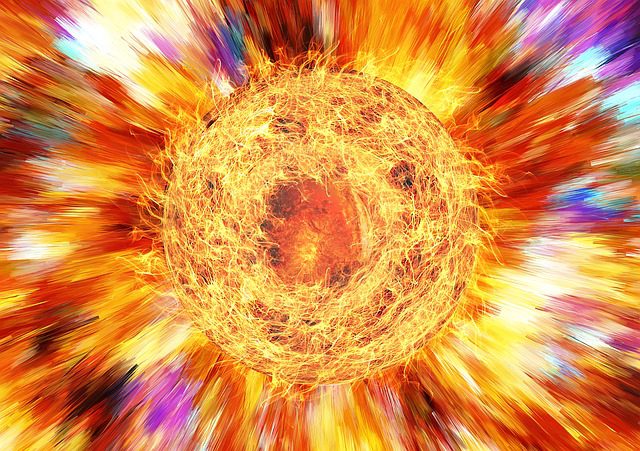
Photo credit: “Big Bang” image [Max Pixel / Creative Commons Zero – CC0. license]
*****
Previous Post

June 23, 2018
Dialogue w Atheist on the Origin of the Universe
Next Post

June 25, 2018 Reply to a Condescending Agnostic Re Science
Browse Our Archives
Select a Category & Last Things About Me Anti-Catholicism Atheism & Agnosticism Baptism and Sacramentalism Bible and Tradition Blessed Virgin Mary Books by Dave Armstrong C. S. Lewis Calvinism & General Protestantism Catholic Apologetics Catholic Apologists Catholic conversion Catholic converts Christmas Church (Ecclesiology) Church History Conversion and Converts Development of Doctrine Eastern Orthodoxy Ecumenism & Christian Unity Eucharist & Liturgy Fathers of the Church French Translations G. K. Chesterton Hell Hell & Satan Hell & Satan & Last Things Heresies & Comparative Religion Holistic Health Inquisition & Crusades & Scandals James White Jews & Judaism & Old Testament John Calvin John Henry Newman Liberal / Modernist Theology Life Issues Literary Resume Lutheranism Mariology Martin Luther Music Orthodoxy Papacy & Infallibility Personal Page Philosophy & Science Political & Ethical & Moral Issues Protestant Persecution & Intolerance Protestantism Purgatory Purgatory & Penance Romantic & Imaginative Theology Saints & Purgatory & Penance Salvation Salvation & Justification Satan & Last Things Sexuality and Gender Issues Spanish Translations Traditionalism vs. Radical Catholic Reactionaries Traducciones al español / tradução para português Trinitarianism & Christology Uncategorized Videos
Select a Month October 2026 September 2026 August 2026 July 2026 June 2026 May 2026 April 2026 March 2026 February 2026 January 2026 December 2025 November 2025 October 2025 September 2025 August 2025 July 2025 June 2025 May 2025 April 2025 March 2025 February 2025 January 2025 December 2024 November 2024 October 2024 September 2024 August 2024 July 2024 June 2024 May 2024 April 2024 March 2024 February 2024 January 2024 December 2023 November 2023 October 2023 September 2023 August 2023 July 2023 June 2023 May 2023 April 2023 March 2023 February 2023 January 2023 December 2022 November 2022 October 2022 September 2022 August 2022 July 2022 June 2022 May 2022 April 2022 March 2022 February 2022 January 2022 December 2021 November 2021 October 2021 September 2021 August 2021 July 2021 June 2021 May 2021 April 2021 March 2021 February 2021 January 2021 December 2020 November 2020 October 2020 September 2020 August 2020 July 2020 June 2020 May 2020 April 2020 March 2020 February 2020 January 2020 December 2019 November 2019 October 2019 September 2019 August 2019 July 2019 June 2019 May 2019 April 2019 March 2019 February 2019 January 2019 December 2018 November 2018 October 2018 September 2018 August 2018 July 2018 June 2018 May 2018 April 2018 March 2018 February 2018 January 2018 December 2017 November 2017 October 2017 September 2017 August 2017 July 2017 June 2017 May 2017 April 2017 March 2017 February 2017 January 2017 December 2016 November 2016 October 2016 September 2016 August 2016 July 2016 June 2016 May 2016 April 2016 March 2016 February 2016 January 2016 December 2015 November 2015 October 2015 September 2015 August 2015 July 2015 June 2015 May 2015 April 2015 March 2015 February 2015 January 2015 December 2014 November 2014 October 2014 September 2014 August 2014 July 2014 June 2014 April 2014 March 2014 February 2014 January 2014 December 2013 November 2013 October 2013 September 2013 August 2013 July 2013 June 2013 April 2013 March 2013 February 2013 January 2013 December 2012 November 2012 October 2012 September 2012 August 2012 July 2012 June 2012 May 2012 April 2012 March 2012 February 2012 January 2012 December 2011 November 2011 October 2011 September 2011 August 2011 July 2011 June 2011 April 2011 March 2011 February 2011 October 2010 September 2010 August 2010 July 2010 April 2010 March 2010 December 2009 October 2009 August 2009 July 2009 June 2009 May 2009 March 2009 February 2009 October 2008 September 2008 April 2008 March 2008 February 2008 January 2008 December 2007 November 2007 October 2007 May 2007 March 2007 February 2007 January 2007 November 2006 October 2006 September 2006 August 2006 July 2006 June 2006 May 2006 April 2006 March 2006 February 2006 October 2005 June 2005 April 2005 February 2005 July 2004 May 2004 April 2004
Follow Us!
TAKE THE
Religious Wisdom Quiz
Who prayed for rain after a long drought and sent his servant to look seven times?
Select your answer to see how you score.
Elijah Isaiah Samuel Hosea
Books by This Author Books by Dave Armstrong
Related posts from Biblical Evidence for Catholicism

God, Modern Physics, & Dark Energy: An Analogy
Biblical Evidence for Catholicism
C. S. Lewis’ Argument for God from Desire
Biblical Evidence for Catholicism

General Debate on Christianity with an Atheist
Biblical Evidence for Catholicism

Parting of the Red Sea & Lake Erie...
Biblical Evidence for Catholicism
TRENDING AT PATHEOS Catholic

I was strolling through the top floor of the brand new Parthenon...

What Does Gêvâh Mean For Kimberley Guifoyle &...
This week, a lot of the news is focused on Kimberly Guilfoyle....

INNER CIRCLE: Profound Mystery (Of Christ In All...
Ephesians 5:31-32 “For this reason, a man will leave his father and...

Do Not Rejoice When Your Enemy Falls: The...
Turning an execution into a public spectacle is a disturbing expression of...

'The Chosen' S6 Trailer: The Passion Gets Very...
Not many watching 'The Chosen' worry about spoilers, but just because they...

The purpose-driven labor priest
A labor activist reads Rick Warren and it gets me wondering about...
view all Catholic blogs
Ad-Free & Subscriber Log-In Subscription Support
- About Us
- 2026 Calendar
- Videos
- Podcasts
- Library of World Religions
- Faith In Media Tracker
- Advertise With Us
- Write for Us
- Privacy Policy
- Terms of Service
- Do Not Sell My Data
- Contact Us
- Radiant Digital
- Manage Newsletter Subscriptions
- Unsubscribe From Notifications
- Sitemap
Copyright 2008-2026, Patheos. All rights reserved.
Subscription Support Ad-Free & Subscriber Log-In
Follow Patheos