
BuddhistCatholicContemplativeEvangelicalGeneral ChristianHinduJewishLatter-day SaintMuslimNew VisionsProgressive Christian
Beliefs
- Buddhist
- Catholic
- Contemplative
- Evangelical
- General Christian
- Hindu
- Jewish
- Latter-day Saint
- More Voices
- Muslim
- New Visions
- Pagan
- Progressive Christian
Topics
- Religion News
- Food and Religion
- Sports and Religion
- Religious Art
- Religious Music and Entertainment
- Religious Events
- History and Religion
- Style and Religion
- Politics and Religion
- Women in Religion
- Recreation Outdoors and Religion
- Business Finance and Religion
- Careers Workplace and Religion
- Education and Religion
- Family Parenting and Religion
- Health Fitness and Religion
- Home and Religion
- Relationships and Religion
- Technology and Religion
- Travel and Religion
Columnists
- Buddhist Columnists
- Business Finance and Religion Columnists
- Careers Workplace and Religion Columnists
- Catholic Columnists
- Contemplative Columnists
- Education and Religion Columnists
- Evangelists Columnists
- Family Parenting and Religion Columnists
- General Christian Columnists
- Health Fitness and Religion Columnists
- Hindu Columnists
- History and Religion Columnists
- Home and Religion Columnists
- Jewish Columnists
- More Voices Columnists
- Latter Day Columnists
- Muslim Columnists
- New Visions Columnists
- Nonreligious Columnists
- Pagan Columnists
- Politics and Religion Columnists
- Progressive Columnists
- Recreation Outdoors and Religion Columnists
- Relationships and Religion Columnists
- Religion News Columnists
- Religious Art Columnists
- Religious Events Columnists
- Religious Music and Entertainment Columnists
- Sports and Religion Columnists
- Style and Religion Columnists
- Technology and Religion Columnists
- Travel and Religion Columnists
- Women in Religion Columnists
Resource Library
- 2026 Calendar
- Library of World Religions
- The 100 Most Holy Places on Earth
- Patheos Answers
- Podcasts
- Videos
- Faith Leaders Database
- Anglican Episcopalian
- Bahai
- Baptist
- Buddhism
- Christianity
- Confucianism
- Eastern Orthodoxy
- Hinduism
- Holiness and Pentecostal
- ISKCON
- Islam
- Judaism
- Lutheran
- Methodist
- The Church of Jesus Christ of Latter-day Saints
- New Age
- Paganism
- Presbytarian and Reformed
- Protestantism
- Religion Behind the Scenes
- Roman Catholic
- Scientology
- Shia Islam
- Sikhism
- Sufism
- Sunni Islam
- Taoism
- Zen
- See all religions
Research Tools
 Ad-Free & Subscriber Log-In Subscription Support
Ad-Free & Subscriber Log-In Subscription Support
Follow Patheos 

- Trending:
- Forgiveness
- |
- Marriage
- |
- Consciousness
- |
- Death Penalty
- |
- Election
- |
- Halloween

-
About
-
Catholic Apologetics
-
Church History
-
Great Apologists
-
Christian Worldview
-
Protestantism & Misc.
- Home
- Catholic
- History and Religion
- Merit & Sanctification: Martin Luther’s Point of View
Merit & Sanctification: Martin Luther’s Point of View
Last updated on: October 17, 2017 at 12:55 pm by Dave Armstrong
Merit & Sanctification: Martin Luther’s Point of View 2017-10-17T12:55:24-04:00 Dave Armstrong
Patheos Explore the world's faith through different perspectives on religion and spirituality! Patheos has the views of the prevalent religions and spiritualities of the world.
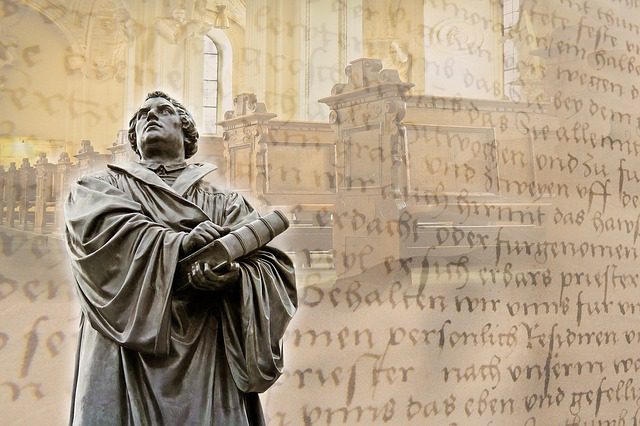
(11-10-14)
***
Merit
[L]ove grows by works of love, and man becomes better . . . (The 95 Theses, #44; 31 October 1517; translated by C. M. Jacobs, 1915)
Sin and evil inclination must be recognized as truly sin; that it does not harm us is to be ascribed to the grace of God, Who will not count it against us if only we strive against it in many trials, works, and sufferings, . . . (Treatise on Baptism, Nov. 1519; translated by C. M. Jacobs, 1915)
But they who in such suffering trust God and retain a good, firm confidence in Him, and believe that He is pleased with them, these see in their sufferings and afflictions nothing but precious merits and the rarest possessions, the value of which no one can estimate. For faith and confidence make precious before God all that which others think most shameful, . . . (Treatise on Good Works, March 1520; translated by W. A. Lambert, 1915)
[W]e cannot boast of many merits and works, if they are viewed apart from grace and mercy, but as it is written, 1 Cor. 1:31: He that glorieth, let him glory in the Lord, . . . (Smalcald Articles, 1537; Pt. III, Art. XIII; translated by W. H. T. Dau and F. Bente in 1921)
Sanctification
If you believe in Christ and in his advent, it is the highest praise and thanks to God to be holy. If you recognize, love, and magnify his grace and work in you, and cast aside and condemn self and the works of self, then are you a Christian. . . . Do you desire to be a part of the holy Christian church and communion of saints, you must also be holy as she is, yet not of yourself but through Christ alone in whom all are holy. (Sermon for the First Sunday in Advent; Matthew 21:1-9, 1521, tr. E. H. Caselmann; in Serm., v. 1)
For this life is nothing more than a life of faith, of love, and of sanctified affliction. But these three will never be perfect in us while we live here on earth, and no one possesses them in perfection except Christ. He is the sun and is set for our example, which we must imitate. For this reason there will always be found among us some that are weak, others that are strong, and again some that are stronger; these are able to suffer less, those more; and so they must all continue in the imitation of Christ. For this life is a constant progress from faith to faith, from love to love, from patience to patience, and from affliction to affliction. It is not righteousness, but justification; not purity, but purification; we have not yet arrived at our destination, but we are all on the road, and some are farther advanced than others. (A Sermon on Confession and the Lord’s Supper; 1524; in Serm., v. 2)
Christian experience . . . must feel and prove, must test and ascertain, whether one is prompted by a sincere and gracious will. He who perseveres and learns in this way will go forward in his experience, finding God’s will so gracious and pleasing he would not exchange it for all the world’s wealth. He will discover that acceptance of God’s will affords him more happiness, even in poverty, disgrace and adversity, than is the lot of any worldling in the midst of earthly honors and pleasures. He will finally arrive at a degree of perfection making him inclined to exchange life for death, and, with Paul, to desire to depart that sin may no more live in him, and that the will of God may be done perfectly in himself in every relation. In this respect he is wholly unlike the world; he conducts himself very differently from it. (Sermon for the First Sunday After Epiphany; Romans 12:1-6, 1525; in Serm., v. 7)
It is true of Christ’s kingdom that his Christians are not perfectly holy. They have begun to be holy and are in a state of progression. . . . we are in a state of progression; but during the progress much of the old and as yet untransformed nature is intermingled. (Sermon for the Fifth Sunday After Epiphany; Colossians 3:12-17, 1525; in Serm., v. 7)
. . . sanctification, deals with the work of the Holy Spirit. The people are to be taught to pray that God rule and protect us by his Holy Spirit, and are to be shown how weak we are and how miserably we fail if God does not draw us to himself and keep us through the Holy Spirit. (Instructions for the Visitors of Parish Pastors in Electoral Saxony, Jan. 1528, tr. Conrad Bergendoff; in LW, v. 40)
[A]fter death sin will have completely passed away and then the Holy Spirit will complete his work and then my sanctification will be complete. . . . the Holy Spirit will sanctify me and is sanctifying me. . . . He begins to sanctify now; when we have died, he will complete this sanctification . . . (Sermons I, ed. and tr. John W. Doberstein; Sermon on the Creed, Dec. 1528; in LW, v. 51)
[T]he Holy Ghost has called me by the Gospel, enlightened me with His gifts, sanctified and kept me in the true faith; even as He calls, gathers, enlightens, and sanctifies the whole Christian Church on earth . . . (Small Catechism, 1529; II; tr. W. H. T. Dau and F. Bente; in BC)
[B]y His grace we believe His holy Word and lead a godly life here in time and yonder in eternity. (Ibid., III)
[W]e have allowed the people to go their own merry way without amending and changing their lives. (Admonition Concerning the Sacrament of the Body and Blood of our Lord, Oct. 1530, tr. Martin E. Lehmann; in LW, v. 38)
[T]he entire man, both as to his person and his works, is to be called and to be righteous and holy from pure grace and mercy, shed upon us [unfolded] and spread over us in Christ. (Smalcald Articles, 1537; Pt. III, Art. XIII; tr. W. H. T. Dau and F. Bente; in BC)
For we need the Decalog not only because it tells us in legal fashion what we are bound to do, but also in order that we may see in it how far the Holy Ghost has brought us in His sanctifying work, and how much we still fall short, so that we may not become careless and think that we have now done all that is required. Thus we are constantly to grow in sanctification and ever to become more and more “a new creature” in Christ. . . . the Holy Ghost is here, and He sanctifies men’s hearts, and brings these fruits out of good, fine hearts, . . . (On the Councils and the Churches, March 1539; tr. C. M. Jacobs; in W5)
But life, which should daily direct, purify, and sanctify itself according to doctrine, . . . as long as it is in the process of purification and sanctification, . . . is graciously excused, pardoned, and forgiven for the sake of the word, through which it is healed and purified . . . (Against Hanswurst, April 1541, tr. Eric W. Gritsch; in LW, v. 41)
Abbreviations / Sources
BC Book of Concord (Triglot Concordia: The Symbolical Books of the Evangelical Lutheran Church: German-Latin-English (Published in 1917 by resolution of the Evangelical Lutheran Synod; St. Louis: Concordia Publishing House, 1921; translated by W. H. T. Dau and F. Bente.
LW Luther’s Works, American edition, edited by Jaroslav Pelikan (volumes 1-30) and Helmut T. Lehmann (volumes 31-55), St. Louis: Concordia Publishing House (volumes 1-30); Philadelphia: Fortress Press (volumes 31-55), starting in 1955.
Serm. Sermons of Martin Luther, The Church Postils; edited and partially translated by John Nicholas Lenker, 8 volumes. Volumes 1-5 were originally published in Minneapolis by Lutherans of All Lands, 1904-1906. Volumes 6-8 were originally published in Minneapolis by The Luther Press, 1908-1909.
W5 Works of Martin Luther, Volume V (Philadelphia: A. J. Holman Co. and The Castle Press: 1931).
***
Photo credit: image by “andibreit” (Nov. 2016) [Pixabay / CC0 Creative Commons license]
***
Previous Post
October 15, 2017
Pope St. John XXIII & Pope Benedict XVI on "Prophets of Doom"
Next Post

October 17, 2017 Armstrong vs. Collins & Walls #1: Newman's Mariology
Browse Our Archives
Select a Category & Last Things About Me Anti-Catholicism Atheism & Agnosticism Baptism and Sacramentalism Bible and Tradition Blessed Virgin Mary Books by Dave Armstrong C. S. Lewis Calvinism & General Protestantism Catholic Apologetics Catholic Apologists Catholic conversion Catholic converts Christmas Church (Ecclesiology) Church History Conversion and Converts Development of Doctrine Eastern Orthodoxy Ecumenism & Christian Unity Eucharist & Liturgy Fathers of the Church French Translations G. K. Chesterton Hell Hell & Satan Hell & Satan & Last Things Heresies & Comparative Religion Holistic Health Inquisition & Crusades & Scandals James White Jews & Judaism & Old Testament John Calvin John Henry Newman Liberal / Modernist Theology Life Issues Literary Resume Lutheranism Mariology Martin Luther Music Orthodoxy Papacy & Infallibility Personal Page Philosophy & Science Political & Ethical & Moral Issues Protestant Persecution & Intolerance Protestantism Purgatory Purgatory & Penance Romantic & Imaginative Theology Saints & Purgatory & Penance Salvation Salvation & Justification Satan & Last Things Sexuality and Gender Issues Spanish Translations Traditionalism vs. Radical Catholic Reactionaries Traducciones al español / tradução para português Trinitarianism & Christology Uncategorized Videos
Select a Month October 2026 September 2026 August 2026 July 2026 June 2026 May 2026 April 2026 March 2026 February 2026 January 2026 December 2025 November 2025 October 2025 September 2025 August 2025 July 2025 June 2025 May 2025 April 2025 March 2025 February 2025 January 2025 December 2024 November 2024 October 2024 September 2024 August 2024 July 2024 June 2024 May 2024 April 2024 March 2024 February 2024 January 2024 December 2023 November 2023 October 2023 September 2023 August 2023 July 2023 June 2023 May 2023 April 2023 March 2023 February 2023 January 2023 December 2022 November 2022 October 2022 September 2022 August 2022 July 2022 June 2022 May 2022 April 2022 March 2022 February 2022 January 2022 December 2021 November 2021 October 2021 September 2021 August 2021 July 2021 June 2021 May 2021 April 2021 March 2021 February 2021 January 2021 December 2020 November 2020 October 2020 September 2020 August 2020 July 2020 June 2020 May 2020 April 2020 March 2020 February 2020 January 2020 December 2019 November 2019 October 2019 September 2019 August 2019 July 2019 June 2019 May 2019 April 2019 March 2019 February 2019 January 2019 December 2018 November 2018 October 2018 September 2018 August 2018 July 2018 June 2018 May 2018 April 2018 March 2018 February 2018 January 2018 December 2017 November 2017 October 2017 September 2017 August 2017 July 2017 June 2017 May 2017 April 2017 March 2017 February 2017 January 2017 December 2016 November 2016 October 2016 September 2016 August 2016 July 2016 June 2016 May 2016 April 2016 March 2016 February 2016 January 2016 December 2015 November 2015 October 2015 September 2015 August 2015 July 2015 June 2015 May 2015 April 2015 March 2015 February 2015 January 2015 December 2014 November 2014 October 2014 September 2014 August 2014 July 2014 June 2014 April 2014 March 2014 February 2014 January 2014 December 2013 November 2013 October 2013 September 2013 August 2013 July 2013 June 2013 April 2013 March 2013 February 2013 January 2013 December 2012 November 2012 October 2012 September 2012 August 2012 July 2012 June 2012 May 2012 April 2012 March 2012 February 2012 January 2012 December 2011 November 2011 October 2011 September 2011 August 2011 July 2011 June 2011 April 2011 March 2011 February 2011 October 2010 September 2010 August 2010 July 2010 April 2010 March 2010 December 2009 October 2009 August 2009 July 2009 June 2009 May 2009 March 2009 February 2009 October 2008 September 2008 April 2008 March 2008 February 2008 January 2008 December 2007 November 2007 October 2007 May 2007 March 2007 February 2007 January 2007 November 2006 October 2006 September 2006 August 2006 July 2006 June 2006 May 2006 April 2006 March 2006 February 2006 October 2005 June 2005 April 2005 February 2005 July 2004 May 2004 April 2004
Follow Us!
TAKE THE
Religious Wisdom Quiz
How did Nehemiah respond to threats and ridicule while rebuilding the wall?
Select your answer to see how you score.
Bribed enemies Gave up Prayed and posted guards Fled Jerusalem
Books by This Author Books by Dave Armstrong
Related posts from Biblical Evidence for Catholicism

Dialogue on Eternal Security / Absolute Assurance
Biblical Evidence for Catholicism

"Faith Alone" Dialogue with a Calvinist
Biblical Evidence for Catholicism

Exegesis of 75 NT Faith [Alone?] & Works...
Biblical Evidence for Catholicism

Does Romans 2 Prove "Faith Alone"? (Mini-Debate)
Biblical Evidence for Catholicism
TRENDING AT PATHEOS Catholic

Janie Learns the Way of the Cross: A...
Teaching children about Jesus' Passion can be challenging. Many parents and educators...

Looking For Good Catholic Writing - October 2026
He alone extends the heavens, and he walks upon the waves of...

In "Irreplaceable," our book on vocation and technology, Trevor Sutton and I...

I was strolling through the top floor of the brand new Parthenon...

What Does Gêvâh Mean For Kimberley Guifoyle &...
This week, a lot of the news is focused on Kimberly Guilfoyle....

INNER CIRCLE: Profound Mystery (Of Christ In All...
Ephesians 5:31-32 “For this reason, a man will leave his father and...
view all Catholic blogs
Ad-Free & Subscriber Log-In Subscription Support
- About Us
- 2026 Calendar
- Videos
- Podcasts
- Library of World Religions
- Faith In Media Tracker
- Advertise With Us
- Write for Us
- Privacy Policy
- Terms of Service
- Do Not Sell My Data
- Contact Us
- Radiant Digital
- Manage Newsletter Subscriptions
- Unsubscribe From Notifications
- Sitemap
Copyright 2008-2026, Patheos. All rights reserved.
Subscription Support Ad-Free & Subscriber Log-In
Follow Patheos