
BuddhistCatholicContemplativeEvangelicalGeneral ChristianHinduJewishLatter-day SaintMuslimNew VisionsProgressive Christian
Beliefs
- Buddhist
- Catholic
- Contemplative
- Evangelical
- General Christian
- Hindu
- Jewish
- Latter-day Saint
- More Voices
- Muslim
- New Visions
- Pagan
- Progressive Christian
Topics
- Religion News
- Food and Religion
- Sports and Religion
- Religious Art
- Religious Music and Entertainment
- Religious Events
- History and Religion
- Style and Religion
- Politics and Religion
- Women in Religion
- Recreation Outdoors and Religion
- Business Finance and Religion
- Careers Workplace and Religion
- Education and Religion
- Family Parenting and Religion
- Health Fitness and Religion
- Home and Religion
- Relationships and Religion
- Technology and Religion
- Travel and Religion
Columnists
- Buddhist Columnists
- Business Finance and Religion Columnists
- Careers Workplace and Religion Columnists
- Catholic Columnists
- Contemplative Columnists
- Education and Religion Columnists
- Evangelists Columnists
- Family Parenting and Religion Columnists
- General Christian Columnists
- Health Fitness and Religion Columnists
- Hindu Columnists
- History and Religion Columnists
- Home and Religion Columnists
- Jewish Columnists
- More Voices Columnists
- Latter Day Columnists
- Muslim Columnists
- New Visions Columnists
- Nonreligious Columnists
- Pagan Columnists
- Politics and Religion Columnists
- Progressive Columnists
- Recreation Outdoors and Religion Columnists
- Relationships and Religion Columnists
- Religion News Columnists
- Religious Art Columnists
- Religious Events Columnists
- Religious Music and Entertainment Columnists
- Sports and Religion Columnists
- Style and Religion Columnists
- Technology and Religion Columnists
- Travel and Religion Columnists
- Women in Religion Columnists
Resource Library
- 2026 Calendar
- Library of World Religions
- The 100 Most Holy Places on Earth
- Patheos Answers
- Podcasts
- Videos
- Faith Leaders Database
- Anglican Episcopalian
- Bahai
- Baptist
- Buddhism
- Christianity
- Confucianism
- Eastern Orthodoxy
- Hinduism
- Holiness and Pentecostal
- ISKCON
- Islam
- Judaism
- Lutheran
- Methodist
- The Church of Jesus Christ of Latter-day Saints
- New Age
- Paganism
- Presbytarian and Reformed
- Protestantism
- Religion Behind the Scenes
- Roman Catholic
- Scientology
- Shia Islam
- Sikhism
- Sufism
- Sunni Islam
- Taoism
- Zen
- See all religions
Research Tools
 Ad-Free & Subscriber Log-In Subscription Support
Ad-Free & Subscriber Log-In Subscription Support
Follow Patheos 

- Trending:
- Forgiveness
- |
- Marriage
- |
- Consciousness
- |
- Death Penalty
- |
- Election
- |
- Halloween

-
About
-
Catholic Apologetics
-
Church History
-
Great Apologists
-
Christian Worldview
-
Protestantism & Misc.
- Home
- Catholic
- History and Religion
- Armstrong vs. Collins & Walls #7: Unbiblical / Non-Patristic Purgatory?
Armstrong vs. Collins & Walls #7: Unbiblical / Non-Patristic Purgatory?
Last updated on: June 5, 2026 at 11:51 pm by Dave Armstrong
Armstrong vs. Collins & Walls #7: Unbiblical / Non-Patristic Purgatory? 2026-06-05T23:51:00-04:00 Dave Armstrong
Patheos Explore the world's faith through different perspectives on religion and spirituality! Patheos has the views of the prevalent religions and spiritualities of the world.
This is one of my many critiques of the book entitled, Roman but Not Catholic: What Remains at Stake 500 Years after the Reformation, by evangelical Protestant theologian Kenneth J. Collins and Anglican philosopher Jerry L. Walls (Grand Rapids, Michigan: Baker Academic, 2017).
*****
Kenneth Collins, in his chapter 2: “Tradition and the Traditions” — after railing against supposedly untethered, unchecked, unbiblical Catholic traditions — states about purgatory in particular:
To rectify this considerable deficit in terms of both earlier church history and generous scriptural support, a deficit that was at times embarrassing, medieval theologians such as Rabanus Maurus (on the doctrine of purgatory) simply appealed to the tradition itself or, by implication, to the Holy Spirit as the guarantee of the tradition . . . simply all-too-human teaching. How do we know that such is merely human teaching? It is at variance with the clear teaching of sacred Scripture.
There is considerable irony and humor here, once one discovers that Jerry Walls, Collins’ co-author of this book, wrote a book defending purgatory. Therefore, he has defended something (at book-length) that Collins thinks is “all-too-human” and “at variance with the clear teaching of sacred Scripture.” It’s “clear” to Collins that Scripture teaches no such thing as purgatory. It’s clear to Walls (and folks like, e.g., C. S. Lewis) that it does teach it. How do Protestants resolve such internal contradictions? They can’t; and it’s one of their major problems. They will never solve it, either. They haven’t in 500 years, so there is no reason to think that they will or can at this late juncture.
Collins thinks that the history of the doctrine is so scarce and nonexistent as to be “embarrassing” and a “considerable deficit.” Yet Walls in his book managed to find enough of such history that Timothy George, dean of Beeson Divinity School of Samford University, wrote a review (on the Amazon page), in which he states: “Walls traces Christian views on purgatory from the early church to C. S. Lewis and comes up with a surprisingly affirmative conclusion . . .” Someone’s gotta be wrong here. The doctrine is either present in the Church fathers or it is not.
As an editor of three books of Church fathers quotations, I am personally acquainted with plenty of such documentation. Cardinal Newman observed that there was much more in the fathers about purgatory, than there is regarding original sin (which almost all Protestants accept). Here is some of that historical data (I could easily provide much more than this):
In short, inasmuch as we understand “the prison” pointed out in the Gospel to be Hades, and as we also interpret “the uttermost farthing” to mean the very smallest offence which has to be recompensed there before the resurrection, no one will hesitate to believe that the soul undergoes in Hades some compensatory discipline, without prejudice to the full process of the resurrection, when the recompense will be administered through the flesh besides. (Tertullian, A Treatise on the Soul, chapter 58; ANF, Vol. III)
But we say that the fire sanctifies not flesh, but sinful souls; meaning not the all-devouring vulgar fire but that of wisdom, which pervades the soul passing through the fire. (St. Clement of Alexandria, Stromata / Miscellanies, Book VII, Chapter 6; ANF, Vol. II)
It is one thing to stand for pardon, another thing to attain to glory: it is one thing, when cast into prison, not to go out thence until one has paid the uttermost farthing; another thing at once to receive the wages of faith and courage. It is one thing, tortured by long suffering for sins, to be cleansed and long purged by fire; another to have purged all sins by suffering. It is one thing, in fine, to be in suspense till the sentence of God at the day of judgment; another to be at once crowned by the Lord. (St. Cyprian, Epistle 51 [55], To Antonianus, 20; ANF, Vol. V, 332)
[A]fter his departure out of the body, he gains knowledge of the difference between virtue and vice, and finds that he is not able to partake of divinity until he has been purged of the filthy cobntagion in his soul by the purifying fire. (St. Gregory of Nyssa, Sermon on the Dead)
[St. Ambrose] clearly stated that the prayers of the living could help to relieve the suffering of the dead, that suffrages could be of use in mitigating the penalties meted out in the other world. (Jacques Le Goff, The Birth of Purgatory, University of Chicago Press, 1984, 60)
If the man whose work is burnt and is to suffer the loss of his labour, while he himself is saved, yet not without proof of fire**:** it follows that if a man’s work remains which he has built upon the foundation, he will be saved without probation by fire, and consequently a difference is established between one degree of salvation and another (St. Jerome, Against Jovinianus, Book II, 22; NPNF 2, Vol. VI)
From these words it more evidently appears that some shall in the last judgment suffer some kind of purgatorial punishments; for what else can be understood by the word, “Who shall abide the day of His entrance, or who shall be able to look upon Him? For He enters as a moulder’s fire, and as the herb of fullers: and He shall sit fusing and purifying as if over gold and silver: and He shall purify the sons of Levi, and pour them out like gold and silver?” [Mal 3:2-3] Similarly Isaiah says, “The Lord shall wash the filthiness of the sons and daughters of Zion, and shall cleanse away the blood from their midst, by the spirit of judgment and by the spirit of burning.” [Isaiah 4:4] . . . when he says, “And he shall purify the sons of Levi, and pour them out like gold and silver, and they shall offer to the Lord sacrifices in righteousness; and the sacrifices of Judah and Jerusalem shall be pleasing to the Lord,” [Mal 3:3-4] he declares that those who shall be purified shall then please the Lord with sacrifices of righteousness, and consequently they themselves shall be purified from their own unrighteousness which made them displeasing to God. Now they themselves, when they have been purified, shall be sacrifices of complete and perfect righteousness; for what more acceptable offering can such persons make to God than themselves? But this question of purgatorial punishments we must defer to another time, to give it a more adequate treatment. (St. Augustine, City of God, Book 20, 25; further references to purgatory in this book occur at 20:26; 21:13, 16, 24, 26)
The Oxford Dictionary of the Christian Church (pp. 1144-1145) provides an introductory overview:
St. Clement of Alexandria already asserts that those who, having repented on their deathbed, had no time to perform works of penance in this life, will be sanctified in the next by purifying fire (Stromateis, 7.6), a conception developed by Origen (Numbers, Hom. 15; J.P. Migne, PG, xii, 169 f.). . . . A more developed doctrine is taught by St. Ambrose, who asserts that the souls of the departed await the end of time in different habitations, their fate varrying acc. to their works, though some are already with Christ. The foundation of the medieval doctrine is found in St. Augustine, who holds that the fate of the individual soul is decided immediately after death, and teaches the absolute certainty of purifying pains in the next life (De Civ. Dei, xxi. 13, and ib., 24), whereas St. Caesarius of Arles already distinguishes between capital sins, which lead to Hell, and minor ones, which may be expurgated either by good works on earth or in Purgatory. This doctrine was sanctioned also by St. Gregory the Great . . .
Philip Schaff (as a “hostile witness” of sorts) sums up the consensus of the fathers and the early Church in this regard:
The majority of Christian believers, being imperfect, enter for an indefinite period into a preparatory state of rest and happiness, usually called Paradise (comp. Luke 23:41) or Abraham’s Bosom (Luke 16:23). There they are gradually purged of remaining infirmities until they are ripe for heaven, into which nothing is admitted but absolute purity. Origen assumed a constant progression to higher and higher regions of knowledge and bliss. (After the fifth or sixth century, certainly since Pope Gregory I., Purgatory was substituted for Paradise). . . .
Eusebius narrates that at the tomb of Constantine a vast crowd of people, in company with the priests of God, with tears and great lamentation offered their prayers to God for the emperor’s soul. Augustin calls prayer for the pious dead in the eucharistic sacrifice an observance of the universal church, handed down from the fathers. He himself remembered in prayer his godly mother at her dying request. . . .
These views of the middle state in connection with prayers for the dead show a strong tendency to the Roman Catholic doctrine of Purgatory, which afterwards came to prevail in the West through the great weight of St. Augustin and Pope Gregory I. . . .
Origen, following in the path of Plato, used the term “purgatorial fire,” by which the remaining stains of the soul shall be burned away; but he understood it figuratively, and connected it with the consuming fire at the final judgment, while Augustin and Gregory I. Transferred it to the middle state. The common people and most of the fathers understood it of a material fire . . . (History of the Christian Church, Vol. 2, Chapter XII, § 156. Between Death and Resurrection, 601, 603-605)
So much for the alleged “scant” history of purgatory in the Church fathers. . . .
Moreover, there is a strong argument indeed that can be made for purgatory from Holy Scripture. I have compiled no less than fifty passages that describe either purgatory or the processes of purging, cleansing, fire (either real or metaphorical), etc., that make up its essence. I’ve written several other papers as well about biblical indications for purgatory (one / two / three / four / five).
I’ve also written many times about scriptural support for prayers and penance for the dead (which pretty much presupposes purgatory) — which St. Paul did regarding Onesiphorus — (one / two / three / four / five / six).
There are all kinds of biblical arguments for purgatory: and very good ones, too. If Collins had been familiar with them, then he could have dealt with at least a few of these in his book. But he did not. That makes it a far less effective persuasive tool against Catholicism. To be impressive or successful in theological debate, one must deal with the best arguments an opponent can put up, not the worst, or none at all. Collins doesn’t even show that he is aware of them, let alone willing or able to take them on.
And the present shortcoming in this respect is by no means an isolated one in the book. In my previous post on the “Queen of Heaven” it was observed that Collins was either completely unaware of the considerable scriptural data regarding the Queen Mother in ancient Israel; or if aware, chose to utterly ignore what is clearly a relevant major (and biblical) Catholic rationale for its doctrine of Mary as Queen of Heaven.
***
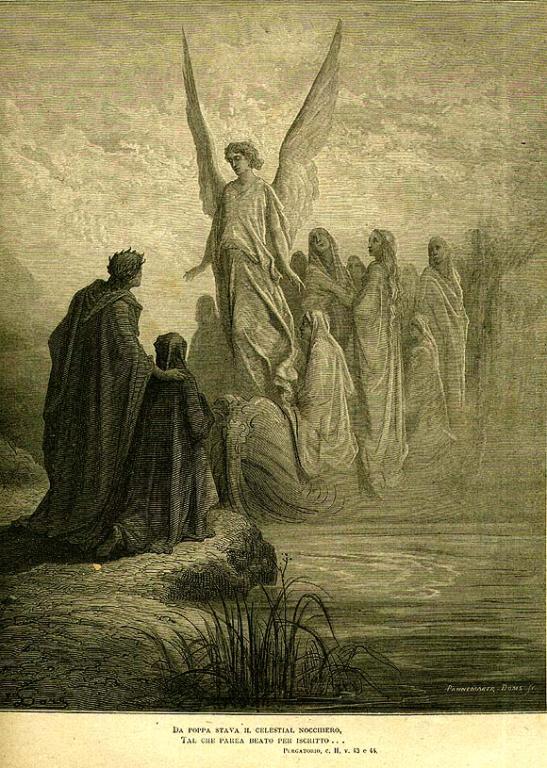
Photo credit: Illustration for Dante’s Purgatorio 02, by Gustave Doré (1832-1883) [public domain / Wikimedia Commons]

***
Previous Post
October 19, 2017
Armstrong vs. Collins & Walls #6: Assumption, Queen Redux
Next Post
October 20, 2017 On the Use of the Titles "Catholic" & "Roman Catholic"
Browse Our Archives
Select a Category & Last Things About Me Anti-Catholicism Atheism & Agnosticism Baptism and Sacramentalism Bible and Tradition Blessed Virgin Mary Books by Dave Armstrong C. S. Lewis Calvinism & General Protestantism Catholic Apologetics Catholic Apologists Catholic conversion Catholic converts Christmas Church (Ecclesiology) Church History Conversion and Converts Development of Doctrine Eastern Orthodoxy Ecumenism & Christian Unity Eucharist & Liturgy Fathers of the Church French Translations G. K. Chesterton Hell Hell & Satan Hell & Satan & Last Things Heresies & Comparative Religion Holistic Health Inquisition & Crusades & Scandals James White Jews & Judaism & Old Testament John Calvin John Henry Newman Liberal / Modernist Theology Life Issues Literary Resume Lutheranism Mariology Martin Luther Music Orthodoxy Papacy & Infallibility Personal Page Philosophy & Science Political & Ethical & Moral Issues Protestant Persecution & Intolerance Protestantism Purgatory Purgatory & Penance Romantic & Imaginative Theology Saints & Purgatory & Penance Salvation Salvation & Justification Satan & Last Things Sexuality and Gender Issues Spanish Translations Traditionalism vs. Radical Catholic Reactionaries Traducciones al español / tradução para português Trinitarianism & Christology Uncategorized Videos
Select a Month October 2026 September 2026 August 2026 July 2026 June 2026 May 2026 April 2026 March 2026 February 2026 January 2026 December 2025 November 2025 October 2025 September 2025 August 2025 July 2025 June 2025 May 2025 April 2025 March 2025 February 2025 January 2025 December 2024 November 2024 October 2024 September 2024 August 2024 July 2024 June 2024 May 2024 April 2024 March 2024 February 2024 January 2024 December 2023 November 2023 October 2023 September 2023 August 2023 July 2023 June 2023 May 2023 April 2023 March 2023 February 2023 January 2023 December 2022 November 2022 October 2022 September 2022 August 2022 July 2022 June 2022 May 2022 April 2022 March 2022 February 2022 January 2022 December 2021 November 2021 October 2021 September 2021 August 2021 July 2021 June 2021 May 2021 April 2021 March 2021 February 2021 January 2021 December 2020 November 2020 October 2020 September 2020 August 2020 July 2020 June 2020 May 2020 April 2020 March 2020 February 2020 January 2020 December 2019 November 2019 October 2019 September 2019 August 2019 July 2019 June 2019 May 2019 April 2019 March 2019 February 2019 January 2019 December 2018 November 2018 October 2018 September 2018 August 2018 July 2018 June 2018 May 2018 April 2018 March 2018 February 2018 January 2018 December 2017 November 2017 October 2017 September 2017 August 2017 July 2017 June 2017 May 2017 April 2017 March 2017 February 2017 January 2017 December 2016 November 2016 October 2016 September 2016 August 2016 July 2016 June 2016 May 2016 April 2016 March 2016 February 2016 January 2016 December 2015 November 2015 October 2015 September 2015 August 2015 July 2015 June 2015 May 2015 April 2015 March 2015 February 2015 January 2015 December 2014 November 2014 October 2014 September 2014 August 2014 July 2014 June 2014 April 2014 March 2014 February 2014 January 2014 December 2013 November 2013 October 2013 September 2013 August 2013 July 2013 June 2013 April 2013 March 2013 February 2013 January 2013 December 2012 November 2012 October 2012 September 2012 August 2012 July 2012 June 2012 May 2012 April 2012 March 2012 February 2012 January 2012 December 2011 November 2011 October 2011 September 2011 August 2011 July 2011 June 2011 April 2011 March 2011 February 2011 October 2010 September 2010 August 2010 July 2010 April 2010 March 2010 December 2009 October 2009 August 2009 July 2009 June 2009 May 2009 March 2009 February 2009 October 2008 September 2008 April 2008 March 2008 February 2008 January 2008 December 2007 November 2007 October 2007 May 2007 March 2007 February 2007 January 2007 November 2006 October 2006 September 2006 August 2006 July 2006 June 2006 May 2006 April 2006 March 2006 February 2006 October 2005 June 2005 April 2005 February 2005 July 2004 May 2004 April 2004
Follow Us!
TAKE THE
Religious Wisdom Quiz
What famous cathedral is in Paris, known for its flying buttresses and rose windows?
Select your answer to see how you score.
Notre Dame St. Paul's St. Peter's Canterbury
Books by This Author Books by Dave Armstrong
Related posts from Biblical Evidence for Catholicism

Bible & Catholicism on Mortal Sin (vs. John...
Biblical Evidence for Catholicism

Does Catholic Intercession of Saints Require Omniscience?
Biblical Evidence for Catholicism

Eternal Hell: Biblical? 25 Verses Say So
Biblical Evidence for Catholicism

Capabilities of Heavenly Saints: Protestant Commentaries
Biblical Evidence for Catholicism
TRENDING AT PATHEOS Catholic

In "Irreplaceable," our book on vocation and technology, Trevor Sutton and I...

I was strolling through the top floor of the brand new Parthenon...

What Does Gêvâh Mean For Kimberley Guifoyle &...
This week, a lot of the news is focused on Kimberly Guilfoyle....

INNER CIRCLE: Profound Mystery (Of Christ In All...
Ephesians 5:31-32 “For this reason, a man will leave his father and...

Do Not Rejoice When Your Enemy Falls: The...
Turning an execution into a public spectacle is a disturbing expression of...

'The Chosen' S6 Trailer: The Passion Gets Very...
Not many watching 'The Chosen' worry about spoilers, but just because they...
view all Catholic blogs
Ad-Free & Subscriber Log-In Subscription Support
- About Us
- 2026 Calendar
- Videos
- Podcasts
- Library of World Religions
- Faith In Media Tracker
- Advertise With Us
- Write for Us
- Privacy Policy
- Terms of Service
- Do Not Sell My Data
- Contact Us
- Radiant Digital
- Manage Newsletter Subscriptions
- Unsubscribe From Notifications
- Sitemap
Copyright 2008-2026, Patheos. All rights reserved.
Subscription Support Ad-Free & Subscriber Log-In
Follow Patheos