
BuddhistCatholicContemplativeEvangelicalGeneral ChristianHinduJewishLatter-day SaintMuslimNew VisionsProgressive Christian
Beliefs
- Buddhist
- Catholic
- Contemplative
- Evangelical
- General Christian
- Hindu
- Jewish
- Latter-day Saint
- More Voices
- Muslim
- New Visions
- Pagan
- Progressive Christian
Topics
- Religion News
- Food and Religion
- Sports and Religion
- Religious Art
- Religious Music and Entertainment
- Religious Events
- History and Religion
- Style and Religion
- Politics and Religion
- Women in Religion
- Recreation Outdoors and Religion
- Business Finance and Religion
- Careers Workplace and Religion
- Education and Religion
- Family Parenting and Religion
- Health Fitness and Religion
- Home and Religion
- Relationships and Religion
- Technology and Religion
- Travel and Religion
Columnists
- Buddhist Columnists
- Business Finance and Religion Columnists
- Careers Workplace and Religion Columnists
- Catholic Columnists
- Contemplative Columnists
- Education and Religion Columnists
- Evangelists Columnists
- Family Parenting and Religion Columnists
- General Christian Columnists
- Health Fitness and Religion Columnists
- Hindu Columnists
- History and Religion Columnists
- Home and Religion Columnists
- Jewish Columnists
- More Voices Columnists
- Latter Day Columnists
- Muslim Columnists
- New Visions Columnists
- Nonreligious Columnists
- Pagan Columnists
- Politics and Religion Columnists
- Progressive Columnists
- Recreation Outdoors and Religion Columnists
- Relationships and Religion Columnists
- Religion News Columnists
- Religious Art Columnists
- Religious Events Columnists
- Religious Music and Entertainment Columnists
- Sports and Religion Columnists
- Style and Religion Columnists
- Technology and Religion Columnists
- Travel and Religion Columnists
- Women in Religion Columnists
Resource Library
- 2026 Calendar
- Library of World Religions
- The 100 Most Holy Places on Earth
- Patheos Answers
- Podcasts
- Videos
- Faith Leaders Database
- Anglican Episcopalian
- Bahai
- Baptist
- Buddhism
- Christianity
- Confucianism
- Eastern Orthodoxy
- Hinduism
- Holiness and Pentecostal
- ISKCON
- Islam
- Judaism
- Lutheran
- Methodist
- The Church of Jesus Christ of Latter-day Saints
- New Age
- Paganism
- Presbytarian and Reformed
- Protestantism
- Religion Behind the Scenes
- Roman Catholic
- Scientology
- Shia Islam
- Sikhism
- Sufism
- Sunni Islam
- Taoism
- Zen
- See all religions
Research Tools
 Ad-Free & Subscriber Log-In Subscription Support
Ad-Free & Subscriber Log-In Subscription Support
Follow Patheos 

- Trending:
- Forgiveness
- |
- Marriage
- |
- Consciousness
- |
- Death Penalty
- |
- Election
- |
- Halloween

-
About
-
Catholic Apologetics
-
Church History
-
Great Apologists
-
Christian Worldview
-
Protestantism & Misc.
- Home
- Catholic
- History and Religion
- Armstrong vs. Collins & Walls #10: St. Peter & the Papacy
Armstrong vs. Collins & Walls #10: St. Peter & the Papacy
Last updated on: June 5, 2026 at 11:51 pm by Dave Armstrong
Armstrong vs. Collins & Walls #10: St. Peter & the Papacy 2026-06-05T23:51:01-04:00 Dave Armstrong
Patheos Explore the world's faith through different perspectives on religion and spirituality! Patheos has the views of the prevalent religions and spiritualities of the world.
This is one of my many critiques of the book entitled, Roman but Not Catholic: What Remains at Stake 500 Years after the Reformation, by evangelical Protestant theologian Kenneth J. Collins and Anglican philosopher Jerry L. Walls (Grand Rapids, Michigan: Baker Academic, 2017).
*****
Kenneth Collins, in his chapter 11: “The Papacy”, states:
Indeed, the notion that Peter was somehow over the universal church is unfounded. . . .
. . . Matthew 16:18 cannot mean that Peter had authority in an extraordinary way over the other apostles.
Matthew 16:18 (RSV) And I tell you, you are Peter, and on this rock I will build my church, and the powers of death shall not prevail against it.
Collins runs through the standard discussions about whether “the rock” Jesus referred to was Peter’s confession, or he himself. And of course, in the end, he clearly favors the “confession” interpretation because that’s the one that works with Protestant relative ecclesiological disorganization and the denial (of most Protestants) of apostolic succession and episcopal, hierarchical ecclesiology, or Church government.
Yet the position of “rock” in Matthew 16:18 being St. Peter himself (which has been the Catholic view for many centuries) is held by a great number of Protestant exegetes in recent times, including some of the very best ones, and is the majority position (as noted in the Encyclopedia Britannica article on “Peter”: 1985, Micropedia, Vol. 9, 330-333). Collins (bless his heart) does manage to mention one of these: Presbyterian linguist Marvin Vincent. Here are many more that he didn’t mention (lest his readers come to understand that this is virtual consensus in biblical commentary today):
- “Jesus, then, is promising Peter that he is going to build his church on him! I accept this view.” –William Hendriksen, New Testament Commentary: Exposition of the Gospel According to Matthew, (Grand Rapids, MI: Baker, 1973), 647.
- “Nowadays a broad consensus has emerged which–in accordance with the words of the text–applies the promise to Peter as a person. On this point liberal (H. J. Holtzmann, E. Schweiger) and conservative (Cullmann, Flew) theologians agree, as well as representatives of Roman Catholic Exegesis.” –Gerhard Maier, “The Church in the Gospel of Matthew: hermeneutical Analysis of the Current Debate,” trans. Harold H. P. Dressler, in D. A. Carson, ed., Biblical Interpretation and Church Text and Context, (Flemington Markets, NSW: Paternoster Press, 1984), 58.
- “By the words ‘this rock’ Jesus means not himself, nor his teaching, nor God the Father, nor Peter’s confession, but Peter himself.” –J. Knox Chamblin, “Matthew,” in Walter A. Eldwell, ed., Evangelical Commentary on the Bible (Grand Rapids: MI: Baker, 1989), 742.
- “. . . If, then, Mt. 16:18 forces us to assume a formal and material identity between petra and Petros, this shows how fully the apostolate, and in it to a special degree the position of Peter, belongs to and is essentially enclosed within, the revelation of Christ. Petros himself is this petra, not just his faith or his confession.” –Gerhard Friedrich, ed., and Geoffrey W. Bromley, trans. and ed.,Theological Dictionary of the New Testament, vol. VI, (Grand Rapids, MI: Eerdmans, 1968), 98-99.
- “The expression ‘this rock’ almost certainly refers to Peter, following immediately after his name, just as the words following ‘the Christ’ in vs. 16 applied to Jesus. The play on words in the Greek between Peter’s name (Petros) and the word ‘rock’ (petra) makes sense only if Peter is the rock and if Jesus is about to explain the significance of this identification.” –Craig L. Blomberg, The New American Commentary: Matthew, vol. 22, (Nashville: Broadman, 1992), 251-252.
- “The foundation of the messianic community will be Peter, the rock, who is recipient of the revelation and maker of the confession (cf. Eph 2:20). The significant leadership role of Peter is a matter of sober history . . . . [T]he plain sense of the whole statement of Jesus would seem to accord best with the view that the rock on which Jesus builds His Church is Peter.” –William E. McCumber, “Matthew,” in William M. Greathouse and Willard H. Taylor, eds.,Beacon Bible Expositions, vol. 1, (Kansas City, MO: Beacon Hill, 1975), 125.
- “‘You are Rock, and on this Rock I will build my church.’ Peter is here pictured as the foundation of the church.” –M. Eugene Boring, “Matthew,” in Pheme Perkins and others, eds., The New Interpreter’s Bible, vol. 8, (Nashville, TN: Abingdon Press, 1995), 345.
- “Let it be observed that Jesus could not here mean himself by the rock, consistently with the image, because he is the builder. To say, ‘I will build,’ would be a very confused image. The suggestion of some expositors that in saying ‘thou art Peter, and on this rock’ he pointed at himself involves an artificiality which to some minds is repulsive.” –John A. Broadus, Commentary on the Gospel of Matthew, (Valley Forge, PA: Judson Press, 1886), 356.
- “Another interpretation is that the word rock refers to Peter himself. This is the obvious meaning of the passage.” –Albert Barnes, Notes on the New Testament, Robert Fraw, ed., (Grand Rapids, MI: Baker, 1973), 170.
- “It is on Peter himself, the confessor of his Messiahship, that Jesus will build the Church. The disciple becomes, as it were, the foundation stone of the community. Attempts to interpret the ‘rock’ as something other than Peter in person (e.g., his faith, the truth revealed to him) are due to Protestant bias, and introduce to the statement a degree of subtlety which is highly unlikely.” –David Hill, “The Gospel of Matthew,” in Ronald E. Clements and Matthew Black, eds., The New Century Bible Commentary, (London: Marshall, Morgan & Scott, 1972), 261.
- “Some interpreters have therefore referred to Jesus as rock here, but the context is against this. Nor is it likely that Peter’s faith or Peter’s confession is meant. It is undoubtedly Peter himself who is to be the Rock, but Peter confessing, faithful and obedient.” –D. Guthrie and others, The New Bible Commentary, (Grand Rapids, MI: Eerdmans, 1953) [reprinted by Inter-Varsity Press], 837.
- “There is no good reason to think that Jesus switched from petros to petra to show that He was not speaking of the man Peter but of his confession as the foundation of the Church. The words ‘on this rock [petra]; indeed refer to Peter.” –Herman N. Ridderbos, Bible Student’s Commentary: Matthew, (Grand Rapids, MI: Zondervan, 1987), 303.
- “The frequent attempts that have been made, largely in the past, to deny this in favor of the view that the confession itself is the rock (e.g., most recently Caragounis) seem to be largely motivated by Protestant prejudice against a passage that is used by the Roman Catholics to justify the papacy.” –Donald A. Hagner, “Matthew 14-28,” in David A. Hubbard and others, eds., World Biblical Commentary, vol. 33b, (Dallas: Word Books, 1995), 470. (Nicholas Hardesty, “Protestant Scholars on Mt 16:16-19”; 9-4-06)
Here are a few more:
Jesus now sums up Peter’s significance in a name, Peter . . . It describes not so much Peter’s character (he did not prove to be ‘rock-like’ in terms of stability or reliability), but his function, as the foundation-stone of Jesus’ church. The feminine word for ‘rock’, ‘petra’, is necessarily changed to the masculine ‘petros’ (stone) to give a man’s name, but the word-play is unmistakable (and in Aramaic would be even more so, as the same form ‘kepha’ would occur in both places). It is only Protestant overreaction to the Roman Catholic claim . . . that what is here said of Peter applies also to the later bishops of Rome, that has led some to claim that the ‘rock’ here is not Peter at all but the faith which he has just confessed. The word-play, and the whole structure of the passage, demands that this verse is every bit as much Jesus’ declaration about Peter as v.16 was Peter’s declaration about Jesus . . . It is to Peter, not to his confession, that the rock metaphor is applied . . . Peter is to be the foundation-stone of Jesus’ new community . . . (Anglican R. T. France, in Leon Morris, general editor, Tyndale New Testament Commentaries, Leicester, England: Inter-Varsity Press / Grand Rapids, Michigan: Eerdmans Pub. Co., 1985, vol. 1: Matthew, 254, 256)
[I]f it were not for Protestant reactions against extremes of Roman Catholic interpretation, it is doubtful whether many would have taken ‘rock’ to be anything or anyone other than Peter . . . In this passage Jesus is the builder of the church and it would be a strange mixture of metaphors that also sees him within the same clauses as its foundation. . . . Had Matthew wanted to say no more than that Peter was a stone in contrast with Jesus the Rock, the more common word would have been “lithos” (“stone” of almost any size). Then there would have been no pun — and that is just the point! (Baptist D. A. Carson; in Frank E. Gaebelein, general editor, Expositor’s Bible Commentary, Grand Rapids, Michigan: Zondervan, 1984, vol. 8: Matthew, Mark, Luke, 368)
[O]ne must dismiss as confessional any attempt to see this rock as meaning the faith, or the Messianic confession of Peter . . . The general sense of the passage is indisputable . . . Peter is the rock on which the new community will be built, and in that community, Peter’s authority to ‘bind’ or ‘release’ will be a carrying out of decisions made in heaven. His teaching and disciplinary activities will be similarly guided by the Spirit to carry out Heaven’s will. (Methodist William F. Albright and C. S. Mann, Anchor Bible, Garden City, New York: Doubleday, 1971, volume 26, 195, 197-198)
How about St. Peter having extraordinary unique authority as not only the the leader of the apostles, but as the first pope and head of the universal Church (Petrine primacy)? It is not unknown for reputable Protestant scholars to hold to this view (my blue highlighting):
Of those twelve men Simon Peter was the acknowledged leader. There are differences between one evangelist and another in their portrayal of Peter, but on this they are agreed. (F. F. Bruce, Peter, Stephen, James, and John, Grand Rapids, Michigan: Eerdmans, 1979, 16)
[I]t was Peter who became the focal point of unity in the great Church, since Peter was probably in fact and effect the bridge-man who did more than any other to hold together the diversity of first-century Christianity. James and Paul, the two other most prominent leading figures in first-century Christianity, were too much identified with their respective ‘brands’ of Christianity, at least in the eyes of Christians at the opposite end of this particular spectrum . . . none of them, including none of the rest of the twelve, seem to have played any role of continuing significance for the whole sweep of Christianity . . . (James D. G. Dunn, Unity and Diversity in the New Testament, London: SCM Press, 2nd edition, 1990, 385; cited in agreement by Bruce in the work above, pp. 42-43)
So Peter, in T. W. Manson’s words, is to be ‘God’s vicegerent . . . The authority of Peter is an authority to declare what is right and wrong for the Christian community. His decisions will be confirmed by God’ (The Sayings of Jesus, 1954, p. 205). (The New Bible Dictionary, general editor: J. D. Douglas; Grand Rapids, Michigan: Eerdmans Pub. Co., 1962, “Power,” section III: “The Power of the Keys,” by R. N. Caswell, pp. 1017-1018)
“The authority of Peter is to be over the Church, and this authority is represented by the keys.” –S. T. Lachs, A Rabbinic Commentary on the New Testament: The Gospels of Matthew, Mark, and Luke, (Hoboken, NJ: Ktav, 1987), 256.
“And what about the ‘keys of the kingdom’? The keys of a royal or noble establishment were entrusted to the chief steward or majordomo; he carried them on his shoulder in earlier times, and there they served as a badge of the authority entrusted to him. About 700 B.C. an oracle from God announced that this authority in the royal palace in Jerusalem was to be conferred on a man called Eliakim . . . . (Isaiah 22:22). So in the new community which Jesus was about to build, Peter would be, so to speak, chief steward.” –F. F. Bruce, The Hard Sayings of Jesus, (Downers Grove, IL: Intervarsity, 1983), 143-144.
“The ‘kingdom of heaven’ is represented by authoritative teaching, the promulgation of authoritative Halakha that lets heaven’s power rule in earthly things . . . . Peter’s role as holder of the keys is fulfilled now, on earth, as chief teacher of the church.” –M. Eugene Boring, “Matthew,” in Pheme Perkins and others, eds., The New Interpreter’s Bible, vol. 8, (Nashville, TN: Abingdon Press, 1995), 346.
I summarized the ample biblical evidences of Peter’s primacy in my paper, 50 New Testament Proofs for Peter’s Primacy & the Papacy [+ reply to an anti-Catholic critique of it]. This was further condensed and concisely rearranged for a National Catholic Register article. I’ve also dealt with the old non sequitur chestnut of contra-papal polemics (briefly alluded to by Collins): Paul’s rebuke of Peter (for hypocrisy; not doctrinal error). And I tackled the question of papal succession, and made a biblical case for that.
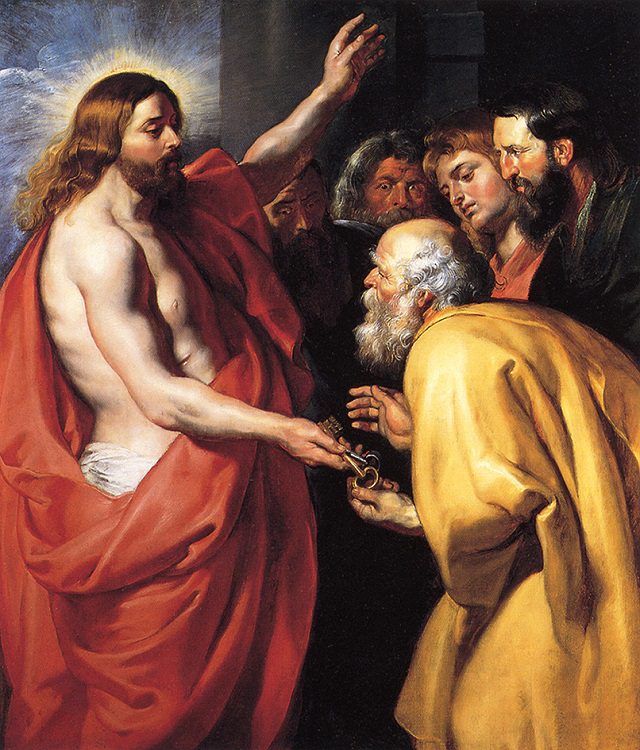
Matthew 16:19 I will give you the keys of the kingdom of heaven, and whatever you bind on earth shall be bound in heaven, and whatever you loose on earth shall be loosed in heaven.
Collins (for good reason, given his goals) completely ignores the Hebraic historical and thematic background of this passage — which goes back to Isaiah 22 –, and all of the implications thereof, which have been massively dealt with by many Protestant commentators. I think folks ought to become acquainted with that fascinating data (rather than be completely in the dark), so here are many more related citations from Protestant scholars (thanks again to Nicholas Hardesty and his article, cited above):
-
- “The keys are the symbol of authority, and Roland de Vaux (Ancient Israel, tr. by John McHugh [New York: McGraw-Hill, 1961], 129 ff.) rightly sees here the same authority as that vested in the vizier, the master of the house, the chamberlain of the royal household in ancient Israel.” –W. F. Albright and C. S. Mann, The Anchor Bible: Matthew, (Garden City, NY: Doubleday, 1971), 196.
- “The image of keys (plural) perhaps suggests not so much the porter, who controls admission to the house, as the steward, who regulates its administration (Is 22:22, in conjunction with 22:15). The issue then is not that of admission to the church (which is not what the kingdom of heaven means; see pp. 45-47) but an authority derived from a delegation of God’s sovereignty.” –Craig S. Keener, The IVP Bible Background Commentary New Testament, (Downer’s Grove, IL: Intervarsity Press, 1993), 256.
- “The keeper of the keys has authority within the house as administrator and teacher (cf. Isa 22:20-25, which may have influenced Matthew here). The language of binding and loosing is rabbinic terminology for authoritative teaching, for having the authority to interpret the Torah and apply it to particular cases, declaring what is permitted and what is not permitted. Jesus, who has taught with authority (7:29) and has given his authority to his disciples (10:1,8 ) here gives his primary disciple the authority to teach in his name.” –M. Eugene Boring, “Matthew,” in Pheme Perkins and others, eds., The New Interpreter’s Bible, vol. 8, (Nashville, TN: Abingdon Press, 1995), 346.
- “The keys of the kingdom would be committed to the chief steward in the royal household and with them goes plenary authority.” –George Buttrick and others, eds., The Interpreter’s Bible, (New York: Abingdon, 1951), 453.
- “What do the expressions ‘bind’ and ‘loose’ signify? According to Rabbinical usage two explanations are equally possible: ‘prohibit’ and ‘permit’, that is, ‘establish rules’; or ‘put under the ban’ and ‘acquit.'” –Oscar Cullman, Peter: Disciple, Apostle, Martyr, trans. Floyd V. Filson, (Philadelphia: Westminster, 1953), 204-205.
- “These terms [binding and loosing] thus refer to a teaching function, and more specifically one of making halakhic pronouncements [i.e., relative to laws not written down in the Jewish Scriptures but based on an oral interpretation of them] which are to be ‘binding’ on the people of God. In that case, Peter’s ‘power of the keys’ declared in [Matthew] 16:19 is not so much that of the doorkeeper, who decides who may or may not be admitted to the kingdom of heaven, but that of the steward . . . . whose keys of office enable him to regulate the affairs of the household.” –R. T. France, Matthew: Evangelist and Teacher, (Grand Rapids, MI: Zondervan, 1989), 247.
- “In other words, Peter would give decisions, based on the teachings of Jesus, which would be bound in heaven; that is, honored by God.” –Ralph Earle, “Matthew,” in A. F. Harper and others, eds., Beacon Bible Commentary, vol. 6, (Kansas City, MO: Beacon Hill, 1964), 156.
- “This verse [Mat 16:19] therefore probably refers primarily to a legislative authority in the church.” –Craig S. Keener, The IVP Bible Background Commentary New Testament, (Downer’s Grove, IL: Intervarsity Press, 1993), 90.
- “Hence handing over the keys implies appointment to full authority. He who has the keys has on the one side control, e.g., over the council chamber or treasury, cf. Mt. 13:52, and on the other the power to allow or forbid entry, cf. Rev. 3:7.” –J. Jeremias, “Kleis,” in Gerhard Kittel, ed., and Geoffrey W. Bromley, trans. and ed., Theological Dictionary of the New Testament, vol. 3, (Grand Rapids, MI: Eerdmans, 1968), 749-750.
- Particularly note-worthy are the words of Martin Luther in his tract called “The Keys,” which he wrote 9 years after his excommunication:
-
- “So we stand there and with open mouth stare heavenward and invent still other keys. Yet Christ says very clearly in Mat. 16:19 that he will give the keys to Peter. He does not say he has two kinds of keys, but he gives to Peter the keys he himself has and no others.” –Martin Luther, “The Keys,” in Conrad Bergendoff, ed., trans. Earl Beyer and Conrad Bergendoff, Luther’s Works, vol. 40, (Philadelphia: Fortress, 1958), 365-366.
- “Isaiah 22:15 ff. undoubtedly lies behind this [Mat 16:19] saying.” –W. F. Albright and C. S. Mann, The Anchor Bible: Matthew, (Garden City, NY: Doubleday, 1971), 196.
- “The keeper of the keys was one of the most important roles a household servant could hold (Mark 13:32-34). A higher official held the keys in a royal kingdom (Is 22:22) and in God’s house, the temple.” –Craig S. Keener, The IVP Bible Background Commentary New Testament, (Downer’s Grove, IL: Intervarsity Press, 1993), 90.
- “‘The keys of the kingdom of heaven: the phrase [from Mat 16:19] is almost certainly based on Is. 22:22 where Shebna the steward is displaced by Eliakim and his authority transferred to him.” –D. Guthrie and others, The New Bible Commentary, (Grand Rapids, MI: Eerdmans, 1953) [reprinted by Intervarsity Press], 837.
- “The master of the palace had similar functions at the court of Judah. Announcing the promotion of Elyaqim, Isaiah 22:22 says: ‘I lay the key of the house of David upon his shoulder, if he opens, none will shut; if he shuts, none will open.’ The Egyptian vizier’s instructions are described in a very similar fashion. Every morning ‘the vizier will send someone to open the gates of the kings house, to admit those who have to enter, and to send out those who have to go out.’ One is reminded of the Lord’s words to Peter, the Vizier of the Kingdom of Heaven (Matthew 16:19).” –Roland de Vaux, Ancient Israel, trans. John McHugh (New York: McGraw-Hill, 1961), 130.
- “In Isa 22:22 the key of the house of David is promised to Eliakim. According to Paul, Jesus is the only foundation (1 Cor 3:11), and in Rev 1:18; 3:7, Jesus possesses the key of David and the keys of death and Hades. But in this passage [Matthew 16:19] Peter is made the foundation (cf. Eph 2:20, where the Christian apostles and prophets are the foundation and Christ is the cornerstone) and holds the keys.” –George Buttrick and others, eds.,The Interpreter’s Bible, (New York: Abingdom, 1951), 453.
- “In Matthew 16:19 it is presupposed that Christ is the master of the house, who has the keys to the Kingdom of Heaven, with which to open to those who come in. Just as in Isaiah 22:22 the Lord lays the keys of the house of David on the shoulders of his servant Eliakim, so Jesus commits to Peter the keys of his house, the Kingdom of Heaven, and thereby installs him as administrator of the house.” –Oscar Cullman, Peter: Disciple, Apostle, Martyr, trans. Floyd V. Filson, (Philadelphia: Westminster, 1953), 203.
- “Materially, then, the keys of the kingdom of God are not different from the key of David. This is confirmed by the fact that in Mt. 16:19, as in Rev. 3:7, Jesus is the One who controls them.” –J. Jeremias, “Kleis,” in Gerhard Kittel, ed., and Geoffrey W. Bromley, trans. and ed.,Theological Dictionary of the New Testament, vol. 3, (Grand Rapids, MI: Eerdmans, 1968), 749-750.
- R. T. France, in his commentary on Mat. 16:19 says that Isaiah 22:22 is “generally regarded as the Old Testament background to the metaphor of keys here. . . .” –R. T. France, Matthew: Evangelist and Teacher, (Grand Rapids, MI: Zondervan, 1989), 247.
Bottom line in this discussion: If one wants to simply bask in centuries of contra- and anti-Catholic polemics and bias, and repeat and memorize and chant those, parrot-like, one can (it’s a free country). But if one is interested in the latest consensus of biblical commentary, and in the background of key passages in the New Testament with regard to Church government, then they have to dig a little deeper, and seriously delve into the endless riches of the Bible and Hebrew Old Testament culture and ways of thinking. I did the latter; Collins clearly did not.
Because of that fact, I’m fully confident that the fair-minded, open-minded reader, who is truly interested in all that the Bible has to say, in its depths (not in mere “surfacey” hyper-selective prooftexting; ignoring mountains of relevant data), will see that the purely biblical case for the primacy of St. Peter and even for the essential kernels of the later fully developed papacy (before we even get to Church history), is surprisingly strong (and some might say, compelling).
***
Photo credit: Christ Surrendering the Keys to St. Peter (c. 1614), by Peter Paul Rubens (1577-1640) [public domain / Wikimedia Commons]
***


Next Post

October 22, 2017 Armstrong vs. Collins & Walls #11: Good & Bad Monothelite Heretics
Browse Our Archives
Select a Category & Last Things About Me Anti-Catholicism Atheism & Agnosticism Baptism and Sacramentalism Bible and Tradition Blessed Virgin Mary Books by Dave Armstrong C. S. Lewis Calvinism & General Protestantism Catholic Apologetics Catholic Apologists Catholic conversion Catholic converts Christmas Church (Ecclesiology) Church History Conversion and Converts Development of Doctrine Eastern Orthodoxy Ecumenism & Christian Unity Eucharist & Liturgy Fathers of the Church French Translations G. K. Chesterton Hell Hell & Satan Hell & Satan & Last Things Heresies & Comparative Religion Holistic Health Inquisition & Crusades & Scandals James White Jews & Judaism & Old Testament John Calvin John Henry Newman Liberal / Modernist Theology Life Issues Literary Resume Lutheranism Mariology Martin Luther Music Orthodoxy Papacy & Infallibility Personal Page Philosophy & Science Political & Ethical & Moral Issues Protestant Persecution & Intolerance Protestantism Purgatory Purgatory & Penance Romantic & Imaginative Theology Saints & Purgatory & Penance Salvation Salvation & Justification Satan & Last Things Sexuality and Gender Issues Spanish Translations Traditionalism vs. Radical Catholic Reactionaries Traducciones al español / tradução para português Trinitarianism & Christology Uncategorized Videos
Select a Month October 2026 September 2026 August 2026 July 2026 June 2026 May 2026 April 2026 March 2026 February 2026 January 2026 December 2025 November 2025 October 2025 September 2025 August 2025 July 2025 June 2025 May 2025 April 2025 March 2025 February 2025 January 2025 December 2024 November 2024 October 2024 September 2024 August 2024 July 2024 June 2024 May 2024 April 2024 March 2024 February 2024 January 2024 December 2023 November 2023 October 2023 September 2023 August 2023 July 2023 June 2023 May 2023 April 2023 March 2023 February 2023 January 2023 December 2022 November 2022 October 2022 September 2022 August 2022 July 2022 June 2022 May 2022 April 2022 March 2022 February 2022 January 2022 December 2021 November 2021 October 2021 September 2021 August 2021 July 2021 June 2021 May 2021 April 2021 March 2021 February 2021 January 2021 December 2020 November 2020 October 2020 September 2020 August 2020 July 2020 June 2020 May 2020 April 2020 March 2020 February 2020 January 2020 December 2019 November 2019 October 2019 September 2019 August 2019 July 2019 June 2019 May 2019 April 2019 March 2019 February 2019 January 2019 December 2018 November 2018 October 2018 September 2018 August 2018 July 2018 June 2018 May 2018 April 2018 March 2018 February 2018 January 2018 December 2017 November 2017 October 2017 September 2017 August 2017 July 2017 June 2017 May 2017 April 2017 March 2017 February 2017 January 2017 December 2016 November 2016 October 2016 September 2016 August 2016 July 2016 June 2016 May 2016 April 2016 March 2016 February 2016 January 2016 December 2015 November 2015 October 2015 September 2015 August 2015 July 2015 June 2015 May 2015 April 2015 March 2015 February 2015 January 2015 December 2014 November 2014 October 2014 September 2014 August 2014 July 2014 June 2014 April 2014 March 2014 February 2014 January 2014 December 2013 November 2013 October 2013 September 2013 August 2013 July 2013 June 2013 April 2013 March 2013 February 2013 January 2013 December 2012 November 2012 October 2012 September 2012 August 2012 July 2012 June 2012 May 2012 April 2012 March 2012 February 2012 January 2012 December 2011 November 2011 October 2011 September 2011 August 2011 July 2011 June 2011 April 2011 March 2011 February 2011 October 2010 September 2010 August 2010 July 2010 April 2010 March 2010 December 2009 October 2009 August 2009 July 2009 June 2009 May 2009 March 2009 February 2009 October 2008 September 2008 April 2008 March 2008 February 2008 January 2008 December 2007 November 2007 October 2007 May 2007 March 2007 February 2007 January 2007 November 2006 October 2006 September 2006 August 2006 July 2006 June 2006 May 2006 April 2006 March 2006 February 2006 October 2005 June 2005 April 2005 February 2005 July 2004 May 2004 April 2004
Follow Us!
TAKE THE
Religious Wisdom Quiz
Who was the king who arranged for Hezekiah's scribes to compile additional Proverbs?
Select your answer to see how you score.
Jeroboam Hezekiah Solomon Ahab
Books by This Author Books by Dave Armstrong
Related posts from Biblical Evidence for Catholicism

Was Peter "Any Old" Apostle? 10 Anti-Papal Arguments
Biblical Evidence for Catholicism

Jesus Founded the [Catholic] Church. If Not Him,...
Biblical Evidence for Catholicism

11 Protestant Objections to Papal Authority Debunked
Biblical Evidence for Catholicism

Matthew 16 & the Papacy (vs. Patrick O'Brien)
Biblical Evidence for Catholicism
TRENDING AT PATHEOS Catholic

Nearly every morning, I make the drive to Detroit with my high-school-age...

The Real AI Story Is Adoption Without Trust
Artificial intelligence has crossed a political threshold. It is no longer a...

A new article, written by Jeff Lindsay and Gale L. Pooley,...

Swimfan: Forgotten Aughts Pleasures
This is a recovery effort. In 2002, My Big Fat Greek Wedding...

Top Three Anti-Catholic Lies About Catholicism
This is my initial transcript for the video, "THE 3 WORST...

Pope Leo Celebrates Mass for Nurses & Docs...
I don't have any idea how he did it, but Pope Leo...
view all Catholic blogs
Ad-Free & Subscriber Log-In Subscription Support
- About Us
- 2026 Calendar
- Videos
- Podcasts
- Library of World Religions
- Faith In Media Tracker
- Advertise With Us
- Write for Us
- Privacy Policy
- Terms of Service
- Do Not Sell My Data
- Contact Us
- Radiant Digital
- Manage Newsletter Subscriptions
- Unsubscribe From Notifications
- Sitemap
Copyright 2008-2026, Patheos. All rights reserved.
Subscription Support Ad-Free & Subscriber Log-In
Follow Patheos