
BuddhistCatholicContemplativeEvangelicalGeneral ChristianHinduJewishLatter-day SaintMuslimNew VisionsProgressive Christian
Beliefs
- Buddhist
- Catholic
- Contemplative
- Evangelical
- General Christian
- Hindu
- Jewish
- Latter-day Saint
- More Voices
- Muslim
- New Visions
- Pagan
- Progressive Christian
Topics
- Religion News
- Food and Religion
- Sports and Religion
- Religious Art
- Religious Music and Entertainment
- Religious Events
- History and Religion
- Style and Religion
- Politics and Religion
- Women in Religion
- Recreation Outdoors and Religion
- Business Finance and Religion
- Careers Workplace and Religion
- Education and Religion
- Family Parenting and Religion
- Health Fitness and Religion
- Home and Religion
- Relationships and Religion
- Technology and Religion
- Travel and Religion
Columnists
- Buddhist Columnists
- Business Finance and Religion Columnists
- Careers Workplace and Religion Columnists
- Catholic Columnists
- Contemplative Columnists
- Education and Religion Columnists
- Evangelists Columnists
- Family Parenting and Religion Columnists
- General Christian Columnists
- Health Fitness and Religion Columnists
- Hindu Columnists
- History and Religion Columnists
- Home and Religion Columnists
- Jewish Columnists
- More Voices Columnists
- Latter Day Columnists
- Muslim Columnists
- New Visions Columnists
- Nonreligious Columnists
- Pagan Columnists
- Politics and Religion Columnists
- Progressive Columnists
- Recreation Outdoors and Religion Columnists
- Relationships and Religion Columnists
- Religion News Columnists
- Religious Art Columnists
- Religious Events Columnists
- Religious Music and Entertainment Columnists
- Sports and Religion Columnists
- Style and Religion Columnists
- Technology and Religion Columnists
- Travel and Religion Columnists
- Women in Religion Columnists
Resource Library
- 2026 Calendar
- Library of World Religions
- The 100 Most Holy Places on Earth
- Patheos Answers
- Podcasts
- Videos
- Faith Leaders Database
- Anglican Episcopalian
- Bahai
- Baptist
- Buddhism
- Christianity
- Confucianism
- Eastern Orthodoxy
- Hinduism
- Holiness and Pentecostal
- ISKCON
- Islam
- Judaism
- Lutheran
- Methodist
- The Church of Jesus Christ of Latter-day Saints
- New Age
- Paganism
- Presbytarian and Reformed
- Protestantism
- Religion Behind the Scenes
- Roman Catholic
- Scientology
- Shia Islam
- Sikhism
- Sufism
- Sunni Islam
- Taoism
- Zen
- See all religions
Research Tools
 Ad-Free & Subscriber Log-In Subscription Support
Follow Patheos 

- Trending:
- Advent
- |
- Forgiveness
- |
- Thanksgiving
- |
- Election
- |
- Seasonal Holidays
- |
- Marriage

-
About
-
Catholic Apologetics
-
Church History
-
Great Apologists
-
Christian Worldview
-
Protestantism & Misc.
- Home
- Catholic
- History and Religion
- The REAL Diet of Augsburg (1530) vs. the Protestant Myth
The REAL Diet of Augsburg (1530) vs. the Protestant Myth
Last updated on: October 23, 2017 at 12:44 pm by Dave Armstrong
The REAL Diet of Augsburg (1530) vs. the Protestant Myth 2017-10-23T12:44:24-04:00 Dave Armstrong
Patheos Explore the world's faith through different perspectives on religion and spirituality! Patheos has the views of the prevalent religions and spiritualities of the world.
(3-3-04; additions from 10-9-07)
***
From my review of the movie Luther:
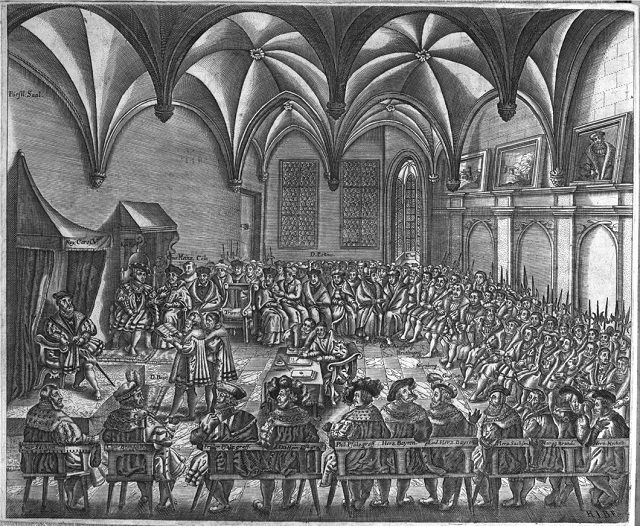
The movie ended with the Diet of Augsburg in 1530 between Protestants and Catholics, and the Protestant “triumph” — as their “case” was allowed to be presented (announced on the hilltops by jubilant Protestants to the surprised Luther). Then writing appears on the screen to the effect that these momentous events heralded a huge step forward for the cause of religious liberty and freedom of conscience.
If the stereotypes of the movie are to be believed, the Protestant princes and other representatives were (to a man), noble, selfless, sincere, committed Christians who simply wanted to worship in peace and to read their Bibles in German without harassment. The Catholics, represented in the scene primarily by Emperor Charles V, only wanted (as the myth would have it) to suppress the Bible, so that no one would see the self-evident biblical truth that Catholicism was false.
The reality, was, of course, far more interesting and complex. Protestant historian Philip Schaff (the very definition of a “biased but fair-minded person”) wrote in his History of the Christian Church:
The Emperor stood by the Pope and the Edict of Worms, but was more moderate than his fanatical surroundings, and treated the Lutherans during the Diet with courteous consideration, while he refused to give the Zwinglians even a hearing. The Lutherans on their part praised him beyond his merits, and were deceived into false hopes; while they would have nothing to do with the Swiss and Strassburgers, although they agreed with them in fourteen out of fifteen articles of faith . . .
Margrave George of Brandenburg declared that he would rather lose his head than deny God. The Emperor replied: ‘Dear prince, not head off, not head off’ . . .
The only blot on the fame of the Lutheran confessors of Augsburg is their intolerant conduct towards the Reformed, which weakened their own cause. The four German cities which sympathized with the Zwinglian view on the Lord’s Supper wished to sign the Confession, with the exception of the tenth article, which rejects their view; but they were excluded, and forced to hand in a separate confession of faith.
Even Martin Luther and Philip Melanchthon couldn’t come to full agreement on matters connected with the Augsburg Confession, as indicated by a series of letters between them at the time of the Diet of Augsburg. Melanchthon, true to his more conciliatory, mild character, took a much different approach than Luther:
He sweated over every portion of the Apology, for he wanted to state the core of evangelical doctrine without alienating the Roman Catholics. (Melanchthon: The Quiet Reformer, Clyde Leonard Manschreck, New York: Abingdon Press, 1958, 182)
The nature of the Mass was a dividing point all along, and indicates the contradictory nature of the Lutheran position, that was claiming to be a continuation of “catholic history” but in fact was an innovation, if it didn’t even retain the central act of Christian worship, according to all those centuries from the time of Christ to 1517. Melanchthon biographer Manschreck subtly notes this disconnect:
Melanchthon’s letters that Sunday afternoon, June 19, to Myconius, Luther, and Camerarius show that he thought the entire dispute might be settled by correcting abuses. Melanchthon believed that the evangelical movement in Germany was a product of the vital spirit of the old Latin church, that the fundamental doctrines of justification by faith were not anything new but a reassertion of the heart of the Christian gospel, which in the centuries of church development had become obscured by ecclesiastical observances. In casting these aside Melanchthon believed the evangelicals were adhering to the pristine practices of the church, as reflected in Scripture and the early fathers, particularly Augustine. To Valdes he was trying to show that the reformation practices were in accord with the old canonical rules and compliant with genuine catholic Christianity, and ought, therefore, to be tolerated and encouraged by the Emperor.
But something happened. Although the evangelicals attended the early morning mass, June 20, as requested . . . not a single evangelical representative participated in the ancient, mysterious rites. Charles showed his displeasure, but the Protestants seemed to have determined upon another course of action. (Manschreck, ibid., 190)
Luther (as we would fully expect) was far less conciliatory than Melanchthon. He wrote to the latter on 28 or 29 June 1530:
I have received your Apology, and I am wondering what you mean when you say you desire to know what and how much we may yield to the Papists? According to my opinion, too much is already conceded to them in the Apology . . . I am ready, as I have always written to you, to yield up everything to them, if they will only leave the Gospel free. (Ibid., 195)
Luther seems to have thought (far differently than Melanchthon) that reconciliation with the Catholics was impossible. Indeed, Manschreck noted that “Historians writing on the Augsburg Confession usually criticize Melanchthon as childish if not traitorous for his activity during this period” (p. 204). He contends that Luther himself would not agree with such an assessment of his friend and successor, but clearly saw “that the basic difference was one of authority” (p. 205).
The very notion that the Augsburg Confession was in entire agreement with prior Catholic history is quite debatable. Catholic Luther biographer Hartmann Grisar wrote:
In fact, the first official edition of the “Confession,” printed in 1530, contained the deceptive declaration (which was subsequently altered) that the impugned doctrines meant no deviation from the Scriptures or the teaching of the Roman Catholic Church, in as far as that teaching could be ascertained from Catholic authors.
. . . the Catholic theologians . . . noted the absence of any declaration relative to the pope, whom the Lutherans had come to regard as Antichrist. The declaration was silent about the universal priesthood of all the faithful in place of the clergy, the incapacity of the human will to do good, and absolute predestination, the very pillars of the doctrinal system of Lutheranism. The antitheses between the two religions on the subject of indulgences and Purgatory were likewise hushed up, and the differences in the veneration of the saints had also vanished.
Hence, honest candor, the preliminary condition of reunion, was missing. (Martin Luther: His Life and Work, translated by Frank J. Eble, edited by Arthur Preuss, Westminster, Maryland: The Newman Press, 1950, 376)
Grisar says of Melanchthon that “His depressed condition of mind is the only thing that helps him over the charge of conscious deception” (p. 377). He implies that Luther (in his letter of August 26th, 1530, partially cited above) was aware of a certain “vacillation” — or at least likely perceptions of same — from the Protestants in the negotiations of Augsburg:
. . . we shall be charged with perfidy and vacillation. But what will the consequence be? Matters may easily be remedied by the steadfastness and the truth of our cause. True, I do not wish that it should so happen; but speak in such wise that, if it should happen, despondency do not ensue. For, once we shall have attained peace and escaped violence, we shall easily make amends for our tricks . . and failings, because God’s mercy rules over us. (Ibid., p. 388)
Catholic historian Warren Carroll described the proceedings and the lack of tolerance in the Lutheran party:
Early in July the bishops presented their complaints to the Diet of the plundering and destruction of churches, seizure of monasteries and hospitals, prohibition of Masses, and attacks on religious processions by the Protestants. When Charles called upon the Protestants to restore the property they had seized, they said that to do so would be against their consciences. Charles responded crushingly: ‘The Word of God, the Gospel, and every law civil and canonical, forbid a man to appropriate to himself the property of another.’ He said that as Emperor he had the duty of guarding the rights of all, especially those Catholics unwilling to accept Protestantism or go into exile, who should at least be allowed to remain in their homes and practice their ancestral faith, specifically the Mass; the Protestants replied that they would not tolerate the Mass . . .
By July it was clear that on matters of doctrine the Lutherans at Augsburg were dissimulating, concealing their real beliefs in the hope of avoiding a final breach without making genuine concessions. On July 6 Melanchthon made the incredible statement:
We have no dogmas which differ from the Roman Church . . . We reverence the authority of the Pope of Rome, and are prepared to remain in allegiance to the Church if only the Pope does not repudiate us.
As it happened, on the very same day Luther, in an exposition on the Second Psalm addressed to Archbishop Albert of Mainz, declared:
Remember that you are not dealing with human beings when you have affairs with the Pope and his crew, but with veritable devils! . . .
On the 13th [of July] Luther announced from Coburg that the Protestants would never tolerate the Mass, which he called blasphemous, and said of the Emperor:
We know that he is in error and that he is striving against the Gospel . . . He does not conform to God’s Word and we do . . .
Luther stated in a letter to Melanchthon [on] August 26:
This talk of compromise . . . is a scandal to God . . . I am thoroughly displeased with this negotiating concerning union in doctrine, since it is utterly impossible unless the Pope wishes to take away his power.
In subsequent letters he declared that no religious settlement was possible as long as the Pope remained and the Mass was unchanged . . .
Luther prepared the final Protestant answer:
The Augsburg Confession must endure, as the true and unadulterated Word of God, until the great Judgment Day . . . Not even an angel from Heaven could alter a syllable of it, and any angel who dared to do so must be accursed and damned . . . The stipulations made that monks and nuns still dwelling in their cloisters should not be expelled, and that the Mass should not be abolished, could not be accepted; for whoever acts against his conscience simply paves his way to Hell. The monastic life and the Mass covered with infamous ignominy the merit and suffering of Christ. Of all the horrors and abominations that could be mentioned, the Mass was the greatest.
. . . no Catholic of spirit and courage could be expected, let alone morally required, to give up all his religious rights without a struggle; and few Protestants, at this point, would allow Catholics to exercise those rights if the Protestants were strong enough to deny them. These were the irreconcilable positions taken by the two sides at the Diet of Augsburg in 1530, which made those long and bloody years of conflict inevitable. (The Cleaving of Christendom; from the series, A History of Christendom, Volume 4, Front Royal, Virginia: Christendom Press, 2000, 103-107)
So we see that this supposedly wonderful newfound “tolerance” and freedom of worship among the early Protestants was shot through with hypocrisy. The Lutherans were obviously courting the Catholic Emperor’s favor (putting politics above principle to some extent), whereas they would have “nothing to do” with their fellow Protestants, the Swiss and Strassburg theologians, even though they disagreed on one article of fifteen; and the Zwinglians wouldn’t sign the confession because of dissent on one article. They held to a symbolic view of the Eucharist (identical to the view of the majority of evangelical Christians today).
And of course, at the same time or shortly thereafter, Luther and Melanchthon and the Zwinglians and Calvinists were executing Anabaptists (who weren’t allowed to speak at all at the Diet of Augsburg) because they believed in adult baptism (like today’s Baptists), and forbidding religious freedom to Catholics. Catholics were required to give up their belief in the authority of the pope and their central religious rite, the Mass; Catholic properties which were stolen and plundered would not be returned, in the name of “conscience,” while the Augsburg Conession is an oracle from God; indeed the veritable “Word of God” itself, practically divinely inspired in every syllable (according to Quasi-Prophet Luther).
This is “tolerance” and “religious freedom”? How does one “negotiate” with such people, who consider every utterance in their statements inspired and infallible and their opponents “devils” who engage in “blasphemy” every Sunday when they worship? Truth is always stranger and more fascinating than fiction.
Nor were things very “tolerant” in Augsburg itself, in matters religious, following the Diet. According to the Catholic Encyclopedia:
At the Diet of Augsburg in 1530, at which the so-called Augsburg Confession was delivered to Emperor V in the chapel of the episcopal palace, the emperor issued an edict according to which all innovations were to be abolished, and Catholics reinstated in their rights and property. The city council, however, set itself up in opposition, recalled (1531) the Protestant preachers who had been expatriated, suppressed Catholic services in all churches except the cathedral (1534), and in 1537 joined the League of Smalkald. At the beginning of this year a decree of the council was made, forbidding everywhere the celebration of Mass, preaching, and all ecclesiastical ceremonies, and giving to the Catholic clergy the alternative of enrolling themselves anew as citizens or leaving the city. An overwhelming majority of both secular and regular clergy chose banishment; the bishop withdrew with the cathedral chapter to Dillingen, whence he addressed to the pope and the emperor an appeal for the redress of his grievances. In the city of Augsburg the Catholic churches were seized by Lutheran and Zwinglian preachers; at the command of the council pictures were removed, and at the instigation of Bucer and others a disgraceful storm of popular iconoclasm followed, resulting in the destruction of many splendid monuments of art and antiquity. The greatest intolerance was exercised towards the Catholics who had remained in the city; their schools were dissolved; parents were compelled to send their children to Lutheran institutions; it was even forbidden to hear Mass outside the city under severe penalties.
***
Photo credit: Reading of the Confessio Augustana in front of Emperor Charles V at the Diet of Augsburg, 1530 [public domain / Wikimedia Commons]

***
Calvinism & General Protestantism
Protestant Persecution & Intolerance
Previous Post

September 29, 2017
Indefectibility: Does God Protect His Church from Doctrinal Error?
Next Post
October 1, 2017 Who's Defending Pope Benedict's "Summorum Pontificum" Now?
Browse Our Archives
Select a Category & Last Things About Me Anti-Catholicism Atheism & Agnosticism Baptism and Sacramentalism Bible and Tradition Blessed Virgin Mary Books by Dave Armstrong C. S. Lewis Calvinism & General Protestantism Catholic Apologetics Catholic Apologists Catholic conversion Catholic converts Christmas Church (Ecclesiology) Church History Conversion and Converts Development of Doctrine Eastern Orthodoxy Ecumenism & Christian Unity Eucharist & Liturgy Fathers of the Church French Translations G. K. Chesterton Hell Hell & Satan Hell & Satan & Last Things Heresies & Comparative Religion Holistic Health Inquisition & Crusades & Scandals James White Jews & Judaism & Old Testament John Calvin John Henry Newman Liberal / Modernist Theology Life Issues Literary Resume Lutheranism Mariology Martin Luther Music Orthodoxy Papacy & Infallibility Personal Page Philosophy & Science Political & Ethical & Moral Issues Protestant Persecution & Intolerance Protestantism Purgatory Purgatory & Penance Romantic & Imaginative Theology Saints & Purgatory & Penance Salvation Salvation & Justification Satan & Last Things Sexuality and Gender Issues Spanish Translations Traditionalism vs. Radical Catholic Reactionaries Traducciones al español / tradução para português Trinitarianism & Christology Uncategorized Videos
Select a Month November 2026 October 2026 September 2026 August 2026 July 2026 June 2026 May 2026 April 2026 March 2026 February 2026 January 2026 December 2025 November 2025 October 2025 September 2025 August 2025 July 2025 June 2025 May 2025 April 2025 March 2025 February 2025 January 2025 December 2024 November 2024 October 2024 September 2024 August 2024 July 2024 June 2024 May 2024 April 2024 March 2024 February 2024 January 2024 December 2023 November 2023 October 2023 September 2023 August 2023 July 2023 June 2023 May 2023 April 2023 March 2023 February 2023 January 2023 December 2022 November 2022 October 2022 September 2022 August 2022 July 2022 June 2022 May 2022 April 2022 March 2022 February 2022 January 2022 December 2021 November 2021 October 2021 September 2021 August 2021 July 2021 June 2021 May 2021 April 2021 March 2021 February 2021 January 2021 December 2020 November 2020 October 2020 September 2020 August 2020 July 2020 June 2020 May 2020 April 2020 March 2020 February 2020 January 2020 December 2019 November 2019 October 2019 September 2019 August 2019 July 2019 June 2019 May 2019 April 2019 March 2019 February 2019 January 2019 December 2018 November 2018 October 2018 September 2018 August 2018 July 2018 June 2018 May 2018 April 2018 March 2018 February 2018 January 2018 December 2017 November 2017 October 2017 September 2017 August 2017 July 2017 June 2017 May 2017 April 2017 March 2017 February 2017 January 2017 December 2016 November 2016 October 2016 September 2016 August 2016 July 2016 June 2016 May 2016 April 2016 March 2016 February 2016 January 2016 December 2015 November 2015 October 2015 September 2015 August 2015 July 2015 June 2015 May 2015 April 2015 March 2015 February 2015 January 2015 December 2014 November 2014 October 2014 September 2014 August 2014 July 2014 June 2014 April 2014 March 2014 February 2014 January 2014 December 2013 November 2013 October 2013 September 2013 August 2013 July 2013 June 2013 April 2013 March 2013 February 2013 January 2013 December 2012 November 2012 October 2012 September 2012 August 2012 July 2012 June 2012 May 2012 April 2012 March 2012 February 2012 January 2012 December 2011 November 2011 October 2011 September 2011 August 2011 July 2011 June 2011 April 2011 March 2011 February 2011 October 2010 September 2010 August 2010 July 2010 April 2010 March 2010 December 2009 October 2009 August 2009 July 2009 June 2009 May 2009 March 2009 February 2009 October 2008 September 2008 April 2008 March 2008 February 2008 January 2008 December 2007 November 2007 October 2007 May 2007 March 2007 February 2007 January 2007 November 2006 October 2006 September 2006 August 2006 July 2006 June 2006 May 2006 April 2006 March 2006 February 2006 October 2005 June 2005 April 2005 February 2005 July 2004 May 2004 April 2004
Follow Us!
TAKE THE
Religious Wisdom Quiz
Who said, "The Lord said to my Lord, ‘Sit at my right hand’"?
Select your answer to see how you score.
Solomon David Isaiah Moses
Books by This Author Books by Dave Armstrong
Related posts from Biblical Evidence for Catholicism
Denominationalism: 50 Biblical Condemnations
Biblical Evidence for Catholicism
On Protestant Explanations of Catholic Conversion
Biblical Evidence for Catholicism
Does Catholic Intercession of Saints Require Omniscience?
Biblical Evidence for Catholicism
Protestant Confessions & "Ever-Virgin" Mary
Biblical Evidence for Catholicism
TRENDING AT PATHEOS Catholic

Smart people saying smart things (11.24.26)
Please take time to listen to Perry Bacon, Sarah Posner, Adam Serwer,...

The Contingency of Our Technology
Last week we were hit with a raft of massive technology outages....

In 1939, President Franklin D. Roosevelt moved Thanksgiving from November 30 to...

Reasons for Restraint: Ricardo Gonzalez, Florida and Dec...
The Morning of January 3 I begin with the dead. On the...

I published this column for Thanksgiving 2012 in the Deseret News....

For many years, Catholicism has been caught up in division over the...
view all Catholic blogs
Ad-Free & Subscriber Log-In Subscription Support
- About Us
- 2026 Calendar
- Videos
- Podcasts
- Library of World Religions
- Faith In Media Tracker
- Advertise With Us
- Write for Us
- Privacy Policy
- Terms of Service
- Do Not Sell My Data
- Contact Us
- Radiant Digital
- Manage Newsletter Subscriptions
- Unsubscribe From Notifications
- Sitemap
Copyright 2008-2026, Patheos, part of the Radiant Digital network of media brands. All rights reserved.
Subscription Support Ad-Free & Subscriber Log-In
Follow Patheos