
BuddhistCatholicContemplativeEvangelicalGeneral ChristianHinduJewishLatter-day SaintMuslimNew VisionsProgressive Christian
Beliefs
- Buddhist
- Catholic
- Contemplative
- Evangelical
- General Christian
- Hindu
- Jewish
- Latter-day Saint
- More Voices
- Muslim
- New Visions
- Pagan
- Progressive Christian
Topics
- Religion News
- Food and Religion
- Sports and Religion
- Religious Art
- Religious Music and Entertainment
- Religious Events
- History and Religion
- Style and Religion
- Politics and Religion
- Women in Religion
- Recreation Outdoors and Religion
- Business Finance and Religion
- Careers Workplace and Religion
- Education and Religion
- Family Parenting and Religion
- Health Fitness and Religion
- Home and Religion
- Relationships and Religion
- Technology and Religion
- Travel and Religion
Columnists
- Buddhist Columnists
- Business Finance and Religion Columnists
- Careers Workplace and Religion Columnists
- Catholic Columnists
- Contemplative Columnists
- Education and Religion Columnists
- Evangelists Columnists
- Family Parenting and Religion Columnists
- General Christian Columnists
- Health Fitness and Religion Columnists
- Hindu Columnists
- History and Religion Columnists
- Home and Religion Columnists
- Jewish Columnists
- More Voices Columnists
- Latter Day Columnists
- Muslim Columnists
- New Visions Columnists
- Nonreligious Columnists
- Pagan Columnists
- Politics and Religion Columnists
- Progressive Columnists
- Recreation Outdoors and Religion Columnists
- Relationships and Religion Columnists
- Religion News Columnists
- Religious Art Columnists
- Religious Events Columnists
- Religious Music and Entertainment Columnists
- Sports and Religion Columnists
- Style and Religion Columnists
- Technology and Religion Columnists
- Travel and Religion Columnists
- Women in Religion Columnists
Resource Library
- 2026 Calendar
- Library of World Religions
- The 100 Most Holy Places on Earth
- Patheos Answers
- Podcasts
- Videos
- Faith Leaders Database
- Anglican Episcopalian
- Bahai
- Baptist
- Buddhism
- Christianity
- Confucianism
- Eastern Orthodoxy
- Hinduism
- Holiness and Pentecostal
- ISKCON
- Islam
- Judaism
- Lutheran
- Methodist
- The Church of Jesus Christ of Latter-day Saints
- New Age
- Paganism
- Presbytarian and Reformed
- Protestantism
- Religion Behind the Scenes
- Roman Catholic
- Scientology
- Shia Islam
- Sikhism
- Sufism
- Sunni Islam
- Taoism
- Zen
- See all religions
Research Tools
 Ad-Free & Subscriber Log-In Subscription Support
Follow Patheos 

- Trending:
- Advent
- |
- Forgiveness
- |
- Thanksgiving
- |
- Election
- |
- Seasonal Holidays
- |
- Marriage

-
About
-
Catholic Apologetics
-
Church History
-
Great Apologists
-
Christian Worldview
-
Protestantism & Misc.
- Home
- Catholic
- History and Religion
- Protestant Inquisitions: “Reformation” Intolerance & Persecution
Protestant Inquisitions: “Reformation” Intolerance & Persecution
Last updated on: November 22, 2021 at 4:01 pm by Dave Armstrong
Protestant Inquisitions: “Reformation” Intolerance & Persecution 2021-11-22T16:01:10-04:00 Dave Armstrong
Patheos Explore the world's faith through different perspectives on religion and spirituality! Patheos has the views of the prevalent religions and spiritualities of the world.
 (originally written in 1991. Revised: 10-31-03 and 3-7-07. Greatly abridged and re-typeset on 9-14-17)
* * * * *
Disclaimer and statement of intent: Unfortunately, the religious “scandal score” needs to be evened up now and then, and the lesser-known “skeletons in the closet” need to be rescued from obscurity, surveyed, and exposed. I take no pleasure in “dredging up” these unsavory occurrences, but it is necessary for honest, fair historical appraisal. This does not mean that I have forsaken ecumenism, or that I wish to bash Protestants, or that I deny corresponding Catholic shortcomings.
Historical facts are what they are, and most Protestants (and Catholics) are unaware of the following historical events and beliefs (while, on the other hand, one always hears about the embarrassing and scandalous Catholic stuff — and not often very accurately or fairly at that). If (as I suspect might often be the case) readers are shocked or surprised by the very title of this paper, this would be a case in point, and justification enough for my purposes of education.
Even James Swan, an anti-Catholic Reformed Protestant polemicist and controversialist, who has often incompetently and unfairly savaged my research on early Protestantism, freely admits:
***“[T]here is a sense in which I’m sympathetic to the defenders of Rome who put forth the Tu quoque argument that Protestants have also committed atrocities, so bringing up Rome’s past sins isn’t a logically compelling argument against her . This is why I rarely have written against Rome by pointing out her moral evils.” (on his website, 9-9-17) He also writes of Hartmann Grisar, the Jesuit Luther biographer whom I cite a lot below: “I have found him to be mostly reliable with his citations.” (2-7-07)
***
With that end and stated outlook in mind, I offer this copiously researched treatise, with all due respect to my Protestant brethren, yet not without some remaining trepidation.* * * * *CONTENTS
I. PROTESTANT INTOLERANCE: AN OVERVIEW
II. PLUNDER AS AN AGENT OF RELIGIOUS REVOLUTION
III. SYSTEMATIC SUPPRESSION OF CATHOLICISM
IV. PROTESTANT CENSORSHIP
BIBLIOGRAPHY
* * * * *
[Citations will refer to authors in the bibliography; any additional information will appear right after the citation; all material is quotations, unless otherwise noted (“Armstrong”)]
***
[P = Protestant scholar / S = secularist / non-religious scholar; otherwise, Catholics]
***
I. PROTESTANT INTOLERANCE: AN OVERVIEW***Historically nothing is more incorrect than the assertion that the Reformation was a movement in favour of intellectual freedom. The exact contrary is the truth. For themselves, it is true, Lutherans and Calvinists claimed liberty of conscience . . . but to grant it to others never occurred to them so long as they were the stronger side. The complete extirpation of the Catholic Church, and in fact of everything that stood in their way, was regarded by the reformers as something entirely natural. (in Grisar, VI, 268-269; Johann von Dollinger, Kirche und Kirchen, 1861, 68)
*
If any one still harbors the traditional prejudice that the early Protestants were more liberal, he must be undeceived. Save for a few splendid sayings of Luther, confined to the early years when he was powerless, there is hardly anything to be found among the leading reformers in favor of freedom of conscience. As soon as they had the power to persecute they did. (Preserved Smith [S], 177)
The Reformers themselves . . . e.g., Luther, Beza, and especially Calvin, were as intolerant to dissentients as the Roman Catholic Church. (Cross, Oxford Dictionary of the Christian Church [P], 1383)
Protestants . . . read blood-curdling stories of the Inquisition and of atrocities committed by Catholics, but what does the average Protestant know of Protestant atrocities in the centuries succeeding the Reformation? Nothing, unless he makes a special study of the subject . . . Yet they are perfectly well known to every scholar . . .
Now granting for the sake of argument, that all that is usually said of Catholic persecutions is true, the fact remains that Protestants, as such, have no right to denounce them, as if such deeds were characteristic of Catholics only. People who live in glass houses should not throw stones . . . It is unquestionable . . . that the champions of Protestantism – Luther, Calvin, Beza, Knox, Cranmer and Ridley — advocated the right of the civil authorities to punish the ‘crime’ of heresy . . . Rousseau says truly: “The Reformation was intolerant from its cradle, and its authors were universal persecutors . . .” Auguste Comte also writes: “The intolerance of Protestantism was certainly not less tyrannical than that with which Catholicism is so much reproached.” (Philosophie Positive, IV, 51)
What makes, however, Protestant persecutions specially revolting is the fact that they were absolutely inconsistent with the primary doctrine of Protestantism — the right of private judgment in matters of religious belief! Nothing can be more illogical than at one moment to assert that one may interpret the Bible to suit himself, and at the next to torture and kill him for having done so! . . .
At all events, the argument that the persecutions for heresy, perpetrated by the Catholics, constitute a reason why one should not enter the Catholic Church, has not a particle more force than a similar argument would have against one’s entering the Protestant Church. In both there have been those deserving of blame in this respect, and what applies to one applies also to the other. (Stoddard, 204-205, 209-210)
The ablest defence of persecution during the 17th century came from the Scottish Presbyterian Samuel Rutherford (A Free Disputation Against Pretended Liberty Of Conscience, 1649). (Chadwick [P], 403)
In England the advocates of religious toleration long continued to be in a minority, but it was . . . defended by J. Milton in his Areopagitica [1644] (to the exclusion, however of RCs) . . . It virtually became the policy of the state by the Act of Toleration (q.v.) of 1689, which excluded only RCs and Unitarians. In the same year Locke published his first Letter concerning Toleration, to be followed by three others, denying the state all right of interference in religious matters and demanding toleration for all except RCs and atheists. (Cross, Oxford Dictionary of the Christian Church [P], 1383-1384)
Often the resistance to tyranny and the demand for religious freedom are combined, as in the Puritan revolution in England; and the victors, having achieved supremacy, then set up a new tyranny and a fresh intolerance. (Harkness [P], 222)
Multitudes of Non-Conformists fled from Ireland and England to America; . . . What is amazing is the fact that, after such experiences, those fugitives did not learn the lesson of toleration, and did not grant to those who differed . . . freedom . . . When they found themselves in a position to persecute, they tried to outdo what they had endured . . . Among those whom they attacked was . . . the Society of Friends, otherwise known as Quakers. (Stoddard, 207)
In Massachusetts, for successive convictions, a Quaker would suffer the loss of one ear and then the other, the boring of the tongue with a hot iron, and sometimes eventually death. In Boston three Quaker men and one woman were hanged. Baptist Roger Williams was banished from Massachusetts in 1635 and founded tolerant Rhode Island (Stoddard, 208).
*
To his credit, he remained tolerant, an exception to the rule, as was William Penn, who was persecuted by Protestants in England and founded the tolerant colony of Pennsylvania. Quakerism (Penn’s faith) has an honorable record of tolerance since, — like its predecessor Anabaptism –, it is one of the most subjective and individualistic of Protestant sects, and eschews association with the “world” (governments, the military, etc.), whence lies the power necessary to persecute. Thus, Quakers were in the forefront of the abolition movement in America in the first half of the 19th century. (Armstrong)
In the 17th century the most notable instances of practical toleration were the colonies of Maryland, founded by Lord Baltimore in 1632 for persecuted Catholics, which offered asylum also to Protestants, and of Rhode Island, founded by Roger Williams. (Cross, Oxford Dictionary of the Christian Church [P], 1383)
Baltimore . . . welcomed, among other English people, even the Catholic-hating Puritans . . . In January of 1691 . . . the new regime brought hard times for Catholics as the Protestants closed their church, forbade them to teach in public . . . but . . . the little outpost of practical Catholic tolerance had left its mark of promise on the land. (Martin Marty [P], Pilgrims in Their Own Land: 500 Years of Religion in America, New York: Penguin, 1984, 83, 85-86)
Lord Baltimore allowed several hundred Puritans, unwelcome in Episcopalian Virginia, to enter Maryland in 1648. (Armstrong, see Ellis, below, p. 37)
For the first time in history . . . all churches would be tolerated, and . . . none would be the agent of the government . . . Catholics and Protestants side by side on terms of equality and toleration unknown in the mother country . . . The effort proved vain; for . . . the Puritan element . . . October, 1654, repealed the Act of Toleration and outlawed the Catholics . . . condemning ten of them to death, four of whom were executed . . . From . . . 1718 down to the outbreak of the Revolution, the Catholics of Maryland were cut off from all participation in public life, to say nothing of the enactments against their religious services and . . . schools for Catholic instruction . . . During the half-century the Catholics had governed Maryland they had not been guilty of a single act of religious oppression. (John Tracy Ellis, American Catholicism, Garden City, New York: Doubleday Image, 1956, 36, 38-39)
Stories of Protestant intolerance in America prior to 1789 could be multiplied indefinitely. Jefferson and Madison, in pushing for complete religious freedom, were reacting primarily to these inter-Protestant wars for dominance, not the squabbles of post-Reformation Europe. Here we are concerned with the immediate era of the Protestant Revolution — roughly 1517 to 1600, so the above anecdotes will have to suffice as altogether typical examples. (Armstrong)
The principle which the Reformation had upheld in the youth of its rebellion — the right of private judgment — was as completely rejected by the Protestant leaders as by the Catholics . . . Toleration was now definitely less after the Reformation than before it. (Durant [S], 456; referring to the year 1555)
Melanchthon accepted the chairmanship of the secular inquisition that suppressed the Anabaptists in Germany with imprisonment or death. . . . he was convinced that God had destined all Anabaptists to hell. (Durant [S], 423)
A regular inquisition was set up in Saxony, with Melanchthon on the bench, and under it many persons were punished, some with death, some with life imprisonment, and some with exile. (Smith [S], 177)
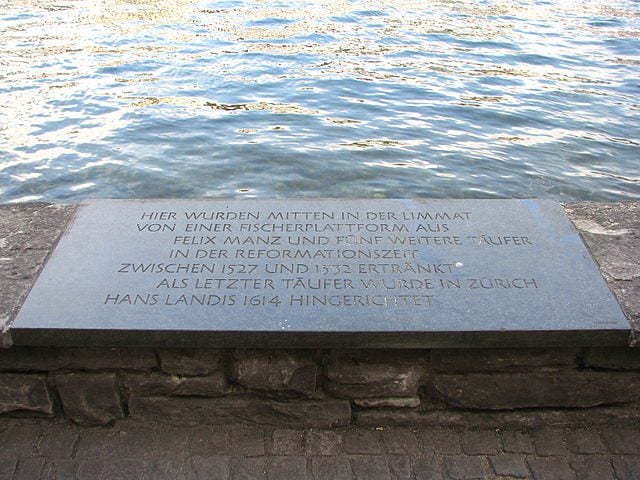
The persecution of the Anabaptists began in Zurich . . . The penalties enjoined by the Town Council of Zurich were ‘drowning, burning, or beheading,’ according as it seemed advisable . . . ‘It is our will,’ the Council proclaimed, ‘that wherever they be found, whether singly or in companies, they shall be drowned to death, and that none of them shall be spared.’ (Janssen, V, 153-157)
In his Dialogues of 1535, Bucer called on governments to exterminate by fire and sword all professing a false religion, and even their wives, children and cattle. (Armstrong; Janssen, V, 367-368, 290-291)
His [John Knox’s] conviction . . . harked back to the darkest practices of the Inquisition . . . Every heretic was to be put to death, and cities predominantly heretical were to be smitten with the sword and utterly destroyed: “To the carnal man this may appear a . . . severe judgment . . . Yet we find no exception, but all are appointed to the cruel death. But in such cases God wills that all . . . desist from reasoning when commandment is given to execute his judgments.” (Durant [S], 614; citing Edwin Muir, John Knox, London: 1920, 142)
[Queen] Elizabeth . . . is on record for the burning of two Dutch Anabaptists in 1575. (Hughes, 143)
An English Servetus could have been burned under Elizabeth, and, in fact, in 1589 she burned an Arian. (Hughes, 274)
In the preface to the Institutes he [John Calvin] admitted the right of the government to put heretics to death . . . He thought that Christians should hate the enemies of God . . . Those who defended heretics . . . should be equally punished. (Smith [S], 178)
[During Calvin’s reign in Geneva, between 1542 and 1546] “58 persons were put to death for heresy.” (Durant [S], 473)
Melanchthon, in a letter to Calvin and Bullinger, gave ‘thanks to the Son of God’ . . . and called the burning [of Michael Servetus] ‘a pious and memorable example to all posterity.’ Bucer declared from his pulpit in Strasbourg that Servetus had deserved to be disemboweled and torn to pieces. Bullinger, generally humane, agreed that civil magistrates must punish blasphemy with death. (Durant [S], 484)
Persecution, including death penalties for heresy, is not just a Catholic failing. It is clearly also a Protestant one, and a general “blind spot” of the Middle Ages, much like abortion is in our own supposedly “enlightened” age. Furthermore, it is an outright lie to assert that Protestantism in its initial appearance, advocated tolerance. The evidence thus far presented refutes this notion beyond any reasonable doubt. (Armstrong)
II. PLUNDER AS AN AGENT OF RELIGIOUS REVOLUTION***There came – round about 1536-40 — a change . . . The temptation to loot Church property and the habit of doing so had appeared and was growing; and this rapidly created a vested interest in promoting the change of religion. Those who attacked Catholic doctrine, as, for instance, in the matters of celibacy in the monastic orders . . . opened the door for the seizure of the enormous clerical endowments . . . by the Princes . . . The property of convents and monasteries passed wholesale to the looters over great areas of Christendom: Scandinavia, the British Isles, the Northern Netherlands, much of the Germanies and many of the Swiss Cantons. The endowments of hospitals, colleges, schools, guilds, were largely though not wholly seized . . . Such an economic change in so short a time our civilization had never seen . . . The new adventurers and the older gentry who had so suddenly enriched themselves, saw, in the return of Catholicism, peril to their immense new fortunes. (Belloc, 9-10)
*
The cities found Protestantism profitable . . . for a slight alteration in their theological garb they escaped from episcopal taxes and courts, and could appropriate pleasant parcels of ecclesiastical property . . . The princes . . . could be spiritual as well as temporal lords, and all the wealth of the Church could be theirs . . . The Lutheran princes suppressed all monasteries in their territory except a few whose inmates had embraced the Protestant faith. (Durant [S], 438-439)
In Sweden Gustavus Vasa deprived the Church of all its landed properties . . . The proportion of land held by the crown increased during his reign from 5.5% to 28%: that of the Church from 21% to nil. (Dickens [P], 191)
The great Scottish nobles . . . supported the religious revolution because it gave them the power to loot the Church and the monarchy wholesale. (Belloc, 112)
This certainly is a fine turn of affairs, if property is wickedly taken away from priests so that soldiers may make use of it in worse fashion; and the latter squander their own wealth, and sometimes that of others, so that no one benefits. (Erasmus, 157)
III. SYSTEMATIC SUPPRESSION OF CATHOLICISM***The presence at sermons [in Zwingli’s Zurich] . . . was enjoined under pain of punishment; all teaching and church worship that deviated from the prescribed regulations was punishable. Even outside the district of Zurich the clergy were not allowed to read Mass or the laity to attend. And it was actually forbidden, ‘under pain of severe punishment, to keep pictures and images even in private houses’ . . . The example of Zurich was followed by other Swiss Cantons. (Janssen, V, 134-135)
*
The Mass was abolished in Zurich in 1525. (Armstrong; Dickens, 117)
William Farel, who preceded Calvin in Geneva, helped to abolish the Mass in August, 1535, seize all the churches, and close its four monasteries and nunnery. (Harkness [P], 8)
His [Farel’s] sermons in St. Peter’s were the occasion of riots; statues were smashed, pictures destroyed, and the treasures of the church, to the amount of 10,000 crowns, disappeared. (Hughes, 226-227)
Martin Bucer . . . though anxious to be regarded as considerate and peaceable . . . advocated quite openly ‘the power of the authorities over consciences’. He never rested until, in 1537 . . . he brought about the entire suppression of the Mass at Augsburg. At his instigation, many fine paintings, monuments and ancient works of art in the churches were wantonly torn, broken and smashed. Whoever refused to submit and attend public worship was obliged within eight days to quit the city boundaries. Catholic citizens were forbidden under severe penalties to attend Catholic worship elsewhere . . . In other . . . cities Bucer acted with no less violence and intolerance, for instance, at Ulm, where he supported Oecolampadius . . . in 1531, and at Strasburg . . . Here, in 1529, after the Town-Council had prohibited Catholic worship, the Councillors were requested by the preachers to help fill the empty churches by issuing regulations prescribing attendance at the sermons. (Grisar, VI, 277-278)
In 1529 the Council of Strassburg also ordered the breaking in pieces of all remaining altars, images and crosses, and several churches and convents were destroyed (Janssen, V, 143-144).
*
Similar events transpired also in Frankfurt-am-Main (Durant [S], 424).
*
At a religious convention at Hamburg in April, 1535 the Lutheran towns of Lubeck, Bremen, Hamburg, Luneburg, Stralsund, Rostock and Wismar all voted to hang Anabaptists and flog Catholics and Zwinglians before banishing them (Janssen, V, 481).
*
Luther’s home territory of Saxony had instituted banishment for Catholics in 1527 (Grisar, VI, 241-242). (Armstrong)
*
In 1522 a rabble forced its way into the church at Wittenberg, on the doors of which Luther had nailed his theses, destroyed all its altars and statues, and . . . drove out the clergy. In Rotenburg also, in 1525, the figure of Christ was decapitated . . . On the 9th of February, 1529, everything previously revered in the fine old cathedral of Basle, Switzerland, was destroyed . . . Such instances of brutality and fanaticism could be cited by scores. (Stoddard, 94)
[In] Constance, on March 10, 1528, the Catholic faith was altogether interdicted . . . by the Council . . . ‘There are no rights whatever beyond those laid down in the Gospel as it is now understood’ . . . Altars were smashed . . . organs were removed as being works of idolatry . . . church treasures were to be sent to the mint. (Janssen, V, 146)
[In John Knox’s Scotland] It was . . . forbidden to say Mass or to be present at Mass, with the punishment for a first offence of loss of all goods and a flogging; for the second offence, banishment; for the third, death. (Hughes, 300)
The Protestant states did not question that teachers of disapproved doctrines should be prevented from preaching. (Chadwick [P], 398)
IV. PROTESTANT CENSORSHIP
The early Protestants were not the champions of free speech and freedom of the press, either, as we are led to believe, any more than they were for freedom of religion or assembly — not by a long shot. Suppression of the Mass and forced Church attendance by civil law are examples of this intolerance regarding freedom of thought and action. (Armstrong)
*
With isolated exceptions . . . we find everywhere the opinions which are exactly in harmony with those of the territorial prince of the day, striving their utmost to suppress all differing views. The theory of the absolute Church authority of the secular powers was in itself enough to make a system of tolerance impossible on the Protestant side . . . From the very first religious life among the Protestants was influenced by the hopeless contradiction that on the one hand Luther imposed it as a sacred duty on every individual, in all matters of faith, to set aside every authority, above all that of the Church, and to follow only his own judgment, while on the other hand the reformed theologians gave the secular princes power over the religion of their land and subjects . . . ‘Luther never attempted to solve this contradiction. In practice he was content that the princes should have supreme control over religion, doctrine and Church, and that it was their right and their duty to suppress every religious creed which differed from their own.’ (Janssen, XIV, 230-231; citing Johann von Dollinger: Kirche und Kirchen, 1861, 52 ff.)
The Corpus doctrinae of Melanchthon had passed muster for a long time in Saxony, but on the occasion of the crypto-Calvinistic controversies the Elector Augustus forbade the work being printed . . .; the press control, which Melanchthon had advocated against others, now hit him himself. (Janssen, XIV, 506)
In the Protestant towns numbers of preachers bestirred themselves zealously with the help of the municipal authorities to suppress the writings of all opposing parties. ‘When first Luther began to write books, it was said,’ so Frederick Staphylus recalled to mind (1560), ‘that it would be contrary to Christian freedom if the Christian folk and the common people were not allowed to read all sorts of books. Now, however . . . the Lutherans themselves are . . . forbidding the purchase and reading of the books of their opponents, and of apostate members and sects.’ (Janssen, XIV, 506-507)
Luther . . . set his pen in motion concerning this Catholic translation of the Bible. ‘The freedom of the Word,’ which he claimed for himself, was not to be accorded to his opponent Emser . . . When . . . he learnt that Emser’s translation . . . was to be printed . . . at Rostock, he not only appealed himself to his follower, Duke Henry of Mecklenburg, with the request that ‘for the glory of the evangel of Christ and the salvation of all souls’ he would put a stop to this printing, but he also worked on the councillors of the Elector of Saxony to support his action. He denied the right and the power of the Catholic authorities to inhibit his books; on the other hand he invoked the arm of the secular authorities against all writings that were displeasing to him. (Janssen, XIV, 503-504)
When the controversy on the Lord’s Supper was started at Wittenberg, the utmost precautions were taken to suppress the writings of the Swiss Reformed theologians and of the German preachers who shared the latter’s views. At the instigation of Luther and Melanchthon there was issued, in 1528, by the Elector John of Saxony, an edict to the following effect: “Books and pamphlets (of the Anabaptists, Sacramentarians, etc.) must not be allowed to be bought or sold or read . . . also those who are aware of such breaches of the orders laid down herein, and do not give information, shall be punished by loss of life and property.” (Armstrong; Janssen, XIV, 232-233; BR, IV, 549)
Melanchthon demanded in the most severe and comprehensive manner the censure and suppression of all books that were hindering to Lutheran teaching. The writings of Zwingli and the Zwinglians were placed formally on the Index at Wittenberg. (Armstrong; Janssen, XIV, 504; cf. Durant [S], 424)
At Strassburg Catholic writings were suppressed as early as 1524 . . . The Council at Frankfort-on-the-Main exercised . . . strict censorship . . . At Rostock, in 1532, the printer of the Brethren of the Common Life was sent to prison, because he had used his printing press to the disadvantage of Protestantism. (Janssen, XIV, 502)
BIBLIOGRAPHY
[P = Protestant work / S = secular work / C = Catholic]
BR = Bretschneider, editor, Corpus Reformation, Halle, 1846.
Hilaire Belloc (C), Characters of the Reformation, Garden City, New York: Doubleday Image, 1958.
Owen Chadwick (P), The Reformation, New York: Penguin, revised edition, 1972.
F. L. Cross & E. A. Livingstone, editors (P), The Oxford Dictionary of the Christian Church, Oxford: Oxford University Press, 2nd edition, 1983.
A. G. Dickens (P), Reformation and Society in 16th-Century Europe, London: Harcourt, Brace & World, 1966.
Will Durant (S), The Reformation, (volume 6 of 10-volume The Story of Civilization, 1967), New York: Simon & Schuster, 1957.
Desiderius Erasmus (C), Christian Humanism and the Reformation, (selections from Erasmus), edited and translated by John C. Olin, New York: Harper & Row, 1965 (originally 1515-34).
Hartmann Grisar, S. J. (C), Luther, translated by E. M. Lamond, edited by Luigi Cappadelta, six volumes, London: Kegan Paul, Trench, Trubner & Co., 1917. [available online]
Georgia Harkness (P), John Calvin: The Man and His Ethics, New York: Abingdon Press, 1931.
Philip Hughes (C), A Popular History of the Reformation, Garden City, New York: Doubleday Image, 1957.
Johannes Janssen (C), History of the German People From the Close of the Middle Ages, 16 volumes, translated by A. M. Christie, St. Louis: B. Herder, 1910 (originally 1891). [available online]
Preserved Smith (S), The Social Background of the Reformation, New York: Collier Books, 1962 (2nd part of author’s The Age of the Reformation, New York: 1920).
John L. Stoddard (C), Rebuilding a Lost Faith, New York: P. J. Kenedy & Sons, 1922.
***
Related Reading:
Protestantism: Historic Persecution & Intolerance (My Web Page)
Luther Favored the Death Penalty for Anabaptists
Luther’s Inflammatory Rhetoric & the Peasants’ Revolt (1524-1525)
Was Luther “Bloodthirsty” & Violent? (James Swan & I Agree!)
Luther Film (2003): Detailed Catholic Critique
Zwingli, Bucer, Oecolampadius: Luther & Lutherans Not Christians
Philip Melanchthon: Death for Denying the Real Presence (He Later Denied the Real Presence Himself)
John Calvin: Capital Punishment for “Heretics” (Anabaptists, Etc.)
John Calvin: Torment of an Inept Execution “Special Will of God”
Calvin the “Destroyer” of Servetus: James Swan Misses Forest for Trees
Calvin Supports Death Penalty for Heresy After Servetus
Early Protestant “Unity”: Calvin vs. Westphal vs. Luther
444 Irish Catholic Martyrs & Heroic Confessors
“Reformation” Theft of Thousands of Catholic Churches
16th Century Theft of Church Properties (vs. Lutheran Historian)
Dialogue on Jihadist & 16th Century Calvinist Iconoclasm (vs. David Scott)
***
*
Practical Matters: Perhaps some of my 3,900+ free online articles (the most comprehensive “one-stop” Catholic apologetics site) or fifty books have helped you (by God’s grace) to decide to become Catholic or to return to the Church, or better understand some doctrines and why we believe them.
*
Or you may believe my work is worthy to support for the purpose of apologetics and evangelism in general. If so, please seriously consider a much-needed financial contribution. I’m always in need of more funds: especially monthly support. “The laborer is worthy of his wages” (1 Tim 5:18, NKJV). 1 December 2021 was my 20th anniversary as a full-time Catholic apologist, and February 2022 marked the 25th anniversary of my blog.
*
PayPal donations are the easiest: just send to my email address: [email protected]. You’ll see the term “Catholic Used Book Service”, which is my old side-business. To learn about the different methods of contributing, including 100% tax deduction, etc., see my page: About Catholic Apologist Dave Armstrong / Donation Information. Thanks a million from the bottom of my heart!
*
***
Photo credit: Zürich-Schipfe quarter : Memorial plate for the Anabaptists, murdered in early 16th century by the Zürich city government: “Here in the middle of the River Limmat from a fishing platform were drowned Felix Manz and five other Anabaptists during the Reformation of 1527 to 1532. Hans Landis, the last Anabaptist, was executed in Zurich during 1614.” Photo by Roland zh (4-10-10) [Wikimedia Commons / Creative Commons Attribution-Share Alike 3.0 Unported license]

***
Calvinism & General Protestantism
Protestant Persecution & Intolerance
Previous Post

September 13, 2017
Why Peter's Marriage Doesn't Disprove Catholicism: A Dialogue
Next Post
September 14, 2017 My Conversion: Through Apathy, Occult, & Evangelicalism to Catholicism
Browse Our Archives
Select a Category & Last Things About Me Anti-Catholicism Atheism & Agnosticism Baptism and Sacramentalism Bible and Tradition Blessed Virgin Mary Books by Dave Armstrong C. S. Lewis Calvinism & General Protestantism Catholic Apologetics Catholic Apologists Catholic conversion Catholic converts Christmas Church (Ecclesiology) Church History Conversion and Converts Development of Doctrine Eastern Orthodoxy Ecumenism & Christian Unity Eucharist & Liturgy Fathers of the Church French Translations G. K. Chesterton Hell Hell & Satan Hell & Satan & Last Things Heresies & Comparative Religion Holistic Health Inquisition & Crusades & Scandals James White Jews & Judaism & Old Testament John Calvin John Henry Newman Liberal / Modernist Theology Life Issues Literary Resume Lutheranism Mariology Martin Luther Music Orthodoxy Papacy & Infallibility Personal Page Philosophy & Science Political & Ethical & Moral Issues Protestant Persecution & Intolerance Protestantism Purgatory Purgatory & Penance Romantic & Imaginative Theology Saints & Purgatory & Penance Salvation Salvation & Justification Satan & Last Things Sexuality and Gender Issues Spanish Translations Traditionalism vs. Radical Catholic Reactionaries Traducciones al español / tradução para português Trinitarianism & Christology Uncategorized Videos
Select a Month November 2026 October 2026 September 2026 August 2026 July 2026 June 2026 May 2026 April 2026 March 2026 February 2026 January 2026 December 2025 November 2025 October 2025 September 2025 August 2025 July 2025 June 2025 May 2025 April 2025 March 2025 February 2025 January 2025 December 2024 November 2024 October 2024 September 2024 August 2024 July 2024 June 2024 May 2024 April 2024 March 2024 February 2024 January 2024 December 2023 November 2023 October 2023 September 2023 August 2023 July 2023 June 2023 May 2023 April 2023 March 2023 February 2023 January 2023 December 2022 November 2022 October 2022 September 2022 August 2022 July 2022 June 2022 May 2022 April 2022 March 2022 February 2022 January 2022 December 2021 November 2021 October 2021 September 2021 August 2021 July 2021 June 2021 May 2021 April 2021 March 2021 February 2021 January 2021 December 2020 November 2020 October 2020 September 2020 August 2020 July 2020 June 2020 May 2020 April 2020 March 2020 February 2020 January 2020 December 2019 November 2019 October 2019 September 2019 August 2019 July 2019 June 2019 May 2019 April 2019 March 2019 February 2019 January 2019 December 2018 November 2018 October 2018 September 2018 August 2018 July 2018 June 2018 May 2018 April 2018 March 2018 February 2018 January 2018 December 2017 November 2017 October 2017 September 2017 August 2017 July 2017 June 2017 May 2017 April 2017 March 2017 February 2017 January 2017 December 2016 November 2016 October 2016 September 2016 August 2016 July 2016 June 2016 May 2016 April 2016 March 2016 February 2016 January 2016 December 2015 November 2015 October 2015 September 2015 August 2015 July 2015 June 2015 May 2015 April 2015 March 2015 February 2015 January 2015 December 2014 November 2014 October 2014 September 2014 August 2014 July 2014 June 2014 April 2014 March 2014 February 2014 January 2014 December 2013 November 2013 October 2013 September 2013 August 2013 July 2013 June 2013 April 2013 March 2013 February 2013 January 2013 December 2012 November 2012 October 2012 September 2012 August 2012 July 2012 June 2012 May 2012 April 2012 March 2012 February 2012 January 2012 December 2011 November 2011 October 2011 September 2011 August 2011 July 2011 June 2011 April 2011 March 2011 February 2011 October 2010 September 2010 August 2010 July 2010 April 2010 March 2010 December 2009 October 2009 August 2009 July 2009 June 2009 May 2009 March 2009 February 2009 October 2008 September 2008 April 2008 March 2008 February 2008 January 2008 December 2007 November 2007 October 2007 May 2007 March 2007 February 2007 January 2007 November 2006 October 2006 September 2006 August 2006 July 2006 June 2006 May 2006 April 2006 March 2006 February 2006 October 2005 June 2005 April 2005 February 2005 July 2004 May 2004 April 2004
Follow Us!
TAKE THE
Religious Wisdom Quiz
True or False: David committed adultery with Bathsheba and arranged for her husband Uriah to be killed.
Select your answer to see how you score.
TRUE FALSE
Books by This Author Books by Dave Armstrong
Related posts from Biblical Evidence for Catholicism
Denominationalism: 50 Biblical Condemnations
Biblical Evidence for Catholicism
On Protestant Explanations of Catholic Conversion
Biblical Evidence for Catholicism
Does Catholic Intercession of Saints Require Omniscience?
Biblical Evidence for Catholicism

Protestant Confessions & "Ever-Virgin" Mary
Biblical Evidence for Catholicism
TRENDING AT PATHEOS Catholic

Watch and Pray: On Mark 13:33-37
Jesus said to his disciples: “Be watchful! Be alert! You do not...

Debate on Purgatory & Biblical Evidences for It
This is from a combox on my video channel, Catholic Bible Highlights....

Set the table for the coming King
On Thursday we visited my sister-in-law for Thanksgiving, and throughout the entire...

If I Stop Becoming, Will I Disappear?
(At our most recent half day Zen retreat, Dr Chris Hoff, a...

A Modest Proposal for President Trump
Trump should just quit the loser Republicans who failed him so badly...
Praise and Thanks As Natural as Breathing
This week I had the privilege of sitting down with Deacon Tom...
view all Catholic blogs
Ad-Free & Subscriber Log-In Subscription Support
- About Us
- 2026 Calendar
- Videos
- Podcasts
- Library of World Religions
- Faith In Media Tracker
- Advertise With Us
- Write for Us
- Privacy Policy
- Terms of Service
- Do Not Sell My Data
- Contact Us
- Radiant Digital
- Manage Newsletter Subscriptions
- Unsubscribe From Notifications
- Sitemap
Copyright 2008-2026, Patheos, part of the Radiant Digital network of media brands. All rights reserved.
Subscription Support Ad-Free & Subscriber Log-In
Follow Patheos