
BuddhistCatholicContemplativeEvangelicalGeneral ChristianHinduJewishLatter-day SaintMuslimNew VisionsProgressive Christian
Beliefs
- Buddhist
- Catholic
- Contemplative
- Evangelical
- General Christian
- Hindu
- Jewish
- Latter-day Saint
- More Voices
- Muslim
- New Visions
- Pagan
- Progressive Christian
Topics
- Religion News
- Food and Religion
- Sports and Religion
- Religious Art
- Religious Music and Entertainment
- Religious Events
- History and Religion
- Style and Religion
- Politics and Religion
- Women in Religion
- Recreation Outdoors and Religion
- Business Finance and Religion
- Careers Workplace and Religion
- Education and Religion
- Family Parenting and Religion
- Health Fitness and Religion
- Home and Religion
- Relationships and Religion
- Technology and Religion
- Travel and Religion
Columnists
- Buddhist Columnists
- Business Finance and Religion Columnists
- Careers Workplace and Religion Columnists
- Catholic Columnists
- Contemplative Columnists
- Education and Religion Columnists
- Evangelists Columnists
- Family Parenting and Religion Columnists
- General Christian Columnists
- Health Fitness and Religion Columnists
- Hindu Columnists
- History and Religion Columnists
- Home and Religion Columnists
- Jewish Columnists
- More Voices Columnists
- Latter Day Columnists
- Muslim Columnists
- New Visions Columnists
- Nonreligious Columnists
- Pagan Columnists
- Politics and Religion Columnists
- Progressive Columnists
- Recreation Outdoors and Religion Columnists
- Relationships and Religion Columnists
- Religion News Columnists
- Religious Art Columnists
- Religious Events Columnists
- Religious Music and Entertainment Columnists
- Sports and Religion Columnists
- Style and Religion Columnists
- Technology and Religion Columnists
- Travel and Religion Columnists
- Women in Religion Columnists
Resource Library
- 2026 Calendar
- Library of World Religions
- The 100 Most Holy Places on Earth
- Patheos Answers
- Podcasts
- Videos
- Faith Leaders Database
- Anglican Episcopalian
- Bahai
- Baptist
- Buddhism
- Christianity
- Confucianism
- Eastern Orthodoxy
- Hinduism
- Holiness and Pentecostal
- ISKCON
- Islam
- Judaism
- Lutheran
- Methodist
- The Church of Jesus Christ of Latter-day Saints
- New Age
- Paganism
- Presbytarian and Reformed
- Protestantism
- Religion Behind the Scenes
- Roman Catholic
- Scientology
- Shia Islam
- Sikhism
- Sufism
- Sunni Islam
- Taoism
- Zen
- See all religions
Research Tools
 Ad-Free & Subscriber Log-In Subscription Support
Ad-Free & Subscriber Log-In Subscription Support
Follow Patheos 

- Trending:
- Forgiveness
- |
- Marriage
- |
- Consciousness
- |
- Death Penalty
- |
- Election
- |
- Halloween

-
About
-
Catholic Apologetics
-
Church History
-
Great Apologists
-
Christian Worldview
-
Protestantism & Misc.
- Home
- Catholic
- History and Religion
- Astonishing Hostility to Higher Education in Early Protestantism
Astonishing Hostility to Higher Education in Early Protestantism
Last updated on: September 25, 2017 at 12:04 pm by Dave Armstrong
Astonishing Hostility to Higher Education in Early Protestantism 2017-09-25T12:04:53-04:00 Dave Armstrong
Patheos Explore the world's faith through different perspectives on religion and spirituality! Patheos has the views of the prevalent religions and spiritualities of the world.
***
(1991)
***
Martin Luther
In 1522 Luther poured out his ire on the “asinine coarseness of the Thomists,” on “the Thomist hogs and donkeys,” on the “stupid audacity and thickheadedness of the Thomists.” (Grisar, I, 163; WA, X-2, 188-190, 206)
In my opinion dialectics can only be harmful to theologians . . . In theology . . . all syllogisms should be set aside. (Janssen, XIV, 123; LL, I, 127; letter to Spalatin, June 29, 1518)
St. Thomas Aquinas, according to Luther, was “a babbler and a chatterer.” (Janssen, XIV, 125) Aquinas and St. John Chrysostom were described as “idle prattlers” with the latter receiving additionally the appellation of “ambitious, haughty man” (Janssen, XIV, 190). One is reminded here of the pagan Greeks who, being unable to understand the intellectual, spiritual and theological brilliance of St. Paul, resort to derision: “What will this babbler say?” (Acts 17:18). It seems that Luther could only caricature men far more brilliant than himself. Here, as do often, he fought a”straw man” of his own invention, with mocking and slander (which is his technique against Catholicism in general). Examples of Luther’s opinion of other Church fathers:
St. Basil was utterly good for nothing . . . Origen he had already placed under the ban; and as for Gregory the Great, the devil had misled him with a childish heresy. St. Augustine also he would not trust, because he . . . had also often erred. St. Jerome: . . . of the faith, and of the true Church and way of life there was not a single word in his writings. (Janssen, XIV, 190)
Philip Melanchthon, in his letter to Johann Brenz (May 1531), illustrates how the Protestants had departed from patristic precedent:
Avert your eyes from such a regeneration of man and from the Law and look only to the promises and to Christ . . . Augustine is not in agreement with the doctrine of Paul, though he comes nearer to it than do the Schoolmen. I quote Augustine as in entire agreement, although he does not sufficiently explain the righteousness of faith; this I do because of public opinion concerning him. (Grisar, IV, 459-460)
Grisar, on p. 459, states that:
The letter was written by Melanchthon to Johann Brenz, but it had the entire approval of Luther, who even appended a few words to it. While clearly throwing overboard Augustine, it is nevertheless anxious to retain him.
[The documentation Grisar gives is “end of May, 1531”, Luthers Briefwechsel, 9, p. 18. This eleven-volume work was edited by L. Enders: Frankfurt & Stuttgart, 1884-1907; also 12 volumes, edited by G. Kawerau, Leipzig, 1910]
We find in Luther’s Table-Talk the following slams against St. Augustine and the Fathers:
Behold what great darkness is in the books of the Fathers concerning faith . . . Augustine wrote nothing to the purpose concerning faith. (DXXVI)
The more I read the books of the Fathers, the more I find myself offended. (DXXX)
Jerome should not be numbered among the teachers of the church, for he was a heretic. (DXXXV) (edition translated by William Hazlitt, Philadelphia: Lutheran Publication Society, n.d., 286-289)
For further reflections on this aspect of Protestantism’s frequent antipathy to the Church fathers, see the section, “Protestantism and the Fathers” on my Fathers of the Church web page.
The Decline of Education and Learning Within (and Because of) Protestantism
Early Protestantism caused:
. . . a decline in . . . learning. Complaints on this score begin to make themselves heard even in the first years after the introduction of the religious innovations; not only from Erasmus and other humanists, but also among the leaders of Protestantism itself, especially from Melanchthon, in whose letters and speeches, from 1522 till his death, laments on the decay of all the fine arts and all learning never cease. (Janssen, XIV, 235)
Numberless persons . . . speak in the bitterest language of the continuous decay of all high morals and fine culture . . . of the increasing depreciation of classical knowledge and of learning in general. (Janssen, XIII, 377)
In Germany, the period from about 1450 to the time of Luther, was:
. . . a time when culture penetrated to all classes of society . . . a time of extraordinary activity in art and learning . . . religious knowledge was zealously diffused, and the development of religious life abundantly fostered . . . The universities attained a height of excellence and distinction undreamt of . . . (Janssen, II, 287)
Protestantism would, unwittingly or not, undermine all this. Referring to Melanchthon, Janssen states:
His efforts for the revival of liberal culture in Wittenberg were completely shipwrecked. In his private letters he had no hesitation in attributing to the Wittenberg theologians the responsibility of the contempt of learning. (Janssen, III, 357; BR, I, 575, 604, 613, 679, 683, 695, 726, 894)
Melanchthon himself, according to a standard Protestant reference, “was far more humanistic than . . . most of the Reformers. He cared for learning as such . . .” (Cross, 898). This “moderate” testified mournfully:
The schools in Germany are deserted . . . among the people learning is universally hated, and even the princes . . . are filled with contempt and hatred for study. (Janssen, XIII, 328-329; BR, I, 756; letter to Arnold Burenius in 1542)
In Germany learning has become an object of contempt. (Janssen, XIII,328; letter to King Henry VIII in 1535)
The first widely-used philosophy text among Protestants was Metaphysics, by the Spanish Jesuit Suarez, published in 1605. (Janssen, XIV, 130)
The Melanchthonian Henry Moller, professor at Wittenberg, actually complained in 1569 of the:
. . . general decline of philosophical studies . . . How many ministers . . . are there at present in Germany who are not completely ignorant of these sciences? . . . The coarse, uneducated books scattered broadcast among the people in which philosophy is slandered and distorted, . . . can have no other result than the complete downfall of learning, the inroad of barbarism into the Church. (Janssen, XIV, 132-133; Dollinger, II, 496)
The Christian humanists of Germany and northern Europe, men of letters and advocates of reading, appreciation of past learning, and education, turned against the Protestants, by and large:
The intolerant dogmatism of the Reformers, their violence of speech, their sectarian fragmentation and animosities, their destruction of religious art, their predestinarian theology, their indifference to secular learning . . . all these shared in alienating the humanists from the Reformation. (Durant, 425)
Erasmus’ Critique of Protestant Anti-Intellectualism
Luther has covered us and good learning with hatred . . . The Church is overburdened with abuse of authority and . . . man-made decrees for the purpose of gain . . . but often an imprudent attempt at a cure makes things worse. What a mass of hatred Luther is bringing down on good learning and Christendom! (Phillips, 171; in 1521)
I greatly wonder . . . what god has stirred up the heart of Luther, in so far as he assails with such license of pen the Roman pontiff, all the universities, philosophy, and the mendicant orders. (Erasmus, 152; letter to Jodocus Jonas, May 10, 1521)
Wherever Lutheranism prevails, learning and liberal culture go to the ground. (Janssen, III, 355; letter to Pirkheimer)
The study of tongues and the love of fine literature is everywhere growing cold. Luther has heaped insufferable odium on it. (Grisar, VI, 32)
Regarding the downfall of the schools of Nuremberg, Erasmus wrote:
All this laziness came in with the new Evangel. (Grisar, VI, 32)
Luther responded in his own inimitable fashion:
I hate Erasmus! . . . I hate him from the bottom of my heart . . . I consider Erasmus to be the greatest enemy Christ has had these thousand years past. (Daniel-Rops, 77; Table-Talk)
Zwingli, who, like Luther, had once admired Erasmus, also split from him:
When I admonished Zwingli in a friendly way he wrote back disdainfully: “What you know is of no use to us; what we know is not for you.”
As if he had been caught up like Paul to the third heaven and learnt some mystery which was hidden to us earthly creatures! (Phillips, 195)
Sources
WA = Weimar Ausgabe edition of Luther’s Works (Werke) in German, 1883. “Br.” = correspondence.
BR = Bretschneider, editor, Corpus Reformation, Halle, 1846.
LL = Luther’s Letters (German), edited by M. De Wette, Berlin: 1828
F. L. Cross and E. A. Livingstone, editors, The Oxford Dictionary of the Christian Church, Oxford: Oxford Univ. Press, 2nd ed., 1983.
Henri Daniel-Rops, The Protestant Reformation, vol. 2, translated by Audrey Butler, Garden City, New York: Doubleday Image, 1961.
Johann Dollinger, The Reformation, Regensburg, 1848.
Will Durant The Reformation, (volume 6 of 10-volume The Story of Civilization, 1967), New York: Simon & Schuster, 1957.
Desiderius Erasmus, Christian Humanism and the Reformation, (selections from Erasmus), edited and translated by John C. Olin, New York: Harper & Row, 1965 (orig. 1515-34).
Hartmann Grisar, Luther, translated by E. M. Lamond, edited by Luigi Cappadelta, six volumes, London: Kegan Paul, Trench, Trubner & Co., 1917.
Johannes Janssen, History of the German People From the Close of the Middle Ages, 16 volumes, translated by A. M. Christie, St. Louis: B. Herder, 1910 (orig. 1891).
Margaret Phillips, Erasmus and the Northern Renaissance, New York: Collier Books, 1965.
***
Related reading:
Early Protestant Antipathy Towards Art (+ Iconoclasm)
Early Protestant Hostility Towards (and Ignorance of) Science
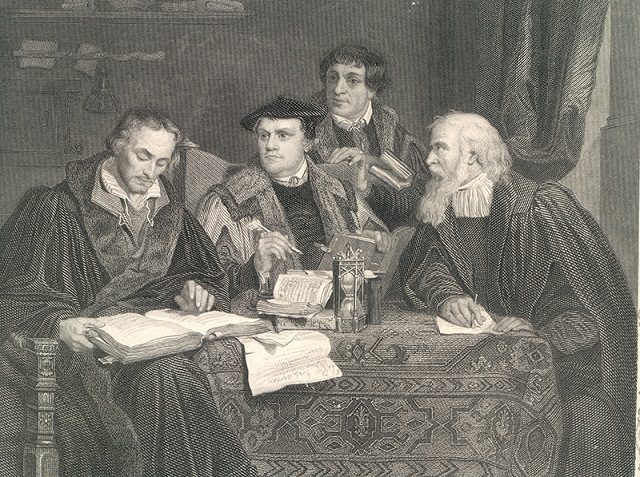
Photo credit: Philip Melanchthon (left) and Martin Luther. Image courtesy of Concordia Historical Institute. [“Gallery”]
***
Calvinism & General Protestantism
Protestant Persecution & Intolerance
education in 16th century Europe
libraries in 16th century Europe
Previous Post

September 25, 2017
Early Protestant Antipathy Towards Art (+ Iconoclasm)
Next Post

September 25, 2017 My Conversion: Apathy, Occult, Evangelicalism, & Catholicism (Pt. 4)
Browse Our Archives
Select a Category & Last Things About Me Anti-Catholicism Atheism & Agnosticism Baptism and Sacramentalism Bible and Tradition Blessed Virgin Mary Books by Dave Armstrong C. S. Lewis Calvinism & General Protestantism Catholic Apologetics Catholic Apologists Catholic conversion Catholic converts Christmas Church (Ecclesiology) Church History Conversion and Converts Development of Doctrine Eastern Orthodoxy Ecumenism & Christian Unity Eucharist & Liturgy Fathers of the Church French Translations G. K. Chesterton Hell Hell & Satan Hell & Satan & Last Things Heresies & Comparative Religion Holistic Health Inquisition & Crusades & Scandals James White Jews & Judaism & Old Testament John Calvin John Henry Newman Liberal / Modernist Theology Life Issues Literary Resume Lutheranism Mariology Martin Luther Music Orthodoxy Papacy & Infallibility Personal Page Philosophy & Science Political & Ethical & Moral Issues Protestant Persecution & Intolerance Protestantism Purgatory Purgatory & Penance Romantic & Imaginative Theology Saints & Purgatory & Penance Salvation Salvation & Justification Satan & Last Things Sexuality and Gender Issues Spanish Translations Traditionalism vs. Radical Catholic Reactionaries Traducciones al español / tradução para português Trinitarianism & Christology Uncategorized Videos
Select a Month October 2026 September 2026 August 2026 July 2026 June 2026 May 2026 April 2026 March 2026 February 2026 January 2026 December 2025 November 2025 October 2025 September 2025 August 2025 July 2025 June 2025 May 2025 April 2025 March 2025 February 2025 January 2025 December 2024 November 2024 October 2024 September 2024 August 2024 July 2024 June 2024 May 2024 April 2024 March 2024 February 2024 January 2024 December 2023 November 2023 October 2023 September 2023 August 2023 July 2023 June 2023 May 2023 April 2023 March 2023 February 2023 January 2023 December 2022 November 2022 October 2022 September 2022 August 2022 July 2022 June 2022 May 2022 April 2022 March 2022 February 2022 January 2022 December 2021 November 2021 October 2021 September 2021 August 2021 July 2021 June 2021 May 2021 April 2021 March 2021 February 2021 January 2021 December 2020 November 2020 October 2020 September 2020 August 2020 July 2020 June 2020 May 2020 April 2020 March 2020 February 2020 January 2020 December 2019 November 2019 October 2019 September 2019 August 2019 July 2019 June 2019 May 2019 April 2019 March 2019 February 2019 January 2019 December 2018 November 2018 October 2018 September 2018 August 2018 July 2018 June 2018 May 2018 April 2018 March 2018 February 2018 January 2018 December 2017 November 2017 October 2017 September 2017 August 2017 July 2017 June 2017 May 2017 April 2017 March 2017 February 2017 January 2017 December 2016 November 2016 October 2016 September 2016 August 2016 July 2016 June 2016 May 2016 April 2016 March 2016 February 2016 January 2016 December 2015 November 2015 October 2015 September 2015 August 2015 July 2015 June 2015 May 2015 April 2015 March 2015 February 2015 January 2015 December 2014 November 2014 October 2014 September 2014 August 2014 July 2014 June 2014 April 2014 March 2014 February 2014 January 2014 December 2013 November 2013 October 2013 September 2013 August 2013 July 2013 June 2013 April 2013 March 2013 February 2013 January 2013 December 2012 November 2012 October 2012 September 2012 August 2012 July 2012 June 2012 May 2012 April 2012 March 2012 February 2012 January 2012 December 2011 November 2011 October 2011 September 2011 August 2011 July 2011 June 2011 April 2011 March 2011 February 2011 October 2010 September 2010 August 2010 July 2010 April 2010 March 2010 December 2009 October 2009 August 2009 July 2009 June 2009 May 2009 March 2009 February 2009 October 2008 September 2008 April 2008 March 2008 February 2008 January 2008 December 2007 November 2007 October 2007 May 2007 March 2007 February 2007 January 2007 November 2006 October 2006 September 2006 August 2006 July 2006 June 2006 May 2006 April 2006 March 2006 February 2006 October 2005 June 2005 April 2005 February 2005 July 2004 May 2004 April 2004
Follow Us!
TAKE THE
Religious Wisdom Quiz
What was Bezalel's profession?
Select your answer to see how you score.
Priest Soldier Farmer Craftsman
Books by This Author Books by Dave Armstrong
Related posts from Biblical Evidence for Catholicism

On Protestant Explanations of Catholic Conversion
Biblical Evidence for Catholicism

Does Catholic Intercession of Saints Require Omniscience?
Biblical Evidence for Catholicism

Protestant Confessions & "Ever-Virgin" Mary
Biblical Evidence for Catholicism

Jesus Founded the [Catholic] Church. If Not Him,...
Biblical Evidence for Catholicism
TRENDING AT PATHEOS Catholic

Pope Leo Celebrates Mass for Nurses & Docs...
I don't have any idea how he did it, but Pope Leo...

The Sermon on the Mount, Part I: Matthew...
The Sermon on the Mount, Part I (Matthew 4:12-5:12) St. Matthew moves...

What's up from Crossway: Reviewing some of their latest A few weeks...

Janie Learns the Way of the Cross: A...
Teaching children about Jesus' Passion can be challenging. Many parents and educators...

Looking For Good Catholic Writing - October 2026
He alone extends the heavens, and he walks upon the waves of...

In "Irreplaceable," our book on vocation and technology, Trevor Sutton and I...
view all Catholic blogs
Ad-Free & Subscriber Log-In Subscription Support
- About Us
- 2026 Calendar
- Videos
- Podcasts
- Library of World Religions
- Faith In Media Tracker
- Advertise With Us
- Write for Us
- Privacy Policy
- Terms of Service
- Do Not Sell My Data
- Contact Us
- Radiant Digital
- Manage Newsletter Subscriptions
- Unsubscribe From Notifications
- Sitemap
Copyright 2008-2026, Patheos. All rights reserved.
Subscription Support Ad-Free & Subscriber Log-In
Follow Patheos