
BuddhistCatholicContemplativeEvangelicalGeneral ChristianHinduJewishLatter-day SaintMuslimNew VisionsProgressive Christian
Beliefs
- Buddhist
- Catholic
- Contemplative
- Evangelical
- General Christian
- Hindu
- Jewish
- Latter-day Saint
- More Voices
- Muslim
- New Visions
- Pagan
- Progressive Christian
Topics
- Religion News
- Food and Religion
- Sports and Religion
- Religious Art
- Religious Music and Entertainment
- Religious Events
- History and Religion
- Style and Religion
- Politics and Religion
- Women in Religion
- Recreation Outdoors and Religion
- Business Finance and Religion
- Careers Workplace and Religion
- Education and Religion
- Family Parenting and Religion
- Health Fitness and Religion
- Home and Religion
- Relationships and Religion
- Technology and Religion
- Travel and Religion
Columnists
- Buddhist Columnists
- Business Finance and Religion Columnists
- Careers Workplace and Religion Columnists
- Catholic Columnists
- Contemplative Columnists
- Education and Religion Columnists
- Evangelists Columnists
- Family Parenting and Religion Columnists
- General Christian Columnists
- Health Fitness and Religion Columnists
- Hindu Columnists
- History and Religion Columnists
- Home and Religion Columnists
- Jewish Columnists
- More Voices Columnists
- Latter Day Columnists
- Muslim Columnists
- New Visions Columnists
- Nonreligious Columnists
- Pagan Columnists
- Politics and Religion Columnists
- Progressive Columnists
- Recreation Outdoors and Religion Columnists
- Relationships and Religion Columnists
- Religion News Columnists
- Religious Art Columnists
- Religious Events Columnists
- Religious Music and Entertainment Columnists
- Sports and Religion Columnists
- Style and Religion Columnists
- Technology and Religion Columnists
- Travel and Religion Columnists
- Women in Religion Columnists
Resource Library
- 2026 Calendar
- Library of World Religions
- The 100 Most Holy Places on Earth
- Patheos Answers
- Podcasts
- Videos
- Faith Leaders Database
- Anglican Episcopalian
- Bahai
- Baptist
- Buddhism
- Christianity
- Confucianism
- Eastern Orthodoxy
- Hinduism
- Holiness and Pentecostal
- ISKCON
- Islam
- Judaism
- Lutheran
- Methodist
- The Church of Jesus Christ of Latter-day Saints
- New Age
- Paganism
- Presbytarian and Reformed
- Protestantism
- Religion Behind the Scenes
- Roman Catholic
- Scientology
- Shia Islam
- Sikhism
- Sufism
- Sunni Islam
- Taoism
- Zen
- See all religions
Research Tools
 Ad-Free & Subscriber Log-In Subscription Support
Ad-Free & Subscriber Log-In Subscription Support
Follow Patheos 

- Trending:
- Forgiveness
- |
- Marriage
- |
- Consciousness
- |
- Death Penalty
- |
- Election
- |
- Halloween

-
About
-
Catholic Apologetics
-
Church History
-
Great Apologists
-
Christian Worldview
-
Protestantism & Misc.
- Home
- Catholic
- History and Religion
- Were Abraham Lincoln and Mark Twain Atheists?
Were Abraham Lincoln and Mark Twain Atheists?
Last updated on: July 18, 2017 at 1:00 pm by Dave Armstrong
Were Abraham Lincoln and Mark Twain Atheists? 2017-07-18T13:00:19-04:00 Dave Armstrong
Patheos Explore the world's faith through different perspectives on religion and spirituality! Patheos has the views of the prevalent religions and spiritualities of the world.
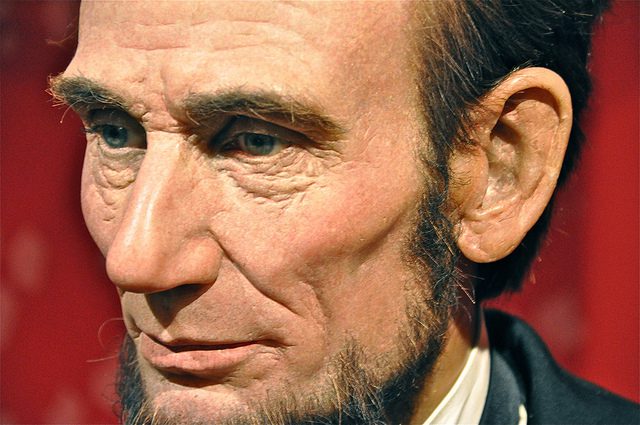
Madame Tussaud’s Abraham Lincoln (photograph by Kevin Burkett: 12-21-12) [Flickr / CC BY-SA 2.0 license]
***
(11-16-06)
*****
[along with fellow so-called atheists Jefferson, Paine, Voltaire, Hume, and Franklin?]
***
Atheist “DagoodS” wrote in one of my comboxes (note: in context, he was speaking rhetorically, but this doesn’t imply that he doesn’t think Twain and Lincoln were atheists):
Imagine I told you that I hold the atheists Abraham Lincoln and Mark Twain in high regard. Now THERE was a fine pair of atheists! . . . When I think of atheism it is the Lincolns and Twains, I see. Not the hordes of also-rans that fail to demonstrate true atheism.
Even the list of notable “‘heroic’ non-believers” that DagoodS directs us to, recognizes distinctions as to belief in God (it notes, for example, that Jefferson was a deist and Paine possibly one, and exercises subtlety and restraint in its very title), but DagoodS shows no such precision of category.
Abraham Lincoln was an atheist? That’s news to me. To the contrary, he is considered by many historians the most religious president ever. Who was he praying to repeatedly during the Civil War? Why is it that he developed his second inaugural address around the notion of divine providence? How can you have a guiding providence if there isn’t anyone there to oversee it?
This sort of historical revisionism (even up to the denial of Jesus’ existence) is one of the more ludicrous elements of atheism. “DagoodS” an intelligent man [an attorney, in fact]. How could he actually fall for the nonsense that Lincoln was an atheist?
I agree that he was by no means an orthodox Christian, nor even any sort of Christian even in a watered-down, insipid liberal Protestant sense, but that is still far different from an atheist (as theists come in many varieties). We must have sensible definition of terms. “Atheist” means no God at all. Even a web page at infidel.org, devoted to the issue, states:
In regard to a Supreme Being he entertained at times Agnostic and even Atheistic opinions. During the later years of his life, however, he professed a sort of Deistic belief, but be did not accept the Christian or anthropomorphic conception of a Deity.
Exactly. This isn’t Christianity, but it isn’t atheism, either. “DagoodS” affirmed that he was an atheist. The same exact silliness is applied to Thomas Jefferson, who was neither an atheist nor a deist (strictly speaking), but rather, a Unitarian (as he referred to himself at least twice in personal letters). Jefferson talked about providence, too, just as Lincoln and also Franklin did. Lincoln is quoted on the same web page:
If God be a just God, all will be saved or none (Manford’s Magazine).
Atheist ignorance and overzealousness on these topics never ends. It is said that philosopher David Hume was an atheist. He was not (I wrote a paper about that and even once amazed a former Christian-turned-atheist philosophy professor at the University of Michigan with this “bombshell” information). Hume accepted one form of the teleological (design) argument for God and never once, it is said, denied that God (of some sort: more like a deist God) existed in his personal letters.
Voltaire and Paine are regarded as atheists. They were not, either. They both believed in God in some sense, but criticized organized religion. The same infidel.org web page states:
The clergy parade Lincoln’s recognitions of a Supreme Being as a triumphant refutation of the claim that he was an Infidel. Yet, at the same time, they do not hesitate to denounce as Infidels, Paine and Voltaire, when they know, or ought to know, that two more profound and reverential believers in God never lived and wrote than Paine and Voltaire.
If Infidelity and Atheism were synonymous terms it would be difficult to maintain that Lincoln, during the last years of his life at least, was an Infidel. But Infidelity and Atheism are not synonymous terms. An Atheist is an Infidel, but an Infidel is not necessarily an Atheist.
Here (from a web page documenting Lincoln’s theism) is a proclamation of fasting and prayer by Lincoln, from March 30, 1863. Either he is lying through his teeth or he is no atheist:
It is the duty of nations as well as of men to own their dependence upon the overruling power of God, and to confess their sins and transgressions in humble sorrow, yet with assured hope that genuine repentance will lead to mercy and pardon, and to recognize the sublime truth, announced in Holy Scripture, and proven by all history, that those nations only are blessed whose God is the Lord. And, insomuch [sic] as we know that by His divine law nations, like individuals, are subjected to punishments and chastisement in this world, may we not justly fear that the awful calamity of civil war which now desolates the land may be but a punishment inflicted upon us for our presumptuous sins, to the needful end of our national reformation as a whole people? We have been the recipients of the choicest bounties of Heaven; we have been preserved these many years in peace and prosperity; we have grown in numbers, wealth and power as no other nation has ever grown. But we have forgotten God. We have forgotten the gracious hand which has preserved us in peace and multiplied and enriched and strengthened us, and we have vainly imagined, in the deceitfulness of our hearts, that all these blessings were produced by some superior wisdom and virtue of our own. Intoxicated with unbroken success, we have become too self-sufficient to feel the necessity of redeeming and preserving grace, too proud to pray to the God that made us. It behooves us, then, to humble ourselves before the offended power, to confess our national sins and to pray for clemency and forgiveness.
Was Lincoln also shamelessly lying in his second inaugural address of 4 March, 1865, about a month before he was murdered?:
The Almighty has His own purposes. “Woe unto the world because of offences! for it must needs be that offences come; but woe to that man by whom the offence cometh!” If we shall suppose that American Slavery is one of those offences which, in the providence of “God, must needs come, but which, having continued through His appointed time, He now wills to remove, and that He gives to both North and South, this terrible war, as the woe due to those by whom the offence came, shall we discern therein any departure from those divine attributes which the believers in a Living God always ascribe to Him?
Fondly do we hope, fervently do we pray, that this mighty scourge of war may speedily pass away. Yet, if God wills that it continue until all the wealth piled up by the bondsman’s 250 years of unrequited toil shall be sunk, and until every drop of blood drawn with the lash shall be paid by another draw with the sword, as was said 3000 years ago, so still must it be said, ‘the judgments of the Lord are true and righteous altogether.
With malice toward none; with charity for all; with firmness in the right, as God gives us to see the right, let us strive on to finish the work we are in; to bind up the nation’s wounds; to care for him who shall have borne the battle, and for his widow, and his orphan – to do all which may achieve and cherish a just, and a lasting peace, among ourselves, and with all nations.
The following is a statement Lincoln made to General Dan Sickles, who participated in the battle of Gettysburg:
Well, I will tell you how it was. In the pinch of the campaign up there (at Gettysburg) when everybody seemed panic stricken and nobody could tell what was going to happen, oppressed by the gravity of our affairs, I went to my room one day and locked the door and got down on my knees before Almighty God and prayed to Him mightily for victory at Gettysburg. I told Him that this war was His war, and our cause His cause, but we could not stand another Fredericksburg or Chancellorsville . . . And after that, I don’t know how it was, and I cannot explain it, but soon a sweet comfort crept into my soul. The feeling came that God had taken the whole business into His own hands and that things would go right at Gettysburg and that is why I had no fears about you.
(July 5, 1863)
Perhaps this proves the truth of the statement, “there are no atheists in foxholes”? Did Lincoln cease to be an atheist the day after Gettysburg, pick it up again for nearly two years, till his second inauguration, and then promptly resume his belief in God in time for that classic speech?
He even mentioned the Holy Spirit, for heaven’s sake, in one of his proclamations (a most politically incorrect and non-secularistic, non-atheistic thing to do indeed):
I invite the people of the United states (on Aug 6) . . . to invoke the influence of His Holy Spirit . . . to guide the counsels of the government with wisdom adequate to so great a national emergency, and to visit with tender care and consolation throughout the length and breadth of our land all those who, through the vicissitudes of marches, voyages, battles, and sieges have been brought to suffer in mind, body, or estate, and finally to lead the whole nation through the paths of repentance and submission to the Divine will back to the perfect enjoyment of union and internal peace.
(July 15, 1863)
And there is his proclamation of the holiday of Thanksgiving:
It has seemed to me fit and proper that they (gifts of God) should be solemnly, reverently, and gratefully acknowledged as with one heart and one voice by the whole American people. I do, therefore, invite my fellow-citizens in every part of the United States, and also those who are at sea and those who are sojourning in foreign lands, to set apart and observe the last Thursday of November next as a day of thanksgiving and praise to our beneficent Father who dwelleth in the heavens.
(October 3, 1863)
Obviously, if Lincoln were truly an atheist during his presidency, then he was an inveterate liar. Since atheists who claim him as one of their own want to make out that he was of such high character (and I fully agree), then this doesn’t fit in with that picture. Therefore, we must conclude that if he was a truthful man to an extraordinary degree, this is inconsistent with a picture of him lying repeatedly about belief in God in his public speeches.
Therefore, one can only reasonably, plausibly conclude that he believed in God. He was not merely a deist but a theist (so it seems from the references to providence), albeit in a sub-Christian manner. Neither deism nor theism is compatible with atheism. So he was not an atheist, and atheists zealous for a known, respected figurehead and hero ought to revise their language to recognize this.
What about Mark Twain? Well, listen to the opinion of Cliff Walker of Positive Atheism magazine. Asked by a professor of English, Harold K. Bush, whether Twain was an atheist, he replied (dated 1 August 2000):
No. (Understand that to me, an atheist is someone who simply lacks a god-belief – for whatever reason – and that I go along with Charles Bradlaugh and the rest who would call an infant an atheist, since a-theism means without theism).
Part of the time he sure seemed like an atheist (such as the poem “Contract with Mrs. T. K. Beecher”) but other times he seemed like a theist or at least one who embraced the supernatural.
Then again, some people change, and others waver. The subject of God and the supernatural is no easy deal, and I don’t blame anyone for being unsure. I try not to categorize someone as atheist or theist unless they consistently use the term (or unless I am in direct dialogue with that person).
Ingersoll called himself an agnostic and an infidel, and I’ll buy that. This gives me something to work on. Paine was clearly a Deist, as was Jefferson.
But Twain was Twain, and who can really explain him? I like him because he merely described his opinions; I don’t remember him attaching a label to himself (but I could be wrong).
I’ve certainly not been the same throughout my life. I first called myself an “atheist” in a courtroom in 1988, and the second time I called myself an “atheist” was shortly before I started putting together the predecessor to this magazine. I was, at one time, a Christian; at another time, I lived with the Hare Krishnas; at still another time, I’d have been glad to read your Tarot.
Because I’ve always had a passion for religion and religious beliefs, and because Twain has had such a profound influence upon me during just about every phase of my life, I’d be interested in any studies of his religious views. If you have a book or article, I’d be interested in reading it. If you could dash off a few notes laying out your case or, better yet, showing both sides of Twain, I’d be more than happy to print it . . .
I have read the old American Atheists article that calls him “two-faced” when it comes to his religious views. (It’s around somewhere; I’ll find it and post it eventually, but am reluctant to post or reprint it because of its tone.) But I think this charge is unfair, considering that religious claims elicit such complex reactions in most people – particularly complex and open-minded people such as Twain. Sure he wavered, but I cannot go so far as to describe him as being two-faced about it. Part of my goal here is to encourage compassion when confronted with others’ religious beliefs, and Twain, of all people, cannot be sized up in three or four pages – if he can be sized up at all!
William Phipps, takes a similar perspective, but coming from a Christian standpoint, and arguing positively for some sort of “Christian” Mark Twain, in his semi-humorously-titled article, “Mark Twain, the Calvinist” (Theology Today, Vol. 51, No. 3 – October 1994):
Many people think Mark Twain was among the cultured despisers of religion and that he became increasingly cynical about both God and humans as he grew older. If being a Christian includes believing in the infallibility of the Bible, the immutability of the species, holy wars, and literal hellfire, then Twain was indeed not religious, not a Christian, and not a Calvinist. But on looking further, both at his life and his writings, one can see that Twain was deeply sensitive to the sovereignty of God and the weakness of those made in the divine likeness. While Twain rejected passages of the Bible that he regarded as absurd and morally repulsive, he was ever a feisty Christian. He wrote: “All that is great and good in our particular civilization came straight from the hand of Jesus Christ.”
. . . Calvinism enabled Twain to discern more keenly the two sides of human nature. “Everyone is a moon and has a dark side,” he quipped. 4 The chasm between the ideal and actual provided the incongruity on which much of Twain’s humor was based. His religion also gave him a compulsion to ridicule the human propensity for self-righteousness. Biographer Edward Wagenknecht writes: “Unchristian conduct on the part of professing Christians was always shocking to Mark Twain. . . . He thinks, he jokes in terms of Calvinism . . . (which) had sunk into the very marrow of his bones.” 5
During the four decades that Twain lived in Hartford he regularly attended the Asylum Hill Congregational Church, where Joseph Twichell was the pastor. It was mainly because of his close friendship with Twichell that Twain settled in Connecticut’s capital and built a house near Twichell. 6 Twain called his church the “Church of the Holy Speculators” because many of its members worked for the insurance companies centered in Hartford. Calvinist Twichell found Twain’s creed as a mature writer acceptable: “I believe in God the Almighty. . . . I think the goodness, the justice, and the mercy of God are manifested in His works.”
. . . In the nineteenth century, people on both sides of the Atlantic seemed especially prone to divorce the performance of faith from the profession of faith. Twain described counterfeit worship this way:
He (God) pronounced his work “good.”. . . Daily we pour out freshlets of disapproval, dispraise, censure, passionate resentment, upon a considerable portion of the work-but not with our mouths. No, it is our acts that betray us, not our words. . . . For ages we have taught ourselves to believe that when we bide a disapproving fact, burying it under a mountain of complimentary lies, He is not aware of it, does not notice it, perceives only the compliments, and is deceived. But is it really so? . . . Is it not a daring affront to the Supreme Intelligence to believe such a thing? Does any of us inordinately praise a mother’s whole family to her face, indiscriminately, and in that same movement slap one of her children? Would not that act turn our inflamed eulogy into nonsense? 15
Twain did not regard holiness as an enemy of hilarity, and he even ranked humor as one of God’s chief attributes. 16 Accordingly, as one made in the divine image, Twain said, “I am God’s fool.” 17 He regarded laughter, conveyed by his fictional and non-fictional writings, as the most effective way of dealing with human foibles. While seriously trusting in God, he laughed at lesser commitments to Bible and sect-and the world laughed with him. Finding much pretense and little Christian substance in the character of his New England contemporary, Mary Baker Eddy, he devoted a book to an examination of the founder of Christian Science.
. . . Albert Paine, who lived with Twain while composing his official biography, commented: “Mark Twain’s God was of colossal proportions-so vast, indeed, that the constellated stars were but molecules in His veins.” 19 Witness to this belief is Captain Stormfield’s Visit to Heaven, Twain’s rollicking treatment of the traditional provincial and literal notions of heaven. His God is too grand to be comprehended by the puny cosmic conceptions of earthlings. Twain had this to say about “the authentic Creator of the real universe:” “Let us now consider . . . that God of unthinkable grandeur and majesty, by comparison with whom all the other gods whose myriads infest the feeble imaginations of men are as a swarm of gnats scattered and lost in the infinitudes of the empty sky.” 20
Two of Twain’s three children, as well as his wife, preceded him in death. Those personal tragedies prompted this jotting on divine suffering:
When I think of the suffering which I see around me, and how it wrings my heart; and then remember what a drop in the ocean this is, compared with the measureless Atlantics of misery which God has to see every day, my resentment is roused against those thoughtless people who are so glib to glorify God, yet never to have a word of pity for Him. 21
Although never certified as a cleric, Twain fulfilled his childhood ambition. Near the end of his life, he wrote: “I have always preached. . . . If the humor came of its own accord and uninvited I have allowed it a place in my sermon, but I was not writing the sermon for the sake of the humor.” 22
[see further documentation of citations in the article]
Likewise, David Tomlinson, in a review of a collection of writings by Twain on biblical themes, posits a “pseudo-Calvinist” Mark Twain:
The curious thing is Twain’s attitude toward Biblical literalism. As an adult, he associated with the minister Joseph Twichell and a set of people who would not have viewed Biblical literature as literal truth. They would have seen it as representing the beliefs of those who did the writing of the Biblical books. The imperfections of the God of “Genesis,” then, should not be attributed to God but to those who wrote about him. What the nineteenth-century sophisticates believed was never what Twain himself could take to heart, however. He had been raised in the Biblical literalism of the small Hannibal churches, and no fancy theological explanations would relieve him of the burden that the literalism he learned there imposed.
This sounds to me like no atheist at all. Rather, it sounds exactly like a troubled, irreverent (and irreverently funny) but ultimately “pious” theist no longer “orthodox” in a Protestant or Catholic sense, but profoundly, deeply influenced by Calvinism and Christianity in general. In other words, he is basically in this respect a wise, funny version of Abraham Lincoln. But neither man was an atheist.
Previous Post

July 17, 2017
Atheist Deconversion Story Series #2: Lorna
Next Post
July 18, 2017 Albert Einstein's "Cosmic Religion": In His Own Words
Browse Our Archives
Select a Category & Last Things About Me Anti-Catholicism Atheism & Agnosticism Baptism and Sacramentalism Bible and Tradition Blessed Virgin Mary Books by Dave Armstrong C. S. Lewis Calvinism & General Protestantism Catholic Apologetics Catholic Apologists Catholic conversion Catholic converts Christmas Church (Ecclesiology) Church History Conversion and Converts Development of Doctrine Eastern Orthodoxy Ecumenism & Christian Unity Eucharist & Liturgy Fathers of the Church French Translations G. K. Chesterton Hell Hell & Satan Hell & Satan & Last Things Heresies & Comparative Religion Holistic Health Inquisition & Crusades & Scandals James White Jews & Judaism & Old Testament John Calvin John Henry Newman Liberal / Modernist Theology Life Issues Literary Resume Lutheranism Mariology Martin Luther Music Orthodoxy Papacy & Infallibility Personal Page Philosophy & Science Political & Ethical & Moral Issues Protestant Persecution & Intolerance Protestantism Purgatory Purgatory & Penance Romantic & Imaginative Theology Saints & Purgatory & Penance Salvation Salvation & Justification Satan & Last Things Sexuality and Gender Issues Spanish Translations Traditionalism vs. Radical Catholic Reactionaries Traducciones al español / tradução para português Trinitarianism & Christology Uncategorized Videos
Select a Month October 2026 September 2026 August 2026 July 2026 June 2026 May 2026 April 2026 March 2026 February 2026 January 2026 December 2025 November 2025 October 2025 September 2025 August 2025 July 2025 June 2025 May 2025 April 2025 March 2025 February 2025 January 2025 December 2024 November 2024 October 2024 September 2024 August 2024 July 2024 June 2024 May 2024 April 2024 March 2024 February 2024 January 2024 December 2023 November 2023 October 2023 September 2023 August 2023 July 2023 June 2023 May 2023 April 2023 March 2023 February 2023 January 2023 December 2022 November 2022 October 2022 September 2022 August 2022 July 2022 June 2022 May 2022 April 2022 March 2022 February 2022 January 2022 December 2021 November 2021 October 2021 September 2021 August 2021 July 2021 June 2021 May 2021 April 2021 March 2021 February 2021 January 2021 December 2020 November 2020 October 2020 September 2020 August 2020 July 2020 June 2020 May 2020 April 2020 March 2020 February 2020 January 2020 December 2019 November 2019 October 2019 September 2019 August 2019 July 2019 June 2019 May 2019 April 2019 March 2019 February 2019 January 2019 December 2018 November 2018 October 2018 September 2018 August 2018 July 2018 June 2018 May 2018 April 2018 March 2018 February 2018 January 2018 December 2017 November 2017 October 2017 September 2017 August 2017 July 2017 June 2017 May 2017 April 2017 March 2017 February 2017 January 2017 December 2016 November 2016 October 2016 September 2016 August 2016 July 2016 June 2016 May 2016 April 2016 March 2016 February 2016 January 2016 December 2015 November 2015 October 2015 September 2015 August 2015 July 2015 June 2015 May 2015 April 2015 March 2015 February 2015 January 2015 December 2014 November 2014 October 2014 September 2014 August 2014 July 2014 June 2014 April 2014 March 2014 February 2014 January 2014 December 2013 November 2013 October 2013 September 2013 August 2013 July 2013 June 2013 April 2013 March 2013 February 2013 January 2013 December 2012 November 2012 October 2012 September 2012 August 2012 July 2012 June 2012 May 2012 April 2012 March 2012 February 2012 January 2012 December 2011 November 2011 October 2011 September 2011 August 2011 July 2011 June 2011 April 2011 March 2011 February 2011 October 2010 September 2010 August 2010 July 2010 April 2010 March 2010 December 2009 October 2009 August 2009 July 2009 June 2009 May 2009 March 2009 February 2009 October 2008 September 2008 April 2008 March 2008 February 2008 January 2008 December 2007 November 2007 October 2007 May 2007 March 2007 February 2007 January 2007 November 2006 October 2006 September 2006 August 2006 July 2006 June 2006 May 2006 April 2006 March 2006 February 2006 October 2005 June 2005 April 2005 February 2005 July 2004 May 2004 April 2004
Follow Us!
TAKE THE
Religious Wisdom Quiz
What city did God command Jonah to preach to?
Select your answer to see how you score.
Babylon Jericho Nineveh Tyre
Books by This Author Books by Dave Armstrong
Related posts from Biblical Evidence for Catholicism

God, Modern Physics, & Dark Energy: An Analogy
Biblical Evidence for Catholicism

General Debate on Christianity with an Atheist
Biblical Evidence for Catholicism

Can Atheists Be Saved? Surprising Biblical Data
Biblical Evidence for Catholicism
Can Atheists Be Saved? YES! (Possibly Some ....
Biblical Evidence for Catholicism
TRENDING AT PATHEOS Catholic

The Sermon on the Mount, Part I: Matthew...
The Sermon on the Mount, Part I (Matthew 4:12-5:12) St. Matthew moves...

What's up from Crossway: Reviewing some of their latest A few weeks...

Janie Learns the Way of the Cross: A...
Teaching children about Jesus' Passion can be challenging. Many parents and educators...

Looking For Good Catholic Writing - October 2026
He alone extends the heavens, and he walks upon the waves of...

In "Irreplaceable," our book on vocation and technology, Trevor Sutton and I...

I was strolling through the top floor of the brand new Parthenon...
view all Catholic blogs
Ad-Free & Subscriber Log-In Subscription Support
- About Us
- 2026 Calendar
- Videos
- Podcasts
- Library of World Religions
- Faith In Media Tracker
- Advertise With Us
- Write for Us
- Privacy Policy
- Terms of Service
- Do Not Sell My Data
- Contact Us
- Radiant Digital
- Manage Newsletter Subscriptions
- Unsubscribe From Notifications
- Sitemap
Copyright 2008-2026, Patheos. All rights reserved.
Subscription Support Ad-Free & Subscriber Log-In
Follow Patheos