
BuddhistCatholicContemplativeEvangelicalGeneral ChristianHinduJewishLatter-day SaintMuslimNew VisionsProgressive Christian
Beliefs
- Buddhist
- Catholic
- Contemplative
- Evangelical
- General Christian
- Hindu
- Jewish
- Latter-day Saint
- More Voices
- Muslim
- New Visions
- Pagan
- Progressive Christian
Topics
- Religion News
- Food and Religion
- Sports and Religion
- Religious Art
- Religious Music and Entertainment
- Religious Events
- History and Religion
- Style and Religion
- Politics and Religion
- Women in Religion
- Recreation Outdoors and Religion
- Business Finance and Religion
- Careers Workplace and Religion
- Education and Religion
- Family Parenting and Religion
- Health Fitness and Religion
- Home and Religion
- Relationships and Religion
- Technology and Religion
- Travel and Religion
Columnists
- Buddhist Columnists
- Business Finance and Religion Columnists
- Careers Workplace and Religion Columnists
- Catholic Columnists
- Contemplative Columnists
- Education and Religion Columnists
- Evangelists Columnists
- Family Parenting and Religion Columnists
- General Christian Columnists
- Health Fitness and Religion Columnists
- Hindu Columnists
- History and Religion Columnists
- Home and Religion Columnists
- Jewish Columnists
- More Voices Columnists
- Latter Day Columnists
- Muslim Columnists
- New Visions Columnists
- Nonreligious Columnists
- Pagan Columnists
- Politics and Religion Columnists
- Progressive Columnists
- Recreation Outdoors and Religion Columnists
- Relationships and Religion Columnists
- Religion News Columnists
- Religious Art Columnists
- Religious Events Columnists
- Religious Music and Entertainment Columnists
- Sports and Religion Columnists
- Style and Religion Columnists
- Technology and Religion Columnists
- Travel and Religion Columnists
- Women in Religion Columnists
Resource Library
- 2026 Calendar
- Library of World Religions
- The 100 Most Holy Places on Earth
- Patheos Answers
- Podcasts
- Videos
- Faith Leaders Database
- Anglican Episcopalian
- Bahai
- Baptist
- Buddhism
- Christianity
- Confucianism
- Eastern Orthodoxy
- Hinduism
- Holiness and Pentecostal
- ISKCON
- Islam
- Judaism
- Lutheran
- Methodist
- The Church of Jesus Christ of Latter-day Saints
- New Age
- Paganism
- Presbytarian and Reformed
- Protestantism
- Religion Behind the Scenes
- Roman Catholic
- Scientology
- Shia Islam
- Sikhism
- Sufism
- Sunni Islam
- Taoism
- Zen
- See all religions
Research Tools
 Ad-Free & Subscriber Log-In Subscription Support
Ad-Free & Subscriber Log-In Subscription Support
Follow Patheos 

- Trending:
- Forgiveness
- |
- Marriage
- |
- Consciousness
- |
- Death Penalty
- |
- Election
- |
- Halloween

-
About
-
Catholic Apologetics
-
Church History
-
Great Apologists
-
Christian Worldview
-
Protestantism & Misc.
- Home
- Catholic
- History and Religion
- Catholic Rule of Faith & Binding Authority: Old Testament Analogies
Catholic Rule of Faith & Binding Authority: Old Testament Analogies
Last updated on: June 6, 2026 at 12:33 am by Dave Armstrong
Catholic Rule of Faith & Binding Authority: Old Testament Analogies 2026-06-06T00:33:06-04:00 Dave Armstrong
Patheos Explore the world's faith through different perspectives on religion and spirituality! Patheos has the views of the prevalent religions and spiritualities of the world.
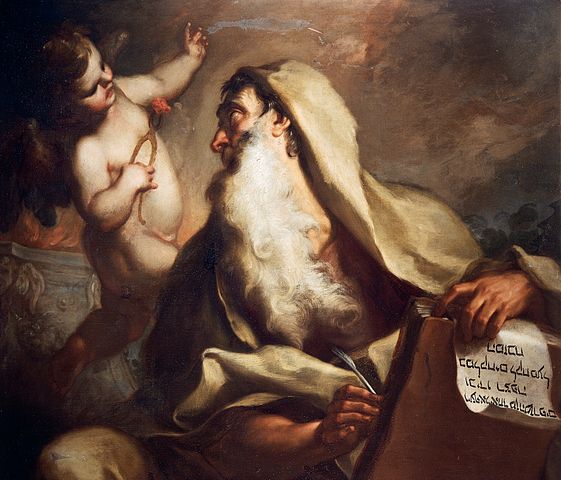
Prophet Isaiah, by Antonio Balestra (1666-1740) [public domain / Wikimedia Commons]

***
(4-9-06)
*****
Doctrine was much less developed in Old Testament times. They didn’t have the Holy Spirit as we do, or the full revelation of the New Testament and the gospel. Therefore, apostolic succession and the protections of infallibility are now possible and thinkable and believable.
The new covenant brought about a major increase of certainty and ability to ascertain spiritual truth in all things. Yet strong notions of authority were present in the old covenant, too, notwithstanding sinners and corruption (as always; nothing new there).
Protestants can talk about sin and corruption all they like, but that doesn’t wipe out the necessity of authoritative teachers, or the fact that this is the norm prescribed by this same Bible that they want to make the sole final (infallible) authority.
What does King Josiah do as soon as the Torah is found (2 Kings 22-23)? He gets the priest. The priest goes to the prophetess. Here are the two teaching authorities. And that is our question at hand. Who had authoritative teaching authority? The king abided by the advice of his advisers, just as Saul ignored Samuel, to his peril (but should have followed his sage advice), and David eventually heeded Nathan’s advice (but tragically too late to avoid the civil war led by his son).
Nor does the fact that the Law as a whole needed interpretation rule out the possibility that certain parts of it were clear and apparent without the need for much interpretation (just as with the Bible as a whole). Catholicism does not require a totally obscure Bible at all. This is a myth. I would argue that the portions that Josiah chiefly acted upon were of such a nature.
How hard is it to understand that idols were contrary to the Law? That’s a no-brainer, so he could see that right away, because it was repeated so often. There is some monstrosity up on a hill that some folks are using in connection with worship. Knock it down; it is an idol. How hard was it to figure out that Passover should be observed? Etc., etc.
Does it thereby follow that the entire Law and Bible could be understood without the need of authoritative teachers? No. And that is rather obvious to this day. Protestants continue to absurdly claim that the Bible is perspicuous, yet fail to agree amongst themselves. And their reasons for why this is (stupidity or sin on the other guy’s part) is as absurd and silly as the original false premise.
The Torah was ineffective when the priests and Levites were lax in their duty to properly teach and interpret it. No argument there. But this is self-evident, and not a contradiction of the Catholic position at all.
As for false priests and prophets: Jesus issued just as devastating criticisms of the Pharisees, yet He commanded His followers to abide by their teaching. So He must have been teaching some notion that the truth could be passed down despite the corruption, not that it was impossible because of the corruption, as many Protestants seem to think. I wrote in my book, The Catholic Verses (p. 50):
Paul shows the high priest, Ananias, respect, even when the latter had him struck on the mouth, and was not dealing with matters strictly of the Old Testament and the Law, but with the question of whether Paul was teaching wrongly and should be stopped (Acts 23:1-5). A few verses later Paul states, “I am a Pharisee, a son of Pharisees” (23:6) and it is noted that the Pharisees and Sadducees in the assembly were divided and that the Sadducees “say that there is no resurrection, nor angel, nor spirit; but the Pharisees acknowledge them all” (23:7-8). Some Pharisees defended Paul (23:9).
So we see that Paul accepts (at least to some tangible degree) the authority of the corrupt priests, just as Jesus accepted the authority (and taught others to do so) of the very Pharisees that He elsewhere excoriated. In fact, right after He says to “practice and observe whatever they tell you” (Matthew 23:3), He launches into His famous denunciations [for hypocrisy] for the rest of the chapter.
Jesus and Paul see nothing improper at all in the concept of a corrupt teacher preserving true teaching. They don’t think that the corrupt teacher loses all authority. So once again we have the biblical teaching, Protestant teachings that contradict it, and the Catholic teaching which is harmonious with it.
Quoting the authoritative words of a true prophet about the foibles and wickedness of false prophets doesn’t proves that prophets have no teaching authority (!). Prophecies had to be proven by future events. If what they said did not come to pass, and they claimed they had a word from the Lord, then they were to be stoned as false prophets. But there was always a true prophet, despite all the false ones.
We can’t plausibly argue that the presence of false prophets rules out any prophets at all, functioning as a primitive “magisterium” for the Jews. Protestants often highlight the wicked guys. But Israel had Jeremiah and Ezekiel and Isaiah and all the rest to tell them the truth. Many did not heed that truth or accept their authority. What else is new? That’s the same as always. Not all (not even a majority) listened to John the Baptist or Jesus Himself, either. And what does that prove? Exactly nothing, as to whether they possessed authority to teach or not, and bind others to their teaching.
Protestants, since they can’t figure out many theological truths, and must fight interminably, have to necessarily take a pessimistic view of things, and analogies from the Old Testament must needs be pessimistic. Therefore, they look at the corruption and all the nonsense that went on in ancient Israel, conclude that authoritative teachers are not to be had, and say that therefore, the chaos in Protestantism is justified because that is how it has always been. And so the individual is thrown upon himself as his own authority (a spectacle every bit as horrifying — if not more so — as having to weed through 17 false prophets to get to a true one).
It’s as if there is no Holy Spirit, no further guidance, no death of Jesus on the cross (in terms of making a difference as to men’s ascertaining of truth). There is no apostolic deposit that we can know and identify, and no succession so that folks could identify the one Church with the one faith.
We don’t say that the age of the Church is no more advanced than all the tragic Jewish history which was corrupt far more than it was righteous and the way God intended it to be. No!; the Christian has faith that because Jesus died and made it possible to obtain the graces of baptism and the Eucharist, and to be indwelt by the Holy Spirit, that now we can know what Christian truth is.
St. Paul certainly presupposes this in his writing, constantly referring nonchalantly (as if it were self-evident) to the one true tradition, received, and passed along. Yet Protestants want to live in the relative uncertainty of the Old Testament times? I find it amazing. But what else can a Protestant do, after all? They are bound by their own self-defeating, endlessly self-contradictory system(s).
I have granted that we don’t have apostolic succession per se in the Old Testament (it obviously did not because of the constant upheavals, decadence, judgments, and subsequent revivals of ancient Israel), but have argued that it doesn’t affect the analogy of Catholicism to the Old Testament system, precisely because we would expect this, based on the Holy Spirit not yet being given to the Church, to guide her.
A sort of “practical infallibility” or simply authority beyond a simple sola Scriptura conception, is certainly present in the Old Testament, and was God’s intention for Israel. It just wasn’t continuous, because of human sin. The Church Age and the coming of the gospel and the Holy Spirit made that possible, because of its supernatural protection, which alone would suffice to accomplish it. We see that in Levites and prophets alike.
A book (assuming it is copied accurately) is not subject to the corruptions and vicissitudes of human nature. It is what it is. So the books sat there and Josiah found them and God’s Law was again known because it could be read. This doesn’t prove sola Scriptura. All it proves is that Israel wasn’t faithful to God and His Law, which we all knew, as this is the overwhelming theme of the entire Old Testament.
Simply saying that the teaching system is irrelevant because it didn’t exist in an unbroken, uncorrupted manner for 3000 years or so of Old Testament history does not suffice. Everyone already knows that, and all agree that the Holy Spirit has a lot to do with it. Most Protestants, after all, manage to believe that the medieval Church fell into great darkness, supposedly obscuring the Bible and the gospel, etc., yet somehow the noble Protestant underground managed to keep the flicker going through all those dreary years till prophet Martin Luther could bring us the Bible, gospel, and good ole truth again.
So why is it so difficult for them to apply the same reasoning to the checkered record of Old Testament observance of the Law as God intended? Within Lutheranism today, for example, we have the same situation: mutual anathematizing regarding the more traditional LCMS and WELS vs. large factions of institutionalized pro-abortion, pro-feminist, theological liberalism in the ELCA (as in most Protestant denominations).
Yet LCMS and WELS Lutherans believe that there is a truth preserved one way or another. One has to simply find it. That’s all we are saying regarding the old covenant. But when we understand the actual system instituted by God, it is far more similar to Catholicism than Lutheranism or any form of Protestantism; that’s my argument.
Priests, Levites, and prophets exercised something between binding teaching authority and infallibility. This is no different, analogously, than popes, councils, and bishops in the Catholic Church. Popes can be infallible, and so can councils in agreement with the pope. It’s true that there is not one, absolute figure like the pope, but when one is in the presence of an Ezra or Jeremiah or Samuel, does it really make any practical difference?
Prophets routinely speak what purports to be the word of God, which is a much higher claim than papal infallibility, which is primarily a preventive, or “negative” guarantee, not positive inspiration or “revelation on the spot.” So one could easily argue that the infallibility (or the charism) was even greater, at least in the case of prophets.
It was even said of the Levites in Malachi 2:4-8: “True instruction was in his mouth, and no wrong was found on his lips. He walked with me in peace and uprightness, and he turned many from iniquity. For the lips of a priest should guard knowledge, and men should seek instruction from his mouth, for he is the messenger of the LORD of hosts.”
This is quite strong and has all the hallmarks of infallibility. The only thing missing is the promise of continuity and succession (so of course Protestants hang on that in arguing against Catholic analogies). But all the essentials are there.
*****
Previous Post
June 6, 2017
Catholic Apologists: Response to Inquiring Questions
Next Post

June 8, 2017 Alleged "Bible Contradictions": Most Are Actually Not So
Browse Our Archives
Select a Category & Last Things About Me Anti-Catholicism Atheism & Agnosticism Baptism and Sacramentalism Bible and Tradition Blessed Virgin Mary Books by Dave Armstrong C. S. Lewis Calvinism & General Protestantism Catholic Apologetics Catholic Apologists Catholic conversion Catholic converts Christmas Church (Ecclesiology) Church History Conversion and Converts Development of Doctrine Eastern Orthodoxy Ecumenism & Christian Unity Eucharist & Liturgy Fathers of the Church French Translations G. K. Chesterton Hell Hell & Satan Hell & Satan & Last Things Heresies & Comparative Religion Holistic Health Inquisition & Crusades & Scandals James White Jews & Judaism & Old Testament John Calvin John Henry Newman Liberal / Modernist Theology Life Issues Literary Resume Lutheranism Mariology Martin Luther Music Orthodoxy Papacy & Infallibility Personal Page Philosophy & Science Political & Ethical & Moral Issues Protestant Persecution & Intolerance Protestantism Purgatory Purgatory & Penance Romantic & Imaginative Theology Saints & Purgatory & Penance Salvation Salvation & Justification Satan & Last Things Sexuality and Gender Issues Spanish Translations Traditionalism vs. Radical Catholic Reactionaries Traducciones al español / tradução para português Trinitarianism & Christology Uncategorized Videos
Select a Month October 2026 September 2026 August 2026 July 2026 June 2026 May 2026 April 2026 March 2026 February 2026 January 2026 December 2025 November 2025 October 2025 September 2025 August 2025 July 2025 June 2025 May 2025 April 2025 March 2025 February 2025 January 2025 December 2024 November 2024 October 2024 September 2024 August 2024 July 2024 June 2024 May 2024 April 2024 March 2024 February 2024 January 2024 December 2023 November 2023 October 2023 September 2023 August 2023 July 2023 June 2023 May 2023 April 2023 March 2023 February 2023 January 2023 December 2022 November 2022 October 2022 September 2022 August 2022 July 2022 June 2022 May 2022 April 2022 March 2022 February 2022 January 2022 December 2021 November 2021 October 2021 September 2021 August 2021 July 2021 June 2021 May 2021 April 2021 March 2021 February 2021 January 2021 December 2020 November 2020 October 2020 September 2020 August 2020 July 2020 June 2020 May 2020 April 2020 March 2020 February 2020 January 2020 December 2019 November 2019 October 2019 September 2019 August 2019 July 2019 June 2019 May 2019 April 2019 March 2019 February 2019 January 2019 December 2018 November 2018 October 2018 September 2018 August 2018 July 2018 June 2018 May 2018 April 2018 March 2018 February 2018 January 2018 December 2017 November 2017 October 2017 September 2017 August 2017 July 2017 June 2017 May 2017 April 2017 March 2017 February 2017 January 2017 December 2016 November 2016 October 2016 September 2016 August 2016 July 2016 June 2016 May 2016 April 2016 March 2016 February 2016 January 2016 December 2015 November 2015 October 2015 September 2015 August 2015 July 2015 June 2015 May 2015 April 2015 March 2015 February 2015 January 2015 December 2014 November 2014 October 2014 September 2014 August 2014 July 2014 June 2014 April 2014 March 2014 February 2014 January 2014 December 2013 November 2013 October 2013 September 2013 August 2013 July 2013 June 2013 April 2013 March 2013 February 2013 January 2013 December 2012 November 2012 October 2012 September 2012 August 2012 July 2012 June 2012 May 2012 April 2012 March 2012 February 2012 January 2012 December 2011 November 2011 October 2011 September 2011 August 2011 July 2011 June 2011 April 2011 March 2011 February 2011 October 2010 September 2010 August 2010 July 2010 April 2010 March 2010 December 2009 October 2009 August 2009 July 2009 June 2009 May 2009 March 2009 February 2009 October 2008 September 2008 April 2008 March 2008 February 2008 January 2008 December 2007 November 2007 October 2007 May 2007 March 2007 February 2007 January 2007 November 2006 October 2006 September 2006 August 2006 July 2006 June 2006 May 2006 April 2006 March 2006 February 2006 October 2005 June 2005 April 2005 February 2005 July 2004 May 2004 April 2004
Follow Us!
TAKE THE
Religious Wisdom Quiz
Who lived in Ur of the Chaldeans before God called him?
Select your answer to see how you score.
Jacob Abram Isaac Lot
Books by This Author Books by Dave Armstrong
Related posts from Biblical Evidence for Catholicism

Jesus Founded the [Catholic] Church. If Not Him,...
Biblical Evidence for Catholicism

A Few "Worst" & "Best" Arguments vs. Protestantism
Biblical Evidence for Catholicism

Jerusalem Council vs. James White & Sola Scriptura
Biblical Evidence for Catholicism

Biblical Perspicuity: Absurd Anti-Catholic "Defense"
Biblical Evidence for Catholicism
TRENDING AT PATHEOS Catholic

In "Irreplaceable," our book on vocation and technology, Trevor Sutton and I...

I was strolling through the top floor of the brand new Parthenon...

What Does Gêvâh Mean For Kimberley Guifoyle &...
This week, a lot of the news is focused on Kimberly Guilfoyle....

INNER CIRCLE: Profound Mystery (Of Christ In All...
Ephesians 5:31-32 “For this reason, a man will leave his father and...

Do Not Rejoice When Your Enemy Falls: The...
Turning an execution into a public spectacle is a disturbing expression of...

'The Chosen' S6 Trailer: The Passion Gets Very...
Not many watching 'The Chosen' worry about spoilers, but just because they...
view all Catholic blogs
Ad-Free & Subscriber Log-In Subscription Support
- About Us
- 2026 Calendar
- Videos
- Podcasts
- Library of World Religions
- Faith In Media Tracker
- Advertise With Us
- Write for Us
- Privacy Policy
- Terms of Service
- Do Not Sell My Data
- Contact Us
- Radiant Digital
- Manage Newsletter Subscriptions
- Unsubscribe From Notifications
- Sitemap
Copyright 2008-2026, Patheos. All rights reserved.
Subscription Support Ad-Free & Subscriber Log-In
Follow Patheos