
BuddhistCatholicContemplativeEvangelicalGeneral ChristianHinduJewishLatter-day SaintMuslimNew VisionsProgressive Christian
Beliefs
- Buddhist
- Catholic
- Contemplative
- Evangelical
- General Christian
- Hindu
- Jewish
- Latter-day Saint
- More Voices
- Muslim
- New Visions
- Pagan
- Progressive Christian
Topics
- Religion News
- Food and Religion
- Sports and Religion
- Religious Art
- Religious Music and Entertainment
- Religious Events
- History and Religion
- Style and Religion
- Politics and Religion
- Women in Religion
- Recreation Outdoors and Religion
- Business Finance and Religion
- Careers Workplace and Religion
- Education and Religion
- Family Parenting and Religion
- Health Fitness and Religion
- Home and Religion
- Relationships and Religion
- Technology and Religion
- Travel and Religion
Columnists
- Buddhist Columnists
- Business Finance and Religion Columnists
- Careers Workplace and Religion Columnists
- Catholic Columnists
- Contemplative Columnists
- Education and Religion Columnists
- Evangelists Columnists
- Family Parenting and Religion Columnists
- General Christian Columnists
- Health Fitness and Religion Columnists
- Hindu Columnists
- History and Religion Columnists
- Home and Religion Columnists
- Jewish Columnists
- More Voices Columnists
- Latter Day Columnists
- Muslim Columnists
- New Visions Columnists
- Nonreligious Columnists
- Pagan Columnists
- Politics and Religion Columnists
- Progressive Columnists
- Recreation Outdoors and Religion Columnists
- Relationships and Religion Columnists
- Religion News Columnists
- Religious Art Columnists
- Religious Events Columnists
- Religious Music and Entertainment Columnists
- Sports and Religion Columnists
- Style and Religion Columnists
- Technology and Religion Columnists
- Travel and Religion Columnists
- Women in Religion Columnists
Resource Library
- 2026 Calendar
- Library of World Religions
- The 100 Most Holy Places on Earth
- Patheos Answers
- Podcasts
- Videos
- Faith Leaders Database
- Anglican Episcopalian
- Bahai
- Baptist
- Buddhism
- Christianity
- Confucianism
- Eastern Orthodoxy
- Hinduism
- Holiness and Pentecostal
- ISKCON
- Islam
- Judaism
- Lutheran
- Methodist
- The Church of Jesus Christ of Latter-day Saints
- New Age
- Paganism
- Presbytarian and Reformed
- Protestantism
- Religion Behind the Scenes
- Roman Catholic
- Scientology
- Shia Islam
- Sikhism
- Sufism
- Sunni Islam
- Taoism
- Zen
- See all religions
Research Tools
 Ad-Free & Subscriber Log-In Subscription Support
Follow Patheos 

- Trending:
- Advent
- |
- Forgiveness
- |
- Thanksgiving
- |
- Election
- |
- Seasonal Holidays
- |
- Marriage

-
About
-
Catholic Apologetics
-
Church History
-
Great Apologists
-
Christian Worldview
-
Protestantism & Misc.
- Home
- Catholic
- History and Religion
- Dialogue: Rich Man’s Prayer to Abraham (Lk 16) & Invocation of Saints
Dialogue: Rich Man’s Prayer to Abraham (Lk 16) & Invocation of Saints
Last updated on: May 3, 2017 at 3:59 pm by Dave Armstrong
Dialogue: Rich Man’s Prayer to Abraham (Lk 16) & Invocation of Saints 2017-05-03T15:59:45-04:00 Dave Armstrong
Patheos Explore the world's faith through different perspectives on religion and spirituality! Patheos has the views of the prevalent religions and spiritualities of the world.
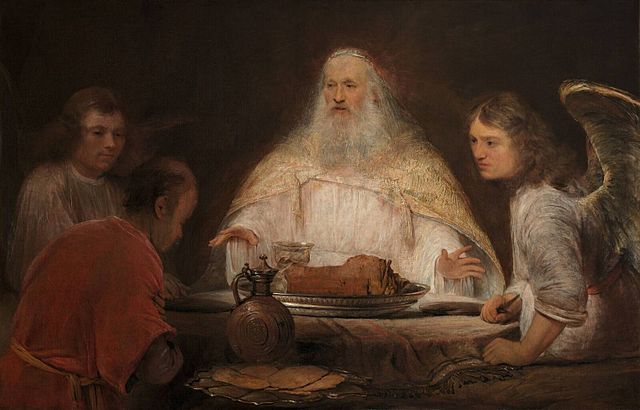
Abraham and the Angels, by Aert de Gelder (1645-1727) [public domain / Wikimedia Commons]

***
Lutheran Pastor Ken Howes (LCMS) is a friendly dialogue partner, whom I respect a lot: especially how he always conducts himself like a Christian gentleman in discussion. His congregation is very blessed to have him. These exchanges occurred on a public Facebook thread. His words will be in blue.
*****
The Defense of the Augsburg Confession was cited by someone else: it’s section on Invocation of Saints. This excerpt states and grants that saints and angels in heaven pray for us. It’s not all that far from that to also believe that, therefore (since they pray for us), we can ask them to pray. The counter-arguments given are quite able to be refuted, and I have done so myself in many ways. See lots of articles on my web page on the Saints.
The Defense of the Augsburg Confession also states the following untruths:
Scripture does not teach the invocation of the saints, or that we are to ask the saints for aid. But since neither a command, nor a promise, nor an example can be produced from the Scriptures concerning the invocation of saints, it follows that conscience can have nothing concerning this invocation that is certain. And since prayer ought to be made from faith, how do we know that God approves this invocation? Whence do we know without the testimony of Scripture that the saints perceive the prayers of each one? . . . 12] Nothing can be produced by the adversaries against this reasoning, that, since invocation does not have a testimony from God’s Word.
Jesus Himself taught in the story (not parable) of the rich man and Lazarus, that the rich man prayed to Abraham (the KJV even uses the phrase, “I pray thee”):
Luke 16:24, 27-28 (RSV) And he called out, `Father Abraham, have mercy upon me, and send Laz’arus to dip the end of his finger in water and cool my tongue; for I am in anguish in this flame.’ . . . [27] And he said, `Then I beg you, father, to send him to my father’s house, [28] for I have five brothers, so that he may warn them, lest they also come into this place of torment.’
Abraham said no to the request, but it doesn’t follow that the request itself was impermissible. Abraham never said, “you can’t pray to me! What are you doing?! You can only pray to God!!!”
Therefore, praying to a saint is a biblical teaching: expressly from Our Lord Jesus. If it is argued that it is “only a parable,” we reply that parables could not contain false theological principles, sanctioned by Jesus, and not condemned by Him.
The scripture on this point is inconclusive; from it we can neither draw a mandate to do so nor draw a mandate not to do so. Given that 1 Timothy tells us that there is one mediator between God and man, Jesus Christ, we, in Reformation churches, generally do not do so. (There are both Lutherans and Anglicans who do.) I have no serious problem with prayers that seek the intercession with a saint, though I think those prayers are probably a nullity. Where I draw the line, and I think good Catholicism would agree with me on it, is when a prayer engages in a hagiolatrous attribution of special powers to a saint (St. Anne to stop a storm; St. Barbara to win a battle; St. Lazarus to cure an illness, etc.). The first of those examples was the situation when Luther decided to become a monk.
I just showed how Jesus taught that the rich man prayed to Abraham, without the slightest hint of any disapproval.
No sign of disapproval–but it is worth noting that it attained nothing; instead, they were directed to Scripture. “They have Moses and the prophets.”
Again, I have no problem with it unless someone ascribes to a saint some supernatural power of his own. There is a line dividing asking a fellow believer (who may or may not hear you) to join you in prayer from seeking supernatural help from that fellow believer himself.
It might be of interest to note that Abraham was known for being very rich. Maybe he was the patron saint of the rich and the rich man, then? 
Nice touch, Dave!
Thanx!
The Bible also has no example of prayer to the Holy Spirit, that I am aware of. Does that mean we can’t do that? Thus, it has at least one more example of prayer to a man than prayer to God the Holy Spirit.
In Luke 16, Abraham clearly has the power to do what the rich man asked, but he refused because it wasn’t God’s will and (as he said), it wouldn’t have succeeded in its purpose anyway.
He actually doesn’t clearly have that power. “And besides all this, between us and you there is a great gulf fixed, so that those who want to pass from here to you cannot, nor can those from there pass to us.” Again, I’ll put prayer asking a saint to join in prayer in a different category from prayer asking a saint to intervene directly.
Abraham never denied that he had the potential power to “send” Lazarus to the rich man’s brothers. This is very interesting, and a slant I hadn’t thought of before. The implication is that he could be sent, and by Abraham, delegated that power by God. The very thought of his being sent to earth is anathema to many Protestants who deny any contact at all between saints in heaven and those on earth (yet Samuel appeared to Saul, and Elijah and Moses appeared with Jesus on the Mount of Transfiguration).
But anyway, he doesn’t tell the rich man that he shouldn’t make the request (and he certainly would have, if that were true, just as angels and men denied worship from men as essentially wrong). It follows that Jesus sanctioned the notion of prayer to men, rather than only to God.
He can’t answer the prayer to send Lazarus over to the “bad” part of Hades, because as he explained, it is impossible for those in the “good” part of Hades (limbo of the fathers) to pass over to the bad part (presumably the holding tank for eventual hell). That is, therefore, a metaphysical impossibility; thus, the prayer is declined for that stated reason; not because Abraham ought not receive any prayer requests, or could not potentially answer any that were possible to answer.
The other refusal dealt with a situation that was not intrinsically impossible, but rather, had to do with the will of men: “If they do not hear Moses and the prophets, neither will they be convinced if some one should rise from the dead.”
Abraham neither denies that he is able to answer / grant the prayer, nor that folks rise from the dead sometimes (as we already know that they do, from Scripture, beyond just Jesus’ Resurrection or His raising of the dead).
He refuses the prayer because it would be of no effect. He knows that the brothers would not respond to sending Lazarus to them.
And of course this teaching had an application to Jesus’ own Resurrection not being sufficient to convince people who were determined to oppose him: who didn’t see in Moses and the prophets the messianic prophecies that Jesus fulfilled.
Related papers:
Bible on Asking Dead Men to Intercede (Luke 16) [7-8-14]
*
Dialogue on Praying to Abraham (Luke 16) [5-22-16]
Previous Post

May 3, 2017
Is God Alone Holy, According to Scripture? Or Can We Be Too?
Next Post
May 4, 2017 Grace Alone & Necessity of Good Works: Ecumenical Agreement
Browse Our Archives
Select a Category & Last Things About Me Anti-Catholicism Atheism & Agnosticism Baptism and Sacramentalism Bible and Tradition Blessed Virgin Mary Books by Dave Armstrong C. S. Lewis Calvinism & General Protestantism Catholic Apologetics Catholic Apologists Catholic conversion Catholic converts Christmas Church (Ecclesiology) Church History Conversion and Converts Development of Doctrine Eastern Orthodoxy Ecumenism & Christian Unity Eucharist & Liturgy Fathers of the Church French Translations G. K. Chesterton Hell Hell & Satan Hell & Satan & Last Things Heresies & Comparative Religion Holistic Health Inquisition & Crusades & Scandals James White Jews & Judaism & Old Testament John Calvin John Henry Newman Liberal / Modernist Theology Life Issues Literary Resume Lutheranism Mariology Martin Luther Music Orthodoxy Papacy & Infallibility Personal Page Philosophy & Science Political & Ethical & Moral Issues Protestant Persecution & Intolerance Protestantism Purgatory Purgatory & Penance Romantic & Imaginative Theology Saints & Purgatory & Penance Salvation Salvation & Justification Satan & Last Things Sexuality and Gender Issues Spanish Translations Traditionalism vs. Radical Catholic Reactionaries Traducciones al español / tradução para português Trinitarianism & Christology Uncategorized Videos
Select a Month November 2026 October 2026 September 2026 August 2026 July 2026 June 2026 May 2026 April 2026 March 2026 February 2026 January 2026 December 2025 November 2025 October 2025 September 2025 August 2025 July 2025 June 2025 May 2025 April 2025 March 2025 February 2025 January 2025 December 2024 November 2024 October 2024 September 2024 August 2024 July 2024 June 2024 May 2024 April 2024 March 2024 February 2024 January 2024 December 2023 November 2023 October 2023 September 2023 August 2023 July 2023 June 2023 May 2023 April 2023 March 2023 February 2023 January 2023 December 2022 November 2022 October 2022 September 2022 August 2022 July 2022 June 2022 May 2022 April 2022 March 2022 February 2022 January 2022 December 2021 November 2021 October 2021 September 2021 August 2021 July 2021 June 2021 May 2021 April 2021 March 2021 February 2021 January 2021 December 2020 November 2020 October 2020 September 2020 August 2020 July 2020 June 2020 May 2020 April 2020 March 2020 February 2020 January 2020 December 2019 November 2019 October 2019 September 2019 August 2019 July 2019 June 2019 May 2019 April 2019 March 2019 February 2019 January 2019 December 2018 November 2018 October 2018 September 2018 August 2018 July 2018 June 2018 May 2018 April 2018 March 2018 February 2018 January 2018 December 2017 November 2017 October 2017 September 2017 August 2017 July 2017 June 2017 May 2017 April 2017 March 2017 February 2017 January 2017 December 2016 November 2016 October 2016 September 2016 August 2016 July 2016 June 2016 May 2016 April 2016 March 2016 February 2016 January 2016 December 2015 November 2015 October 2015 September 2015 August 2015 July 2015 June 2015 May 2015 April 2015 March 2015 February 2015 January 2015 December 2014 November 2014 October 2014 September 2014 August 2014 July 2014 June 2014 April 2014 March 2014 February 2014 January 2014 December 2013 November 2013 October 2013 September 2013 August 2013 July 2013 June 2013 April 2013 March 2013 February 2013 January 2013 December 2012 November 2012 October 2012 September 2012 August 2012 July 2012 June 2012 May 2012 April 2012 March 2012 February 2012 January 2012 December 2011 November 2011 October 2011 September 2011 August 2011 July 2011 June 2011 April 2011 March 2011 February 2011 October 2010 September 2010 August 2010 July 2010 April 2010 March 2010 December 2009 October 2009 August 2009 July 2009 June 2009 May 2009 March 2009 February 2009 October 2008 September 2008 April 2008 March 2008 February 2008 January 2008 December 2007 November 2007 October 2007 May 2007 March 2007 February 2007 January 2007 November 2006 October 2006 September 2006 August 2006 July 2006 June 2006 May 2006 April 2006 March 2006 February 2006 October 2005 June 2005 April 2005 February 2005 July 2004 May 2004 April 2004
Follow Us!
TAKE THE
Religious Wisdom Quiz
What mountain was the site of Elijah's showdown with Baal's prophets?
Select your answer to see how you score.
Mount Hermon Mount Carmel Mount Sinai Mount Tabor
Books by This Author Books by Dave Armstrong
Related posts from Biblical Evidence for Catholicism

Bible & Catholicism on Mortal Sin (vs. John...
Biblical Evidence for Catholicism
Does Catholic Intercession of Saints Require Omniscience?
Biblical Evidence for Catholicism

Eternal Hell: Biblical? 25 Verses Say So
Biblical Evidence for Catholicism

Capabilities of Heavenly Saints: Protestant Commentaries
Biblical Evidence for Catholicism
TRENDING AT PATHEOS Catholic

Smart people saying smart things (11.24.26)
Please take time to listen to Perry Bacon, Sarah Posner, Adam Serwer,...

The Contingency of Our Technology
Last week we were hit with a raft of massive technology outages....

In 1939, President Franklin D. Roosevelt moved Thanksgiving from November 30 to...

Reasons for Restraint: Ricardo Gonzalez, Florida and Dec...
The Morning of January 3 I begin with the dead. On the...

I published this column for Thanksgiving 2012 in the Deseret News....

For many years, Catholicism has been caught up in division over the...
view all Catholic blogs
Ad-Free & Subscriber Log-In Subscription Support
- About Us
- 2026 Calendar
- Videos
- Podcasts
- Library of World Religions
- Faith In Media Tracker
- Advertise With Us
- Write for Us
- Privacy Policy
- Terms of Service
- Do Not Sell My Data
- Contact Us
- Radiant Digital
- Manage Newsletter Subscriptions
- Unsubscribe From Notifications
- Sitemap
Copyright 2008-2026, Patheos, part of the Radiant Digital network of media brands. All rights reserved.
Subscription Support Ad-Free & Subscriber Log-In
Follow Patheos