
BuddhistCatholicContemplativeEvangelicalGeneral ChristianHinduJewishLatter-day SaintMuslimNew VisionsProgressive Christian
Beliefs
- Buddhist
- Catholic
- Contemplative
- Evangelical
- General Christian
- Hindu
- Jewish
- Latter-day Saint
- More Voices
- Muslim
- New Visions
- Pagan
- Progressive Christian
Topics
- Religion News
- Food and Religion
- Sports and Religion
- Religious Art
- Religious Music and Entertainment
- Religious Events
- History and Religion
- Style and Religion
- Politics and Religion
- Women in Religion
- Recreation Outdoors and Religion
- Business Finance and Religion
- Careers Workplace and Religion
- Education and Religion
- Family Parenting and Religion
- Health Fitness and Religion
- Home and Religion
- Relationships and Religion
- Technology and Religion
- Travel and Religion
Columnists
- Buddhist Columnists
- Business Finance and Religion Columnists
- Careers Workplace and Religion Columnists
- Catholic Columnists
- Contemplative Columnists
- Education and Religion Columnists
- Evangelists Columnists
- Family Parenting and Religion Columnists
- General Christian Columnists
- Health Fitness and Religion Columnists
- Hindu Columnists
- History and Religion Columnists
- Home and Religion Columnists
- Jewish Columnists
- More Voices Columnists
- Latter Day Columnists
- Muslim Columnists
- New Visions Columnists
- Nonreligious Columnists
- Pagan Columnists
- Politics and Religion Columnists
- Progressive Columnists
- Recreation Outdoors and Religion Columnists
- Relationships and Religion Columnists
- Religion News Columnists
- Religious Art Columnists
- Religious Events Columnists
- Religious Music and Entertainment Columnists
- Sports and Religion Columnists
- Style and Religion Columnists
- Technology and Religion Columnists
- Travel and Religion Columnists
- Women in Religion Columnists
Resource Library
- 2026 Calendar
- Library of World Religions
- The 100 Most Holy Places on Earth
- Patheos Answers
- Podcasts
- Videos
- Faith Leaders Database
- Anglican Episcopalian
- Bahai
- Baptist
- Buddhism
- Christianity
- Confucianism
- Eastern Orthodoxy
- Hinduism
- Holiness and Pentecostal
- ISKCON
- Islam
- Judaism
- Lutheran
- Methodist
- The Church of Jesus Christ of Latter-day Saints
- New Age
- Paganism
- Presbytarian and Reformed
- Protestantism
- Religion Behind the Scenes
- Roman Catholic
- Scientology
- Shia Islam
- Sikhism
- Sufism
- Sunni Islam
- Taoism
- Zen
- See all religions
Research Tools
 Ad-Free & Subscriber Log-In Subscription Support
Follow Patheos 

- Trending:
- Advent
- |
- Forgiveness
- |
- Thanksgiving
- |
- Election
- |
- Seasonal Holidays
- |
- Marriage

-
About
-
Catholic Apologetics
-
Church History
-
Great Apologists
-
Christian Worldview
-
Protestantism & Misc.
- Home
- Catholic
- History and Religion
- Dialogue on Oral Tradition & Apostolic Succession
Dialogue on Oral Tradition & Apostolic Succession
Last updated on: May 31, 2018 at 1:00 pm by Dave Armstrong
Dialogue on Oral Tradition & Apostolic Succession 2018-05-31T13:00:59-04:00 Dave Armstrong
Patheos Explore the world's faith through different perspectives on religion and spirituality! Patheos has the views of the prevalent religions and spiritualities of the world.
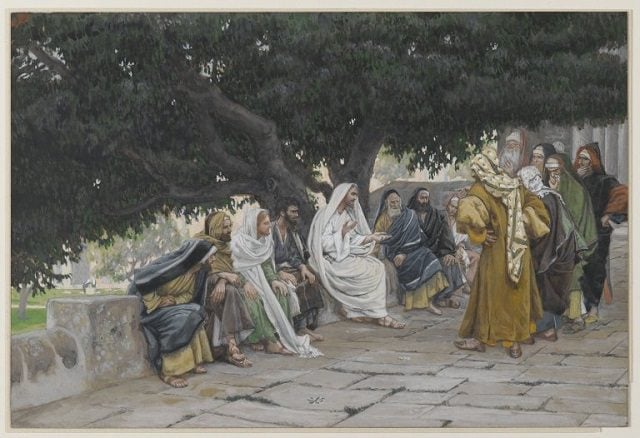
Jesus referred to “Moses’ seat” as the basis upon which the Pharisees had teaching authority. This is an analogy to apostolic succession. The Pharisees and the Saduccees Come to Tempt Jesus, by James Tissot (1836-1902) [public domain / Wikimedia Commons]

***
John E. Taylor is a Presbyterian friend of mine (OPC). This occurred in a Facebook thread on my page. His words will be in blue.
***
Then someone tell me what “Jewish traditions” we should be observing, if it was Jewish tradition that gave us the Old Testament canon, the way it is alleged that it was “Catholic tradition” that gave us the New Testament canon. No Jewish traditions, Dave? Then why should I be so concerned about Catholic traditions?
That’s a huge, huge topic. Certainly you know enough about that to know I couldn’t possibly give any fully adequate short answer.
But in a nutshell: Catholic tradition is developed from biblical and apostolic tradition, which is why we keep it. Protestant traditions are a mixed bag of authentic Catholic traditions and a host of non-biblical novelties introduced in the 16th century.
But you didn’t answer my question about JEWISH traditions!  The fact is, I DON’T know a whole lot about them, which is why I asked.
I certainly have no use for “Protestant” traditions like “altar calls” and getting “saved” by praying “the sinner’s prayer”. No doubt the Reformers would have repudiated them, too.
I did answer by saying: “That’s a huge, huge topic. . . .”
Can’t you name one extra-biblical Jewish tradition we should believe? You’ve made a career out of citing such Catholic traditions.
I have great confidence in you.
Moses’ seat. Jesus espoused that one in Matthew 23; even said that Christians should heed the teachings of the non-Christian Pharisees. Put that in your pipe and smoke it!
I’ve been impressed by rabbinic interpretation of OT Scripture. They unfortunately are a tad weak when it comes to the Messiah.
So Dave, name me a Pharisaical tradition “from Moses’ seat” we’re supposed to follow.
Just one.
Even I can name a fistful of Catholic ones – papal primacy, immaculate conception, Marian queenship, purgatory, indulgences, the infallibility of Catholic doctrine, the ultimate Scriptural interpretive authority delegated to the Catholic Magisterium.
You’re the expert, the full-time apologist. I’m just a working stiff, hack interpreter for the automotive industry. So surely you can name one Jewish tradition we should follow, because that same tradition gave us the OT canon.
I just did. I’m not gonna go round and round on this, when you have yet to produce even one Protestant scholarly source that backs you up on the “other Mary” being the Blessed Virgin. It’s the “floating ducks / 101 topics at once” Protestant tactical routine, and I don’t play that game.
If you want more, go to my web page on Judaism and Christianity: it’ll be a feast for ya.
I read your Sola Scriptura article. Re “2) JEWISH ORAL TRADITION WAS ACCEPTED BY JESUS AND THE APOSTLES:”
The names of Jannes and Jambres, the rock in the wilderness, and phrases like “He shall be called a Nazarene” and “the seat of Moses”, etc., hardly constitute doctrinal tradition of the sort Catholics appeal to.
I didn’t say they did. You simply assumed that. The argument that I made was the following, plainly described:
the Old Testament analogy is much more in line with both the early Church and present-day Catholicism (which developed from that early Church) and its notions of Church authority and tradition, than with the Protestant sola Scriptura rule of faith.
That’s not an argument of absolute equation, but one of relative similarity: “a is much more like b than c.”
Analogies also are usually not total; they admit of degrees. That is the case here.
As for the allegation of successors to Moses, they sure weren’t reliable in Jeremiah’s day, were they? They saw Jerusalem destroyed, something they most fallibly taught SURELY wouldn’t happen, and persecuted Jeremiah for telling them otherwise.
That was an “allegation” of Jesus. He’s the one who referred to it. I have engaged in extremely extensive debates with James White over this issue.
Succession was built into Judaism via the Aaronic priesthood and, later, the Davidic dynasty. What room does that leave for succession via some oral tradition?
And Jeremiah’s fingerless contemporaries are just ONE example of Jewish leaders’ apostasy – Old Testament history is a sad repetition of that one theme, finally resulting in their murdering the Lord of Glory.
So Jewish succession seems like a mighty weak reed to lean on.
Nor does an analogy to succession in the old covenant to that in the new depend upon the total faithfulness of such successors. It’s simply a matter of “succession occurred in the OT” and looking to see who continues that succession today. Catholics do and Protestants do not. I have written about indefectibility in the Old Testament (in intense discussions with a Lutheran apologist), further drawing the analogy.
As for the angelology tradition, I’d say it caused much trouble. It was the first error Hebrews had to correct in the writer’s attempt to persuade them not to return to Judaism (Heb. 1)
In other words, that tradition was distracting the Hebrews from Christ — the same thing I see so much Catholic tradition doing — Mary, saints, papal supremacy, to name only a few.
How do “Mary, saints, papal supremacy” distract anyone from Christ (as a grand, sweeping generalization), anymore than your TULIP, faith alone, and sola Scriptura distract you from Christ? We don’t make that claim about you. You ought not say stupid and ridiculous things about us, either. It’s unseemly, and it’s a lie.
But you just have to make false dichotomies and either/or fallacies. It’s been part and parcel of the Protestant mindset from the beginning: especially in Calvinists, but by no means confined to them.
One can’t possibly honor and venerate Mary or other saints, while worshiping and adoring God infinitely more. According to the Bible and Catholicism, this is entirely possible, but not in the Calvinist mind, where everything is a zero sum game: any mere veneration must detract from worship of God.
Nor does papal supremacy detract from God in the least bit. Peter was the leader in the early Church, by Jesus’ own choice (He built the Church upon Peter). We believe there is a leader now, too.
You guys eschew such leadership, yet I would contend that how the typical committed Calvinist views John Calvin — as almost an oracle of God –, is making him a leader in fact at least as much as we view popes. Calvin would affect the daily lives of Calvinists far more than popes affect ours.
I’ll make a deal with you. I won’t purport to speak for Catholics about distractions, if you don’t purport to speak for Calvinists about their esteem for Calvin.
I should add also (with regard to your recalling of massive old covenant sin in their successions) that Jesus wasn’t concerned the sin and hypocrisy of the Pharisees would affect their teaching, so that no one should follow it. He expressly stated:
Matthew 23:2-3 (RSV) The scribes and the Pharisees sit on Moses’ seat; [3] so practice and observe whatever they tell you, but not what they do; for they preach, but do not practice.
If hypocrisy and sin means that one can’t teach at all, and loses authority, then we have had no teacher in the history of the Church. Thus, your objection proves too much.
And it’s interesting you keep waving Mt. 23:2-3 at me. I take that one as literally as you (and I) take v. 9, for I have addressed a priest as “Father” on numerous occasions.
I never said hypocrisy and sin means one can’t teach at all; I was simply saying the Jews had no infallible succession authority in 586 BC and 33-70 AD when their teaching led to the destruction of the nation (and numerous points in between), which makes me a tad skeptical with anyone’s claim to have it now.
You say merely believing in such a thing as a pope is a “distraction” from our Lord Jesus. I simply observed that how Calvinists view Calvin gives him more authority in their lives than popes have in ours. After all, no pope wrote a gigantic book that started an entirely new denomination and way of thinking.
Even so, I never said that that distracted you from Christ.
But this is what you get when man-centered and man-made religion (i.e., all the novel traditions of men that Calvin brought in) takes center stage. He comes and overthrows dozens of things that had been believed for 1500 years. No pope ever does that. Popes have to honor previous existing apostolic tradition. Therefore, they have no authority to arbitrarily proclaim novelties, like Luther and Calvin did.
So you see that the “making a mere man the leader” argument is a two-edged sword. We are not dumbstruck when you run down the papacy. We have solid replies to offer back to you. This is an argument I’ve made for over 25 years: about the Protestant founders being de facto “super-popes.”
Shusaku Endo is a Catholic novelist whose work “The Silence” had recently been made into a movie. It’s about the heroic Catholics in Japan who faced horrible persecution. The book mentions the hero priest’s concern that the peasant flock he inherited spoke more lovingly about Mary than about Jesus, and it concerned him and he resolved to talk to them about it.
Unfortunately he being Caucasian, his flock risked their lives whenever they saw him (he was locked in a shed for his own safety), and as I recall they had to move him away before he could talk to them about it.
It’s a stirring book.
There are Catholics who are out of balance. Vatican II straightforwardly addressed that. But I reject the wild generalizations that you draw, which come far more from Protestant either/or obsessions with false and unbiblical dichotomies than with Catholic behavior en masse.
We’ve been systematically misrepresented, lo, all these centuries. Why should it be different now?
Ok, ok, let me say Mary, etc. “runs the danger of being a distraction”.
That statement is much better, so I appreciate the qualification.
In fact, all Christians have to be vigilant to allow anything to be placed above God in their allegiance and priorities, since that is idolatry. Catholics are no worse than anyone else in that regard.
Jesus also said “Beware of the leaven of the Pharisees and the Sadducees” (Mt. 16:6 – the very ones he said sit in the seat of Moses)
I also think your Mt. 23 citation needs to be read in the context of the entire chapter!
To be sure ANYONE can add leaven to his teaching. The “Galatian heresy” (Christ plus keeping the law), forbidding the drinking of alcohol, etc.
One Presbyterian minister I know had to be defrocked for teaching your had to be a 5-point Calvinist to be saved!
So Christ’s “Beware of the leaven…” applied to us all.
Peace, brother!
How does this somehow wipe out His plain statement: “practice and observe whatever they tell you”? It’s amazing how Protestants will ignore very clear, perspicuous biblical teachings, even from the lips of Jesus Himself, if it goes against their preconceived theologies. They will deliberately ignore one motif and highlight another, forgetting that all of Scripture is inspired and has to be coherently harmonized. This is what you are doing right now.
You guys are far too predictable. I could have given your argument myself. One just needs to learn the talking points.
Jesus observed pharisaical customs, since it was the mainstream Jewish school of the day. It had variations within it. But He said their teachings should be followed, even if they are hypocrites.
Paul called himself a Pharisee twice. It was not a totally wicked thing to be a Pharisee, anymore than “tradition” is [supposedly] always a “dirty word” in Scripture.
It occurred to me that another Jewish tradition Protestants follow, rather than the virtually universal patristic teaching, is to accept the 39-book canon of the Old Testament. That was the majority (Palestinian) Jewish position, while Jesus and other NT writers cited the Septuagint, which contained the Deuterocanon: which was from the Alexandrian / Hellenistic Jewish tradition. The Catholic Encyclopedia (“Canon of the Old Testament”) states: “the New Testament undoubtedly shows a preference for the Septuagint; out of the 350 texts from the Old Testament, 300 favour the language of the Greek version rather than that of the Hebrew.”
The same article also observed:
The sub-Apostolic writings of Clement, Polycarp, the author of the Epistle of Barnabas, of the pseudo-Clementine homilies, and the “Shepherd” of Hermas, contain implicit quotations from or allusions to all the deuterocanonicals except Baruch (which anciently was often united with Jeremias) and I Machabees and the additions to David. No unfavourable argument can be drawn from the loose, implicit character of these citations, since these Apostolic Fathers quote the protocanonical Scriptures in precisely the same manner.
Coming down to the next age, that of the apologists, we find Baruch cited by Athenagoras as a prophet. St. Justin Martyr is the first to note that the Church has a set of Old Testament Scriptures different from the Jews’, and also the earliest to intimate the principle proclaimed by later writers, namely, the self-sufficiency of the Church in establishing the Canon; its independence of the Synagogue in this respect.
Thus, when it goes along with your received tradition, you’ll follow [majority, not unanimous] Jewish thought, even after the arrival of the new covenant, rather than the Christian tradition of the early Church. Jerome (the lone major anomaly among the fathers as regards the canon) did the same, because he lived in Bethlehem, and was highly influenced by Jewish thinking. We saw where he lived: right next to where Jesus was born, in 2014.
But since we don’t follow lone men, rather than the collective of wise Christian teachers, in Church councils, we reject his dissenting view and follow what the Church decreed.
As to what was meant by the “leaven of the Pharisees,” I did a huge study of that, and concluded that it was clearly hypocrisy as opposed to false doctrine. This is, of course, what Jesus consistently rebuked them for. They had pretty good doctrines. It was the Sadducees who rejected many crucial doctrines (the “liberals” of their day). If you don’t believe my conclusion, then take note of what Jesus said:
Luke 12:1 (RSV) . . . “Beware of the leaven of the Pharisees, which is hypocrisy.”
Paul teaches basically the same thing.
So you have disproven nothing in my argument. Jesus plainly said that their teachings should be followed, but not their hypocrisy.
Indeed. When the Pharisees taught the Old Testament – accurately – they should be followed. Protestants don’t have a problem with that.
But though they sat in the seat of Moses, the vast majority of them failed to recognize the Messiah when they were face to face with him.
Not exactly a teaching of theirs I can place much confidence in.
Jesus’s comments about the Pharisees were rather complex:
Matthew 15:12-14 (ESV) Then the disciples came and said to him, “Do you know that the Pharisees were offended when they heard this saying?” He answered, “Every plant that my heavenly Father has not planted will be rooted up. Let them alone; they are blind guides. And if the blind lead the blind, both will fall into a pit.”
Leave alone those who sit in the seat of Moses?
You’ve repeatedly accused Protestants of cherrypicking but the shoe is on you guys’ foot, too.
If they were essentially bad and wicked, why did Paul call himself one, and why did Jesus follow their customs?
John Calvin makes a very interesting comment in his commentary on Matthew 23:2, and takes a sort of middle position on the matter:
2. In the chair of Moses. Reasons were not wanting for inserting here what Luke relates at a different place. Besides that the doctrine is the same, I have no doubt that Luke, after having said that the scribes were sharply and severely reproved by our Lord, added also the other reproofs which Matthew delayed till the proper place; for already we have frequently seen that the Evangelists, as occasion required, collected into one place various discourses of Christ. But as the narrative of Matthew is more full, I choose rather to take his words as the subject of exposition.
Our Lord gives a general exhortation to believers to beware of conforming their life to the wicked conduct of the scribes, but, on the contrary, to regulate it by the rule of the Law which they hear from the mouth of the scribes; for it was necessary (as I have lately hinted) that he should reprove many abuses in them, that the whole people might not be infected. Lest, through their crimes, the doctrine of which they were the ministers and heralds should be injured, he enjoins believers to attend to their words, and not to their actions; as if he had said, that there is no reason why the bad examples of pastors should hinder the children of God from holiness of life. That the word scribes, agreeably to the Hebrew idiom, denotes the teachers or expounders of the Law, is well known; and it is certain that Luke calls the same persons lawyers (89)
Now our Lord refers peculiarly to the Pharisees, who belonged to the number of the scribes, because at that time this sect held the highest rank in the government of the Church, and in the exposition of Scripture. For we have formerly mentioned that, while the Sadducees and Essenes preferred the literal interpretation of Scripture, the Pharisees followed a different manner of teaching, which had been handed down, as it were, to them by their ancestors, which was, to make subtle inquiries into the mystical meaning of Scripture. This was also the reason why they received their name; for they are called Pherusim, that is, expounders. (90) And though they had debased the whole of Scripture by their false opinions, yet, as they plumed themselves on that popular method of instruction, their authority was highly esteemed in explaining the worship of God and the rule of holy life. The phrase ought, therefore, to be thus interpreted: “The Pharisees and other scribes, or, the scribes, among whom the Pharisees are the most highly esteemed, when they speak to you, are good teachers of a holy life, but by their works they give you very bad instructions; and therefore attend to their lips rather than to their hands.”
It may now be asked, Ought we to submit to all the instructions of teachers without exception? For it is plain enough, that the scribes of that age had wickedly and basely corrupted the Law by false inventions, had burdened wretched souls by unjust laws, and had corrupted the worship of God by many superstitions; but Christ wishes their doctrine to be observed, as if it had been unlawful to oppose their tyranny. The answer is easy. He does not absolutely compare any kind of doctrine with the life, but the design of Christ was, to distinguish the holy Law of God from their profane works. For to sit in the chair of Moses is nothing else than to teach, according to the Law of God, how we ought to live. And though I am not quite certain whence the phrase is derived, yet there is probability in the conjecture of those who refer it to the pulpit which Ezra erected, from which the Law was read aloud, (Nehemiah 8:4.) Certainly, when the Rabbis expounded Scripture, those who were about to speak rose up in succession; but it was perhaps the custom that the Law itself should be proclaimed from a more elevated spot. That man, therefore, sits in the chair of Moses who teaches, not from himself, or at his own suggestion, but according to the authority and word of God. But it denotes, at the same time, a lawful calling; for Christ commands that the scribes should be heard, because they were the public teachers of the, Church.
The Papists reckon it enough, that those who issue laws should possess the title and occupy the station; for in this way they torture the words of Christ to mean, that we are bound to receive obediently whatever the ordinary prelates of the Church enjoin. But this calumny is abundantly refuted by another injunction of Christ, when he bids them beware of the leaven of the Pharisees, (Matthew 16:6.)
If Christ pronounces it to be not only lawful, but even proper, to reject whatever of their own the scribes mingle with the pure doctrine of the Law, certainly we are not bound to embrace, without discrimination or the exercise of judgment, whatever they are pleased to enjoin. Besides, if Christ had intended here to bind the consciences of his followers to the commandments of men, there would have been no good ground for what he said in another passage, that it is in vain to worship God by the commandments of men, (Matthew 15:9.)
Hence it is evident, that Christ exhorts the people to obey the scribes, only so far as they adhere to the pure and simple exposition of the Law. For the exposition of, Augustine is accurate, and in accordance with Christ’s meaning, that, “the scribes taught the Law of God while they sat in the chair of Moses; and, therefore, that the sheep ought to hear the voice of the Shepherd by them, as by hirelings.” To which words he immediately adds: “God therefore teaches by them; but if they wish to teach any thing of their own, refuse to hear, refuse to do them.” With this sentiment accords what the same writer says in his Fourth Book of Christian Doctrine: “Because good believers do not obediently listen to any sort of man, but to God himself; therefore we may profitably listen even to those whose lives are not profitable.” It was, therefore, not the chair of the scribes, but the chair of Moses, that constrained them to teach what was good, even when they did not do what was good. For what they did in their life was their own; but the chair of another man did not permit them to teach what was their own.
I have Calvin’s Commentaries on my smart phone and I was reading what he said on that passage yesterday!
But how do we distinguish always between “false teaching” and “hypocrisy”? For example (and trust me, I’m not playing “gotcha” here):
Mark 7:9-13 ESV And he said to them, “You have a fine way of rejecting the commandment of God in order to establish your tradition! For Moses said, ‘Honor your father and your mother’; and, ‘Whoever reviles father or mother must surely die.’ But you say, ‘If a man tells his father or his mother, “Whatever you would have gained from me is Corban”‘ (that is, given to God)— then you no longer permit him to do anything for his father or mother, thus making void the word of God by your tradition that you have handed down. And many such things you do.”
Whatever this is, it’s a false teaching, a false application of the Law, based on a flawed view of God. And “many such things you do”, indicating this was pretty typical. Here’s another one:
Matthew 23:16-19 ESV “Woe to you, blind guides, who say, ‘If anyone swears by the temple, it is nothing, but if anyone swears by the gold of the temple, he is bound by his oath.’ You blind fools! For which is greater, the gold or the temple that has made the gold sacred? And you say, ‘If anyone swears by the altar, it is nothing, but if anyone swears by the gift that is on the altar, he is bound by his oath.’ You blind men! For which is greater, the gift or the altar that makes the gift sacred?
Again, a false teaching vs. the inviolability of one’s word, as clearly taught in the Law, because the Pharisees couldn’t wrap their minds around God’s truthfulness and the necessity to be like him. Finally:
Matthew 23:23-24 ESV “Woe to you, scribes and Pharisees, hypocrites! For you tithe mint and dill and cumin, and have neglected the weightier matters of the law: justice and mercy and faithfulness. These you ought to have done, without neglecting the others. You blind guides, straining out a gnat and swallowing a camel!
Again, they couldn’t have “…neglected the weightier matters of the law: justice and mercy and faithfulness” without having imbibed – and taught – a lot of false teaching.
In conclusion, I’m not sure what to do with this “seat of Moses” thing. I still don’t think you guys have the right answer, given the hair-raising things that the Pharisees both taught and practiced while sitting in the seat of Moses, culminating in the murder of our Lord, which would have been impossible without error, “heaps upon heaps”.
(cf. And Samson said, “With the jawbone of a donkey, heaps upon heaps, with the jawbone of a donkey have I struck down a thousand men.”
Judges 15:16 ESV
Well, I agree with you that there are some complexities here, as with the whole “Law vs. Grace” / old and new covenant situations. That’s why I tried repeatedly to take a pass about dealing with these issues, but you kept pressing, so I gave an example: Moses’ Seat: which concept is never mentioned in the Old Testament. Therefore, Jesus was citing an extrabiblical tradition and saying to follow pharisaical teachings.
Certainly, this is not what most Protestants would have expected. They would have thought that He wouldn’t cite an extrabiblical tradition at all, and wouldn’t say anything nice about pharisaical teachings, given the hypocrisy charge and the sorts of false teachings that you highlight (from His own words).
Yet He did, and it has to be interpreted somehow. I think Calvin actually articulated a nuanced position that doesn’t “diss” tradition altogether, and has some elements of the Catholic general argument, and of course, also a different Protestant perspective. Calvin is certainly very thoughtful and stimulating. I’ve never denied that. I just think (as you’d expect) he has lots of false premises that he builds arguments upon.
I don’t know what else to say about this topic. I already debated it at extreme length with James White. I think I have shown for sure (at the very least) that extrabiblical traditions (not necessarily contrary to biblical teaching!) come into play here. But particulars can be debated.
*****
Previous Post
May 17, 2017
Fasting for the Dead in the Old Testament (Not Unlike Praying)
Next Post
May 20, 2017 “Ad Orientem”: A Defense of Priests Facing the Altar at Mass
Browse Our Archives
Select a Category & Last Things About Me Anti-Catholicism Atheism & Agnosticism Baptism and Sacramentalism Bible and Tradition Blessed Virgin Mary Books by Dave Armstrong C. S. Lewis Calvinism & General Protestantism Catholic Apologetics Catholic Apologists Catholic conversion Catholic converts Christmas Church (Ecclesiology) Church History Conversion and Converts Development of Doctrine Eastern Orthodoxy Ecumenism & Christian Unity Eucharist & Liturgy Fathers of the Church French Translations G. K. Chesterton Hell Hell & Satan Hell & Satan & Last Things Heresies & Comparative Religion Holistic Health Inquisition & Crusades & Scandals James White Jews & Judaism & Old Testament John Calvin John Henry Newman Liberal / Modernist Theology Life Issues Literary Resume Lutheranism Mariology Martin Luther Music Orthodoxy Papacy & Infallibility Personal Page Philosophy & Science Political & Ethical & Moral Issues Protestant Persecution & Intolerance Protestantism Purgatory Purgatory & Penance Romantic & Imaginative Theology Saints & Purgatory & Penance Salvation Salvation & Justification Satan & Last Things Sexuality and Gender Issues Spanish Translations Traditionalism vs. Radical Catholic Reactionaries Traducciones al español / tradução para português Trinitarianism & Christology Uncategorized Videos
Select a Month November 2026 October 2026 September 2026 August 2026 July 2026 June 2026 May 2026 April 2026 March 2026 February 2026 January 2026 December 2025 November 2025 October 2025 September 2025 August 2025 July 2025 June 2025 May 2025 April 2025 March 2025 February 2025 January 2025 December 2024 November 2024 October 2024 September 2024 August 2024 July 2024 June 2024 May 2024 April 2024 March 2024 February 2024 January 2024 December 2023 November 2023 October 2023 September 2023 August 2023 July 2023 June 2023 May 2023 April 2023 March 2023 February 2023 January 2023 December 2022 November 2022 October 2022 September 2022 August 2022 July 2022 June 2022 May 2022 April 2022 March 2022 February 2022 January 2022 December 2021 November 2021 October 2021 September 2021 August 2021 July 2021 June 2021 May 2021 April 2021 March 2021 February 2021 January 2021 December 2020 November 2020 October 2020 September 2020 August 2020 July 2020 June 2020 May 2020 April 2020 March 2020 February 2020 January 2020 December 2019 November 2019 October 2019 September 2019 August 2019 July 2019 June 2019 May 2019 April 2019 March 2019 February 2019 January 2019 December 2018 November 2018 October 2018 September 2018 August 2018 July 2018 June 2018 May 2018 April 2018 March 2018 February 2018 January 2018 December 2017 November 2017 October 2017 September 2017 August 2017 July 2017 June 2017 May 2017 April 2017 March 2017 February 2017 January 2017 December 2016 November 2016 October 2016 September 2016 August 2016 July 2016 June 2016 May 2016 April 2016 March 2016 February 2016 January 2016 December 2015 November 2015 October 2015 September 2015 August 2015 July 2015 June 2015 May 2015 April 2015 March 2015 February 2015 January 2015 December 2014 November 2014 October 2014 September 2014 August 2014 July 2014 June 2014 April 2014 March 2014 February 2014 January 2014 December 2013 November 2013 October 2013 September 2013 August 2013 July 2013 June 2013 April 2013 March 2013 February 2013 January 2013 December 2012 November 2012 October 2012 September 2012 August 2012 July 2012 June 2012 May 2012 April 2012 March 2012 February 2012 January 2012 December 2011 November 2011 October 2011 September 2011 August 2011 July 2011 June 2011 April 2011 March 2011 February 2011 October 2010 September 2010 August 2010 July 2010 April 2010 March 2010 December 2009 October 2009 August 2009 July 2009 June 2009 May 2009 March 2009 February 2009 October 2008 September 2008 April 2008 March 2008 February 2008 January 2008 December 2007 November 2007 October 2007 May 2007 March 2007 February 2007 January 2007 November 2006 October 2006 September 2006 August 2006 July 2006 June 2006 May 2006 April 2006 March 2006 February 2006 October 2005 June 2005 April 2005 February 2005 July 2004 May 2004 April 2004
Follow Us!
TAKE THE
Religious Wisdom Quiz
What famous cathedral is in Paris, known for its flying buttresses and rose windows?
Select your answer to see how you score.
Canterbury Notre Dame St. Paul's St. Peter's
Books by This Author Books by Dave Armstrong
Related posts from Biblical Evidence for Catholicism
Jesus Founded the [Catholic] Church. If Not Him,...
Biblical Evidence for Catholicism
A Few "Worst" & "Best" Arguments vs. Protestantism
Biblical Evidence for Catholicism
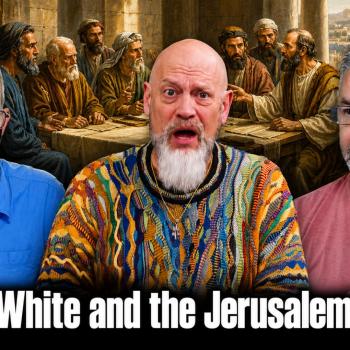
Jerusalem Council vs. James White & Sola Scriptura
Biblical Evidence for Catholicism
Biblical Perspicuity: Absurd Anti-Catholic "Defense"
Biblical Evidence for Catholicism
TRENDING AT PATHEOS Catholic

Prioritizing Jesus This Advent
Miller’s Station UMC| 29 November 2026| Mathew 19:16-27 When we prioritize Jesus,...

A Subtle Indicator of Legalism
Legalism was invented by pastors who don’t want to be woken up...
The Two Advents of the Babe and the...
We just celebrated the great family holiday of Thanksgiving and after going...

What are your dreams trying to tell you?...
Dreams can seem crazy. You’re suddenly with a person you haven’t seen...

Advent Begins in the Waiting: Preparing for Jesus
The Christmas season seems to arrive earlier every year. Before Halloween decorations...

As was predicted many years ago, the Interpreter Foundation's website is...
view all Catholic blogs
Ad-Free & Subscriber Log-In Subscription Support
- About Us
- 2026 Calendar
- Videos
- Podcasts
- Library of World Religions
- Faith In Media Tracker
- Advertise With Us
- Write for Us
- Privacy Policy
- Terms of Service
- Do Not Sell My Data
- Contact Us
- Radiant Digital
- Manage Newsletter Subscriptions
- Unsubscribe From Notifications
- Sitemap
Copyright 2008-2026, Patheos, part of the Radiant Digital network of media brands. All rights reserved.
Subscription Support Ad-Free & Subscriber Log-In
Follow Patheos