
BuddhistCatholicContemplativeEvangelicalGeneral ChristianHinduJewishLatter-day SaintMuslimNew VisionsProgressive Christian
Beliefs
- Buddhist
- Catholic
- Contemplative
- Evangelical
- General Christian
- Hindu
- Jewish
- Latter-day Saint
- More Voices
- Muslim
- New Visions
- Pagan
- Progressive Christian
Topics
- Religion News
- Food and Religion
- Sports and Religion
- Religious Art
- Religious Music and Entertainment
- Religious Events
- History and Religion
- Style and Religion
- Politics and Religion
- Women in Religion
- Recreation Outdoors and Religion
- Business Finance and Religion
- Careers Workplace and Religion
- Education and Religion
- Family Parenting and Religion
- Health Fitness and Religion
- Home and Religion
- Relationships and Religion
- Technology and Religion
- Travel and Religion
Columnists
- Buddhist Columnists
- Business Finance and Religion Columnists
- Careers Workplace and Religion Columnists
- Catholic Columnists
- Contemplative Columnists
- Education and Religion Columnists
- Evangelists Columnists
- Family Parenting and Religion Columnists
- General Christian Columnists
- Health Fitness and Religion Columnists
- Hindu Columnists
- History and Religion Columnists
- Home and Religion Columnists
- Jewish Columnists
- More Voices Columnists
- Latter Day Columnists
- Muslim Columnists
- New Visions Columnists
- Nonreligious Columnists
- Pagan Columnists
- Politics and Religion Columnists
- Progressive Columnists
- Recreation Outdoors and Religion Columnists
- Relationships and Religion Columnists
- Religion News Columnists
- Religious Art Columnists
- Religious Events Columnists
- Religious Music and Entertainment Columnists
- Sports and Religion Columnists
- Style and Religion Columnists
- Technology and Religion Columnists
- Travel and Religion Columnists
- Women in Religion Columnists
Resource Library
- 2026 Calendar
- Library of World Religions
- The 100 Most Holy Places on Earth
- Patheos Answers
- Podcasts
- Videos
- Faith Leaders Database
- Anglican Episcopalian
- Bahai
- Baptist
- Buddhism
- Christianity
- Confucianism
- Eastern Orthodoxy
- Hinduism
- Holiness and Pentecostal
- ISKCON
- Islam
- Judaism
- Lutheran
- Methodist
- The Church of Jesus Christ of Latter-day Saints
- New Age
- Paganism
- Presbytarian and Reformed
- Protestantism
- Religion Behind the Scenes
- Roman Catholic
- Scientology
- Shia Islam
- Sikhism
- Sufism
- Sunni Islam
- Taoism
- Zen
- See all religions
Research Tools
 Ad-Free & Subscriber Log-In Subscription Support
Follow Patheos 

- Trending:
- Advent
- |
- Forgiveness
- |
- Thanksgiving
- |
- Election
- |
- Seasonal Holidays
- |
- Marriage

-
About
-
Catholic Apologetics
-
Church History
-
Great Apologists
-
Christian Worldview
-
Protestantism & Misc.
- Home
- Catholic
- History and Religion
- Communitarian Aspects of Catholic Worship at Mass
Communitarian Aspects of Catholic Worship at Mass
Last updated on: June 6, 2026 at 12:32 am by Dave Armstrong
Communitarian Aspects of Catholic Worship at Mass 2026-06-06T00:32:48-04:00 Dave Armstrong
Patheos Explore the world's faith through different perspectives on religion and spirituality! Patheos has the views of the prevalent religions and spiritualities of the world.
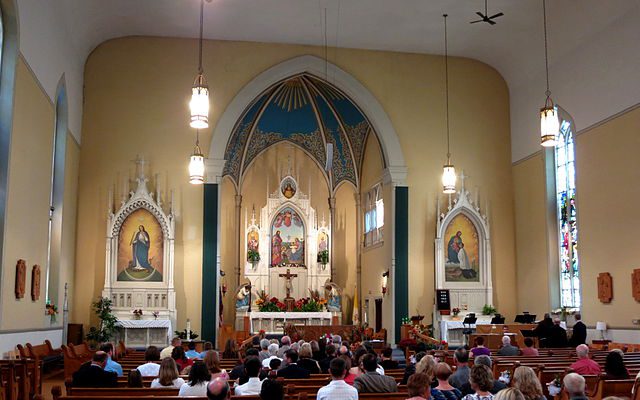
Holy Family Catholic Church (Oldenburg, Indiana). Photo by “Nheyob” (9-21-13) [Wikimedia Commons / Creative Commons Attribution-Share Alike 3.0 Unported license]

***
(11-29-07)
***
A Catholic woman asked some questions and was critical of certain statements made by CHNI (probably Marcus Grodi). Here was my response. Her words will be paraphrased and in blue.
* * * * *
When I go to Mass (so I have been taught), it is just God and myself, and no one else.
Obviously, the others who are there exist, too! The Church was meant to be a community. Take, for example, the Last Supper, our model for the Holy Eucharist, and in fact, the literal beginning of that rite, which is, of course central to the Mass. It wouldn’t make sense that it was only He and John present, or He and Peter, etc. No; He was there with all twelve disciples. It was a Passover meal, after all, which was certainly a communal, family event. hence, Jesus said (to all the disciples): “I have earnestly desired to eat this passover with you before I suffer” (Luke 22:15; RSV)
I’m not there to talk to other parishioners, but to God.
During the Mass, that is certainly true. But that doesn’t mean it is not a community, with all doing the liturgy and offering the Sacrifice of the Mass together with the priest.
It is a vertical relationship of myself and God, as opposed to a “communal gathering.” I join my prayer with that of others in those parts of the Mass where all participate, but it is essentially “He and I.”
I don’t understand why you draw this distinction, since you deny that it is a “communal gathering” yet you join your prayers with those of the priest and laypeople present. Isn’t that a contradiction? It’s not just “Jesus and Me” in the Mass: it is the communal sense of “Jesus and His Church; His Bride.” It is the Church that gathers, not a collection of atomistic individuals, who happen to be there together at that particular time.
“Praying in community” is not a Catholic notion and shouldn’t be forced on Catholics. We reply as a “family of God” only when we respond to the priest’s prayers.
The Mass necessarily involves a collective, communitarian sense. It is indeed the entire congregation offering the Mass together. The priest presides, but he is not the only one making the offering. The Catechism of the Catholic Church makes this quite clear in many entries (my bolded emphases added):
1352 The anaphora: with the Eucharistic Prayer – the prayer of thanksgiving and consecration – we come to the heart and summit of the celebration:
In the preface, the Church gives thanks to the Father, through Christ, in the Holy Spirit, for all his works: creation, redemption, and sanctification. The whole community thus joins in the unending praise that the Church in heaven, the angels and all the saints, sing to the thrice-holy God.
1353 In the epiclesis, the Church asks the Father to send his Holy Spirit (or the power of his blessing) on the bread and wine, so that by his power they may become the body and blood of Jesus Christ and so that those who take part in the Eucharist may be one body and one spirit (some liturgical traditions put the epiclesis after the anamnesis). [first part]
1354 In the anamnesis that follows, the Church calls to mind the Passion, resurrection, and glorious return of Christ Jesus; she presents to the Father the offering of his Son which reconciles us with him.
In the intercessions, the Church indicates that the Eucharist is celebrated in communion with the whole Church in heaven and on earth, the living and the dead, and in communion with the pastors of the Church, the Pope, the diocesan bishop, his presbyterium and his deacons, and all the bishops of the whole world together with their Churches.
1357 We carry out this command of the Lord by celebrating the memorial of his sacrifice. In so doing, we offer to the Father what he has himself given us: the gifts of his creation, bread and wine which, by the power of the Holy Spirit and by the words of Christ, have become the body and blood of Christ. Christ is thus really and mysteriously made present.
1359 The Eucharist, the sacrament of our salvation accomplished by Christ on the cross, is also a sacrifice of praise in thanksgiving for the work of creation. In the Eucharistic sacrifice the whole of creation loved by God is presented to the Father through the death and the Resurrection of Christ. Through Christ the Church can offer the sacrifice of praise in thanksgiving for all that God has made good, beautiful, and just in creation and in humanity.
1360 The Eucharist is a sacrifice of thanksgiving to the Father, a blessing by which the Church expresses her gratitude to God for all his benefits, for all that he has accomplished through creation, redemption, and sanctification. Eucharist means first of all “thanksgiving.”
1361 The Eucharist is also the sacrifice of praise by which the Church sings the glory of God in the name of all creation. This sacrifice of praise is possible only through Christ: he unites the faithful to his person, to his praise, and to his intercession, so that the sacrifice of praise to the Father is offered through Christ and with him, to be acceptedin him.
1368 The Eucharist is also the sacrifice of the Church. The Church which is the Body of Christ participates in the offering of her Head. With him, she herself is offered whole and entire. She unites herself to his intercession with the Father for all men. In the Eucharist the sacrifice of Christ becomes also the sacrifice of the members of his Body. The lives of the faithful, their praise, sufferings, prayer, and work, are united with those of Christ and with his total offering, and so acquire a new value. Christ’s sacrifice present on the altar makes it possible for all generations of Christians to be united with his offering.
In the catacombs the Church is often represented as a woman in prayer, arms outstretched in the praying position. Like Christ who stretched out his arms on the cross, through him, with him, and in him, she offers herself and intercedes for all men.
1369 The whole Church is united with the offering and intercession of Christ. . . . The community intercedes also for all ministers who, for it and with it, offer the Eucharistic sacrifice: [partial]
1370 To the offering of Christ are united not only the members still here on earth, but also those already in the glory of heaven. In communion with and commemorating the Blessed Virgin Mary and all the saints, the Church offers the Eucharistic sacrifice. In the Eucharist the Church is as it were at the foot of the cross with Mary, united with the offering and intercession of Christ.
Individual prayer, praise, and thanksgiving to God at various times in the Mass is fine, during periods of silence and meditation. Otherwise, we are urged to actively participate in the entire Mass, and not to be passive “spectators” or recipients. I’m not saying you aren’t participating; you clearly are, in profound ways. I’m simply disagreeing that it is not a community offering at Mass.
Protestants gather for “community prayer” because they have only the Bible and the Holy Spirit, but not the eucharistic Jesus substantially present, as we do.
Perhaps it is largely a semantic difference. I’m not denying the personal time of communion between a Catholic and and their Lord at Mass. But I think you shouldn’t deny, either, the communal aspects of the Mass. Even the Lord’s Prayer is communal: it is offered in the plural:
Our Father . . . give us this day our daily bread. . . forgive us our trespasses, as we forgive those who trespass against us . . . lead us not into temptation, but deliver us from evil . . .
There are plenty of singular prayers in the Psalms (many from David). But when Jesus taught us to pray, it was in this communal, group sense. I think that is highly significant.
My point is that the Mass is a communitarian effort insofar as the congregation actually participate in the offering. The Catechism makes this very clear. I think we’re just pointing out different aspects that complement, not contradict each other.
The Catechism shows that “community” is not “non-Catholic” at all. It’s not a liberal idea (though the liberals in the Church have clearly abused it, just like they do everything else), as you appeared to me to imply; it is an apostolic tradition idea and a Bible idea. That is where I saw that your analysis went too far, in my opinion. But most of what you expressed is fine. It’s a “both/and” scenario, not “either/or.”
I despise theological liberalism. I have a web page about it and a portion of one of my books devoted to this extremely serious error. The present issue, however, is not, I think, one having to do with any liberal or dissident notions. We mustn’t fall into the “guilt by association” fallacy. Maybe your parish has some goofy stuff going on, but that doesn’t mean we should throw out the baby with the bath water. Can we agree that what you are stressing and what I am stressing are both true?
Previous Post
May 2, 2017
Catholic Converts' Qualms: Mariology, Formal Worship, Etc.
Next Post

May 3, 2017 Is God Alone Holy, According to Scripture? Or Can We Be Too?
Browse Our Archives
Select a Category & Last Things About Me Anti-Catholicism Atheism & Agnosticism Baptism and Sacramentalism Bible and Tradition Blessed Virgin Mary Books by Dave Armstrong C. S. Lewis Calvinism & General Protestantism Catholic Apologetics Catholic Apologists Catholic conversion Catholic converts Christmas Church (Ecclesiology) Church History Conversion and Converts Development of Doctrine Eastern Orthodoxy Ecumenism & Christian Unity Eucharist & Liturgy Fathers of the Church French Translations G. K. Chesterton Hell Hell & Satan Hell & Satan & Last Things Heresies & Comparative Religion Holistic Health Inquisition & Crusades & Scandals James White Jews & Judaism & Old Testament John Calvin John Henry Newman Liberal / Modernist Theology Life Issues Literary Resume Lutheranism Mariology Martin Luther Music Orthodoxy Papacy & Infallibility Personal Page Philosophy & Science Political & Ethical & Moral Issues Protestant Persecution & Intolerance Protestantism Purgatory Purgatory & Penance Romantic & Imaginative Theology Saints & Purgatory & Penance Salvation Salvation & Justification Satan & Last Things Sexuality and Gender Issues Spanish Translations Traditionalism vs. Radical Catholic Reactionaries Traducciones al español / tradução para português Trinitarianism & Christology Uncategorized Videos
Select a Month November 2026 October 2026 September 2026 August 2026 July 2026 June 2026 May 2026 April 2026 March 2026 February 2026 January 2026 December 2025 November 2025 October 2025 September 2025 August 2025 July 2025 June 2025 May 2025 April 2025 March 2025 February 2025 January 2025 December 2024 November 2024 October 2024 September 2024 August 2024 July 2024 June 2024 May 2024 April 2024 March 2024 February 2024 January 2024 December 2023 November 2023 October 2023 September 2023 August 2023 July 2023 June 2023 May 2023 April 2023 March 2023 February 2023 January 2023 December 2022 November 2022 October 2022 September 2022 August 2022 July 2022 June 2022 May 2022 April 2022 March 2022 February 2022 January 2022 December 2021 November 2021 October 2021 September 2021 August 2021 July 2021 June 2021 May 2021 April 2021 March 2021 February 2021 January 2021 December 2020 November 2020 October 2020 September 2020 August 2020 July 2020 June 2020 May 2020 April 2020 March 2020 February 2020 January 2020 December 2019 November 2019 October 2019 September 2019 August 2019 July 2019 June 2019 May 2019 April 2019 March 2019 February 2019 January 2019 December 2018 November 2018 October 2018 September 2018 August 2018 July 2018 June 2018 May 2018 April 2018 March 2018 February 2018 January 2018 December 2017 November 2017 October 2017 September 2017 August 2017 July 2017 June 2017 May 2017 April 2017 March 2017 February 2017 January 2017 December 2016 November 2016 October 2016 September 2016 August 2016 July 2016 June 2016 May 2016 April 2016 March 2016 February 2016 January 2016 December 2015 November 2015 October 2015 September 2015 August 2015 July 2015 June 2015 May 2015 April 2015 March 2015 February 2015 January 2015 December 2014 November 2014 October 2014 September 2014 August 2014 July 2014 June 2014 April 2014 March 2014 February 2014 January 2014 December 2013 November 2013 October 2013 September 2013 August 2013 July 2013 June 2013 April 2013 March 2013 February 2013 January 2013 December 2012 November 2012 October 2012 September 2012 August 2012 July 2012 June 2012 May 2012 April 2012 March 2012 February 2012 January 2012 December 2011 November 2011 October 2011 September 2011 August 2011 July 2011 June 2011 April 2011 March 2011 February 2011 October 2010 September 2010 August 2010 July 2010 April 2010 March 2010 December 2009 October 2009 August 2009 July 2009 June 2009 May 2009 March 2009 February 2009 October 2008 September 2008 April 2008 March 2008 February 2008 January 2008 December 2007 November 2007 October 2007 May 2007 March 2007 February 2007 January 2007 November 2006 October 2006 September 2006 August 2006 July 2006 June 2006 May 2006 April 2006 March 2006 February 2006 October 2005 June 2005 April 2005 February 2005 July 2004 May 2004 April 2004
Follow Us!
TAKE THE
Religious Wisdom Quiz
What mountain was the site of Elijah's showdown with Baal's prophets?
Select your answer to see how you score.
Mount Hermon Mount Carmel Mount Sinai Mount Tabor
Books by This Author Books by Dave Armstrong
Related posts from Biblical Evidence for Catholicism
The Mass & Development of Doctrine (vs. Wes...
Biblical Evidence for Catholicism
Miraculous Eucharist (vs. Francois Turretin #4)
Biblical Evidence for Catholicism
God's Presence, the Ark, the Eucharist, & Death
Biblical Evidence for Catholicism
Protestant Eucharistic Objections Fail (Turretin)
Biblical Evidence for Catholicism
TRENDING AT PATHEOS Catholic

Smart people saying smart things (11.24.26)
Please take time to listen to Perry Bacon, Sarah Posner, Adam Serwer,...

The Contingency of Our Technology
Last week we were hit with a raft of massive technology outages....

In 1939, President Franklin D. Roosevelt moved Thanksgiving from November 30 to...

Reasons for Restraint: Ricardo Gonzalez, Florida and Dec...
The Morning of January 3 I begin with the dead. On the...

I published this column for Thanksgiving 2012 in the Deseret News....

For many years, Catholicism has been caught up in division over the...
view all Catholic blogs
Ad-Free & Subscriber Log-In Subscription Support
- About Us
- 2026 Calendar
- Videos
- Podcasts
- Library of World Religions
- Faith In Media Tracker
- Advertise With Us
- Write for Us
- Privacy Policy
- Terms of Service
- Do Not Sell My Data
- Contact Us
- Radiant Digital
- Manage Newsletter Subscriptions
- Unsubscribe From Notifications
- Sitemap
Copyright 2008-2026, Patheos, part of the Radiant Digital network of media brands. All rights reserved.
Subscription Support Ad-Free & Subscriber Log-In
Follow Patheos