
BuddhistCatholicContemplativeEvangelicalGeneral ChristianHinduJewishLatter-day SaintMuslimNew VisionsProgressive Christian
Beliefs
- Buddhist
- Catholic
- Contemplative
- Evangelical
- General Christian
- Hindu
- Jewish
- Latter-day Saint
- More Voices
- Muslim
- New Visions
- Pagan
- Progressive Christian
Topics
- Religion News
- Food and Religion
- Sports and Religion
- Religious Art
- Religious Music and Entertainment
- Religious Events
- History and Religion
- Style and Religion
- Politics and Religion
- Women in Religion
- Recreation Outdoors and Religion
- Business Finance and Religion
- Careers Workplace and Religion
- Education and Religion
- Family Parenting and Religion
- Health Fitness and Religion
- Home and Religion
- Relationships and Religion
- Technology and Religion
- Travel and Religion
Columnists
- Buddhist Columnists
- Business Finance and Religion Columnists
- Careers Workplace and Religion Columnists
- Catholic Columnists
- Contemplative Columnists
- Education and Religion Columnists
- Evangelists Columnists
- Family Parenting and Religion Columnists
- General Christian Columnists
- Health Fitness and Religion Columnists
- Hindu Columnists
- History and Religion Columnists
- Home and Religion Columnists
- Jewish Columnists
- More Voices Columnists
- Latter Day Columnists
- Muslim Columnists
- New Visions Columnists
- Nonreligious Columnists
- Pagan Columnists
- Politics and Religion Columnists
- Progressive Columnists
- Recreation Outdoors and Religion Columnists
- Relationships and Religion Columnists
- Religion News Columnists
- Religious Art Columnists
- Religious Events Columnists
- Religious Music and Entertainment Columnists
- Sports and Religion Columnists
- Style and Religion Columnists
- Technology and Religion Columnists
- Travel and Religion Columnists
- Women in Religion Columnists
Resource Library
- 2026 Calendar
- Library of World Religions
- The 100 Most Holy Places on Earth
- Patheos Answers
- Podcasts
- Videos
- Faith Leaders Database
- Anglican Episcopalian
- Bahai
- Baptist
- Buddhism
- Christianity
- Confucianism
- Eastern Orthodoxy
- Hinduism
- Holiness and Pentecostal
- ISKCON
- Islam
- Judaism
- Lutheran
- Methodist
- The Church of Jesus Christ of Latter-day Saints
- New Age
- Paganism
- Presbytarian and Reformed
- Protestantism
- Religion Behind the Scenes
- Roman Catholic
- Scientology
- Shia Islam
- Sikhism
- Sufism
- Sunni Islam
- Taoism
- Zen
- See all religions
Research Tools
 Ad-Free & Subscriber Log-In Subscription Support
Ad-Free & Subscriber Log-In Subscription Support
Follow Patheos 

- Trending:
- Forgiveness
- |
- Marriage
- |
- Consciousness
- |
- Death Penalty
- |
- Election
- |
- Halloween

-
About
-
Catholic Apologetics
-
Church History
-
Great Apologists
-
Christian Worldview
-
Protestantism & Misc.
- Home
- Catholic
- History and Religion
- Peter the Rock: Protestant Contra-Catholic Exegetical Bias
Peter the Rock: Protestant Contra-Catholic Exegetical Bias
Last updated on: June 6, 2026 at 12:32 am by Dave Armstrong
Peter the Rock: Protestant Contra-Catholic Exegetical Bias 2026-06-06T00:32:07-04:00 Dave Armstrong
Patheos Explore the world's faith through different perspectives on religion and spirituality! Patheos has the views of the prevalent religions and spiritualities of the world.
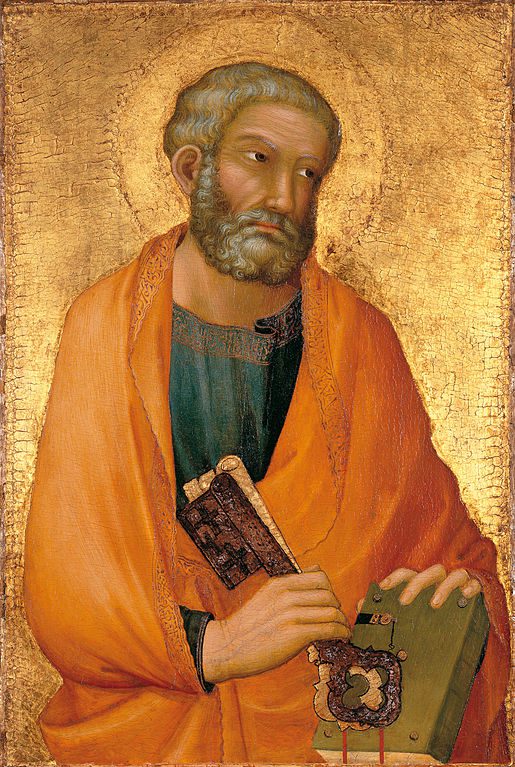
St. Peter (1326), by Simone Martini (1285-1344) [public domain / Wikimedia Commons]

***
(7-7-09)
***
Matthew 16:18 (RSV) And I tell you, you are Peter, and on this rock I will build my church, and the powers of death shall not prevail against it.
This curious phenomenon was one of the central themes of my book, The Catholic Verses (2004). I wrote in its Introduction:
No one comes to the Bible as a completely impartial and objective “observer” or reader. We all approach it, whether consciously or unconsciously, with some sort of preexisting theology, or at least a disposition towards a certain viewpoint. It is impossible not to do this. It is part of the very nature of the thinking process. . . .
I shall contend throughout this book that — far too often — Protestants do not take all of Scripture into account, and that they are guilty of eisegesis (reading into Scripture one’s own presuppositions), or seriously erroneous exegesis, at least as often as Catholics are, if not more frequently. . . .
I hasten to add – and emphasize to the greatest degree – that these tendencies of bias and subjectivism and subconscious influence of denominational traditions do not necessarily entail a deliberate attempt to ignore or to twist Scripture. Every serious student of the Bible comes to the biblical text with a theological framework, in order to interpret it and make sense of it in its entirety. This is proper and right, and no one should have any objection to it. . . .
. . . without questioning (at all) the sincerity or integrity of Protestants, I shall now proceed to offer a critique of common Protestant attempts to ignore, explain away, rationalize, wish away, over-polemicize, minimize, de-emphasize, evade clear consequences of, or special plead with regard to “the Catholic Verses”: 95 biblical passages.
In Chapter Four, on the papacy, I commented specifically on historic Protestant exegesis of Matthew 16:18-19:
Many Protestants are uncomfortable with Matthew 16:18-19, first because of its extraordinary implications for St. Peter’s preeminence as the supreme earthly head of the Church, or Pope; which he was appointed by our Lord Jesus himself. The Church, according to Jesus (and in the Catholic view), is built upon Peter. In the figure and leadership of Peter in the Bible, the Catholic Church sees a primitive (later highly developed) model for Church government and papal headship. (pp. 55-56)
Historically, the standard polemical response of Protestants to the phraseology of rock was to contend that it referred only to Peter’s faith, not Peter himself. In that way, the institutional element of the charge from the Lord to St. Peter is avoided. If faith is the exclusive key to the meaning, then Peter can be viewed as merely a representative of a general principle, rather than unique in the sense of institutional, concrete leadership and jurisdiction. (p. 56)
Somewhat surprisingly, the consensus among Protestant commentators today (including such eminent scholars such as R. T. France, D. A. Carson, William Hendriksen, Gerhard Maier, and Craig L. Blomberg), is that rock indeed refers to Peter himself, not his faith. They try to evade any further “Catholic” implication, though, by denying the notion of papal succession — that Peter as rock applies to Peter alone. (pp. 57-58)
Here we are concerned with St. Peter as the proclaimed leader of the Church. The finer points and particulars of such an office require another discussion entirely. Scarcely any biblical passages contain a fully developed doctrine. That is as true of the papacy and ecclesiology as it is of any Christian theological construct. (p. 58)
Situations like this usually arise when the Catholic exegetical argument is (quite arguably) superior to any Protestant alternative, and when (as in the present instance) the basic Catholic contention has become the consensus position of prominent biblical commentators across the board:
Though in the past some authorities have considered that the term rock refers to Jesus himself or to Peter’s faith, the consensus of the great majority of scholars today is that the most obvious and traditional understanding should be construed, namely, that rock refers to the person of Peter.
(Encyclopaedia Britannica, 1985 edition, “Peter,” Micropedia, vol. 9, 330-333. D. W. O’Connor, the author of the article, is himself Protestant and author of Peter in Rome: The Literary, Liturgical and Archaeological Evidence [1969] )
Catholics have been contending all along that Peter himself was the “rock”: not his confession of faith; nor Jesus Himself. Now it is widely accepted that this is indeed what the passage teaches. But for centuries, many (most?) Protestant commentators denied this, and it looks they did so primarily due to mere polemical reaction against the Catholic claim and Catholic dogmatic beliefs about the papacy, in part built upon this passage.
This is not just my opinion, but that of several prominent Protestant exegetes, past and present, as I will now demonstrate. These eminent Bible scholars maintain that the passage is very clear, and was only interpreted otherwise out of polemical reaction to the Catholic exegesis. If this can occur (rather strikingly) with regard to Matthew 16:18, who knows how prevalent the same tendency has been elsewhere in Protestant exegesis, wherever issues arise that are key to the Protestant-Catholic dispute?
Ironically, while Catholics are routinely accused of eisegesis, it looks like Protestants have committed quite a bit of it themselves, in their rush to distance themselves from Catholic exegetical viewpoints. To “prove” that a passage has no “Catholic” implications whatsoever, many Protestant commentators have been quite willing to special plead and engage in outright eisegesis. I provided dozens of examples of this in The Catholic Verses. Here I need only cite Protestants chastising fellow Protestant commentators, to prove my point that it occurred:
Another interpretation is, that the word rock refers to Peter himself. This is the obvious meaning of the passage; and had it not been that the church of Rome has abused it, and applied it to what was never intended, no other would have been sought for.
(Presbyterian Albert Barnes, Barnes’ Notes on the New Testament, Philadelphia: 1832; see larger excerpt)
The application of the promise to St. Peter has been elaborately impugned by Dr. Wordsworth. His zeal to appropriate the rock to Christ has somewhat overshot itself. In arguing that the term can apply to none but God, he will find it difficult surely to deny all reference to a rock in the name Peter. To me, it is equally difficult, nay, impossible, to deny all reference, in “upon this rock,” to the preceding word Peter. Let us keep to the plain straightforward sense of Scripture, however that sense may have been misused by Rome.
(Anglican Henry Alford, The New Testament for English Readers, four volumes, London: Rivingtons, 1868; reprinted by Baker Publishing Group, 1983, Vol. 1, p. 319; see larger excerpt)
As Peter means rock, the natural interpretation is that ‘upon this rock’ means upon thee. No other explanation would probably at the present day be attempted, but for the fact that the obvious meaning has been abused by Papists to the support of their theory. But we must not allow the abuse of a truth to turn us away from its use; nor must the convenience of religious controversy determine our interpretation of Scripture teaching. (p. 355)
The Protestant reluctance to admit that the rock means Peter really plays into the hands of the Romish controversialists. It favors the impression that conceding that point would be conceding all that the Romanist claims . . . Now to take Peter as the rock is certainly the most natural and obvious meaning. And to make this the life or death issue is to give the Romanist a serious polemical advantage. In general, it is a great principle of Biblical interpretation to take the most obvious meaning of any phrase, unless it would thus yield a sense hopelessly in conflict with the unambiguous teaching of other passages. (p. 357)
(Baptist John Albert Broadus, Commentary on Matthew, 1886; reprinted by Grand Rapids, Michigan: Kregel Classics, 1990; see larger excerpt)
In view of the background of verse 19 . . . one must dismiss as confessional interpretation any attempt to see this rock as meaning the faith, or the Messianic confession of Peter.
(Methodist William F. Albright, and C.S. Mann, Anchor Bible, Garden City, New York: Doubleday, 1971, Vol. 26, 195, 197-198)
Attempts to interpret the “rock” as something other than Peter in person (e.g., his faith, the truth revealed to him) are due to Protestant bias, and introduce to the statement a degree of subtlety which is highly unlikely.
(Presbyterian David Hill, “The Gospel of Matthew,” in Ronald E. Clements and Matthew Black, editors, The New Century Bible Commentary: London: Marshall, Morgan & Scott, 1972, 261)
On the basis of the distinction between ‘petros’ . . . and ‘petra’ . . . , many have attempted to avoid identifying Peter as the rock on which Jesus builds his church. Peter is a mere ‘stone,’ it is alleged; but Jesus himself is the ‘rock’ . . . Others adopt some other distinction . . . Yet if it were not for Protestant reactions against extremes of Roman Catholic interpretation, it is doubtful whether many would have taken ‘rock’ to be anything or anyone other than Peter . . .
(Baptist D. A. Carson; in Frank E. Gaebelein, general editor, Expositor’s Bible Commentary, Grand Rapids, Michigan: Zondervan, 1984, vol. 8: Matthew, Mark, Luke [Matthew: D. A. Carson], 368)
It is only Protestant overreaction to the Roman Catholic claim . . . that what is here said of Peter applies also to the later bishops of Rome, that has led some to claim that the ‘rock’ here is not Peter at all but the faith which he has just confessed. The word-play, and the whole structure of the passage, demands that this verse is every bit as much Jesus’ declaration about Peter as v.16 was Peter’s declaration about Jesus . . . It is to Peter, not to his confession, that the rock metaphor is applied . . . Peter is to be the foundation-stone of Jesus’ new community . . . which will last forever.
(Anglican R. T. France; in Leon Morris, general editor, Tyndale New Testament Commentaries, Leicester, England: Inter-Varsity Press / Grand Rapids, Michigan: Eerdmans Pub. Co., 1985, Vol. 1: Matthew, 254, 256)
The frequent attempts that have been made, largely in the past, to deny this in favor of the view that the confession itself is the rock (e.g., most recently Caragounis) seem to be largely motivated by Protestant prejudice against a passage that is used by the Roman Catholics to justify the papacy.
(Presbyterian Donald A. Hagner, “Matthew 14-28,” in David A. Hubbard and others, editors, World Biblical Commentary, vol. 33b; Dallas: Word Books, 1995, 470)
See also the excellent, copiously documented article by fellow Catholic apologist Nicholas Hardesty: Protestant Scholars on Mt 16:16-19.
*****
Meta Description: Protestant commentators have traditionally denied that Peter was the rock: oftentimes due to mere polemical reaction against the Catholic claim.
Meta Keywords: apostolic succession, Bible & Papacy, biblical authority, canon of Scripture, ecclesiology, papacy, Petrine primacy, popes, primacy of Rome, Rule of Faith, Sola Scriptura, St. Peter, Protestant exegesis. exegesis & anti-Catholicism, exegetical bias
Protestant exegesis. exegesis & anti-Catholicism
Previous Post
October 18, 2016
Relation of Baptism to Baptism of Desire
Next Post

November 2, 2016 Dialogue on 2016 Presidential Polls (Outliers, Accuracy, Etc.)
Browse Our Archives
Select a Category & Last Things About Me Anti-Catholicism Atheism & Agnosticism Baptism and Sacramentalism Bible and Tradition Blessed Virgin Mary Books by Dave Armstrong C. S. Lewis Calvinism & General Protestantism Catholic Apologetics Catholic Apologists Catholic conversion Catholic converts Christmas Church (Ecclesiology) Church History Conversion and Converts Development of Doctrine Eastern Orthodoxy Ecumenism & Christian Unity Eucharist & Liturgy Fathers of the Church French Translations G. K. Chesterton Hell Hell & Satan Hell & Satan & Last Things Heresies & Comparative Religion Holistic Health Inquisition & Crusades & Scandals James White Jews & Judaism & Old Testament John Calvin John Henry Newman Liberal / Modernist Theology Life Issues Literary Resume Lutheranism Mariology Martin Luther Music Orthodoxy Papacy & Infallibility Personal Page Philosophy & Science Political & Ethical & Moral Issues Protestant Persecution & Intolerance Protestantism Purgatory Purgatory & Penance Romantic & Imaginative Theology Saints & Purgatory & Penance Salvation Salvation & Justification Satan & Last Things Sexuality and Gender Issues Spanish Translations Traditionalism vs. Radical Catholic Reactionaries Traducciones al español / tradução para português Trinitarianism & Christology Uncategorized Videos
Select a Month October 2026 September 2026 August 2026 July 2026 June 2026 May 2026 April 2026 March 2026 February 2026 January 2026 December 2025 November 2025 October 2025 September 2025 August 2025 July 2025 June 2025 May 2025 April 2025 March 2025 February 2025 January 2025 December 2024 November 2024 October 2024 September 2024 August 2024 July 2024 June 2024 May 2024 April 2024 March 2024 February 2024 January 2024 December 2023 November 2023 October 2023 September 2023 August 2023 July 2023 June 2023 May 2023 April 2023 March 2023 February 2023 January 2023 December 2022 November 2022 October 2022 September 2022 August 2022 July 2022 June 2022 May 2022 April 2022 March 2022 February 2022 January 2022 December 2021 November 2021 October 2021 September 2021 August 2021 July 2021 June 2021 May 2021 April 2021 March 2021 February 2021 January 2021 December 2020 November 2020 October 2020 September 2020 August 2020 July 2020 June 2020 May 2020 April 2020 March 2020 February 2020 January 2020 December 2019 November 2019 October 2019 September 2019 August 2019 July 2019 June 2019 May 2019 April 2019 March 2019 February 2019 January 2019 December 2018 November 2018 October 2018 September 2018 August 2018 July 2018 June 2018 May 2018 April 2018 March 2018 February 2018 January 2018 December 2017 November 2017 October 2017 September 2017 August 2017 July 2017 June 2017 May 2017 April 2017 March 2017 February 2017 January 2017 December 2016 November 2016 October 2016 September 2016 August 2016 July 2016 June 2016 May 2016 April 2016 March 2016 February 2016 January 2016 December 2015 November 2015 October 2015 September 2015 August 2015 July 2015 June 2015 May 2015 April 2015 March 2015 February 2015 January 2015 December 2014 November 2014 October 2014 September 2014 August 2014 July 2014 June 2014 April 2014 March 2014 February 2014 January 2014 December 2013 November 2013 October 2013 September 2013 August 2013 July 2013 June 2013 April 2013 March 2013 February 2013 January 2013 December 2012 November 2012 October 2012 September 2012 August 2012 July 2012 June 2012 May 2012 April 2012 March 2012 February 2012 January 2012 December 2011 November 2011 October 2011 September 2011 August 2011 July 2011 June 2011 April 2011 March 2011 February 2011 October 2010 September 2010 August 2010 July 2010 April 2010 March 2010 December 2009 October 2009 August 2009 July 2009 June 2009 May 2009 March 2009 February 2009 October 2008 September 2008 April 2008 March 2008 February 2008 January 2008 December 2007 November 2007 October 2007 May 2007 March 2007 February 2007 January 2007 November 2006 October 2006 September 2006 August 2006 July 2006 June 2006 May 2006 April 2006 March 2006 February 2006 October 2005 June 2005 April 2005 February 2005 July 2004 May 2004 April 2004
Follow Us!
TAKE THE
Religious Wisdom Quiz
How did Jesus heal the mute and deaf man in Decapolis?
Select your answer to see how you score.
Anointed his head Gave bread Put fingers in ears and touched tongue Said "Go in peace"
Books by This Author Books by Dave Armstrong
Related posts from Biblical Evidence for Catholicism

Was Peter "Any Old" Apostle? 10 Anti-Papal Arguments
Biblical Evidence for Catholicism

Jesus Founded the [Catholic] Church. If Not Him,...
Biblical Evidence for Catholicism

Deuterocanon & Javier Perdomo's Straw Men
Biblical Evidence for Catholicism

St. Athanasius & the Deuterocanon (vs. Javier Perdomo)
Biblical Evidence for Catholicism
TRENDING AT PATHEOS Catholic

Emotion in Early Christianity by Andrew Crislip
Andrew Crislip’s Emotion in Early Christianity examines an often overlooked dimension of...

16 Spiritual Touchstones for a More Grounded Life
After decades of spiritual study, here are 16 principles I try...

Catholic Evangelization: Sharing Your Faith Every Day
Welcome back to the Graceful Awakening mini-series called, “From Faith to Mission.” ...

The Pillar of the Boatmen: the Ancient Monument...
The Pillar of the Boatmen is a Romano-Gaulish sculpture that dates from...

In one sense walking into Westminster Abbey is like walking down the...

'Super Scam Me' Exposes AI Jon Bon Jovi...
Leslie Pickett believed she was in a relationship with Jon Bon Jovi....
view all Catholic blogs
Ad-Free & Subscriber Log-In Subscription Support
- About Us
- 2026 Calendar
- Videos
- Podcasts
- Library of World Religions
- Faith In Media Tracker
- Advertise With Us
- Write for Us
- Privacy Policy
- Terms of Service
- Do Not Sell My Data
- Contact Us
- Radiant Digital
- Manage Newsletter Subscriptions
- Unsubscribe From Notifications
- Sitemap
Copyright 2008-2026, Patheos. All rights reserved.
Subscription Support Ad-Free & Subscriber Log-In
Follow Patheos