
BuddhistCatholicContemplativeEvangelicalGeneral ChristianHinduJewishLatter-day SaintMuslimNew VisionsProgressive Christian
Beliefs
- Buddhist
- Catholic
- Contemplative
- Evangelical
- General Christian
- Hindu
- Jewish
- Latter-day Saint
- More Voices
- Muslim
- New Visions
- Pagan
- Progressive Christian
Topics
- Religion News
- Food and Religion
- Sports and Religion
- Religious Art
- Religious Music and Entertainment
- Religious Events
- History and Religion
- Style and Religion
- Politics and Religion
- Women in Religion
- Recreation Outdoors and Religion
- Business Finance and Religion
- Careers Workplace and Religion
- Education and Religion
- Family Parenting and Religion
- Health Fitness and Religion
- Home and Religion
- Relationships and Religion
- Technology and Religion
- Travel and Religion
Columnists
- Buddhist Columnists
- Business Finance and Religion Columnists
- Careers Workplace and Religion Columnists
- Catholic Columnists
- Contemplative Columnists
- Education and Religion Columnists
- Evangelists Columnists
- Family Parenting and Religion Columnists
- General Christian Columnists
- Health Fitness and Religion Columnists
- Hindu Columnists
- History and Religion Columnists
- Home and Religion Columnists
- Jewish Columnists
- More Voices Columnists
- Latter Day Columnists
- Muslim Columnists
- New Visions Columnists
- Nonreligious Columnists
- Pagan Columnists
- Politics and Religion Columnists
- Progressive Columnists
- Recreation Outdoors and Religion Columnists
- Relationships and Religion Columnists
- Religion News Columnists
- Religious Art Columnists
- Religious Events Columnists
- Religious Music and Entertainment Columnists
- Sports and Religion Columnists
- Style and Religion Columnists
- Technology and Religion Columnists
- Travel and Religion Columnists
- Women in Religion Columnists
Resource Library
- 2026 Calendar
- Library of World Religions
- The 100 Most Holy Places on Earth
- Patheos Answers
- Podcasts
- Videos
- Faith Leaders Database
- Anglican Episcopalian
- Bahai
- Baptist
- Buddhism
- Christianity
- Confucianism
- Eastern Orthodoxy
- Hinduism
- Holiness and Pentecostal
- ISKCON
- Islam
- Judaism
- Lutheran
- Methodist
- The Church of Jesus Christ of Latter-day Saints
- New Age
- Paganism
- Presbytarian and Reformed
- Protestantism
- Religion Behind the Scenes
- Roman Catholic
- Scientology
- Shia Islam
- Sikhism
- Sufism
- Sunni Islam
- Taoism
- Zen
- See all religions
Research Tools
 Ad-Free & Subscriber Log-In Subscription Support
Ad-Free & Subscriber Log-In Subscription Support
Follow Patheos 

- Trending:
- Forgiveness
- |
- Marriage
- |
- Consciousness
- |
- Death Penalty
- |
- Election
- |
- Halloween

-
About
-
Catholic Apologetics
-
Church History
-
Great Apologists
-
Christian Worldview
-
Protestantism & Misc.
- Home
- Catholic
- History and Religion
- Protestantism Was NOT a Revolt?
Protestantism Was NOT a Revolt?
Last updated on: April 18, 2017 at 6:56 pm by Dave Armstrong
Protestantism Was NOT a Revolt? 2017-04-18T18:56:49-04:00 Dave Armstrong
Patheos Explore the world's faith through different perspectives on religion and spirituality! Patheos has the views of the prevalent religions and spiritualities of the world.
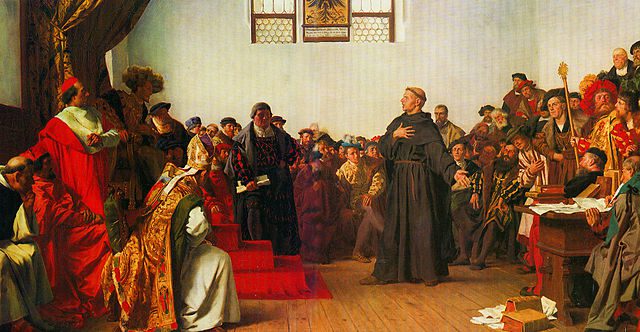
Luther at the Diet of Worms (1877), by Anton von Werner (1843-1915) [public domain / Wikimedia Commons]

***
[6-2-03; slightly revised on 12-8-11]
***
The so-called Protestant “Reformation” had to do with the abolition of five of seven sacraments, the move to sola Scriptura as the rule of faith over against an authoritative Church and councils and apostolic succession and episcopacy (and including a papacy as well), the ending of the Sacrifice of the Mass, the move away from transubstantiation, the ditching of purgatory, the end of baptismal regeneration among many Protestants, and even infant baptism in some camps.
*
It had to do with the cessation of the notion of the communion of saints and intercession of saints, and much of Mariology, and forensic, imputed justification vs. infused; the removal of seven previously accepted books from the Bible.
*
What does the corruption of the medieval papacy have to do with Luther’s adoption of double predestination and utter rejection of free will, or Calvinist iconoclasm or the suggestion from the highest Protestant quarters to Philip of Hesse that he lie about his bigamy; or the widespread early Protestant antipathy to philosophy and science and art? Etc., etc., etc.
*
To act as if the Protestant Revolt would not have happened but for medieval problems of schism and papal power is to ignore a host of other factors, as if they were non-contributors. It’s historically ludicrous. No Catholic who knows history at all will deny that that Catholic corruption was a major factor, but to claim that some reforms of the papacy would have prevented the so-called “Reformation” is a position which is well-nigh unprovable, given all that occurred during that turbulent time, and how many traditional Christian doctrines were ditched by the Protestants. There was far more going on here than merely the usual intrigues of church politics and power plays.
*
Some claim that there may not have been a “Reformation” if only the papacy had been reformed in the earlier Middle Ages. But what does getting rid of the papacy and episcopacy and apostolic succession have to do with a corrupt papacy? In other words, how does corruption lead to a conclusion of utter worthlessness, such that something can be discarded? Something is either intrinsically bad and evil or unbiblical or it is not.
*
If it were intrinsically a bad thing, then it wouldn’t take corruption to want to get rid of it (as an evil thing is already “corrupt” anyway). If it is not intrinsically bad, then the proper response is to reform it and get it back to where it should be, not banish and abolish it. Either way, it makes no sense. If the Papacy “per se” wasn’t the problem, why, then, was the papacy abolished in Protestantism? This is nonsensical, incoherent reasoning.
*
The “Reformation” was not that (it is a misnomer), but rather, a Revolution insofar as it departed from passed-down Christian Tradition, as I am demonstrating in a roundabout way. It was a Christian movement, but not a “reformation” of some so-called pure early church, because such an animal never existed (i.e., the early church did not remotely resemble any brand of Protestantism, which claimed to merely be restoring it — the literal meaning of “Reformation”). One can’t re-form something that never existed in any form.
*
The Catholic has as much right to call what happened a Revolt as the Protestant has to call it aReformation. I don’t choose terms of historical epochs based on partisan concerns. I would argue that “Revolt” is much more neutral, whereas “Reformation” presupposes in its very use and literal meaning a Protestant outlook. We deny that what Protestantism brought the world was a return to the early Church, so how can we use the term?
*
It has become a standard term just as Enlightenment has, but note how the latter is also thoroughly biased. All Christians can agree, however, that what happened in the 18th century was no “enlightenment” — a big light that went on in culture because Christian tenets were being rejected and the goddess of “reason” put in their place.
*
Dogmas and corruptions in practice are two different things. If indeed the papacy can be defended from the Bible alone, what effect does corruption fourteen centuries later have to do with that case? Even during the life of St. Paul, he was railing against the corrupt churches, yet still calling them (most interestingly) “churches.” Jesus did the same at the beginning of the book of Revelation. Thus, such a thing as a papacy can exist and be defended from Scripture and theological reasoning, whether it is corrupt or not. Corruption does not render something non-existent.
*
St. Catherine of Siena railed against corrupt popes every bit as much as Luther did. But she did it with intelligence, sanctity, and lack of foul-mouthed vulgarities and widely distributed woodcuts showing, e.g., the pope being expelled from the anus of a goat, etc. St. Catherine, after all, still believed in the papacy, whereas Luther had abandoned it because the Church was so brash and “closed-minded” as to refuse to adopt his heresies.
*
Let’s try an analogy to bring the point home. How about if I rush up to a Calvinist school (or Westminster Seminary or some place like that) and demand that they deny TULIP and if not, to show me from “Scripture and plain reason” how they can possibly defend their “clearly false” beliefs?
*
Failing that, I will stomp my foot, cry “here I stand” and be carried out by the staunch defenders of Established Orthodoxy, perhaps fleeing to a present-day Wartburg Castle in the backwoods of Maine, where I can come up with ideas for vulgar woodcuts of Calvin or R. C. Sproul being eliminated from the rear end of a grizzly bear. I’m sure I would be wildly popular in Calvinist circles, wouldn’t I?
***
Meta Description: Explanation of the basic Catholic outlook concerning what happened when Protestantism arose in the 16th century.
*
Meta Keywords: Luther, Martin Luther, founder of Protestantism, origin of Protestantism, Protestant Reformation, Reformation, Protestant reformers, Reformers, Lutheranism, religious wars, 16th century Germany, Protestant revolt, Protestant Revolution, 95 Theses, Here I stand, Diet of Worms, Philip Melanchthon, Counter-Reformation, Catholic Reformation, Bondage of the Will, Peasants’ Revolt
Previous Post
July 23, 2016
Presidential Poll Reversals / Likely Voters Analysis
Next Post
August 1, 2016 Luther Wasn't a Revolutionary?! HUH?!
Browse Our Archives
Select a Category & Last Things About Me Anti-Catholicism Atheism & Agnosticism Baptism and Sacramentalism Bible and Tradition Blessed Virgin Mary Books by Dave Armstrong C. S. Lewis Calvinism & General Protestantism Catholic Apologetics Catholic Apologists Catholic conversion Catholic converts Christmas Church (Ecclesiology) Church History Conversion and Converts Development of Doctrine Eastern Orthodoxy Ecumenism & Christian Unity Eucharist & Liturgy Fathers of the Church French Translations G. K. Chesterton Hell Hell & Satan Hell & Satan & Last Things Heresies & Comparative Religion Holistic Health Inquisition & Crusades & Scandals James White Jews & Judaism & Old Testament John Calvin John Henry Newman Liberal / Modernist Theology Life Issues Literary Resume Lutheranism Mariology Martin Luther Music Orthodoxy Papacy & Infallibility Personal Page Philosophy & Science Political & Ethical & Moral Issues Protestant Persecution & Intolerance Protestantism Purgatory Purgatory & Penance Romantic & Imaginative Theology Saints & Purgatory & Penance Salvation Salvation & Justification Satan & Last Things Sexuality and Gender Issues Spanish Translations Traditionalism vs. Radical Catholic Reactionaries Traducciones al español / tradução para português Trinitarianism & Christology Uncategorized Videos
Select a Month October 2026 September 2026 August 2026 July 2026 June 2026 May 2026 April 2026 March 2026 February 2026 January 2026 December 2025 November 2025 October 2025 September 2025 August 2025 July 2025 June 2025 May 2025 April 2025 March 2025 February 2025 January 2025 December 2024 November 2024 October 2024 September 2024 August 2024 July 2024 June 2024 May 2024 April 2024 March 2024 February 2024 January 2024 December 2023 November 2023 October 2023 September 2023 August 2023 July 2023 June 2023 May 2023 April 2023 March 2023 February 2023 January 2023 December 2022 November 2022 October 2022 September 2022 August 2022 July 2022 June 2022 May 2022 April 2022 March 2022 February 2022 January 2022 December 2021 November 2021 October 2021 September 2021 August 2021 July 2021 June 2021 May 2021 April 2021 March 2021 February 2021 January 2021 December 2020 November 2020 October 2020 September 2020 August 2020 July 2020 June 2020 May 2020 April 2020 March 2020 February 2020 January 2020 December 2019 November 2019 October 2019 September 2019 August 2019 July 2019 June 2019 May 2019 April 2019 March 2019 February 2019 January 2019 December 2018 November 2018 October 2018 September 2018 August 2018 July 2018 June 2018 May 2018 April 2018 March 2018 February 2018 January 2018 December 2017 November 2017 October 2017 September 2017 August 2017 July 2017 June 2017 May 2017 April 2017 March 2017 February 2017 January 2017 December 2016 November 2016 October 2016 September 2016 August 2016 July 2016 June 2016 May 2016 April 2016 March 2016 February 2016 January 2016 December 2015 November 2015 October 2015 September 2015 August 2015 July 2015 June 2015 May 2015 April 2015 March 2015 February 2015 January 2015 December 2014 November 2014 October 2014 September 2014 August 2014 July 2014 June 2014 April 2014 March 2014 February 2014 January 2014 December 2013 November 2013 October 2013 September 2013 August 2013 July 2013 June 2013 April 2013 March 2013 February 2013 January 2013 December 2012 November 2012 October 2012 September 2012 August 2012 July 2012 June 2012 May 2012 April 2012 March 2012 February 2012 January 2012 December 2011 November 2011 October 2011 September 2011 August 2011 July 2011 June 2011 April 2011 March 2011 February 2011 October 2010 September 2010 August 2010 July 2010 April 2010 March 2010 December 2009 October 2009 August 2009 July 2009 June 2009 May 2009 March 2009 February 2009 October 2008 September 2008 April 2008 March 2008 February 2008 January 2008 December 2007 November 2007 October 2007 May 2007 March 2007 February 2007 January 2007 November 2006 October 2006 September 2006 August 2006 July 2006 June 2006 May 2006 April 2006 March 2006 February 2006 October 2005 June 2005 April 2005 February 2005 July 2004 May 2004 April 2004
Follow Us!
TAKE THE
Religious Wisdom Quiz
What city did David capture and make the capital of Israel?
Select your answer to see how you score.
Bethlehem Samaria Jerusalem Hebron
Books by This Author Books by Dave Armstrong
Related posts from Biblical Evidence for Catholicism

A Few "Worst" & "Best" Arguments vs. Protestantism
Biblical Evidence for Catholicism

Book: Martin Luther: Dissenter and Defender
Biblical Evidence for Catholicism
Luther’s Anfechtung vs. Paul’s Spiritual Confidence
Biblical Evidence for Catholicism
"Martin Luther: Dissenter & Defender": Introduction
Biblical Evidence for Catholicism
TRENDING AT PATHEOS Catholic

I was strolling through the top floor of the brand new Parthenon...

What Does Gêvâh Mean For Kimberley Guifoyle &...
This week, a lot of the news is focused on Kimberly Guilfoyle....

INNER CIRCLE: Profound Mystery (Of Christ In All...
Ephesians 5:31-32 “For this reason, a man will leave his father and...

Do Not Rejoice When Your Enemy Falls: The...
Turning an execution into a public spectacle is a disturbing expression of...

'The Chosen' S6 Trailer: The Passion Gets Very...
Not many watching 'The Chosen' worry about spoilers, but just because they...

The purpose-driven labor priest
A labor activist reads Rick Warren and it gets me wondering about...
view all Catholic blogs
Ad-Free & Subscriber Log-In Subscription Support
- About Us
- 2026 Calendar
- Videos
- Podcasts
- Library of World Religions
- Faith In Media Tracker
- Advertise With Us
- Write for Us
- Privacy Policy
- Terms of Service
- Do Not Sell My Data
- Contact Us
- Radiant Digital
- Manage Newsletter Subscriptions
- Unsubscribe From Notifications
- Sitemap
Copyright 2008-2026, Patheos. All rights reserved.
Subscription Support Ad-Free & Subscriber Log-In
Follow Patheos