
BuddhistCatholicContemplativeEvangelicalGeneral ChristianHinduJewishLatter-day SaintMuslimNew VisionsProgressive Christian
Beliefs
- Buddhist
- Catholic
- Contemplative
- Evangelical
- General Christian
- Hindu
- Jewish
- Latter-day Saint
- More Voices
- Muslim
- New Visions
- Pagan
- Progressive Christian
Topics
- Religion News
- Food and Religion
- Sports and Religion
- Religious Art
- Religious Music and Entertainment
- Religious Events
- History and Religion
- Style and Religion
- Politics and Religion
- Women in Religion
- Recreation Outdoors and Religion
- Business Finance and Religion
- Careers Workplace and Religion
- Education and Religion
- Family Parenting and Religion
- Health Fitness and Religion
- Home and Religion
- Relationships and Religion
- Technology and Religion
- Travel and Religion
Columnists
- Buddhist Columnists
- Business Finance and Religion Columnists
- Careers Workplace and Religion Columnists
- Catholic Columnists
- Contemplative Columnists
- Education and Religion Columnists
- Evangelists Columnists
- Family Parenting and Religion Columnists
- General Christian Columnists
- Health Fitness and Religion Columnists
- Hindu Columnists
- History and Religion Columnists
- Home and Religion Columnists
- Jewish Columnists
- More Voices Columnists
- Latter Day Columnists
- Muslim Columnists
- New Visions Columnists
- Nonreligious Columnists
- Pagan Columnists
- Politics and Religion Columnists
- Progressive Columnists
- Recreation Outdoors and Religion Columnists
- Relationships and Religion Columnists
- Religion News Columnists
- Religious Art Columnists
- Religious Events Columnists
- Religious Music and Entertainment Columnists
- Sports and Religion Columnists
- Style and Religion Columnists
- Technology and Religion Columnists
- Travel and Religion Columnists
- Women in Religion Columnists
Resource Library
- 2026 Calendar
- Library of World Religions
- The 100 Most Holy Places on Earth
- Patheos Answers
- Podcasts
- Videos
- Faith Leaders Database
- Anglican Episcopalian
- Bahai
- Baptist
- Buddhism
- Christianity
- Confucianism
- Eastern Orthodoxy
- Hinduism
- Holiness and Pentecostal
- ISKCON
- Islam
- Judaism
- Lutheran
- Methodist
- The Church of Jesus Christ of Latter-day Saints
- New Age
- Paganism
- Presbytarian and Reformed
- Protestantism
- Religion Behind the Scenes
- Roman Catholic
- Scientology
- Shia Islam
- Sikhism
- Sufism
- Sunni Islam
- Taoism
- Zen
- See all religions
Research Tools
 Ad-Free & Subscriber Log-In Subscription Support
Ad-Free & Subscriber Log-In Subscription Support
Follow Patheos 

- Trending:
- Forgiveness
- |
- Marriage
- |
- Consciousness
- |
- Death Penalty
- |
- Election
- |
- Halloween

-
About
-
Catholic Apologetics
-
Church History
-
Great Apologists
-
Christian Worldview
-
Protestantism & Misc.
- Home
- Catholic
- History and Religion
- John 6, the Eucharist, & Parables (Dialogue)
John 6, the Eucharist, & Parables (Dialogue)
Last updated on: February 25, 2017 at 3:38 pm by Dave Armstrong
John 6, the Eucharist, & Parables (Dialogue) 2017-02-25T15:38:23-04:00 Dave Armstrong
Patheos Explore the world's faith through different perspectives on religion and spirituality! Patheos has the views of the prevalent religions and spiritualities of the world.
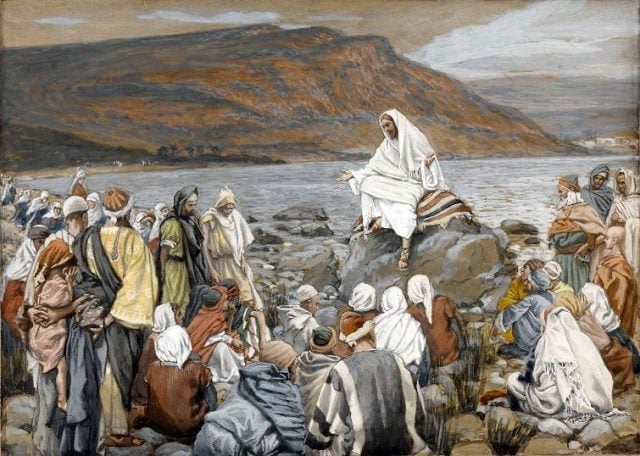
Jesus Teaches the People by the Sea, by James Tissot (1836-1902) [public domain / Wikimedia Commons]

***
(8-16-09)
*****
I put up the post, “John 6: Literal Eucharistic Interpretation (Analogical Cross-Referencing and Insufficient Counter-Arguments).” My friend then responded on his site with More Discussion on the Hard Sayings of Jesus in John 6. I am now counter-replying to that. Calvinist “Pilgrimsarbour”‘s words will be in blue:
* * * * *
Dave’s post deals specifically with John 6:44-66, but I will be bringing in other sections of the chapter for additional context and clarification.
In this section of John’s gospel Jesus is preaching to the multitudes after having miraculously fed them. Earlier in the chapter beginning with verse 22, we see Jesus discoursing on His role as the “bread of life.” Like the manna in the desert, the Father has given the people the true bread of life, Jesus Himself. At question here is what did the people understand about what Jesus was teaching them, and what didn’t they understand. The Jews grumbled against Him for saying that He had come down from heaven, so they understood that He was speaking of Himself in a divine, pre-existent way as the bread that the Father gave to the world (vv. 41-42).
Catholics agree that this earlier portion of John 6 is a more general treatment of soteriology, and Jesus as Savior: no real disagreement on that. We believe, however, that the latter portion moves into directly eucharistic territory. Jesus’ terminology becomes more and more graphic and specifically about eating His Flesh and drinking His Blood and how that ties into salvation; as opposed to talking about belief in Him apart from sacramental considerations.
They also got riled when He spoke of eating His flesh, thinking that He was advocating cannibalism (v. 52). But it was after He told them that no one could come to Him unless the Father had granted it to them to do so that “many of His disciples turned back and no longer walked with Him” (v. 66). This “hard saying” was, shall we say, the last straw.
This is an interesting take, but I think it fails and reads too much into the saying of John 6:65 as the direct cause of the desertion, rather than what came before. I think that is rather easily demonstrated. The heart of the eucharistic message of John 6 occurs in 6:52-58. It was after this teaching, that we see recorded:
John 6:61a Many of his disciples when they heard it, said, “This is a hard saying; who can listen to it?”
Verse 61 reveals to us that Jesus knew (“knowing in himself” – RSV) that these disciples were already murmuring, and He directly challenges them: “Do you take offense at this?” (6:61b). In verse 64 He notes, “But there are some of you that do not believe.” Quite clearly, we are dealing with unbelief and rebellion here; not mere misunderstanding. Jesus knew that; the text informs us of it as well. To say, in light of all this, that the main reason they were mad is because Jesus highlighted election at the end of it, is to, I submit, miss the forest for the trees. When in verse 66 we read of the desertion, it is referring to the previous discourse, not just the immediately preceding statement. They were already disbelieving and hardhearted, and Jesus noted that before He made the latter statement that you seem to want to make the primary reason for their desertion. I think it is implausible exegesis.
Within the context of what the people could or could not understand about what Jesus was saying, Dave said…
Jesus certainly would have explained what He meant in order to clear up the misunderstanding (and the abandonment), rather than simply reiterate and emphasize the same point more and more strongly: as the passage records (emphasis mine).
But I think the Scriptures lead us to a different conclusion. Jesus spoke to the multitudes at all times in parables:
34 All these things Jesus said to the crowds in parables; indeed, he said nothing to them without a parable. 35 This was to fulfill what was spoken by the prophet: “I will open my mouth in parables; I will utter what has been hidden since the foundation of the world” (Matthew 13:34-35, emphasis mine).
Jesus explains to His disciples the reason why He teaches the crowds in parables in Matthew 13:10-13:
10 Then the disciples came and said to him, “Why do you speak to them in parables?” 11 And he answered them, “To you it has been given to know the secrets of the kingdom of heaven, but to them it has not been given. 12 For to the one who has, more will be given, and he will have an abundance, but from the one who has not, even what he has will be taken away. 13 This is why I speak to them in parables, because seeing they do not see, and hearing they do not hear, nor do they understand” (emphasis mine).
Luke puts it similarly but a bit more starkly when he says, “…To you it has been given to know the secrets of the kingdom of God, but for others they are in parables, so that ‘seeing they may not see, and hearing they may not understand” (Luke 8:10, emphasis mine).
Scripture indicates that when Jesus speaks to the crowds He uses parables, but when He speaks to His own He elaborates clearly the meaning of the parables. When He taught in the temple his plain speaking caused the Jewish leaders to conspire to harm Him (Luke 6:6-11; John 8:48-59). His discourse with Nicodemus, for example, is spiritual language to illustrate literal truths, but Jesus doesn’t leave Nicodemus “hanging” like He does with many of those in the crowds. Instead He presses him to keep asking questions so that he might finally understand what Jesus is teaching him. The import of this scene is that Jesus clearly wants Nicodemus to understand Him.
Yes; so far I completely agree. This is all true.
It is not Jesus’ intention that everyone will understand what He is saying because it is not His intention to save every human being. Only those who were “appointed to eternal life” (Acts 13:48) would understand and believe Him. If anyone has a saving knowledge about the kindgom of heaven it’s because it was given to him by the Spirit. And what he has will increase. But those to whom life is not granted, “even what he has will be taken away.” This also ties in with what the Bible has to say about the Spirit hardening and softening hearts.
Moreover, it seems clear that the disciples that Jesus takes aside for the purpose of explaining the meaning of the parables are the chosen twelve, and perhaps some others that belonged to Him “…For Jesus knew from the first who those were that did not believe…” (John 6:64). The other “disciples” mentioned are followers who gave up after awhile as they wrestled with the “hard sayings” of Jesus. Not only were the bread of life, and the eating of the flesh and drinking of the blood hard sayings, but the immediate context indicates that the people stopped following Him when they heard that in order to be saved they had to first be drawn to Jesus by the Father: [65] And he said, “This is why I told you that no one can come to me unless it is granted him by the Father” (John 6:65, emphasis mine).
I agree with some of this, but disagree with the Calvinist interpretation of limited atonement and God not desiring to save everyone; also, the hardening of hearts is not a unilateral action of God; it is primarily the free will actions of those who rebel against Him, coupled with providential and anthropopathic language. I’ve written about the “hardening” issue elsewhere, and in any event, this whole line of thought departs from the question at hand (the Eucharist and John 6). Jesus knows that some will believe and some will not. But this has no effect on His “policy” of explaining His parables and deeper teachings to His disciples, as opposed to the larger masses of folk. We agree on that (you have just demonstrated that this is the case, from Scripture). But as we shall soon see, this very observation creates a major difficulty in your position, not mine.
Finally, it’s striking to note that of all four gospels, John is the only one that does not record for us the institution of the Lord’s Supper. If chapter 6 is truly teaching about the Eucharist, how could John neglect to tell us about the institution of this important sacrament which would have taken place a year after the events recorded in chapter 6? It’s an argument from silence, I admit, but it is nonetheless compelling.
I think it is unarguable that not every detail of our Lord’s life and mission necessarily needs to appear in each Gospel. It is why we have four, after all: they all complement each other and provide their own unique features and details. So, far from being some difficulty, this is altogether to be expected. It’s a non-issue.
That said; John does indirectly refer to the Last Supper (wherein the institution occurs), by referencing the Passover meal and Judas’ betrayal (13:1-2).
Secondly, the motif of the greatest being the servant of all (13:12-16) is present in accounts in the Synoptics also.
Thirdly, the Johannine narrative takes up Judas’ betrayal again, in a very clear parallel to the Synoptic Last Supper stories (13:21-30). John provides the detail of the morsel given to Judas, thus identifying the betrayer to Peter and John (13:23-26). We see a similar detail in, e.g., Matthew 26:20-23.
Fourth, the prediction of Peter’s denials occurs in John and the synoptics (cf. e.g., Matt. 26:33-35 with John 14:37-38).
Fifth, Jesus refers to going away and returning to the disciples (cf. Matt. 26:31-32 with John 14:1-3,18-20).
Therefore, the same events are being referred to. John wasn’t required to record the institution of the Eucharist because there was no need to (the Synoptics having provided that). John gives many details that the other three do not provide. This approach, then, offers no disproof of the Catholic eucharistic position at all. It’s a rabbit trail that dead ends.
Returning to the central point; you have contended that Jesus tells His disciples what His parables mean, but not the larger crowds. This is explicitly stated in Matthew 13:10-11 and Luke 8:9-10: passages you yourself cited in whole or in part, above. And note that the “disciples” were not just the Twelve, but included also at least the “seventy” mentioned in Luke 10:1 ff.: sent out to preach the gospel and heal the sick (10:9) and to cast out demons (10:17), by the express power of Jesus (10:19-20). Jesus “rejoiced” upon their enthusiastic report and thanked His Father, “that thou hast hidden these things from the wise and understanding and revealed them to babes . . .” (10:21): language quite similar to the parables being understood by disciples and not all the masses at large.
Fast forward, then, to John 6, and who is being referred to? “His disciples” (three times: 6:60-61, 66). We have already agreed and established that Jesus revealed the inner secrets and deeper teachings of the gospel of the kingdom to His disciples. That is who these people are.
Therefore, by all your reasoning and all indication of Holy Scripture, He would surely have revealed this teaching to these disciples who deserted Him (just as I stated, and the same thing you set out to dispute, above). But He did not. Therefore, plainly it wasn’t a matter of His teaching not being understood or comprehended, but a matter of it being rejected (as the text expressly asserts in 6:61,64), because He always explained the deeper meanings to His disciples, and these were His disciples.
He didn’t have to explain in this instance because it was a matter of not accepting what was understood, rather than not understanding what needed to be accepted. After all, being betrayed or abandoned even by the twelve didn’t stop Jesus from explaining all things to them. Peter was the leader of the disciples all along, and Jesus knew he would deny Him, but that didn’t prevent Him from sharing more deeply with Peter than any other disciple. Jesus refers to the abandonment of the twelve (well, eleven), even in the midst of His detailed teaching in John 13-17:
John 16:32 The hour is coming, indeed it has come, when you will be scattered, every man to his home, and will leave me alone; yet I am not alone, for the Father is with me.
So knowing that someone would betray or reject or temporarily abandon Him did not stop Jesus from teaching His own disciples. Even Judas received many firsthand teachings from Jesus.
Therefore, He would have gone on to explain things properly and in more detail (until they “got” it) to the disciples of John 6 who deserted Him because they couldn’t accept the Real Presence and eucharistic realism. He didn’t, precisely because they understood and were hardhearted. When Jesus knows that (speaking generally now), He explains no further, but challenges (e.g., Matthew 23 and the hypocrisy of the Pharisees), or falls silent (as in most of His trial). And that is what happened in this instance. The “argument from parables against the Catholic interpretation of John 6” thus falls flat; it collapses in a heap.
Moving on now to portions of the follow-up post: The Purpose of Parables:
Mark 4:10-12 10 And when he was alone, those around him with the twelve asked him about the parables. 11 And he said to them, “To you has been given the secret of the kingdom of God, but for those outside everything is in parables, 12 so that “they may indeed see but not perceive, and may indeed hear but not understand, lest they should turn and be forgiven.”
This further confirms my argument, because note that the secrets are told not just to the Twelve but also to “those around him with the twelve.”
This could mean that Jesus uses parables to increase the crowd’s understanding. However, then I would have to believe that when Jesus does speak plainly to the crowds, they don’t understand him. Really? The examples of the crowds and the Jewish leaders taking up stones to kill him in other parts of the Scriptures should remove all doubt as to whether they understood Him or not. No, it’s the parables that the crowds don’t understand, not the plain teaching. If Jesus wanted to be understood by everyone, then why didn’t He just stick to plain teaching? And the text is clear about the reason why:“…but to them it has not been given.” Even in this very passage, John 6:41 ff., the Jews understood exactly what Jesus meant–that He was pre-existent with the Father and came down from heaven.
That’s right. He explains to His disciples, and that is who the listeners in John 6 were. But He didn’t explain further there when they started grumbling and murmuring. Therefore, this shows (via plausibility by extensive direct analogy of similar scenarios) that they disbelieved His teaching (which is the Real, Substantial Presence in the Holy Eucharist). They refused to give the assent of faith, even with an incomplete understanding, and so left.
And Luke, as I said, puts it more starkly:
“…To you it has been given to know the secrets of the kingdom of God, but for others they are in parables, so that ‘seeing they may not see, and hearing they may not understand’ (Luke 8:10, emphasis mine).
Why does He say this? Well, because Jesus is quoting from Isaiah 6 (as He clearly states in Matthew 13:13-15) in which Isaiah has a vision of the Lord, at which time the Lord gives him instructions:
8 And I heard the voice of the Lord saying, “Whom shall I send, and who will go for us?” Then I said, “Here am I! Send me.” 9 And he said, “Go, and say to this people: ‘Keep on hearing, but do not understand; keep on seeing, but do not perceive.’ 10 Make the heart of this people dull, and their ears heavy, and blind their eyes; lest they see with their eyes, and hear with their ears, and understand with their hearts, and turn and be healed.”
Yep. I think you have argued yourself into a corner, by noting correctly that Jesus reveals secrets to His disciples. That clinches the very argument I was trying to make in my original post. You did much of my work for me. Thanks! Much obliged! :-)
The fact that Jesus always does this proves that it was not a matter of mere misunderstanding (thinking the Eucharist was cannibalism and suchlike). They refused to (willed not to) believe and exercise faith (as Abraham did, when he didn’t understand God’s purposes). They were like Doubting Thomases. And what they rejected was eucharistic realism: precisely as Protestants today do. It requires more faith than symbolism or mystical, spiritual presence (whatever that is, beyond the omnipresence that is always occurring). They didn’t yet have it, and they decided not to try to stick around in order to get it.
Often, belief in the Real, Substantial Presence of Jesus Christ in the Eucharist or transubstantiation, is the first thing a Catholic ditches, on the way out of the Catholic faith. Many, sadly, have the skeptical outlook of the former disciples of John 6. This flies against the Bible itself and the overwhelming consensus of the greatest teachers in the early Church. And that ought to give anyone significant pause.
*****
Meta Description: Explanation of how the literal nature of Jesus’ teaching in John 6 is fundamentally different from the symbolism inherent in parables.
Meta Keywords: consecration, Holy communion, Holy Eucharist, Real presence, sacramentalism, sacrifice of the mass, substantial presence, The Mass, transubstantiation
Previous Post
May 16, 2016
Luther: Scripture Easily Grasped by "Plowboys"
Next Post

May 17, 2016 Flat Earth: Biblical Teaching?
Browse Our Archives
Select a Category & Last Things About Me Anti-Catholicism Atheism & Agnosticism Baptism and Sacramentalism Bible and Tradition Blessed Virgin Mary Books by Dave Armstrong C. S. Lewis Calvinism & General Protestantism Catholic Apologetics Catholic Apologists Catholic conversion Catholic converts Christmas Church (Ecclesiology) Church History Conversion and Converts Development of Doctrine Eastern Orthodoxy Ecumenism & Christian Unity Eucharist & Liturgy Fathers of the Church French Translations G. K. Chesterton Hell Hell & Satan Hell & Satan & Last Things Heresies & Comparative Religion Holistic Health Inquisition & Crusades & Scandals James White Jews & Judaism & Old Testament John Calvin John Henry Newman Liberal / Modernist Theology Life Issues Literary Resume Lutheranism Mariology Martin Luther Music Orthodoxy Papacy & Infallibility Personal Page Philosophy & Science Political & Ethical & Moral Issues Protestant Persecution & Intolerance Protestantism Purgatory Purgatory & Penance Romantic & Imaginative Theology Saints & Purgatory & Penance Salvation Salvation & Justification Satan & Last Things Sexuality and Gender Issues Spanish Translations Traditionalism vs. Radical Catholic Reactionaries Traducciones al español / tradução para português Trinitarianism & Christology Uncategorized Videos
Select a Month October 2026 September 2026 August 2026 July 2026 June 2026 May 2026 April 2026 March 2026 February 2026 January 2026 December 2025 November 2025 October 2025 September 2025 August 2025 July 2025 June 2025 May 2025 April 2025 March 2025 February 2025 January 2025 December 2024 November 2024 October 2024 September 2024 August 2024 July 2024 June 2024 May 2024 April 2024 March 2024 February 2024 January 2024 December 2023 November 2023 October 2023 September 2023 August 2023 July 2023 June 2023 May 2023 April 2023 March 2023 February 2023 January 2023 December 2022 November 2022 October 2022 September 2022 August 2022 July 2022 June 2022 May 2022 April 2022 March 2022 February 2022 January 2022 December 2021 November 2021 October 2021 September 2021 August 2021 July 2021 June 2021 May 2021 April 2021 March 2021 February 2021 January 2021 December 2020 November 2020 October 2020 September 2020 August 2020 July 2020 June 2020 May 2020 April 2020 March 2020 February 2020 January 2020 December 2019 November 2019 October 2019 September 2019 August 2019 July 2019 June 2019 May 2019 April 2019 March 2019 February 2019 January 2019 December 2018 November 2018 October 2018 September 2018 August 2018 July 2018 June 2018 May 2018 April 2018 March 2018 February 2018 January 2018 December 2017 November 2017 October 2017 September 2017 August 2017 July 2017 June 2017 May 2017 April 2017 March 2017 February 2017 January 2017 December 2016 November 2016 October 2016 September 2016 August 2016 July 2016 June 2016 May 2016 April 2016 March 2016 February 2016 January 2016 December 2015 November 2015 October 2015 September 2015 August 2015 July 2015 June 2015 May 2015 April 2015 March 2015 February 2015 January 2015 December 2014 November 2014 October 2014 September 2014 August 2014 July 2014 June 2014 April 2014 March 2014 February 2014 January 2014 December 2013 November 2013 October 2013 September 2013 August 2013 July 2013 June 2013 April 2013 March 2013 February 2013 January 2013 December 2012 November 2012 October 2012 September 2012 August 2012 July 2012 June 2012 May 2012 April 2012 March 2012 February 2012 January 2012 December 2011 November 2011 October 2011 September 2011 August 2011 July 2011 June 2011 April 2011 March 2011 February 2011 October 2010 September 2010 August 2010 July 2010 April 2010 March 2010 December 2009 October 2009 August 2009 July 2009 June 2009 May 2009 March 2009 February 2009 October 2008 September 2008 April 2008 March 2008 February 2008 January 2008 December 2007 November 2007 October 2007 May 2007 March 2007 February 2007 January 2007 November 2006 October 2006 September 2006 August 2006 July 2006 June 2006 May 2006 April 2006 March 2006 February 2006 October 2005 June 2005 April 2005 February 2005 July 2004 May 2004 April 2004
Follow Us!
TAKE THE
Religious Wisdom Quiz
What is the shortest chapter in the Bible?
Select your answer to see how you score.
Psalm 1 Psalm 150 Psalm 100 Psalm 117
Books by This Author Books by Dave Armstrong
Related posts from Biblical Evidence for Catholicism

Three More Anti-Catholic Lies About Catholicism (#6-4)
Biblical Evidence for Catholicism

Top Ten Anti-Catholic Lies (#10-7)
Biblical Evidence for Catholicism

The Mass & Development of Doctrine (vs. Wes...
Biblical Evidence for Catholicism

Miraculous Eucharist (vs. Francois Turretin #4)
Biblical Evidence for Catholicism
TRENDING AT PATHEOS Catholic

I was strolling through the top floor of the brand new Parthenon...

What Does Gêvâh Mean For Kimberley Guifoyle &...
This week, a lot of the news is focused on Kimberly Guilfoyle....

INNER CIRCLE: Profound Mystery (Of Christ In All...
Ephesians 5:31-32 “For this reason, a man will leave his father and...

Do Not Rejoice When Your Enemy Falls: The...
Turning an execution into a public spectacle is a disturbing expression of...

'The Chosen' S6 Trailer: The Passion Gets Very...
Not many watching 'The Chosen' worry about spoilers, but just because they...

The purpose-driven labor priest
A labor activist reads Rick Warren and it gets me wondering about...
view all Catholic blogs
Ad-Free & Subscriber Log-In Subscription Support
- About Us
- 2026 Calendar
- Videos
- Podcasts
- Library of World Religions
- Faith In Media Tracker
- Advertise With Us
- Write for Us
- Privacy Policy
- Terms of Service
- Do Not Sell My Data
- Contact Us
- Radiant Digital
- Manage Newsletter Subscriptions
- Unsubscribe From Notifications
- Sitemap
Copyright 2008-2026, Patheos. All rights reserved.
Subscription Support Ad-Free & Subscriber Log-In
Follow Patheos