
BuddhistCatholicContemplativeEvangelicalGeneral ChristianHinduJewishLatter-day SaintMuslimNew VisionsProgressive Christian
Beliefs
- Buddhist
- Catholic
- Contemplative
- Evangelical
- General Christian
- Hindu
- Jewish
- Latter-day Saint
- More Voices
- Muslim
- New Visions
- Pagan
- Progressive Christian
Topics
- Religion News
- Food and Religion
- Sports and Religion
- Religious Art
- Religious Music and Entertainment
- Religious Events
- History and Religion
- Style and Religion
- Politics and Religion
- Women in Religion
- Recreation Outdoors and Religion
- Business Finance and Religion
- Careers Workplace and Religion
- Education and Religion
- Family Parenting and Religion
- Health Fitness and Religion
- Home and Religion
- Relationships and Religion
- Technology and Religion
- Travel and Religion
Columnists
- Buddhist Columnists
- Business Finance and Religion Columnists
- Careers Workplace and Religion Columnists
- Catholic Columnists
- Contemplative Columnists
- Education and Religion Columnists
- Evangelists Columnists
- Family Parenting and Religion Columnists
- General Christian Columnists
- Health Fitness and Religion Columnists
- Hindu Columnists
- History and Religion Columnists
- Home and Religion Columnists
- Jewish Columnists
- More Voices Columnists
- Latter Day Columnists
- Muslim Columnists
- New Visions Columnists
- Nonreligious Columnists
- Pagan Columnists
- Politics and Religion Columnists
- Progressive Columnists
- Recreation Outdoors and Religion Columnists
- Relationships and Religion Columnists
- Religion News Columnists
- Religious Art Columnists
- Religious Events Columnists
- Religious Music and Entertainment Columnists
- Sports and Religion Columnists
- Style and Religion Columnists
- Technology and Religion Columnists
- Travel and Religion Columnists
- Women in Religion Columnists
Resource Library
- 2026 Calendar
- Library of World Religions
- The 100 Most Holy Places on Earth
- Patheos Answers
- Podcasts
- Videos
- Faith Leaders Database
- Anglican Episcopalian
- Bahai
- Baptist
- Buddhism
- Christianity
- Confucianism
- Eastern Orthodoxy
- Hinduism
- Holiness and Pentecostal
- ISKCON
- Islam
- Judaism
- Lutheran
- Methodist
- The Church of Jesus Christ of Latter-day Saints
- New Age
- Paganism
- Presbytarian and Reformed
- Protestantism
- Religion Behind the Scenes
- Roman Catholic
- Scientology
- Shia Islam
- Sikhism
- Sufism
- Sunni Islam
- Taoism
- Zen
- See all religions
Research Tools
 Ad-Free & Subscriber Log-In Subscription Support
Ad-Free & Subscriber Log-In Subscription Support
Follow Patheos 

- Trending:
- Forgiveness
- |
- Marriage
- |
- Consciousness
- |
- Death Penalty
- |
- Election
- |
- Halloween

-
About
-
Catholic Apologetics
-
Church History
-
Great Apologists
-
Christian Worldview
-
Protestantism & Misc.
- Home
- Catholic
- History and Religion
- Is Lutheranism Officially Anti-Catholic?
Is Lutheranism Officially Anti-Catholic?
Last updated on: March 8, 2024 at 6:08 pm by Dave Armstrong
Is Lutheranism Officially Anti-Catholic? 2024-03-08T18:08:31-04:00 Dave Armstrong
Patheos Explore the world's faith through different perspectives on religion and spirituality! Patheos has the views of the prevalent religions and spiritualities of the world.
The Book of Concord and the Catholic Mass
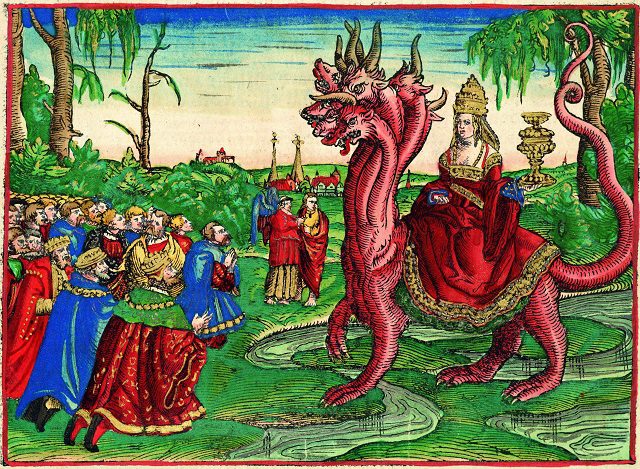
Colored version of the Whore of Babylon illustration from Martin Luther’s 1534 translation of the Bible, from the Workshop of Lucas Cranach [public domain / Wikimedia Commons].

(4-26-05)
The following dialogue with Lutheran “BWL” occurred in comments below. Since I did a little work in my reply, I thought it would be appropriate to make it a new paper of its own. His words will be in blue. Citations from the Book of Concord will be in green.
* * *
Not to be nit-picky, but my understanding is that Luther and Calvin saw the RCC not as a false church, but as an impure one, which is an important distinction. They both recognized the validity of Catholic baptisms, and Luther thought the RC also had a true communion. Although Luther was critical of certain elements of RC communion practice (communion in one kind, the mass as a sacrifice) he did famously say that he’d rather drink blood with the pope than wine with the Reformed. Just a suggestion, but if you want to take on anti-Catholics, bringing up Calvin and Luther’s view of Rome actually helps your case.
As I’ve mentioned before, this should work against Reformed Baptist types by showing how Luther and Calvin would see their sacramentology (or anti-sacramentology, however you want to put this) as conflicting with Reformational soteriology. In other words, on the whole it helps you to point out how while Reform Baptist like to claim the mantel of defending the Reformation they actually conflict with the Reformers on numerous and important points.
I believe that it is a mixed bag, when it comes to Luther and Calvin’s view of the Catholic Church. I think they contradict themselves. I’ve found it impossible to interpret their views in this vein in a consistent, coherent fashion. On the other hand, I’ve written about Luther’s more “Catholic” beliefs (including compiling an entire book of these).
I’d be delighted to conclude that they regarded Catholics as more or less equal brothers-in-Christ, but there is too much that suggests otherwise, which has never been adequately explained to me by those like yourself who believe that they were not anti-Catholics (you’re welcome to be the first; be my guest). I always say regarding Calvin, that if he thinks I participate in the grossest blasphemy, sacrilege, and idolatry every week at Mass, then that can hardly be squared with thinking that all this is Christian.
First, as you know Luther was prone to uh, exaggerations and harsh, polemical language. This certainly was a big flaw of his, though it’s worth pointing out his Catholic opponents were at times prone to nasty polemics at first. My point is, however, that Luther should be taken with a grain of salt.
Are you maintaining, then, that every time Luther wrote something which could reasonably be construed as denying that the Catholic Church is truly Christian, it should be taken in this way, as merely his excess in language? There is not a single instance of these utterances that he meant literally? It seems to me that this would be an extraordinary claim, and almost impossible to prove.
To my knowledge, however, Luther and the Lutheran church has always regarded Rome as a christian church, though an impure one with many doctrinal flaws. That includes the sacrifice of the mass. I don’t see, however, why you think serious disagreements in this regard makes Luther and the Lutherans, for example, “anti-Catholic.”
I think it has to be judged on an individual case basis (as regards individual opinions). Lutherans, like Anglicans and Reformed, contain both views, and many members seem confused about even their own positions.
The RCC doesn’t recognize Lutheran orders, nor from what I understand does it think that Lutherans receive Christ’s true body and blood when they take communion.
That’s correct.
So, if the Lutheran disagreement over the sacrifice of the mass makes Lutherans “anti-Catholic”, why isn’t the Catholic church “anti-Lutheran” since the RC doesn’t recognize Lutheran communion?
The difference would be if the mass is considered blasphemy and sacrilege and idolatry (whereas we would never say that about a Lutheran service, or any standard Protestant worship service; we would say they convey grace of some sort, even if not technically “sacramental”).
The above view (where it occurs) would make the mass, by definition, a non-Christian thing. Then you would be in the incoherent, odd position of agreeing that Catholicism is Christian, despite the fact that its central rite is utterly non-Christian (and, far beyond that, anti-Christian, as it is idolatry, blasphemy, etc.). Quite a bizarre state of affairs, there . . .
In fact, the Book of Concord confirms my suspicion that Lutheranism is officially anti-Catholic. Lutherans are bound to this as their confession, so it can’t be cavalierly dismissed as some old irrelevant document.
Smalcald Articles [1537], Part II, Article II: The Mass:
The Mass in the papacy must be regarded as the greatest and most horrible abomination because it runs into direct and violent conflict with this fundamental article. Yet, above and beyond all others, it has been the supreme and most precious of the papal idolatries . . .
If there were reasonable papists, one would speak to them in the following friendly fashion:
“Why do you cling so tenaciously to your Masses?
1. “After all, they are a purely human invention. They are not commanded by God . . . Christ says, ‘In vain do they worship me, teaching as doctrines the precepts of men’ (Matt. 15:9).”
. . . 3. . . . “one can be saved in a better way without the Mass. Will the Mass not then collapse of itself — not only for the rude rabble, but also for all godly, Christian, sensible, God-fearing people — especially if they hear that it is a dangerous thing which was fabricated and invented without God’s Word and will?”
. . . 5. “The Mass is and can be nothing else that a human work, even a work of evil scoundrels . . .”
Accordingly we are and remain eternally divided and opposed the one to the other. The papists are well aware that if the Mass falls, the papacy will fall with it.Before they would permit this to happen, they would put us all to death.
Besides, this dragon’s tail — that is, the Mass — has brought forth a brood of vermin and the poison of manifest idolatries. (The Book of Concord, translated and edited by Theodore Tappert, St. Louis: Concordia Publishing House / Muhlenberg Press, 1959, pp. 293-294)
Apology of the Augsburg Confession [1531], Article XXIV: The Mass
Carnal men cannot stand it when only the sacrifice of Christ is honored as a propitiation. For they do not understand the righteousness of faith but give equal honor to other sacrifices and services. A false idea clung to the wicked priests in Judah, and in Israel the worship of Baal continued; yet the church of God was there, condemning wicked services. So in the papal realm the worship of Baal clings — namely, the abuse of the Mass . . . And it seems that this worship of Baal will endure together with the papal realm until Christ comes to judge and by the glory of his coming destroys the kingdom of Antichrist. Meanwhile all those who truly believe the Gospel should reject those wicked services invented against God’s command to obscure the glory of Christ and the righteousness of faith. (Tappert, ibid., 268)
I guess at the end of the day I don’t see why strong disagreements among Christians makes them “anti”.
Not disagreements, but denial of the status of other Christians as Christians. It’s the devil’s biggest victory: if half of the Body of Christ denies that the other half even belongs in the Body at all, then what could be better for the devil’s purposes? We’ll always be hopelessly divided. So the world keeps going to hell because (anti-Catholic, anti-Protestant, anti-Orthodox) Christians can’t even recognize fellow believers.
If we all recognize each others baptisms, why is this “anti” stuff even a real question? It’s not like Lutherans are Reformed or fundamentalist Baptists or something.
Because (obviously) if anti-Catholicism is entrenched in both the founding confessional documents and the founders of a religious point of view, then it will continue on, because it was in the roots from the beginning. How Lutherans square the realities of these aspects of the Book of Concord, I don’t know, but it creates an internal contradiction if one says that they follow the Lutheran confessions, yet dissent on the nature of the Mass and so forth, and are not themselves anti-Catholic.
How would you square these two things, BWL, if you have become aware of some passages that perhaps you were not aware of before, in the Book of Concord? I’m very curious. There may very well be a way that ecumenical Lutherans reconcile this, through some interpretive means that I am not yet aware of. I’d be more than happy to be educated by those who feel that they have a solution to this apparent dilemma for ecumenical Lutherans. Please (you or friends of yours who might help us better understand) teach me . . . I don’t want division; I would love for there to be a way to reconcile these two things. No one would be happier than I would be to learn that there is some coherent explanation of this, so that anti-Catholicism is not necessary to hold as a confessional Lutheran.
***
Previous Post

May 9, 2016
Divine Healing: Is It God's Will to Heal in Every Case?
Next Post
May 10, 2016 Martin Luther: Fascinating Facts (Series of Articles)
Browse Our Archives
Select a Category & Last Things About Me Anti-Catholicism Atheism & Agnosticism Baptism and Sacramentalism Bible and Tradition Blessed Virgin Mary Books by Dave Armstrong C. S. Lewis Calvinism & General Protestantism Catholic Apologetics Catholic Apologists Catholic conversion Catholic converts Christmas Church (Ecclesiology) Church History Conversion and Converts Development of Doctrine Eastern Orthodoxy Ecumenism & Christian Unity Eucharist & Liturgy Fathers of the Church French Translations G. K. Chesterton Hell Hell & Satan Hell & Satan & Last Things Heresies & Comparative Religion Holistic Health Inquisition & Crusades & Scandals James White Jews & Judaism & Old Testament John Calvin John Henry Newman Liberal / Modernist Theology Life Issues Literary Resume Lutheranism Mariology Martin Luther Music Orthodoxy Papacy & Infallibility Personal Page Philosophy & Science Political & Ethical & Moral Issues Protestant Persecution & Intolerance Protestantism Purgatory Purgatory & Penance Romantic & Imaginative Theology Saints & Purgatory & Penance Salvation Salvation & Justification Satan & Last Things Sexuality and Gender Issues Spanish Translations Traditionalism vs. Radical Catholic Reactionaries Traducciones al español / tradução para português Trinitarianism & Christology Uncategorized Videos
Select a Month October 2026 September 2026 August 2026 July 2026 June 2026 May 2026 April 2026 March 2026 February 2026 January 2026 December 2025 November 2025 October 2025 September 2025 August 2025 July 2025 June 2025 May 2025 April 2025 March 2025 February 2025 January 2025 December 2024 November 2024 October 2024 September 2024 August 2024 July 2024 June 2024 May 2024 April 2024 March 2024 February 2024 January 2024 December 2023 November 2023 October 2023 September 2023 August 2023 July 2023 June 2023 May 2023 April 2023 March 2023 February 2023 January 2023 December 2022 November 2022 October 2022 September 2022 August 2022 July 2022 June 2022 May 2022 April 2022 March 2022 February 2022 January 2022 December 2021 November 2021 October 2021 September 2021 August 2021 July 2021 June 2021 May 2021 April 2021 March 2021 February 2021 January 2021 December 2020 November 2020 October 2020 September 2020 August 2020 July 2020 June 2020 May 2020 April 2020 March 2020 February 2020 January 2020 December 2019 November 2019 October 2019 September 2019 August 2019 July 2019 June 2019 May 2019 April 2019 March 2019 February 2019 January 2019 December 2018 November 2018 October 2018 September 2018 August 2018 July 2018 June 2018 May 2018 April 2018 March 2018 February 2018 January 2018 December 2017 November 2017 October 2017 September 2017 August 2017 July 2017 June 2017 May 2017 April 2017 March 2017 February 2017 January 2017 December 2016 November 2016 October 2016 September 2016 August 2016 July 2016 June 2016 May 2016 April 2016 March 2016 February 2016 January 2016 December 2015 November 2015 October 2015 September 2015 August 2015 July 2015 June 2015 May 2015 April 2015 March 2015 February 2015 January 2015 December 2014 November 2014 October 2014 September 2014 August 2014 July 2014 June 2014 April 2014 March 2014 February 2014 January 2014 December 2013 November 2013 October 2013 September 2013 August 2013 July 2013 June 2013 April 2013 March 2013 February 2013 January 2013 December 2012 November 2012 October 2012 September 2012 August 2012 July 2012 June 2012 May 2012 April 2012 March 2012 February 2012 January 2012 December 2011 November 2011 October 2011 September 2011 August 2011 July 2011 June 2011 April 2011 March 2011 February 2011 October 2010 September 2010 August 2010 July 2010 April 2010 March 2010 December 2009 October 2009 August 2009 July 2009 June 2009 May 2009 March 2009 February 2009 October 2008 September 2008 April 2008 March 2008 February 2008 January 2008 December 2007 November 2007 October 2007 May 2007 March 2007 February 2007 January 2007 November 2006 October 2006 September 2006 August 2006 July 2006 June 2006 May 2006 April 2006 March 2006 February 2006 October 2005 June 2005 April 2005 February 2005 July 2004 May 2004 April 2004
Follow Us!
TAKE THE
Religious Wisdom Quiz
Who was stoned to death for preaching about Jesus?
Select your answer to see how you score.
Peter Paul Stephen James
Books by This Author Books by Dave Armstrong
Related posts from Biblical Evidence for Catholicism

Three More Anti-Catholic Lies About Catholicism (#6-4)
Biblical Evidence for Catholicism

Top Ten Anti-Catholic Lies (#10-7)
Biblical Evidence for Catholicism

Does Catholic Intercession of Saints Require Omniscience?
Biblical Evidence for Catholicism

Protestant Confessions & "Ever-Virgin" Mary
Biblical Evidence for Catholicism
TRENDING AT PATHEOS Catholic

Janie Learns the Way of the Cross: A...
Teaching children about Jesus' Passion can be challenging. Many parents and educators...

Looking For Good Catholic Writing - October 2026
He alone extends the heavens, and he walks upon the waves of...

In "Irreplaceable," our book on vocation and technology, Trevor Sutton and I...

I was strolling through the top floor of the brand new Parthenon...

What Does Gêvâh Mean For Kimberley Guifoyle &...
This week, a lot of the news is focused on Kimberly Guilfoyle....

INNER CIRCLE: Profound Mystery (Of Christ In All...
Ephesians 5:31-32 “For this reason, a man will leave his father and...
view all Catholic blogs
Ad-Free & Subscriber Log-In Subscription Support
- About Us
- 2026 Calendar
- Videos
- Podcasts
- Library of World Religions
- Faith In Media Tracker
- Advertise With Us
- Write for Us
- Privacy Policy
- Terms of Service
- Do Not Sell My Data
- Contact Us
- Radiant Digital
- Manage Newsletter Subscriptions
- Unsubscribe From Notifications
- Sitemap
Copyright 2008-2026, Patheos. All rights reserved.
Subscription Support Ad-Free & Subscriber Log-In
Follow Patheos