
BuddhistCatholicContemplativeEvangelicalGeneral ChristianHinduJewishLatter-day SaintMuslimNew VisionsProgressive Christian
Beliefs
- Buddhist
- Catholic
- Contemplative
- Evangelical
- General Christian
- Hindu
- Jewish
- Latter-day Saint
- More Voices
- Muslim
- New Visions
- Pagan
- Progressive Christian
Topics
- Religion News
- Food and Religion
- Sports and Religion
- Religious Art
- Religious Music and Entertainment
- Religious Events
- History and Religion
- Style and Religion
- Politics and Religion
- Women in Religion
- Recreation Outdoors and Religion
- Business Finance and Religion
- Careers Workplace and Religion
- Education and Religion
- Family Parenting and Religion
- Health Fitness and Religion
- Home and Religion
- Relationships and Religion
- Technology and Religion
- Travel and Religion
Columnists
- Buddhist Columnists
- Business Finance and Religion Columnists
- Careers Workplace and Religion Columnists
- Catholic Columnists
- Contemplative Columnists
- Education and Religion Columnists
- Evangelists Columnists
- Family Parenting and Religion Columnists
- General Christian Columnists
- Health Fitness and Religion Columnists
- Hindu Columnists
- History and Religion Columnists
- Home and Religion Columnists
- Jewish Columnists
- More Voices Columnists
- Latter Day Columnists
- Muslim Columnists
- New Visions Columnists
- Nonreligious Columnists
- Pagan Columnists
- Politics and Religion Columnists
- Progressive Columnists
- Recreation Outdoors and Religion Columnists
- Relationships and Religion Columnists
- Religion News Columnists
- Religious Art Columnists
- Religious Events Columnists
- Religious Music and Entertainment Columnists
- Sports and Religion Columnists
- Style and Religion Columnists
- Technology and Religion Columnists
- Travel and Religion Columnists
- Women in Religion Columnists
Resource Library
- 2026 Calendar
- Library of World Religions
- The 100 Most Holy Places on Earth
- Patheos Answers
- Podcasts
- Videos
- Faith Leaders Database
- Anglican Episcopalian
- Bahai
- Baptist
- Buddhism
- Christianity
- Confucianism
- Eastern Orthodoxy
- Hinduism
- Holiness and Pentecostal
- ISKCON
- Islam
- Judaism
- Lutheran
- Methodist
- The Church of Jesus Christ of Latter-day Saints
- New Age
- Paganism
- Presbytarian and Reformed
- Protestantism
- Religion Behind the Scenes
- Roman Catholic
- Scientology
- Shia Islam
- Sikhism
- Sufism
- Sunni Islam
- Taoism
- Zen
- See all religions
Research Tools
 Ad-Free & Subscriber Log-In Subscription Support
Ad-Free & Subscriber Log-In Subscription Support
Follow Patheos 

- Trending:
- Forgiveness
- |
- Marriage
- |
- Consciousness
- |
- Death Penalty
- |
- Election
- |
- Halloween

-
About
-
Catholic Apologetics
-
Church History
-
Great Apologists
-
Christian Worldview
-
Protestantism & Misc.
- Home
- Catholic
- History and Religion
- Dialogue w Lutheran on Christian Authority
Dialogue w Lutheran on Christian Authority
Last updated on: February 27, 2017 at 1:09 pm by Dave Armstrong
Dialogue w Lutheran on Christian Authority 2017-02-27T13:09:41-04:00 Dave Armstrong
Patheos Explore the world's faith through different perspectives on religion and spirituality! Patheos has the views of the prevalent religions and spiritualities of the world.
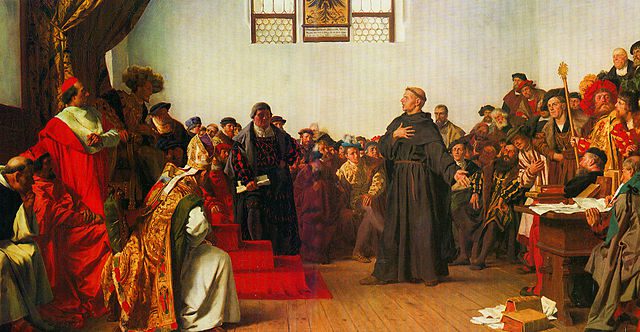
Luther at the Diet of Worms (1877), by Anton von Werner (1843-1915) [public domain / Wikimedia Commons]

***
The words of CKRuch (LCMS) will be in blue. He was responding to my post, Jerusalem Council vs. Sola Scriptura.
*****
Still digesting this but I see some issues with your argument. You cannot use the authority of scripture to diminish the authority of scripture.
Of course not, because it is what it is: God’s inspired, infallible revelation.
I’m sure you’d argue that you cannot use scripture to affirm it’s own authority, either.
You can, but technically, it’s a circular argument. But I think one can use parts of Scripture to verify it’s authenticity and inspired status; for example, fulfilled prophecy. For it to be inspired it has to at least claim this. Then if we assume for the sake of argument that it is inspired and infallible, it should be internally consistent and harmonious. And indeed it is that. It still requires faith to believe it is revelation, but God gives us many clues and evidences.
Both lead to logical issues and only appeal to faith.
Well, it’s a mixture: faith and reason. The appeal to Church history or tradition also requires faith, but it is a reasonable faith, able to be substantiated historiographically.
Either the Bible is the Word of God, in which case it has all authority, or it contains the Word of God (if that is your belief) or some of God’s Word, in which case it has full authority in all matters which it does address. I don’t think it profitable for one embracing the latter two to try and persuade one embracing the first.
It has authority, but it is not the sole authority because it also delegates authority to tradition, apostolic succession, the Church, bishops, popes, and apostles. These are aspects of complementary authority, not contradictory. Both / and. “Three-legged stool” . . .
I think you need to look at the entire passage and read Peter’s argument (which comes on the heels of his dream in Acts 10):
“The apostles and the elders were gathered together to consider this matter. And after there had been much debate, Peter stood up and said to them, “Brothers, you know that in the early days God made a choice among you, that by my mouth the Gentiles should hear the word of the gospel and believe. And God, who knows the heart, bore witness to them, by giving them the Holy Spirit just as he did to us, and he made no distinction between us and them, having cleansed their hearts by faith. Now, therefore, why are you putting God to the test by placing a yoke on the neck of the disciples that neither our fathers nor we have been able to bear? But we believe that we will be saved through the grace of the Lord Jesus, just as they will.”
I have. :-)
Peter finally has his last word against the Judaizers, Paul and Barnabas testify, as well. But there is still an uneasiness and James works a compromise, limited concession to kosher laws. A compromise is not doctrine and not infallible.
It was not a dogma for all time, but it was binding at the time, as suggested by ” it has seemed good to the Holy Spirit and to us” (Acts 15:28). Because this was binding authority, St. Paul went around and “delivered to them for observance the decisions which had been reached by the apostles and elders who were at Jerusalem” (Acts 16:4).
Recall that in 1 Corinthians 8, Paul allows that Christians may eat food sacrificed to idols as long as one is mindful of how it may affect those of weaker or immature faith. We certainly wouldn’t expect Irish Catholics to give up blood pudding, would we? Sexual immorality? Well, of course, but that was not because this council decreed it to be sinful.
The council confesses that the Holy Spirit is shared and that God has imparted faith to the Gentiles without them being Judaized. They have caused no doctrine to come into being. Rather, they stand as mediators, willing to conceal part of the truth concerning Christain liberty for the sake of peace and agree that respecting the weaker, the Judaizers, was critical for the sake of the Church, for unity. In a sense, allowing the false sensibilities of Judaizers to be appeased and burdening the Gentiles with false rules concerning food, the council was refusing to assume a ruling role. For, if the Gentiles disobeyed the council concerning foods, we know they would not have been in error because a church council cannot bind one to something false even if it has the authority to bind one to something true. Truth is the source of binding authority and of all confession.
The Jerusalem council had authority, but not all its decrees were meant for all times and places. Catholic apologist and theologian Scott Hahn wrote in his commentary on 1 Corinthians 8 in the Ignatius Catholic Study Bible:
The Council of Florence declared in 1442 that the Apostolic decree of Acts 15:22-29 was only a temporary restriction placed upon the Gentiles to encourage fellowship between Jewish and Gentile converts in the early Church. This restriction was lifted once these ethnic circumstances had changed. . . .
These clarifications help to demonstrate that Paul and the Jerusalem Council were not in conflict at the theological level.
So it seems to me that there are two questions here: Did the council have (binding) authority? Yes. Was it dealing with unchangeable dogma in this instance? No. It’s still not sola Scriptura, because in that system no council can be infallible and binding. Only Scripture is that. Luther’s movement would never have gotten off the ground at all if he hadn’t denied Catholic authority, by asserting that “councils can and do err” and by adopting the alternate, anti-traditional Scripture Alone viewpoint.
All that aside, you are debating a Baptist, one who is not “sola scriptura” in any proper sense. They have no confession, reject the creeds, reject the real presence, reject the sacramental nature of baptism.
Well, he’s Reformed Baptist, so I think he would accept Calvinist creeds and confessions.
In other words, they reject the authority of scripture in these matters. If they were sola scriptura, they would not seek to find the church by personal revelation in scripture, by personal interpretation, mystical experience, or any other revelation of God outside Word and Sacrament, the public revelation given to all and received in the Church.
As a Lutheran, I have always been astounded at both Catholic and Protestant misinterpretations of sola scriptura. It simply means that any revelation or teaching must agree with scripture if it is to be embraced as true and essential. Any teaching not in contradiction with scripture must point one to Christ in Word and Sacrament, but cannot be taught as essential.
That’s not my understanding of what sola Scriptura means. Rather, it is that “only Scripture is the final, infallible authority.” What you say is easily compatible with Catholicism and Orthodoxy, for we, too, believe that all our teachings do and must agree with Holy Scripture, and are completely harmonious with it. That’s different from saying (an extreme sola Scriptura or “solo Scriptura” doctrine) that all proofs whatever for doctrine must explicitly be in Scripture (the canon of Scripture, for example, is not). But most Catholics (including myself) believe in the material sufficiency of Scripture. There is at least indirect, implicit, or deductive data about any and every Catholic, Christian doctrine in Holy Scripture. That is certainly what I’ve found in my apologetics research, and its emphasis on “Biblical evidence for Catholicism.”
Your point:
“6. Scripture itself does not rule out the presence of an authoritative oral tradition, not recorded in words. Paul refers more than once to a non-written tradition (e.g., 2 Tim 1:13-14, 2:2).”
Is easily addressed by the fact that the oral tradition was, eventually, passed down to us as scripture. There were no gospels and the epistles were in the works, not disseminated, when the Church was in infancy. However, Peter, Paul and all the apostles referenced constantly the scriptures they did have, the Old Testament, in relating the Gospel of Christ. This we know from the writings we do have. You dismiss that, too easily when you would insist that the Bible list its own books. That is flippant.
I don’t “insist” that the Bible list its own books; I simply state the fact that it did not. Protestants are thus left with a fallible list of infallible books, and sola Scriptura itself is cast into doubt, since we have no certainly (other than the authoritative Church) as to what books are the Bible. The binding, infallible Church authority that decreed the canon is directly contradictory to sola Scriptura.
The Bible is the Church’s book. To the Church belongs the ministry of Word and Sacrament. The Church is not “me and God” or a “personal Savior” in the sense that a Baptist may claim and the Word is not a private thing.
We are in total agreement on that.
So, to say that the canon of scripture comes together in as inspired a manner as the scriptures were written is not a stretch. Yet, the Church has always had differences, from the time of the Apostolic Fathers in terms of anitlegomena and apocrypha with difference among East, West, and Ethiopian which persist. In the end, we rely on faith that the canon is what it needs to be, can focus on what all churches agree to (as if there is counsel, there) and that God preserves the faith across translations.
Sola scriptura does not supplant the authority of the Church, it roots the Church’s authority in the Word. The Church remains the keeper, teacher, and interpreter and it is not an affront to the Church’s authority for anyone to ask “where is that written?” The Church should ever be ready to give a defense.
But the Church is not infallible in the sola Scriptura rule of faith. Apostolic tradition is not infallible (hence Lutheranism departed from it in many respects). Ecumenical councils are not infallible and binding.
The good news is that (despite these disagreements), Lutheranism and Catholicism are far closer in viewpoint on the matter of authority than Baptists or other “low church” denominations are to Catholicism, because Lutherans grant far more authority and “place” to councils and creeds and confessions (Book of Concord), albeit in a sub-infallible sense.
*****
Meta Description: Nice dialogue with a Lutheran about the authority of the Jerusalem council, & the relation of Scripture to Christian authority.
Meta Keywords: Bible Only, biblical prooftexts, biblical theology, Christian Authority, exegesis, councils, ecumenical councils, hermeneutics, Holy Bible, infallible authority, Rule of Faith, Sacred Scripture, Scripture Alone, Sola Scriptura, Lutheranism, Lutheran rule of faith, Lutheran authority, Book of Concord
Previous Post

May 5, 2016
15 Reasons Why Donald Trump Wins in November
Next Post

May 6, 2016 Catholic Church's Wise Views on Illegal Immigration
Browse Our Archives
Select a Category & Last Things About Me Anti-Catholicism Atheism & Agnosticism Baptism and Sacramentalism Bible and Tradition Blessed Virgin Mary Books by Dave Armstrong C. S. Lewis Calvinism & General Protestantism Catholic Apologetics Catholic Apologists Catholic conversion Catholic converts Christmas Church (Ecclesiology) Church History Conversion and Converts Development of Doctrine Eastern Orthodoxy Ecumenism & Christian Unity Eucharist & Liturgy Fathers of the Church French Translations G. K. Chesterton Hell Hell & Satan Hell & Satan & Last Things Heresies & Comparative Religion Holistic Health Inquisition & Crusades & Scandals James White Jews & Judaism & Old Testament John Calvin John Henry Newman Liberal / Modernist Theology Life Issues Literary Resume Lutheranism Mariology Martin Luther Music Orthodoxy Papacy & Infallibility Personal Page Philosophy & Science Political & Ethical & Moral Issues Protestant Persecution & Intolerance Protestantism Purgatory Purgatory & Penance Romantic & Imaginative Theology Saints & Purgatory & Penance Salvation Salvation & Justification Satan & Last Things Sexuality and Gender Issues Spanish Translations Traditionalism vs. Radical Catholic Reactionaries Traducciones al español / tradução para português Trinitarianism & Christology Uncategorized Videos
Select a Month October 2026 September 2026 August 2026 July 2026 June 2026 May 2026 April 2026 March 2026 February 2026 January 2026 December 2025 November 2025 October 2025 September 2025 August 2025 July 2025 June 2025 May 2025 April 2025 March 2025 February 2025 January 2025 December 2024 November 2024 October 2024 September 2024 August 2024 July 2024 June 2024 May 2024 April 2024 March 2024 February 2024 January 2024 December 2023 November 2023 October 2023 September 2023 August 2023 July 2023 June 2023 May 2023 April 2023 March 2023 February 2023 January 2023 December 2022 November 2022 October 2022 September 2022 August 2022 July 2022 June 2022 May 2022 April 2022 March 2022 February 2022 January 2022 December 2021 November 2021 October 2021 September 2021 August 2021 July 2021 June 2021 May 2021 April 2021 March 2021 February 2021 January 2021 December 2020 November 2020 October 2020 September 2020 August 2020 July 2020 June 2020 May 2020 April 2020 March 2020 February 2020 January 2020 December 2019 November 2019 October 2019 September 2019 August 2019 July 2019 June 2019 May 2019 April 2019 March 2019 February 2019 January 2019 December 2018 November 2018 October 2018 September 2018 August 2018 July 2018 June 2018 May 2018 April 2018 March 2018 February 2018 January 2018 December 2017 November 2017 October 2017 September 2017 August 2017 July 2017 June 2017 May 2017 April 2017 March 2017 February 2017 January 2017 December 2016 November 2016 October 2016 September 2016 August 2016 July 2016 June 2016 May 2016 April 2016 March 2016 February 2016 January 2016 December 2015 November 2015 October 2015 September 2015 August 2015 July 2015 June 2015 May 2015 April 2015 March 2015 February 2015 January 2015 December 2014 November 2014 October 2014 September 2014 August 2014 July 2014 June 2014 April 2014 March 2014 February 2014 January 2014 December 2013 November 2013 October 2013 September 2013 August 2013 July 2013 June 2013 April 2013 March 2013 February 2013 January 2013 December 2012 November 2012 October 2012 September 2012 August 2012 July 2012 June 2012 May 2012 April 2012 March 2012 February 2012 January 2012 December 2011 November 2011 October 2011 September 2011 August 2011 July 2011 June 2011 April 2011 March 2011 February 2011 October 2010 September 2010 August 2010 July 2010 April 2010 March 2010 December 2009 October 2009 August 2009 July 2009 June 2009 May 2009 March 2009 February 2009 October 2008 September 2008 April 2008 March 2008 February 2008 January 2008 December 2007 November 2007 October 2007 May 2007 March 2007 February 2007 January 2007 November 2006 October 2006 September 2006 August 2006 July 2006 June 2006 May 2006 April 2006 March 2006 February 2006 October 2005 June 2005 April 2005 February 2005 July 2004 May 2004 April 2004
Follow Us!
TAKE THE
Religious Wisdom Quiz
Who prayed for rain after a long drought and sent his servant to look seven times?
Select your answer to see how you score.
Elijah Isaiah Samuel Hosea
Books by This Author Books by Dave Armstrong
Related posts from Biblical Evidence for Catholicism

Does Catholic Intercession of Saints Require Omniscience?
Biblical Evidence for Catholicism

Protestant Confessions & "Ever-Virgin" Mary
Biblical Evidence for Catholicism

Jesus Founded the [Catholic] Church. If Not Him,...
Biblical Evidence for Catholicism

A Few "Worst" & "Best" Arguments vs. Protestantism
Biblical Evidence for Catholicism
TRENDING AT PATHEOS Catholic

I was strolling through the top floor of the brand new Parthenon...

What Does Gêvâh Mean For Kimberley Guifoyle &...
This week, a lot of the news is focused on Kimberly Guilfoyle....

INNER CIRCLE: Profound Mystery (Of Christ In All...
Ephesians 5:31-32 “For this reason, a man will leave his father and...

Do Not Rejoice When Your Enemy Falls: The...
Turning an execution into a public spectacle is a disturbing expression of...

'The Chosen' S6 Trailer: The Passion Gets Very...
Not many watching 'The Chosen' worry about spoilers, but just because they...

The purpose-driven labor priest
A labor activist reads Rick Warren and it gets me wondering about...
view all Catholic blogs
Ad-Free & Subscriber Log-In Subscription Support
- About Us
- 2026 Calendar
- Videos
- Podcasts
- Library of World Religions
- Faith In Media Tracker
- Advertise With Us
- Write for Us
- Privacy Policy
- Terms of Service
- Do Not Sell My Data
- Contact Us
- Radiant Digital
- Manage Newsletter Subscriptions
- Unsubscribe From Notifications
- Sitemap
Copyright 2008-2026, Patheos. All rights reserved.
Subscription Support Ad-Free & Subscriber Log-In
Follow Patheos