
BuddhistCatholicContemplativeEvangelicalGeneral ChristianHinduJewishLatter-day SaintMuslimNew VisionsProgressive Christian
Beliefs
- Buddhist
- Catholic
- Contemplative
- Evangelical
- General Christian
- Hindu
- Jewish
- Latter-day Saint
- More Voices
- Muslim
- New Visions
- Pagan
- Progressive Christian
Topics
- Religion News
- Food and Religion
- Sports and Religion
- Religious Art
- Religious Music and Entertainment
- Religious Events
- History and Religion
- Style and Religion
- Politics and Religion
- Women in Religion
- Recreation Outdoors and Religion
- Business Finance and Religion
- Careers Workplace and Religion
- Education and Religion
- Family Parenting and Religion
- Health Fitness and Religion
- Home and Religion
- Relationships and Religion
- Technology and Religion
- Travel and Religion
Columnists
- Buddhist Columnists
- Business Finance and Religion Columnists
- Careers Workplace and Religion Columnists
- Catholic Columnists
- Contemplative Columnists
- Education and Religion Columnists
- Evangelists Columnists
- Family Parenting and Religion Columnists
- General Christian Columnists
- Health Fitness and Religion Columnists
- Hindu Columnists
- History and Religion Columnists
- Home and Religion Columnists
- Jewish Columnists
- More Voices Columnists
- Latter Day Columnists
- Muslim Columnists
- New Visions Columnists
- Nonreligious Columnists
- Pagan Columnists
- Politics and Religion Columnists
- Progressive Columnists
- Recreation Outdoors and Religion Columnists
- Relationships and Religion Columnists
- Religion News Columnists
- Religious Art Columnists
- Religious Events Columnists
- Religious Music and Entertainment Columnists
- Sports and Religion Columnists
- Style and Religion Columnists
- Technology and Religion Columnists
- Travel and Religion Columnists
- Women in Religion Columnists
Resource Library
- 2026 Calendar
- Library of World Religions
- The 100 Most Holy Places on Earth
- Patheos Answers
- Podcasts
- Videos
- Faith Leaders Database
- Anglican Episcopalian
- Bahai
- Baptist
- Buddhism
- Christianity
- Confucianism
- Eastern Orthodoxy
- Hinduism
- Holiness and Pentecostal
- ISKCON
- Islam
- Judaism
- Lutheran
- Methodist
- The Church of Jesus Christ of Latter-day Saints
- New Age
- Paganism
- Presbytarian and Reformed
- Protestantism
- Religion Behind the Scenes
- Roman Catholic
- Scientology
- Shia Islam
- Sikhism
- Sufism
- Sunni Islam
- Taoism
- Zen
- See all religions
Research Tools
 Ad-Free & Subscriber Log-In Subscription Support
Ad-Free & Subscriber Log-In Subscription Support
Follow Patheos 

- Trending:
- Forgiveness
- |
- Marriage
- |
- Consciousness
- |
- Death Penalty
- |
- Election
- |
- Halloween

-
About
-
Catholic Apologetics
-
Church History
-
Great Apologists
-
Christian Worldview
-
Protestantism & Misc.
- Home
- Catholic
- History and Religion
- St. Mary Magdalene: Former Prostitute?
St. Mary Magdalene: Former Prostitute?
Last updated on: May 1, 2019 at 5:03 pm by Dave Armstrong
St. Mary Magdalene: Former Prostitute? 2019-05-01T17:03:12-04:00 Dave Armstrong
Patheos Explore the world's faith through different perspectives on religion and spirituality! Patheos has the views of the prevalent religions and spiritualities of the world.
. . . and/or the Repentant “Sinner” Woman of Luke 7?
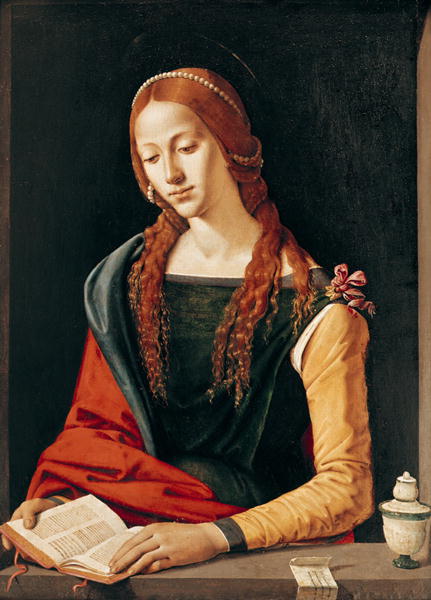
Mary Magdalene Reading (1500-1510), by Piero di Cosimo (1462-1521) [public domain / Wikimedia Commons]

***
(7-22-09)
*****
As I understand it, the notion that Mary Magdalene was a prostitute comes from conflating the woman who anointed Jesus’ feet (Luke 7) with Mary Magdalene. Luke 7:39 seems to imply that the woman described was a harlot (“what sort of woman this is” in RSV). The Bible itself doesn’t make this equation (at least not explicitly or directly). The Bible does plainly assert that she was cured of possession by seven demons (Lk 8:2; cf. Mk 16:9).
The Protestant New Bible Dictionary (edited by J. D. Douglas, Grand Rapids, Michigan, Eerdmans, 1962) states (“Mary”, p. 792):
-
- There is really no justification for identifying Mary of Bethany with Mary Magdalene, and certainly none for associating either with the sinful woman of Luke 7. . . . If Luke had known that the Mary of chapter 8 was the same person as the sinner of chapter 7 is it not probable that he would have made the connection explicit?
*
The Catholic Encyclopedia, however (“St. Mary Magdalen”), makes a different argument:
-
- The Greek Fathers, as a whole, distinguish the three persons:
-
- * the “sinner” of Luke 7:36-50;
-
- * the sister of Martha and Lazarus, Luke 10:38-42 and John 11; and
-
- * Mary Magdalen.
-
- On the other hand most of the Latins hold that these three were one and the same. Protestant critics, however, believe there were two, if not three, distinct persons. It is impossible to demonstrate the identity of the three; but those commentators undoubtedly go too far who assert, as does Westcott (on John 11:1), “that the identity of Mary with Mary Magdalene is a mere conjecture supported by no direct evidence, and opposed to the general tenour of the gospels.” It is the identification of Mary of Bethany with the “sinner” of Luke 7:37, which is most combatted by Protestants. It almost seems as if this reluctance to identify the “sinner” with the sister of Martha were due to a failure to grasp the full significance of the forgiveness of sin.
*
The article does concede that if we had only Luke’s Gospel to go by, this theory would be unsubstantiated:
- . . . here again we note that there is no suggestion of an identification of the three persons (the “sinner”, Mary Magdalen, and Mary of Bethany), and if we had only St. Luke to guide us we should certainly have no grounds for so identifying them.
*
But it goes on to make various deductive arguments from the book of John (none, I think, compelling) and concludes triumphantly:
- If the foregoing argument holds good, Mary of Bethany and the “sinner” are one and the same. But an examination of St. John’s Gospel makes it almost impossible to deny the identity of Mary of Bethany with Mary Magdalen.
*
So there was a tradition in western, Latin Catholicism, of one person (Mary Magdalene = Mary of Bethany = the sinner woman of Lk 7:36-50, who anointed Jesus’ feet). This article in The Catholic Encyclopedia was written by Hugh Pope in 1910. Not all traditions, however, carry equal weight, and not all are binding. Personally, I think the Greek fathers were right about this.
Nor do all Catholic sources agree with this older tradition. A Catholic Commentary on Holy Scripture, edited by Dom Bernard Orchard (London: Thomas Nelson & Sons, 1953) is a completely orthodox work, and it takes a different position. Commenting on Luke 7:36-50, it states:
- The similarities between this story and those recorded in Mt 26:6-13; Mk 14:3-9; Jn 12:1-8, have led to the opinion that the four evangelists narrate the same incident. Latin tradition since the time of St Gregory the Great has been in favour of identity; the general tradition among the Greeks (except for Origen) is that Lk’s incident is altogether different and most modern Catholic commentators adopt this view. It must be admitted that the divergences seem irreconcilable . . . There is nothing in Lk which justifies identifying her with Mary of Magdala, 8:2, or Mary of Bethany, 10:38 ff. Greek tradition generally distinguishes them all.
Note also that the Catholic Church in its first thousand years was composed of both Latin and Greek traditions. They were both Catholic. So it is not disallowed to believe that a Greek, or eastern exegetical tradition was more correct than a Latin (western) one. I think this is one such instance.
In the article, posted at Catholic News Service, “Scholars seek to correct Christian tradition on Mary Magdalene,”, written by Jerry Filteau, it is stated:
-
- In A.D. 591 Pope St. Gregory the Great preached a sermon in which he identified as one person the New Testament figures of Mary Magdalene, the sinful woman who anointed Jesus’ feet and washed them with her tears, and the Mary who was the sister of Lazarus and Martha of Bethany.
-
- Although he was only reflecting a tradition that had gained some ground in the West (and was resisted by many of the church’s early theologians), the sermon became a reference point for later scholarship, teaching and preaching in the West, Father Raymond F. Collins, a New Testament scholar at The Catholic University of America, said in an interview. . . .
-
- The identification of Mary Magdalene as a repentant sinful woman was solidified in the Latin Church for centuries by the use of that story, reported in the seventh chapter of Luke, as the Gospel reading for Mary Magdalene’s feast, July 22. In fact, in the Roman Calendar before the Second Vatican Council, the day was called the feast of “Mary Magdalene, penitent.”
-
- Father Collins noted that this changed in 1969 with the reform of the Roman Missal and the Roman Calendar. Since then the Gospel reading for Mary Magdalene’s feast has been Chapter 20, verses 1-2 and 11-18, of the Gospel of John.
This seems to have been a rather late tradition, in terms of the fathers, with Gregory Great living into the 7th century. Thus, it is not particularly compelling as proof that this exegetical tradition was apostolic, and preserved in the first five centuries (when most of the well-known Church fathers lived). Further research along those lines would yield fascinating results, I’m sure.
Fr. William Saunders, on the other hand, in his article, “Who Really Was Mary Magdalene?,” (Catholic Culture website), takes the traditional view expressed in The Catholic Encyclopedia.
The Catholics United for the Faith website put out a lengthy, informative article about Mary Magdalene, “St. Mary Magdalene: A Model Penitent,” taking the traditional western view also, but noted (importantly for our purposes):
- Either way, although ancient, this tradition is not to be confused with an essential aspect of the Catholic faith. There are many reasons to accept this tradition, but it is not a doctrine of the Church.
*
Catholics (as seen in the above conflicting understandings) are at liberty to differ on this question. In any event, whatever her sins were, St. Mary repented of them and became a great saint and early witness of the resurrected Jesus, and that is far more important than these other “identity” disputes.
***
Previous Post

April 20, 2016
Debates w Anti-Catholic Polemicists
Next Post

April 21, 2016 Virgin Mary: Woman of Revelation 12?
Browse Our Archives
Select a Category & Last Things About Me Anti-Catholicism Atheism & Agnosticism Baptism and Sacramentalism Bible and Tradition Blessed Virgin Mary Books by Dave Armstrong C. S. Lewis Calvinism & General Protestantism Catholic Apologetics Catholic Apologists Catholic conversion Catholic converts Christmas Church (Ecclesiology) Church History Conversion and Converts Development of Doctrine Eastern Orthodoxy Ecumenism & Christian Unity Eucharist & Liturgy Fathers of the Church French Translations G. K. Chesterton Hell Hell & Satan Hell & Satan & Last Things Heresies & Comparative Religion Holistic Health Inquisition & Crusades & Scandals James White Jews & Judaism & Old Testament John Calvin John Henry Newman Liberal / Modernist Theology Life Issues Literary Resume Lutheranism Mariology Martin Luther Music Orthodoxy Papacy & Infallibility Personal Page Philosophy & Science Political & Ethical & Moral Issues Protestant Persecution & Intolerance Protestantism Purgatory Purgatory & Penance Romantic & Imaginative Theology Saints & Purgatory & Penance Salvation Salvation & Justification Satan & Last Things Sexuality and Gender Issues Spanish Translations Traditionalism vs. Radical Catholic Reactionaries Traducciones al español / tradução para português Trinitarianism & Christology Uncategorized Videos
Select a Month October 2026 September 2026 August 2026 July 2026 June 2026 May 2026 April 2026 March 2026 February 2026 January 2026 December 2025 November 2025 October 2025 September 2025 August 2025 July 2025 June 2025 May 2025 April 2025 March 2025 February 2025 January 2025 December 2024 November 2024 October 2024 September 2024 August 2024 July 2024 June 2024 May 2024 April 2024 March 2024 February 2024 January 2024 December 2023 November 2023 October 2023 September 2023 August 2023 July 2023 June 2023 May 2023 April 2023 March 2023 February 2023 January 2023 December 2022 November 2022 October 2022 September 2022 August 2022 July 2022 June 2022 May 2022 April 2022 March 2022 February 2022 January 2022 December 2021 November 2021 October 2021 September 2021 August 2021 July 2021 June 2021 May 2021 April 2021 March 2021 February 2021 January 2021 December 2020 November 2020 October 2020 September 2020 August 2020 July 2020 June 2020 May 2020 April 2020 March 2020 February 2020 January 2020 December 2019 November 2019 October 2019 September 2019 August 2019 July 2019 June 2019 May 2019 April 2019 March 2019 February 2019 January 2019 December 2018 November 2018 October 2018 September 2018 August 2018 July 2018 June 2018 May 2018 April 2018 March 2018 February 2018 January 2018 December 2017 November 2017 October 2017 September 2017 August 2017 July 2017 June 2017 May 2017 April 2017 March 2017 February 2017 January 2017 December 2016 November 2016 October 2016 September 2016 August 2016 July 2016 June 2016 May 2016 April 2016 March 2016 February 2016 January 2016 December 2015 November 2015 October 2015 September 2015 August 2015 July 2015 June 2015 May 2015 April 2015 March 2015 February 2015 January 2015 December 2014 November 2014 October 2014 September 2014 August 2014 July 2014 June 2014 April 2014 March 2014 February 2014 January 2014 December 2013 November 2013 October 2013 September 2013 August 2013 July 2013 June 2013 April 2013 March 2013 February 2013 January 2013 December 2012 November 2012 October 2012 September 2012 August 2012 July 2012 June 2012 May 2012 April 2012 March 2012 February 2012 January 2012 December 2011 November 2011 October 2011 September 2011 August 2011 July 2011 June 2011 April 2011 March 2011 February 2011 October 2010 September 2010 August 2010 July 2010 April 2010 March 2010 December 2009 October 2009 August 2009 July 2009 June 2009 May 2009 March 2009 February 2009 October 2008 September 2008 April 2008 March 2008 February 2008 January 2008 December 2007 November 2007 October 2007 May 2007 March 2007 February 2007 January 2007 November 2006 October 2006 September 2006 August 2006 July 2006 June 2006 May 2006 April 2006 March 2006 February 2006 October 2005 June 2005 April 2005 February 2005 July 2004 May 2004 April 2004
Follow Us!
TAKE THE
Religious Wisdom Quiz
True or False: The Israelites were commanded to observe the Day of Atonement once a year.
Select your answer to see how you score.
TRUE FALSE
Books by This Author Books by Dave Armstrong
Related posts from Biblical Evidence for Catholicism

Bible & Catholicism on Mortal Sin (vs. John...
Biblical Evidence for Catholicism

Does Catholic Intercession of Saints Require Omniscience?
Biblical Evidence for Catholicism

Capabilities of Heavenly Saints: Protestant Commentaries
Biblical Evidence for Catholicism

Revelation 5 & 8 (Intercession of Saints &...
Biblical Evidence for Catholicism
TRENDING AT PATHEOS Catholic

Nearly every morning, I make the drive to Detroit with my high-school-age...

The Real AI Story Is Adoption Without Trust
Artificial intelligence has crossed a political threshold. It is no longer a...

A new article, written by Jeff Lindsay and Gale L. Pooley,...

Swimfan: Forgotten Aughts Pleasures
This is a recovery effort. In 2002, My Big Fat Greek Wedding...

Top Three Anti-Catholic Lies About Catholicism
This is my initial transcript for the video, "THE 3 WORST...

Pope Leo Celebrates Mass for Nurses & Docs...
I don't have any idea how he did it, but Pope Leo...
view all Catholic blogs
Ad-Free & Subscriber Log-In Subscription Support
- About Us
- 2026 Calendar
- Videos
- Podcasts
- Library of World Religions
- Faith In Media Tracker
- Advertise With Us
- Write for Us
- Privacy Policy
- Terms of Service
- Do Not Sell My Data
- Contact Us
- Radiant Digital
- Manage Newsletter Subscriptions
- Unsubscribe From Notifications
- Sitemap
Copyright 2008-2026, Patheos. All rights reserved.
Subscription Support Ad-Free & Subscriber Log-In
Follow Patheos