
BuddhistCatholicContemplativeEvangelicalGeneral ChristianHinduJewishLatter-day SaintMuslimNew VisionsProgressive Christian
Beliefs
- Buddhist
- Catholic
- Contemplative
- Evangelical
- General Christian
- Hindu
- Jewish
- Latter-day Saint
- More Voices
- Muslim
- New Visions
- Pagan
- Progressive Christian
Topics
- Religion News
- Food and Religion
- Sports and Religion
- Religious Art
- Religious Music and Entertainment
- Religious Events
- History and Religion
- Style and Religion
- Politics and Religion
- Women in Religion
- Recreation Outdoors and Religion
- Business Finance and Religion
- Careers Workplace and Religion
- Education and Religion
- Family Parenting and Religion
- Health Fitness and Religion
- Home and Religion
- Relationships and Religion
- Technology and Religion
- Travel and Religion
Columnists
- Buddhist Columnists
- Business Finance and Religion Columnists
- Careers Workplace and Religion Columnists
- Catholic Columnists
- Contemplative Columnists
- Education and Religion Columnists
- Evangelists Columnists
- Family Parenting and Religion Columnists
- General Christian Columnists
- Health Fitness and Religion Columnists
- Hindu Columnists
- History and Religion Columnists
- Home and Religion Columnists
- Jewish Columnists
- More Voices Columnists
- Latter Day Columnists
- Muslim Columnists
- New Visions Columnists
- Nonreligious Columnists
- Pagan Columnists
- Politics and Religion Columnists
- Progressive Columnists
- Recreation Outdoors and Religion Columnists
- Relationships and Religion Columnists
- Religion News Columnists
- Religious Art Columnists
- Religious Events Columnists
- Religious Music and Entertainment Columnists
- Sports and Religion Columnists
- Style and Religion Columnists
- Technology and Religion Columnists
- Travel and Religion Columnists
- Women in Religion Columnists
Resource Library
- 2026 Calendar
- Library of World Religions
- The 100 Most Holy Places on Earth
- Patheos Answers
- Podcasts
- Videos
- Faith Leaders Database
- Anglican Episcopalian
- Bahai
- Baptist
- Buddhism
- Christianity
- Confucianism
- Eastern Orthodoxy
- Hinduism
- Holiness and Pentecostal
- ISKCON
- Islam
- Judaism
- Lutheran
- Methodist
- The Church of Jesus Christ of Latter-day Saints
- New Age
- Paganism
- Presbytarian and Reformed
- Protestantism
- Religion Behind the Scenes
- Roman Catholic
- Scientology
- Shia Islam
- Sikhism
- Sufism
- Sunni Islam
- Taoism
- Zen
- See all religions
Research Tools
 Ad-Free & Subscriber Log-In Subscription Support
Ad-Free & Subscriber Log-In Subscription Support
Follow Patheos 

- Trending:
- Forgiveness
- |
- Marriage
- |
- Consciousness
- |
- Death Penalty
- |
- Election
- |
- Halloween

-
About
-
Catholic Apologetics
-
Church History
-
Great Apologists
-
Christian Worldview
-
Protestantism & Misc.
- Home
- Catholic
- History and Religion
- My Supposed “Hybrid” Post-Conversion Faith
My Supposed “Hybrid” Post-Conversion Faith
Last updated on: March 1, 2017 at 12:30 pm by Dave Armstrong
My Supposed “Hybrid” Post-Conversion Faith 2017-03-01T12:30:01-04:00 Dave Armstrong
Patheos Explore the world's faith through different perspectives on religion and spirituality! Patheos has the views of the prevalent religions and spiritualities of the world.
“Neither Fish Nor Fowl”
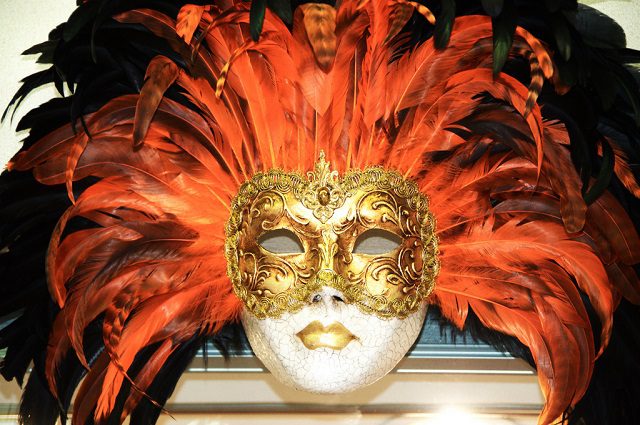
Venetian Carnival Mask. Photo by “gnuckx”: 30 May 2010 [Flickr / CC BY 2.0 license]
(9-19-06)
***
I love these cynical often fact-free analyses of my conversion and supposed ultimate theological commitments. Steve Hays, of Triablogue fame (no dummy, though still somehow an anti-Catholic) just doesn’t get it. I don’t think he ever will, because these things are so elementary. Having failed (just like James White) in his attempt to play the “ignorance card” with regard to my conversion, he now resorts to what might be called the “chameleon” or “sheep in wolves’ clothing” special pleading rationale, to try to explain away a Catholic convert. I’m not really a Catholic, you see. That’s the key. Neither is Scott Hahn (with whom I’m honored to be mentioned in the same sentence). Rather than elaborate further, I’ll simply cite Steve’s words, from his post on the topic, about yours truly.
*****
I had written in his comboxes:
In the position you are in, it was wise to use evasive humor. If you continue to admit that I may still (possibly) be in a state of grace and refuse to apply the word “apostate” (and all the unsavory aspects that conjures up) to me, then you have to deal with your less charitable mates like DJP and no doubt many other fans of yours who think like he does.
If you change your mind, then I believe you will have to struggle with a great deal of cognitive dissonance and explain how an apostate unregenerate person can write all the stuff that I write, much of which even you would agree with, including, e.g., my strong defenses of the Bible just last night in responding to Ed Babinski on the “last days” / false prophecy issue.
So either way, you’d be in the hot seat, now that your mythical scenario of my alleged former blissful ignorance and superficiality was shown to be precisely that: blissfully ignorant and superficial.
I don’t fit into the category you thought I was in. And I know that gives you pause, because you are a thoughtful person, and know better than to make the silly quick judgments of folks like DJP (who couldn’t even comprehend my half-jesting reply) and travis, etc.
You may not admit this publicly, but it doesn’t take a rocket scientist . . . even this little crack of sorts gives me hope that you can reason your way out of the morass of self-defeating anti-Catholicism some time in the not-too-distant future.
Steve cited that and then “replied” (all emphases added):
2.I also draw a distinction between the laity and the clergy. Someone like Rahner, Raymond Brown, or Benedict XVI is going to be far more self-consciously consistent about his theological commitments than the average layman.
There are Catholic laymen who, because they’re involved in group Bible studies with their Evangelical friends and coworkers, end up with a personal theology that is more Evangelical than their church.
3.Apropos (2), many Evangelical immigrants to Rome bring along a certain amount of contraband theology stashed away in their luggage.
As I’ve observed in the past, they are often far more conservative than cradle Catholics or the clergy. Indeed, they’re often at odds with their adopted denomination.
So guys like Dave Armstrong and Scott Hahn present an artificially Evangelicalized version of Roman Catholicism.
Consider Hahn’s use of covenant theology to defend and explicate Catholic dogma. This is clearly a carryover from his Presbyterian past.
He’s grafting elements of one theological system onto elements of an opposing theological system.
So they end up with a sterile hybrid theology that isn’t consistently Catholic or Protestant.
4.The reason that an apologist like Hahn is successful in bringing Evangelical fence-straddlers over to the Rome fold is precisely the because he has erected an Evangelicaloid bridge between the two traditions.
When Evangelicals read about his version of Catholicism, it looks uncannily familiar. A family resemblance. They’ve seen it before. The shock of recognition. A long lost son. Twins separated at birth. This is what we always believed!
5.When they present Catholicism, the outside surface of the door has a heavy coat of Evangelical paint, while the inside surface of the door has a Catholic coat of paint.
Kind of like the Gingerbread house in Hansel and Gretel – with Evangelical icing, sprinkles, gum drops, M&Ms;, marshmallows, and candy canes on the outside, along with a yummy aroma from the chimney.
And later in the comments:
I don’t read Catholic popularizers and lay apologetes to learn about Catholic theology.
I read them to study the bad arguments for Catholicism.
. . . The RCC turned its back on the Gospel with the Council of Trent.
- In addition, Vatican II codified modernism.
. . . there’s nothing to prevent the RCC from going the way of the other liberalizing and dying mainline denominations.
* * * * *
This was brought to you for both humorous and educational purposes: I know, it is very funny (while sad at the same time), but we need to know how our evangelical friends regard us (particularly us lowly, “hybrid” convert-types). Whatever truth they see in our views, they will tend to say came from Protestantism, but in their ignorance of the extent of the common ground between Catholics and Protestants, they often seem to be unable to comprehend that a good thing in Catholic theology might have no particular reference to Protestantism, either historically or theologically.
So, for example (it’s happened a million times), a person of this perspective might see me defending material sufficiency of Scripture and simply regard that as “sola Scriptura light.” It is not; it is a perfectly Catholic point of view, which doesn’t deny the authority of Tradition or Church in the least. It is assumed that any significant interest in the Bible must be latent Protestantism (particularly, in a convert).
Well, in a sense I can say (even with a degree of pride and affection for my past) that my interest in the Bible stemmed from my evangelical experience, because that is where I first learned to love the Bible and cherish and study it (and evangelicalism excels in, and is to be highly commended for, teaching this very thing). It doesn’t follow, however, that Catholicism is “anti-Bible,” simply because I learned it there before my conversion, or because your average Protestant is more biblically-literate than your average Catholic. Nor does it follow that everyone who loves the Bible must be a closet proponent of sola Scriptura.
Nothing – repeat, NOTHING I do or believe now is inconsistent with magisterial Catholicism in the least. I may emphasize the Bible relatively more, because:
- it is true that I do love to do Bible study,
and
- this is the language that reaches Protestants, who constitute my primary “target audience” for my apologetics.
But that is altogether a “Catholic thing” as well as a “Protestant thing.” Catholics have defended the faith from the Bible since Christian time immemorial (see the Fathers). It’s the same with sola gratia, which we fully believe. Catholics aren’t Pelagians. When we say we are saved by God’s grace and it alone, we aren’t closet evangelicals, or ignorant Catholics, but good, Tridentine Catholics. We don’t even have to deny all soteriological imputation altogether or some measure of “faith alone.”
Or I may write about God’s providence and predestination: both very Catholic things. I may defend the Holy Trinity or the Two Natures of Jesus, or evangelize, or go to prayer meetings, or seek mystical experiences with God, or be a charismatic, or feed the hungry. Ditto. It’s all “Catholic.” I’m a Catholic. I accept all that the Church teaches; all her dogmas, and in fact, I believe (following my mentor Fr. Hardon and statements in St. Thomas Aquinas and Cardinal Newman) that anyone who doubts any dogma of the Catholic faith has lost the supernatural virtue of faith.
That’s what I am. Now Steve can play games with the “ignorant Catholic who makes it to salvation despite the Church, blah blah blah” card all he likes, but it won’t work with me. I was no ignorant Protestant, and I am no cafeteria Catholic. He tried to make out that I was a stupid Protestant, and now an equally clueless Catholic who doesn’t know the teachings of his own Church. It’s a losing, desperate effort. He’ll deny implying this out of one side of his mouth, yet anyone can see what he is driving at in this present post.
Give it up, Steve. I know you said you liked me as a person and you seem most reluctant to label me as an apostate. It’s good to be charitable and nuanced, but your anti-Catholic view (not Protestantism per se, but only the fringe anti-Catholic aspect of a tiny group of Protestants) demands the charge of apostasy in my case. I willfully rejected certain false teachings of Protestantism (while continuing to joyfully acknowledge many more things that we both hold in common) and accepted the complete teaching of the Catholic Church with sufficient understanding and full consent of the will (and, I might add, great joy).
Therefore, based on your belief that the Catholic Church is “an apostate denomination” (stated later in this same paper), I MUST be an apostate (at least in a “theological, doctrinal” outward sense), since I accept all that teaching (and I understand perfectly well what it is that I accept: not in the sense of exhaustive knowledge, of course, but in terms of the particular tenets and doctrines that Catholics are required to accept and believe in faith). There is no logical way out of this. That’s why I said that your anti-Catholicism will cause you cognitive dissonance somewhere down the line. But the “hybrid” sophistry is obviously the way you rationalize seeming difficulties in explaining how folks who obviously love the Bible and know a bit of theology, like myself and Scott Hahn, can manage to merge that with allegiance to Catholicism.
It’s because it’s fully Christian, my friend . . . the sooner you grasp that, the better off you’ll be. You may disagree with this, that, and the other (just as you do with your hundreds of fellow Protestant denominations), but it is a Christian system. And unless it is regarded as that, there is no possible logical way to regard Protestantism as a Christian system. It is either both or neither. The true “hybrid” here, therefore, is your viciously self-defeating, ludicrous anti-Catholicism, not the allegiance of a former evangelical Protestant to Catholicism in its fullness and entirety.
Previous Post
April 5, 2016
On Mystery & Reason in Theology
Next Post
April 5, 2016 Do Catholics Excommunicate People to Hell?
Browse Our Archives
Select a Category & Last Things About Me Anti-Catholicism Atheism & Agnosticism Baptism and Sacramentalism Bible and Tradition Blessed Virgin Mary Books by Dave Armstrong C. S. Lewis Calvinism & General Protestantism Catholic Apologetics Catholic Apologists Catholic conversion Catholic converts Christmas Church (Ecclesiology) Church History Conversion and Converts Development of Doctrine Eastern Orthodoxy Ecumenism & Christian Unity Eucharist & Liturgy Fathers of the Church French Translations G. K. Chesterton Hell Hell & Satan Hell & Satan & Last Things Heresies & Comparative Religion Holistic Health Inquisition & Crusades & Scandals James White Jews & Judaism & Old Testament John Calvin John Henry Newman Liberal / Modernist Theology Life Issues Literary Resume Lutheranism Mariology Martin Luther Music Orthodoxy Papacy & Infallibility Personal Page Philosophy & Science Political & Ethical & Moral Issues Protestant Persecution & Intolerance Protestantism Purgatory Purgatory & Penance Romantic & Imaginative Theology Saints & Purgatory & Penance Salvation Salvation & Justification Satan & Last Things Sexuality and Gender Issues Spanish Translations Traditionalism vs. Radical Catholic Reactionaries Traducciones al español / tradução para português Trinitarianism & Christology Uncategorized Videos
Select a Month October 2026 September 2026 August 2026 July 2026 June 2026 May 2026 April 2026 March 2026 February 2026 January 2026 December 2025 November 2025 October 2025 September 2025 August 2025 July 2025 June 2025 May 2025 April 2025 March 2025 February 2025 January 2025 December 2024 November 2024 October 2024 September 2024 August 2024 July 2024 June 2024 May 2024 April 2024 March 2024 February 2024 January 2024 December 2023 November 2023 October 2023 September 2023 August 2023 July 2023 June 2023 May 2023 April 2023 March 2023 February 2023 January 2023 December 2022 November 2022 October 2022 September 2022 August 2022 July 2022 June 2022 May 2022 April 2022 March 2022 February 2022 January 2022 December 2021 November 2021 October 2021 September 2021 August 2021 July 2021 June 2021 May 2021 April 2021 March 2021 February 2021 January 2021 December 2020 November 2020 October 2020 September 2020 August 2020 July 2020 June 2020 May 2020 April 2020 March 2020 February 2020 January 2020 December 2019 November 2019 October 2019 September 2019 August 2019 July 2019 June 2019 May 2019 April 2019 March 2019 February 2019 January 2019 December 2018 November 2018 October 2018 September 2018 August 2018 July 2018 June 2018 May 2018 April 2018 March 2018 February 2018 January 2018 December 2017 November 2017 October 2017 September 2017 August 2017 July 2017 June 2017 May 2017 April 2017 March 2017 February 2017 January 2017 December 2016 November 2016 October 2016 September 2016 August 2016 July 2016 June 2016 May 2016 April 2016 March 2016 February 2016 January 2016 December 2015 November 2015 October 2015 September 2015 August 2015 July 2015 June 2015 May 2015 April 2015 March 2015 February 2015 January 2015 December 2014 November 2014 October 2014 September 2014 August 2014 July 2014 June 2014 April 2014 March 2014 February 2014 January 2014 December 2013 November 2013 October 2013 September 2013 August 2013 July 2013 June 2013 April 2013 March 2013 February 2013 January 2013 December 2012 November 2012 October 2012 September 2012 August 2012 July 2012 June 2012 May 2012 April 2012 March 2012 February 2012 January 2012 December 2011 November 2011 October 2011 September 2011 August 2011 July 2011 June 2011 April 2011 March 2011 February 2011 October 2010 September 2010 August 2010 July 2010 April 2010 March 2010 December 2009 October 2009 August 2009 July 2009 June 2009 May 2009 March 2009 February 2009 October 2008 September 2008 April 2008 March 2008 February 2008 January 2008 December 2007 November 2007 October 2007 May 2007 March 2007 February 2007 January 2007 November 2006 October 2006 September 2006 August 2006 July 2006 June 2006 May 2006 April 2006 March 2006 February 2006 October 2005 June 2005 April 2005 February 2005 July 2004 May 2004 April 2004
Follow Us!
TAKE THE
Religious Wisdom Quiz
Proverbs warns against what kind of woman as a symbol of temptation?
Select your answer to see how you score.
Widow Mother-in-law Queen Adulterous woman
Books by This Author Books by Dave Armstrong
Related posts from Biblical Evidence for Catholicism

On Protestant Explanations of Catholic Conversion
Biblical Evidence for Catholicism

Three More Anti-Catholic Lies About Catholicism (#6-4)
Biblical Evidence for Catholicism

Top Ten Anti-Catholic Lies (#10-7)
Biblical Evidence for Catholicism

"Baptism" & Romans 10 (Engwer's Silly Word Games)
Biblical Evidence for Catholicism
TRENDING AT PATHEOS Catholic

The Sermon on the Mount, Part I: Matthew...
The Sermon on the Mount, Part I (Matthew 4:12-5:12) St. Matthew moves...

What's up from Crossway: Reviewing some of their latest A few weeks...

Janie Learns the Way of the Cross: A...
Teaching children about Jesus' Passion can be challenging. Many parents and educators...

Looking For Good Catholic Writing - October 2026
He alone extends the heavens, and he walks upon the waves of...

In "Irreplaceable," our book on vocation and technology, Trevor Sutton and I...

I was strolling through the top floor of the brand new Parthenon...
view all Catholic blogs
Ad-Free & Subscriber Log-In Subscription Support
- About Us
- 2026 Calendar
- Videos
- Podcasts
- Library of World Religions
- Faith In Media Tracker
- Advertise With Us
- Write for Us
- Privacy Policy
- Terms of Service
- Do Not Sell My Data
- Contact Us
- Radiant Digital
- Manage Newsletter Subscriptions
- Unsubscribe From Notifications
- Sitemap
Copyright 2008-2026, Patheos. All rights reserved.
Subscription Support Ad-Free & Subscriber Log-In
Follow Patheos