
BuddhistCatholicContemplativeEvangelicalGeneral ChristianHinduJewishLatter-day SaintMuslimNew VisionsProgressive Christian
Beliefs
- Buddhist
- Catholic
- Contemplative
- Evangelical
- General Christian
- Hindu
- Jewish
- Latter-day Saint
- More Voices
- Muslim
- New Visions
- Pagan
- Progressive Christian
Topics
- Religion News
- Food and Religion
- Sports and Religion
- Religious Art
- Religious Music and Entertainment
- Religious Events
- History and Religion
- Style and Religion
- Politics and Religion
- Women in Religion
- Recreation Outdoors and Religion
- Business Finance and Religion
- Careers Workplace and Religion
- Education and Religion
- Family Parenting and Religion
- Health Fitness and Religion
- Home and Religion
- Relationships and Religion
- Technology and Religion
- Travel and Religion
Columnists
- Buddhist Columnists
- Business Finance and Religion Columnists
- Careers Workplace and Religion Columnists
- Catholic Columnists
- Contemplative Columnists
- Education and Religion Columnists
- Evangelists Columnists
- Family Parenting and Religion Columnists
- General Christian Columnists
- Health Fitness and Religion Columnists
- Hindu Columnists
- History and Religion Columnists
- Home and Religion Columnists
- Jewish Columnists
- More Voices Columnists
- Latter Day Columnists
- Muslim Columnists
- New Visions Columnists
- Nonreligious Columnists
- Pagan Columnists
- Politics and Religion Columnists
- Progressive Columnists
- Recreation Outdoors and Religion Columnists
- Relationships and Religion Columnists
- Religion News Columnists
- Religious Art Columnists
- Religious Events Columnists
- Religious Music and Entertainment Columnists
- Sports and Religion Columnists
- Style and Religion Columnists
- Technology and Religion Columnists
- Travel and Religion Columnists
- Women in Religion Columnists
Resource Library
- 2026 Calendar
- Library of World Religions
- The 100 Most Holy Places on Earth
- Patheos Answers
- Podcasts
- Videos
- Faith Leaders Database
- Anglican Episcopalian
- Bahai
- Baptist
- Buddhism
- Christianity
- Confucianism
- Eastern Orthodoxy
- Hinduism
- Holiness and Pentecostal
- ISKCON
- Islam
- Judaism
- Lutheran
- Methodist
- The Church of Jesus Christ of Latter-day Saints
- New Age
- Paganism
- Presbytarian and Reformed
- Protestantism
- Religion Behind the Scenes
- Roman Catholic
- Scientology
- Shia Islam
- Sikhism
- Sufism
- Sunni Islam
- Taoism
- Zen
- See all religions
Research Tools
 Ad-Free & Subscriber Log-In Subscription Support
Ad-Free & Subscriber Log-In Subscription Support
Follow Patheos 

- Trending:
- Forgiveness
- |
- Marriage
- |
- Consciousness
- |
- Death Penalty
- |
- Election
- |
- Halloween

-
About
-
Catholic Apologetics
-
Church History
-
Great Apologists
-
Christian Worldview
-
Protestantism & Misc.
- Home
- Catholic
- History and Religion
- How to Receive Communion: Tradition & Abuses
How to Receive Communion: Tradition & Abuses
Last updated on: February 27, 2017 at 2:11 pm by Dave Armstrong
How to Receive Communion: Tradition & Abuses 2017-02-27T14:11:59-04:00 Dave Armstrong
Patheos Explore the world's faith through different perspectives on religion and spirituality! Patheos has the views of the prevalent religions and spiritualities of the world.
Including Discussion of Extraordinary Ministers of Holy Communion
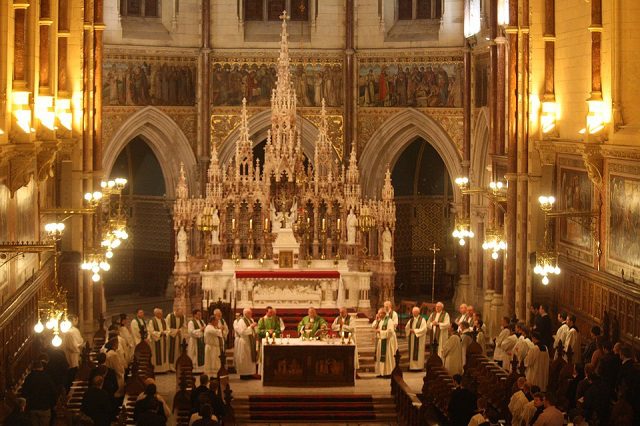
Mass at an Irish Seminary [public domain / Pixabay]
***
(28 January 2000; a few minor revisions made on 27 April 2016, and listing of related papers added)
***
[words of others in my old discussion list are in blue]
*****
Ok, this is how Holy Communion is given in every single Catholic church within driving distance of me: Most churches now have ushers that will stand at the head of your pew when it’s your “turn” to go up. We remain kneeling until our turn. We then stand, form a line behind those ahead of us, and walk slowly toward the Priest or Deacon, or server. They lift the Host, say “This is the Body of Christ” (although some simply say “The Body of Christ”), we say “Amen”, and cross ourselves, and either offer our hands, or open our mouths . Most who receive “in the hand” step to the side, face the altar, and cross themselves, but I’ve noticed some don’t do that. Most receive “in the hand” – I almost never see anyone receive “by mouth” any more.
I receive in the mouth except on rare occasions where I am at a church where virtually everyone receives in the hand. Since we have altar rails in the front of our church where one kneels to receive Holy Communion, I am kneeling when I receive. I bow before I receive at other churches where people are standing. And I seek out the priest if at all possible, because in most churches, it is unnecessary to have so many eucharistic ministers — just your typical American pragmatism and being-in-a-hurry, in my opinion.
And I think there are liberal and impious overtones to that: all these people (though well-intentioned in most cases, no doubt) are up on the altar. A friend of mine calls them “busybodies.” I rather like that. It takes away the sole prerogatives of the priest in a subtle way. I know, it’s subjective, and not absolute, yet liberal theological notions and liturgical abuses have a way of creeping in; a sort of diabolical incrementalism (just as in politics and morality).
At every church I’ve been to (for ten years now). I have always seen someone who receives in the mouth. It is not a liturgical absolute, but it should be recognized that this was the norm until recently. Fr. Peter M. J. Stravinskas, in his The Catholic Answer Book (Huntington, Indiana: Our Sunday Visitor, 1990, pp. 92-99), informs us of the following:
- Communion in the hand, standing, was the norm for the first few centuries.
- As eucharistic doctrine developed and abuses increased, the Church mandated that communion was to be on the tongue only (by the early Middle Ages).
- Communion on the tongue is still the universal practice for the churches of the East, both Catholic and Orthodox.
- During the Protestant Revolt, communion in the hand became a way of asserting the priesthood of the laity and a symbol of the denial of the Real Presence; therefore the Catholic Church held firm.
- Liberal Catholic countries such as Holland, France, and Canada began experimenting with communion in the hand in the late 60s.
- Pope Paul VI, in the 1969 document Memoriale Domini, outlined all the reasons why communion in the hand was inadvisable and why the traditional method was to be preferred and maintained. But he allowed a “loophole” for countries which had begun the practice illicitly to petition the Holy See for permission.
- In 1977 a bare majority of bishops in the United States — going against the local tradition- – voted for communion in the hand and received permission to introduce the practice.
- Most countries in the world do not permit communion in the hand.
[ . . .]- No one can be forced to stand to receive communion.
- No one can be denied the right to receive on the tongue.
- For the above reasons, Pope John Paul II frowns upon the practice of communion in the hand. It is against universal liturgical law.
- John Paul II has specifically addressed these matters in Inaestimabile Donum, in which he spoke forcefully against several eucharistic abuses.
- John Paul II has repeatedly spoken out strongly against lay people distributing Holy Communion unnecessarily. He has said that priests who fail to minister the Eucharist themselves exhibit a “reprehensible attitude.”
- The Pontifical Commission for the Authentic Interpretation of the Code of Canon Law stated that lay people are never to serve as extraordinary ministers of the Eucharist when sufficient priests and deacons are available (not just ones who are celebrants of the Mass).
[ . . . ]- Lay Eucharistic ministers, according to Immensae Caritatis (Pope Paul VI’s decree permitting this practice) and the revised Code of Canon Law, are only supposed to be used in these circumstances:
a) Lack of a priest, deacon, or acolyte;
b) Inability of the priest to function due to health or advanced age;
c) A very large number of communicants.
Fr. Stravinskas writes (pp. 92-95):
The lived reality in the United States has had negative consequences. This is one of the most serious problems to emerge in the postconciliar Church in America, since it touches on the very heart of the Catholic Faith and practice . . . in a most visible way, affecting every Catholic . . .
By permitting nearly anyone at all to distribute the Eucharist, we are communicating a message at the symbolic level that this action is really not all that special. What is anyone’s responsibility is no one’s responsibility . . .
[This] fosters the American ‘in and out’ mentality of Sunday Mass . . . This approach, though almost always innocent, nonetheless culminates in a desacralization of the Church, the Eucharist, and the priesthood . . .
The whole point of the [Second Vatican] council’s theology of the laity was that the laity had their own unique role to play in bringing the Gospel to contemporary humanity – in the world, not in the sanctuary . . .
The role of the priest is to preach and administer the sacraments, so that the laity can be faithful witnesses in the world, thus inviting people there to follow Christ . . .
Please note that we are not concerned with heresy here but with an imprudent, unwise liturgical practice, reflective of bad sociology. Like other Americanisms in the Church, this one fails to take a holistic view of reality, neglects long-range implications, and does not take seriously the nonverbal, symbolic power of liturgical communication . . .
The Church refers to [eucharistic servers] as extraordinary ministers of Holy Communion. They are so called because they are to function only in extraordinary circumstances . . .
And we wonder why people lose their Faith in the Real Presence and even leave the Church!
They seem to be reverent, as far as I can tell. No one stuffing their mouth casually as they fish in their pocket for their car keys!!
That is not at issue, but there are larger, troubling implications, as indicated above. Something has to explain the loss of faith in the Real Presence. These factors, though no doubt not the only ones, seem to me to be plausible explanations of much of the loss of traditional faith and understanding. The whole point of ritual is to represent and to “positively condition” a deeper reality (the Real Presence). Change the ritual, and you undermine the reality. It seems obvious to me. And so we have seen a mass exodus from Catholic orthodoxy around the world.
Then you return to your seat, kneel, pray, and remain kneeling until [the dismissal].
Fr. Stravinskas notes the irony that many people meditate in their seats for a time, equaling that which the whole process would take without the lay servers. So if time is truly an issue, they should skidaddle out the door; otherwise, why all the servers?
In any Catholic church I’ve attended here in Western New England, not when I lived in Central Florida either, nor when we lived in North Central Ohio, not in my mom’s church in Central Mass, not in my college church in Boston, not in the very Lithuanian church my grandfather attended in Upstate NY. Never seen it done that way, never. Not in over 30 years of going to church, not in over 30 years of people watching…sorry…
Very sad. And of course all these ostensibly pious, devout, good people are among those who deny the Real Presence and the wrongness of contraception. The issue of receiving in mortal sin is another very serious problem, which I will not deal with here.
The only “lack of reverence” I see is in those who boogie out the door as Communion starts, because they want to get out of the parking lot before “rush hour”… that really bugs me…
Sure; but again, the issue is a much larger one than merely the inner dispositions and outer countenance of those in the communion line. It has to do with symbol and sacrament, a sense of the sacred and of mystery, and of the awesome event which is taking place at every Mass: Christ coming to us: body, blood, soul, and divinity. Those things are undermined by many of these practices, in my humble opinion.
That’s a large part of the reason I attend a very traditional church, and why I prefer Latin Mass (Novus Ordo).
*****
Note: this paper is from the year 2000. My position has developed and modified somewhat since then (but not greatly). I’ve certainly engaged the various arguments and opinions in much greater depth than I did in this post, which was mostly citing Fr. Stravinskas. See other related papers:
Dialogue: Receiving Communion (vs. Traditionalist) [6-25-08]
Posture During the “Our Father” & the Rubrics [7-7-08]
Extraordinary Over-Use of Extraordinary Ministers [11-20-08]
Dialogue w Priests on “Eucharistic Ministers” [12-1-08]
Thoughts on Communion in the Hand (7-13-11)
Kneeling for Communion & Worship (Etc.) [1-23-13]
Michael Voris & Historic Communion in the Hand (Standing) [8-8-13]
The Preference of Receiving Holy Communion from a Priest [12-18-13]
Communion in the Hand, Standing (Norm till 500-900 AD) [9-3-15]
Thoughts: Communion in the Hand & Reverence [9-4-15]
Reverence of Hand-Communion: Biblical Evidence [9-5-15]
St. Augustine’s Holy Communion [10-4-15]
*****
Meta Description: Discussion of the issues of proper reverence & piety at Mass, including bodily posture & reception of Holy Communion.
Meta Keywords: Communion in the hand, communion on the tongue, Holy communion, interior disposition, kneeling for communion, liturgy, piety, Real presence, reverence, solemnity, The Mass, transubstantiation, worship from the heart, eucharistic ministers, eucharistic ministers of Holy Communion, EMHC
eucharistic ministers of Holy Communion
Previous Post
April 26, 2016
Answers for Protestant Eucharist Questions
Next Post
April 27, 2016 Catholic Closed Communion: A Defense
Browse Our Archives
Select a Category & Last Things About Me Anti-Catholicism Atheism & Agnosticism Baptism and Sacramentalism Bible and Tradition Blessed Virgin Mary Books by Dave Armstrong C. S. Lewis Calvinism & General Protestantism Catholic Apologetics Catholic Apologists Catholic conversion Catholic converts Christmas Church (Ecclesiology) Church History Conversion and Converts Development of Doctrine Eastern Orthodoxy Ecumenism & Christian Unity Eucharist & Liturgy Fathers of the Church French Translations G. K. Chesterton Hell Hell & Satan Hell & Satan & Last Things Heresies & Comparative Religion Holistic Health Inquisition & Crusades & Scandals James White Jews & Judaism & Old Testament John Calvin John Henry Newman Liberal / Modernist Theology Life Issues Literary Resume Lutheranism Mariology Martin Luther Music Orthodoxy Papacy & Infallibility Personal Page Philosophy & Science Political & Ethical & Moral Issues Protestant Persecution & Intolerance Protestantism Purgatory Purgatory & Penance Romantic & Imaginative Theology Saints & Purgatory & Penance Salvation Salvation & Justification Satan & Last Things Sexuality and Gender Issues Spanish Translations Traditionalism vs. Radical Catholic Reactionaries Traducciones al español / tradução para português Trinitarianism & Christology Uncategorized Videos
Select a Month October 2026 September 2026 August 2026 July 2026 June 2026 May 2026 April 2026 March 2026 February 2026 January 2026 December 2025 November 2025 October 2025 September 2025 August 2025 July 2025 June 2025 May 2025 April 2025 March 2025 February 2025 January 2025 December 2024 November 2024 October 2024 September 2024 August 2024 July 2024 June 2024 May 2024 April 2024 March 2024 February 2024 January 2024 December 2023 November 2023 October 2023 September 2023 August 2023 July 2023 June 2023 May 2023 April 2023 March 2023 February 2023 January 2023 December 2022 November 2022 October 2022 September 2022 August 2022 July 2022 June 2022 May 2022 April 2022 March 2022 February 2022 January 2022 December 2021 November 2021 October 2021 September 2021 August 2021 July 2021 June 2021 May 2021 April 2021 March 2021 February 2021 January 2021 December 2020 November 2020 October 2020 September 2020 August 2020 July 2020 June 2020 May 2020 April 2020 March 2020 February 2020 January 2020 December 2019 November 2019 October 2019 September 2019 August 2019 July 2019 June 2019 May 2019 April 2019 March 2019 February 2019 January 2019 December 2018 November 2018 October 2018 September 2018 August 2018 July 2018 June 2018 May 2018 April 2018 March 2018 February 2018 January 2018 December 2017 November 2017 October 2017 September 2017 August 2017 July 2017 June 2017 May 2017 April 2017 March 2017 February 2017 January 2017 December 2016 November 2016 October 2016 September 2016 August 2016 July 2016 June 2016 May 2016 April 2016 March 2016 February 2016 January 2016 December 2015 November 2015 October 2015 September 2015 August 2015 July 2015 June 2015 May 2015 April 2015 March 2015 February 2015 January 2015 December 2014 November 2014 October 2014 September 2014 August 2014 July 2014 June 2014 April 2014 March 2014 February 2014 January 2014 December 2013 November 2013 October 2013 September 2013 August 2013 July 2013 June 2013 April 2013 March 2013 February 2013 January 2013 December 2012 November 2012 October 2012 September 2012 August 2012 July 2012 June 2012 May 2012 April 2012 March 2012 February 2012 January 2012 December 2011 November 2011 October 2011 September 2011 August 2011 July 2011 June 2011 April 2011 March 2011 February 2011 October 2010 September 2010 August 2010 July 2010 April 2010 March 2010 December 2009 October 2009 August 2009 July 2009 June 2009 May 2009 March 2009 February 2009 October 2008 September 2008 April 2008 March 2008 February 2008 January 2008 December 2007 November 2007 October 2007 May 2007 March 2007 February 2007 January 2007 November 2006 October 2006 September 2006 August 2006 July 2006 June 2006 May 2006 April 2006 March 2006 February 2006 October 2005 June 2005 April 2005 February 2005 July 2004 May 2004 April 2004
Follow Us!
TAKE THE
Religious Wisdom Quiz
Who asked Jesus, "What is truth?"
Select your answer to see how you score.
Caiaphas Pilate Nicodemus Herod
Books by This Author Books by Dave Armstrong
Related posts from Biblical Evidence for Catholicism

Top Ten Anti-Catholic Lies (#10-7)
Biblical Evidence for Catholicism

The Mass & Development of Doctrine (vs. Wes...
Biblical Evidence for Catholicism

Miraculous Eucharist (vs. Francois Turretin #4)
Biblical Evidence for Catholicism

God's Presence, the Ark, the Eucharist, & Death
Biblical Evidence for Catholicism
TRENDING AT PATHEOS Catholic

I was strolling through the top floor of the brand new Parthenon...

What Does Gêvâh Mean For Kimberley Guifoyle &...
This week, a lot of the news is focused on Kimberly Guilfoyle....

INNER CIRCLE: Profound Mystery (Of Christ In All...
Ephesians 5:31-32 “For this reason, a man will leave his father and...

Do Not Rejoice When Your Enemy Falls: The...
Turning an execution into a public spectacle is a disturbing expression of...

'The Chosen' S6 Trailer: The Passion Gets Very...
Not many watching 'The Chosen' worry about spoilers, but just because they...

The purpose-driven labor priest
A labor activist reads Rick Warren and it gets me wondering about...
view all Catholic blogs
Ad-Free & Subscriber Log-In Subscription Support
- About Us
- 2026 Calendar
- Videos
- Podcasts
- Library of World Religions
- Faith In Media Tracker
- Advertise With Us
- Write for Us
- Privacy Policy
- Terms of Service
- Do Not Sell My Data
- Contact Us
- Radiant Digital
- Manage Newsletter Subscriptions
- Unsubscribe From Notifications
- Sitemap
Copyright 2008-2026, Patheos. All rights reserved.
Subscription Support Ad-Free & Subscriber Log-In
Follow Patheos