
BuddhistCatholicContemplativeEvangelicalGeneral ChristianHinduJewishLatter-day SaintMuslimNew VisionsProgressive Christian
Beliefs
- Buddhist
- Catholic
- Contemplative
- Evangelical
- General Christian
- Hindu
- Jewish
- Latter-day Saint
- More Voices
- Muslim
- New Visions
- Pagan
- Progressive Christian
Topics
- Religion News
- Food and Religion
- Sports and Religion
- Religious Art
- Religious Music and Entertainment
- Religious Events
- History and Religion
- Style and Religion
- Politics and Religion
- Women in Religion
- Recreation Outdoors and Religion
- Business Finance and Religion
- Careers Workplace and Religion
- Education and Religion
- Family Parenting and Religion
- Health Fitness and Religion
- Home and Religion
- Relationships and Religion
- Technology and Religion
- Travel and Religion
Columnists
- Buddhist Columnists
- Business Finance and Religion Columnists
- Careers Workplace and Religion Columnists
- Catholic Columnists
- Contemplative Columnists
- Education and Religion Columnists
- Evangelists Columnists
- Family Parenting and Religion Columnists
- General Christian Columnists
- Health Fitness and Religion Columnists
- Hindu Columnists
- History and Religion Columnists
- Home and Religion Columnists
- Jewish Columnists
- More Voices Columnists
- Latter Day Columnists
- Muslim Columnists
- New Visions Columnists
- Nonreligious Columnists
- Pagan Columnists
- Politics and Religion Columnists
- Progressive Columnists
- Recreation Outdoors and Religion Columnists
- Relationships and Religion Columnists
- Religion News Columnists
- Religious Art Columnists
- Religious Events Columnists
- Religious Music and Entertainment Columnists
- Sports and Religion Columnists
- Style and Religion Columnists
- Technology and Religion Columnists
- Travel and Religion Columnists
- Women in Religion Columnists
Resource Library
- 2026 Calendar
- Library of World Religions
- The 100 Most Holy Places on Earth
- Patheos Answers
- Podcasts
- Videos
- Faith Leaders Database
- Anglican Episcopalian
- Bahai
- Baptist
- Buddhism
- Christianity
- Confucianism
- Eastern Orthodoxy
- Hinduism
- Holiness and Pentecostal
- ISKCON
- Islam
- Judaism
- Lutheran
- Methodist
- The Church of Jesus Christ of Latter-day Saints
- New Age
- Paganism
- Presbytarian and Reformed
- Protestantism
- Religion Behind the Scenes
- Roman Catholic
- Scientology
- Shia Islam
- Sikhism
- Sufism
- Sunni Islam
- Taoism
- Zen
- See all religions
Research Tools
 Ad-Free & Subscriber Log-In Subscription Support
Ad-Free & Subscriber Log-In Subscription Support
Follow Patheos 

- Trending:
- Forgiveness
- |
- Marriage
- |
- Consciousness
- |
- Death Penalty
- |
- Election
- |
- Halloween

-
About
-
Catholic Apologetics
-
Church History
-
Great Apologists
-
Christian Worldview
-
Protestantism & Misc.
- Home
- Catholic
- History and Religion
- Dialogue on Objections to the “Apocrypha”
Dialogue on Objections to the “Apocrypha”
Last updated on: February 27, 2017 at 2:55 pm by Dave Armstrong
Dialogue on Objections to the “Apocrypha” 2017-02-27T14:55:30-04:00 Dave Armstrong
Patheos Explore the world's faith through different perspectives on religion and spirituality! Patheos has the views of the prevalent religions and spiritualities of the world.
(largely vs. Dr. Norman Geisler)
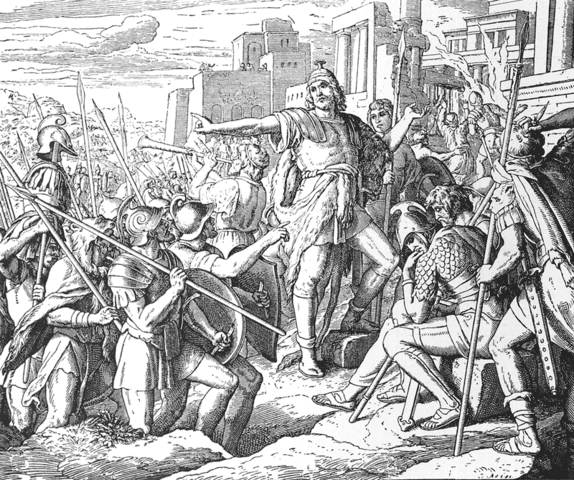
Judas Maccabeus, who led the Jewish revolt against the Seleucid Empire (167-160 B.C.), by Julius Schnorr von Carolsfeld (1794-1872) [public domain / Wikimedia Commons]

***
(1996)
***
An educated and committed evangelical Protestant friend (since received into the Catholic Church) wrote to me in October 1996, inquiring about arguments against the deuterocanonical books (“Apocrypha”) raised in Norman Geisler and Ralph MacKenzie’s book Roman Catholics and Evangelicals: Agreements and Differences (Grand Rapids, Michigan: Baker Books, 1995). Her words are in blue:
* * * * *
Let me throw out some specific issues that Geisler raises . . . . 1) Item 7 regarding the councils [p.160]. a) Do the councils at Hippo and Carthage explicitly state the same deutero-canonical books that are included now?
I believe so – this is my understanding.
b) What about his claim that they were local councils and not binding on the whole church? [p.162]
That is irrelevant for at least four reasons:
1) They merely followed St. Augustine (Hippo being his See) and St. Athanasius and solidified what had already been essentially arrived at through consensus;
2) Protestants accept them (excluding the “Apocryphal” books, which is arbitrary on their part), and haven’t ever challenged the 66 books which all Christians hold in common. Why? They must believe implicitly and somewhat inconsistently (in terms of epistemology and authority questions) that God guided the men at these councils to figure out what allegedly every individual Christian with the Holy Spirit and an open mind and heart (i.e., Calvin’s view) can figure out individually (as opposed to the earliest Fathers who could not figure it out – the process taking a good 350 years!);
3) It was preceded by a Roman Council (382) of identical opinion, as you note (see below), as well as “ratification” by Popes Innocent I (405, 414) and Gelasius I (495). The 6th Council of Carthage (419) also concurred;
4) These would be binding by virtue of the ordinary Magisterium, for all Catholics, as dogma in line with true, apostolic Tradition, even though they were not technically Ecumenical Councils. But this is true for many doctrines, including the Immaculate Conception, Transubstantiation, infused justification, the infallibility of the pope, etc. Just because they were not finally, dogmatically defined in an Ecumenical Council until a later date does not mean that they were not binding parts of Tradition. The Catholic must obey – especially practically speaking – the teachings which are held firmly by the Catholic Church. There is some room and allowance for disagreement in such a situation, but it must be exercised with extreme caution and deference to the Church as “Mother” and “Guardian of the Deposit of Faith,” lest a skeptical, individualistic, and/or “anti-Traditional” attitude predominate.
Didn’t one of these councils also affirm the NT as we know it?
They all agreed on that – it being a settled issue by that time.
And didn’t one of these councils affirm some pretty standard doctrine like the trinity or something?
The Council of Rome (382) dealt with trinitarian issues. I’m not sure about the others offhand.
– see text note 13 about a). any proof about the claim that the Catholic scholars assume it [Baruch] was part of Jeremiah. [p.163]
I don’t know for sure – that would require a trip to the seminary library for me to ascertain. The relevant point is that it was included in the Canon of the Bible, wherever it was placed, a factor which is altogether secondary to the main point of discussion vis-a-vis the Canon. Baruch was Jeremiah’s secretary (Jer 36:4-32, 45:1-2), hence the connection, and I see no problem.
I find it quite amusing that Geisler picks at St. Augustine’s authoritative position on p.163, yet you can be sure that if the great Father had agreed with Geisler on this point, that fact would have been emphasized throughout the chapter (since we find this tendency frequently elsewhere in the book). This is, of course, arbitrary, and a double standard. Geisler would have us value his opinion more than that of St. Augustine?!! Isn’t that the unspoken assumption in all of this after-the-fact analysis?! And looked at from that perspective, Geisler’s enterprise is quite insubstantial and futile, in my humble opinion (not that he is consciously intending it that way). He is a prisoner of his own inadequate epistemological and ecclesiological principle. It’s either the Magisterium, or the “priesthood” of “orthodox” scholars and commentators such as Geisler, F.F. Bruce, D.A. Carson, John Gerstner, R.C. Sproul, etc. As long as the latter contradict each other, I will stick with Catholic Tradition (and for many other reasons as well). At least that is logically consistent, whether one accepts the premises or not!
– what about textnote 17 [p.163]
Assuming for the sake of argument that St. Augustine was inconsistent on this point of the “prophetic” nature of books (which is altogether possible – Fathers not being infallible), so what? This would have no bearing on conciliar and papal decisions of the Church, which alone are binding, not the individual opinions of Fathers, Doctors, or theologians, however great and brilliant. So that even if Geisler is correct on this relatively trivial point, the overall Catholic argument is not affected in the least. Dr. Geisler would have to somehow prove that Christian councils are inferior to sola Scriptura as a means of inculcating theological and moral truth to the faithful. And that would be quite a task indeed.
2) . . . the Council of Rome in 382. Geisler mentions nothing of this. Is there proof that this council affirmed all the deutero books as scriptural too?
Convenient for him to omit, isn’t it? The Oxford Dictionary of the Christian Church (2nd ed., edited by F.L. Cross and E.A. Livingstone, Oxford Univ. Press, 1983, p.232) states:
A council probably held at Rome in 382 under St. Damasus gave a complete list of the canonical books of both the Old Testament and the New Testament (also known as the ‘Gelasian Decree’ because it was reproduced by Gelasius in 495), which is identical with the list given at Trent.
3) Geisler in his defense of the Protestant canon states that all the OT books were written by Prophets. What about Esther? My NIV says that we don’t know so how could we know that it was a Prophet? Was David considered a Prophet? – he wrote much of the Psalms.
Good point! I don’t think anyone would consider Esther a Prophet. Her book is also interesting in that it never mentions God, so that it would be difficult for an isolated individual to discover its inspired status, let alone its canonicity, every bit as much as is the case with 1 and 2 Maccabees, which are likewise histories of the Jews. I think David could be considered a Prophet, at least at times, when he gives messianic prophecies, such as Psalm 22. But It’s difficult to regard Solomon, e.g., as a Prophet, come to think of it, from what I remember of his life. And Nehemiah (an architect and administrator), and Ezra (a sort of Secretary of State in the Persian government), and whoever wrote Job and Ruth? Joshua was a Prophet? It appears that Geisler’s argument here is quite insufficient.
4) He gives some strong arguments [about alleged “propheticity” of all OT books] on page 167 – the middle and longest paragraph.
Well, they are only “strong” assuming his premise: viz., that a book must be “prophetic” to be part of the Canon. But I think that view is fatally injured by the above arguments, which are simple enough to arrive at. Geisler’s arguments are inconsistent and arbitrarily applied. He rails against the Catholic view, wherever it differs, all the while ignoring the huge deficiencies and even often self-defeating nature of the opposing Protestant claims. Geisler is a great scholar (in fact my favorite current-day Protestant apologist), but he, too, falls prey in this book to the almost ubiquitous evangelical bias against the Catholic Church. This is unfortunate. Nevertheless, I still regard his book as by far the best one written by evangelical Protestants on the subject of Catholicism. At least he believes that Catholics are Christians and does a good job in fairly presenting and explaining Catholic views.
*****
Meta Description: Brief dialogue in which I mostly reply to the objections of Protestant apologist Dr. Norman Geisler.
Meta Keywords: 46 books, 73 books, Apocrypha, apocryphal books, biblical canon, canon of Scripture, canonicity, deuterocanon, deuterocanonical books, Old Testament, septuagint, The Bible
Previous Post

April 18, 2016
"Apocrypha": Historical Case for Canonicity
Next Post

April 19, 2016 Fictional Dialogue on Eucharistic Real Presence
Browse Our Archives
Select a Category & Last Things About Me Anti-Catholicism Atheism & Agnosticism Baptism and Sacramentalism Bible and Tradition Blessed Virgin Mary Books by Dave Armstrong C. S. Lewis Calvinism & General Protestantism Catholic Apologetics Catholic Apologists Catholic conversion Catholic converts Christmas Church (Ecclesiology) Church History Conversion and Converts Development of Doctrine Eastern Orthodoxy Ecumenism & Christian Unity Eucharist & Liturgy Fathers of the Church French Translations G. K. Chesterton Hell Hell & Satan Hell & Satan & Last Things Heresies & Comparative Religion Holistic Health Inquisition & Crusades & Scandals James White Jews & Judaism & Old Testament John Calvin John Henry Newman Liberal / Modernist Theology Life Issues Literary Resume Lutheranism Mariology Martin Luther Music Orthodoxy Papacy & Infallibility Personal Page Philosophy & Science Political & Ethical & Moral Issues Protestant Persecution & Intolerance Protestantism Purgatory Purgatory & Penance Romantic & Imaginative Theology Saints & Purgatory & Penance Salvation Salvation & Justification Satan & Last Things Sexuality and Gender Issues Spanish Translations Traditionalism vs. Radical Catholic Reactionaries Traducciones al español / tradução para português Trinitarianism & Christology Uncategorized Videos
Select a Month October 2026 September 2026 August 2026 July 2026 June 2026 May 2026 April 2026 March 2026 February 2026 January 2026 December 2025 November 2025 October 2025 September 2025 August 2025 July 2025 June 2025 May 2025 April 2025 March 2025 February 2025 January 2025 December 2024 November 2024 October 2024 September 2024 August 2024 July 2024 June 2024 May 2024 April 2024 March 2024 February 2024 January 2024 December 2023 November 2023 October 2023 September 2023 August 2023 July 2023 June 2023 May 2023 April 2023 March 2023 February 2023 January 2023 December 2022 November 2022 October 2022 September 2022 August 2022 July 2022 June 2022 May 2022 April 2022 March 2022 February 2022 January 2022 December 2021 November 2021 October 2021 September 2021 August 2021 July 2021 June 2021 May 2021 April 2021 March 2021 February 2021 January 2021 December 2020 November 2020 October 2020 September 2020 August 2020 July 2020 June 2020 May 2020 April 2020 March 2020 February 2020 January 2020 December 2019 November 2019 October 2019 September 2019 August 2019 July 2019 June 2019 May 2019 April 2019 March 2019 February 2019 January 2019 December 2018 November 2018 October 2018 September 2018 August 2018 July 2018 June 2018 May 2018 April 2018 March 2018 February 2018 January 2018 December 2017 November 2017 October 2017 September 2017 August 2017 July 2017 June 2017 May 2017 April 2017 March 2017 February 2017 January 2017 December 2016 November 2016 October 2016 September 2016 August 2016 July 2016 June 2016 May 2016 April 2016 March 2016 February 2016 January 2016 December 2015 November 2015 October 2015 September 2015 August 2015 July 2015 June 2015 May 2015 April 2015 March 2015 February 2015 January 2015 December 2014 November 2014 October 2014 September 2014 August 2014 July 2014 June 2014 April 2014 March 2014 February 2014 January 2014 December 2013 November 2013 October 2013 September 2013 August 2013 July 2013 June 2013 April 2013 March 2013 February 2013 January 2013 December 2012 November 2012 October 2012 September 2012 August 2012 July 2012 June 2012 May 2012 April 2012 March 2012 February 2012 January 2012 December 2011 November 2011 October 2011 September 2011 August 2011 July 2011 June 2011 April 2011 March 2011 February 2011 October 2010 September 2010 August 2010 July 2010 April 2010 March 2010 December 2009 October 2009 August 2009 July 2009 June 2009 May 2009 March 2009 February 2009 October 2008 September 2008 April 2008 March 2008 February 2008 January 2008 December 2007 November 2007 October 2007 May 2007 March 2007 February 2007 January 2007 November 2006 October 2006 September 2006 August 2006 July 2006 June 2006 May 2006 April 2006 March 2006 February 2006 October 2005 June 2005 April 2005 February 2005 July 2004 May 2004 April 2004
Follow Us!
TAKE THE
Religious Wisdom Quiz
Who succeeded Moses as the leader of Israel?
Select your answer to see how you score.
Caleb Samuel Aaron Joshua
Books by This Author Books by Dave Armstrong
Related posts from Biblical Evidence for Catholicism

A Few "Worst" & "Best" Arguments vs. Protestantism
Biblical Evidence for Catholicism

Deuterocanon & Javier Perdomo's Straw Men
Biblical Evidence for Catholicism

St. Athanasius & the Deuterocanon (vs. Javier Perdomo)
Biblical Evidence for Catholicism

Jerusalem Council vs. James White & Sola Scriptura
Biblical Evidence for Catholicism
TRENDING AT PATHEOS Catholic

Methodist Central Hall and Westminster Abbey
Situated on the same square is Methodist Central Hall and Westminster Abbey. ...

57th Dove Awards Honor Dolly Parton, Crown New...
On gospel music’s biggest night, the 57th annual GMA Dove Awards honored...

The First Eucharistic Controversy: Christ’s Real Presence
For Catholics, the Eucharist is the source and summit of the Christian...

What a Stop Sign Can Teach Us About...
How to Make a Decision When You Can't Hear God Main point:...

Archdiocese Hosts Military Marriage Retreat in Germany
RASTATT, Germany — The transient military lifestyle, with its frequent deployments and...

Nearly every morning, I make the drive to Detroit with my high-school-age...
view all Catholic blogs
Ad-Free & Subscriber Log-In Subscription Support
- About Us
- 2026 Calendar
- Videos
- Podcasts
- Library of World Religions
- Faith In Media Tracker
- Advertise With Us
- Write for Us
- Privacy Policy
- Terms of Service
- Do Not Sell My Data
- Contact Us
- Radiant Digital
- Manage Newsletter Subscriptions
- Unsubscribe From Notifications
- Sitemap
Copyright 2008-2026, Patheos. All rights reserved.
Subscription Support Ad-Free & Subscriber Log-In
Follow Patheos