
BuddhistCatholicContemplativeEvangelicalGeneral ChristianHinduJewishLatter-day SaintMuslimNew VisionsProgressive Christian
Beliefs
- Buddhist
- Catholic
- Contemplative
- Evangelical
- General Christian
- Hindu
- Jewish
- Latter-day Saint
- More Voices
- Muslim
- New Visions
- Pagan
- Progressive Christian
Topics
- Religion News
- Food and Religion
- Sports and Religion
- Religious Art
- Religious Music and Entertainment
- Religious Events
- History and Religion
- Style and Religion
- Politics and Religion
- Women in Religion
- Recreation Outdoors and Religion
- Business Finance and Religion
- Careers Workplace and Religion
- Education and Religion
- Family Parenting and Religion
- Health Fitness and Religion
- Home and Religion
- Relationships and Religion
- Technology and Religion
- Travel and Religion
Columnists
- Buddhist Columnists
- Business Finance and Religion Columnists
- Careers Workplace and Religion Columnists
- Catholic Columnists
- Contemplative Columnists
- Education and Religion Columnists
- Evangelists Columnists
- Family Parenting and Religion Columnists
- General Christian Columnists
- Health Fitness and Religion Columnists
- Hindu Columnists
- History and Religion Columnists
- Home and Religion Columnists
- Jewish Columnists
- More Voices Columnists
- Latter Day Columnists
- Muslim Columnists
- New Visions Columnists
- Nonreligious Columnists
- Pagan Columnists
- Politics and Religion Columnists
- Progressive Columnists
- Recreation Outdoors and Religion Columnists
- Relationships and Religion Columnists
- Religion News Columnists
- Religious Art Columnists
- Religious Events Columnists
- Religious Music and Entertainment Columnists
- Sports and Religion Columnists
- Style and Religion Columnists
- Technology and Religion Columnists
- Travel and Religion Columnists
- Women in Religion Columnists
Resource Library
- 2026 Calendar
- Library of World Religions
- The 100 Most Holy Places on Earth
- Patheos Answers
- Podcasts
- Videos
- Faith Leaders Database
- Anglican Episcopalian
- Bahai
- Baptist
- Buddhism
- Christianity
- Confucianism
- Eastern Orthodoxy
- Hinduism
- Holiness and Pentecostal
- ISKCON
- Islam
- Judaism
- Lutheran
- Methodist
- The Church of Jesus Christ of Latter-day Saints
- New Age
- Paganism
- Presbytarian and Reformed
- Protestantism
- Religion Behind the Scenes
- Roman Catholic
- Scientology
- Shia Islam
- Sikhism
- Sufism
- Sunni Islam
- Taoism
- Zen
- See all religions
Research Tools
 Ad-Free & Subscriber Log-In Subscription Support
Ad-Free & Subscriber Log-In Subscription Support
Follow Patheos 

- Trending:
- Forgiveness
- |
- Marriage
- |
- Consciousness
- |
- Death Penalty
- |
- Election
- |
- Halloween

-
About
-
Catholic Apologetics
-
Church History
-
Great Apologists
-
Christian Worldview
-
Protestantism & Misc.
- Home
- Catholic
- History and Religion
- Catholic Closed Communion: A Defense
Catholic Closed Communion: A Defense
Last updated on: February 27, 2017 at 2:10 pm by Dave Armstrong
Catholic Closed Communion: A Defense 2017-02-27T14:10:52-04:00 Dave Armstrong
Patheos Explore the world's faith through different perspectives on religion and spirituality! Patheos has the views of the prevalent religions and spiritualities of the world.
Reply to a Lutheran Who Was Offended by Being Excluded
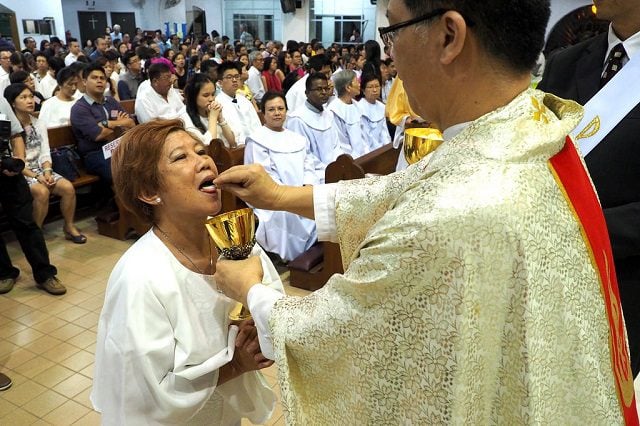
First Holy Communion. Photo by John Ragai, 3-27-16 [Flickr / CC BY 2.0 license]
(10-30-08)
This comes from exchanges on the Coming Home Network forum. The woman whose words are in blue is the wife of the man in question. She is a Catholic.
* * *
After attending Mass just twice with me, my Lutheran husband refuses to go ever again because of the Church’s “rules” about Communion. He believes it is wrong to tell anyone they cannot receive Communion, for any reason—in other words, no one should be excommunicated, and Protestants should be welcome to receive, regardless of what they think it means (the true Body and Blood or just a symbol). His basis for this belief is the portrayal of The Last Supper in the Bible: Jesus said, “Do this,” and no one was turned away, not even Judas, who was the betrayer. I trust that Holy Mother Church knows what she’s doing when she says people must be “properly disposed” to receive and be “in communion to receive Communion.” My husband feels the Church has not earned this trust and that all the lack of Christian unity is the Roman Catholic Church’s fault (for insisting people accept every single thing the Magisterium says as Truth). Like that somehow, if the Church would just welcome everyone with open arms and allow all to receive Communion, the rift would begin to mend. (Would it? But that’s a different question!) In the meantime, he is unwilling to budge. Are there Scriptures or writings from early Church history which demonstrate that it’s okay with Jesus to turn people away from the Eucharist? (Or, if not turn them away, then at least have this clear teaching that only Catholics in good standing are supposed to receive?) One of you smart guys or gals on here must be able offer some insight. I’ve been struggling with this issue for months.
Great question. It’s not a lack of charity at all; it is a biblical mandate. That’s the bottom line: what does Scripture say about who should receive communion, and what that act signifies (in the corporate sense)? Several Christian groups have closed communion: not just Catholics (Missouri Synod Lutherans come to mind).
* * *
I have mentioned to my husband about other Christians who have closed Communion (including some Lutherans), but he thinks they are ALL WRONG—which is why he is picky about which Lutheran church he goes to. I was remembering this a.m., though, that we had to become MEMBERS of our Lutheran churches before the pastors would baptize our babies there. Isn’t that kind of the same thing/just as “bad,” if one is going to make a fuss? This issue, more than anything else, is what keeps my husband from considering joining the Catholic Church. He doesn’t agree with the Marian doctrines, either, but the Eucharist is the real stumbling block.
I think the Bible is fairly clear that the Christian community is to be united in doctrine. This is presupposed before they take Holy Communion together. It’s precisely why the early Church took a long time with converts: they had to thoroughly understand and accept the Catholic faith before being allowed to the communion table.
Your husband may have many reasons he gives for his opinion on this, but he has to ground them at some point in Scripture: that which Protestants and Catholics hold in common, and which both regard as inspired revelation.
My husband sees Communion as a beautiful thing, as well, but that’s partly why he has such a problem with “men” keeping people away from Jesus (by keeping them from taking Communion). It makes so much sense to us who understand how TRULY big a deal this is, but my husband comes from the Lutheran tradition, which acknowledges the “Real Presence” but doesn’t really treat the sacrament as if it really IS Jesus (for instance, if they use a loaf of bread from the grocery store to do Communion, they don’t really have a problem with tossing out the leftovers).
[Dave: various Lutherans differ on their beliefs in this regard]
I would like to say that I have been totally enjoying reading your blog/website. I am learning a lot there (reading about the Reformation now). Trying to get up the courage to direct my husband to that site. Any mention of anything Catholic stirs up tension between us, so generally I try to avoid bringing things up—though we have done plenty of discussing. It wears me out!
The info on your site is a lot to take in. For me, it’s been great affirmation for my decision to leave Protestantism and become (go back to being) a Catholic. Still, my husband loves, in arguments, to bring up the terrible things done by Catholics to “keep people in line” in the past (e.g., the Spanish Inquisition and so forth). I remind him of the many acts of violence done by Protestants to Catholics, but other than invasions of monasteries, I usually don’t have too many examples (and honestly, I think he thinks they probably deserved it). Your blog is an ARSENAL of such info! I will, however, hold off on directing him there until I am sure he is ready for it. And even then, it will probably only make him mad. He is extremely smart and remembers everything and seems able to win any argument. He’s mostly intellect, I’m mostly emotion, so you can see how I don’t do too well trying to persuade him of anything. He prefers to read Lutheran websites that will keep him grounded in the faith tradition of his youth.
* * *
On a very recent episode of “The Journey Home,” someone e-mailed to ask about this very topic—he and his wife had converted and his wife still struggled with Protestants being unable to take Communion. In reply, Marcus mentioned that up until about 200 years ago, ALL churches (as far as he knew) had closed Communion. He seemed to indicate that this started changing as more and more Protestant churches splintered into new denominations and as the churches became more liberal. Does anyone know anything about this or know where I could find out more about how this happened and why? If I’m going to mention this to my husband, he is going to want FACTS—names and dates and places, that sort of thing—or else he won’t believe it.
* * *
My husband and I had another of our long discussions just the other night. Nothing I said had any effect on him. He says that when he sits in a Catholic Mass, all he can feel is rejection. Regardless of the fact that he believes every word of the Creed and does in fact believe in the Real Presence, the unspoken message at Mass (from his perspective) is this: “Since you refuse to accept every single Catholic teaching as absolute Truth, you are not a ‘true’ Christian, and therefore, you may not receive Jesus through Communion in this place.” For him, it all boils down to authority. Plain and simple, he cannot accept that the Catholic Church legitimately possesses the authority it claims for itself. Because of this, many Catholic teachings are suspect. I’ll have to address these in other threads in the forum. In the meantime, I just keep praying for unity. It’s all in God’s hands.
* * *
the unspoken message at Mass (from his perspective) is this: “Since you refuse to accept every single Catholic teaching as absolute Truth, you are not a ‘true’ Christian, and therefore, you may not receive Jesus through Communion in this place.”
This is, of course, contrary to fact. It’s not about Catholics denying that other non-Catholic Christians are Christian, but about the proper, legitimate, straightforward requirements for participation in any given group, be it religious or otherwise. Some people can’t meet the requirements to get in the military. A seven-foot man is not likely to be a jockey, and a five-foot man will likely not get into the NBA (though a few actually have). One has to meet requirements to enter a college or to be hired at a job, with particular requirements. You gotta be 35 to be President of the United States, and 30 to be a Senator. What “discrimination”!
*
Likewise, being a Catholic means something intellectually; doctrinally. Many denominations care little about doctrinal distinctives, but we do, and so did all the early Protestants (and, I would say, Jesus and the apostles and Church fathers). We presuppose a doctrinal unity. Taking communion is being part of the Catholic Church. Therefore, one who doesn’t agree with Catholic teachings cannot partake. What’s so complicated or controversial about that (I’m writing rhetorically now, with your husband in mind)?
I’ve never understood, myself, why this is so vexing to some people. I really don’t get it. I would never dream of partaking in a Protestant service. It would have never crossed my mind, back when I was a Protestant, to partake of communion in a service (let alone to be offended that I wasn’t allowed to), if I knew that they had membership requirements, or even if I personally disagreed with them on doctrine (even if they allowed intercommunion themselves).
To me it was a simple matter of both respect for one’s surroundings and honesty. I wasn’t one of them, by choice. Why would I want to, in effect, pretend to be one of them, by doing everything that they do when they get together to worship God?
This attitude perhaps has something to do with a sort of theological relativism (I’m trying to comprehend it now, by speculating as to its ultimate cause). This is the thinking that holds that we’re all in the same boat. Honestly-held differences don’t matter anymore. But this is an insult to all the men and women of any Christian stripe who lived and fought and strove for the promulgation of the distinctive beliefs that they truly believed in with all their hearts and souls (some even dying for those faiths and visions). In the past, people at least recognized that there was one truth, and that one had to argue and contend about that truth (Jude 3). They didn’t just say it was irrelevant, and that anyone who named the name of Jesus could receive the Holy Eucharist, even if they had a heretical notion even of Who Jesus was.
This sort of analysis was eloquently stated by my friend Al Kresta, in a marvelous talk detailing his conversion (reversion) story, given in my own home, that I later transcribed. He was critiquing the notion of “mere Christianity”:
Mere Christianity also undermines confidence in the local church, or (if you believe in them) the denomination, which is secondary to one’s primary commitment to Christ. But this is schizophrenic. It pits the head against the body, and ultimately it betrays Jesus Who says the gates of hell would not prevail against His Church, the body. These things are connected. The head doesn’t regard the body as a “necessary evil” like many evangelicals do. They think that you gotta go somewhere to get Bible teaching, so you go to church. [The Church] is secondary only in the sense that it flows from my commitment to God, and is entailed in that commitment. How ecumenical is mere Christianity, if it removes the doctrine of the Church, which is central to two of the three Christian traditions? So it really isn’t very fair to Orthodoxy and Catholicism. [It amounts to saying that] God is not able to adequately reveal Himself through the things that he has made, or the people that He has called. It’s a slap in the face of God.
Mere Christianity is dishonest in that it requires a soft-peddling of differences between Christians. And it belittles our brothers and sisters in the past. When we say “let’s transcend and rise above all these denominational distinctives,” we are actually emasculating the various Christian traditions. The very things that Wesley and Luther and Calvin found as solutions to the problems of their day, we’re saying, “it’s not important. Let’s just get above ’em. It doesn’t matter that these brothers regarded these things as central and essential to the Christian life.
We’re so superior to them that we can just rise above it.” And I find that that’s a very belittling approach to these men and women. Accept them on their own terms. Disagree with them if you have to. But don’t say they’re irrelevant. Within their systems, these denominational distinctives are meant to be solutions to serious problems in the Christian life, and when we don’t take them on their own terms, then we’re regarding these men and their traditions as pathological, petty, or unwise. I think Luther was wrong [about justification], but I can’t say he’s unimportant, you see. And that’s what I don’t like about “mere Christianity.”
For him, it all boils down to authority. Plain and simple, he cannot accept that the Catholic Church legitimately possesses the authority it claims for itself.
I find this ironic, because he has now contradicted himself, when one steps back and closely scrutinizes what he is maintaining. He objects to the Catholic Church drawing lines based on its own understanding of requirements for Holy Communion, worked out from the very beginning of Church history (in the early days of the Church, new catechumens went through a long, arduous process of education and spiritual formation before even being allowed into the second part of the Mass).
He rejects Catholic authority, yet at the same time is offended that he is not allowed to be part of the ritual that this same authority — that he rejects –, sensibly sets limits to. Note the comparison between the following two things:
- Rejecting the self-understood authority of a form of Christianity.
or:
- Rejecting the rules that same Christian body sets for itself and being offended that they don’t bend to everyone’s whim and fancy.
I would contend that anyone can and should honestly exercise their minds and conscience and supernatural, God-given faith in determining which faith is true or the most true. That’s an honest and honorable exercise (and we encourage it on this forum and in CHNI as a whole, as part of our very purpose). But being tiffed and miffed because some Christian group says we can’t receive communion with them is both irrational and also arguably dishonest.
If he can reject Catholic claims of authority altogether, why does he not recognize that the Catholic Church can consistently reject his assumed arguments for receiving the Eucharist in a Catholic Mass? He doesn’t set the rules for this body that he rejects; they do! So why in the world does this offend him? Should I hold a grudge against Harvard Law School my entire life, if I didn’t meet the requirements to get into the school? Are they supposed to bend their entire rules and “tradition” just so I can come in and not be offended? It makes no sense. The two propositions don’t go together. He needs to work through the issue in a more self-consistent manner.
I was a bit more rigorous and “tough” in this reflection because we’re dealing with a person who seems to pride himself on his thinking and skepticism (by your report). Well, then I am challenging him to be much more aware of his premises and the illogical and inconsistent conclusions that he has deduced from them. If he truly loves thinking and logic, and so forth, then he’ll welcome the challenge and not get angry, because that is what thinkers do. They love the challenge (just like the fathers did with regard to the challenge of heretics), because it lets them exercise their minds and analytical abilities, to better defend what they already believe, or else discard their position as inadequate to answer the critiques directed towards it.
*****
Meta Description: Explanation for why Catholics believe one must accept all Catholic teachings in order to receive Holy Communion.
Meta Keywords: closed communion, Holy communion, Protestants & Catholic communion, Eucharist, The Mass
Protestants & Catholic communion
Previous Post
April 27, 2016
How to Receive Communion: Tradition & Abuses
Next Post
April 27, 2016 Jerusalem Council vs. Sola Scriptura
Browse Our Archives
Select a Category & Last Things About Me Anti-Catholicism Atheism & Agnosticism Baptism and Sacramentalism Bible and Tradition Blessed Virgin Mary Books by Dave Armstrong C. S. Lewis Calvinism & General Protestantism Catholic Apologetics Catholic Apologists Catholic conversion Catholic converts Christmas Church (Ecclesiology) Church History Conversion and Converts Development of Doctrine Eastern Orthodoxy Ecumenism & Christian Unity Eucharist & Liturgy Fathers of the Church French Translations G. K. Chesterton Hell Hell & Satan Hell & Satan & Last Things Heresies & Comparative Religion Holistic Health Inquisition & Crusades & Scandals James White Jews & Judaism & Old Testament John Calvin John Henry Newman Liberal / Modernist Theology Life Issues Literary Resume Lutheranism Mariology Martin Luther Music Orthodoxy Papacy & Infallibility Personal Page Philosophy & Science Political & Ethical & Moral Issues Protestant Persecution & Intolerance Protestantism Purgatory Purgatory & Penance Romantic & Imaginative Theology Saints & Purgatory & Penance Salvation Salvation & Justification Satan & Last Things Sexuality and Gender Issues Spanish Translations Traditionalism vs. Radical Catholic Reactionaries Traducciones al español / tradução para português Trinitarianism & Christology Uncategorized Videos
Select a Month October 2026 September 2026 August 2026 July 2026 June 2026 May 2026 April 2026 March 2026 February 2026 January 2026 December 2025 November 2025 October 2025 September 2025 August 2025 July 2025 June 2025 May 2025 April 2025 March 2025 February 2025 January 2025 December 2024 November 2024 October 2024 September 2024 August 2024 July 2024 June 2024 May 2024 April 2024 March 2024 February 2024 January 2024 December 2023 November 2023 October 2023 September 2023 August 2023 July 2023 June 2023 May 2023 April 2023 March 2023 February 2023 January 2023 December 2022 November 2022 October 2022 September 2022 August 2022 July 2022 June 2022 May 2022 April 2022 March 2022 February 2022 January 2022 December 2021 November 2021 October 2021 September 2021 August 2021 July 2021 June 2021 May 2021 April 2021 March 2021 February 2021 January 2021 December 2020 November 2020 October 2020 September 2020 August 2020 July 2020 June 2020 May 2020 April 2020 March 2020 February 2020 January 2020 December 2019 November 2019 October 2019 September 2019 August 2019 July 2019 June 2019 May 2019 April 2019 March 2019 February 2019 January 2019 December 2018 November 2018 October 2018 September 2018 August 2018 July 2018 June 2018 May 2018 April 2018 March 2018 February 2018 January 2018 December 2017 November 2017 October 2017 September 2017 August 2017 July 2017 June 2017 May 2017 April 2017 March 2017 February 2017 January 2017 December 2016 November 2016 October 2016 September 2016 August 2016 July 2016 June 2016 May 2016 April 2016 March 2016 February 2016 January 2016 December 2015 November 2015 October 2015 September 2015 August 2015 July 2015 June 2015 May 2015 April 2015 March 2015 February 2015 January 2015 December 2014 November 2014 October 2014 September 2014 August 2014 July 2014 June 2014 April 2014 March 2014 February 2014 January 2014 December 2013 November 2013 October 2013 September 2013 August 2013 July 2013 June 2013 April 2013 March 2013 February 2013 January 2013 December 2012 November 2012 October 2012 September 2012 August 2012 July 2012 June 2012 May 2012 April 2012 March 2012 February 2012 January 2012 December 2011 November 2011 October 2011 September 2011 August 2011 July 2011 June 2011 April 2011 March 2011 February 2011 October 2010 September 2010 August 2010 July 2010 April 2010 March 2010 December 2009 October 2009 August 2009 July 2009 June 2009 May 2009 March 2009 February 2009 October 2008 September 2008 April 2008 March 2008 February 2008 January 2008 December 2007 November 2007 October 2007 May 2007 March 2007 February 2007 January 2007 November 2006 October 2006 September 2006 August 2006 July 2006 June 2006 May 2006 April 2006 March 2006 February 2006 October 2005 June 2005 April 2005 February 2005 July 2004 May 2004 April 2004
Follow Us!
TAKE THE
Religious Wisdom Quiz
I made a rash vow that cost me my only child after a military victory. Who am I?
Select your answer to see how you score.
Jephthah Samson Gideon Barak
Books by This Author Books by Dave Armstrong
Related posts from Biblical Evidence for Catholicism

The Mass & Development of Doctrine (vs. Wes...
Biblical Evidence for Catholicism

Miraculous Eucharist (vs. Francois Turretin #4)
Biblical Evidence for Catholicism

God's Presence, the Ark, the Eucharist, & Death
Biblical Evidence for Catholicism
Protestant Eucharistic Objections Fail (Turretin)
Biblical Evidence for Catholicism
TRENDING AT PATHEOS Catholic

The Sermon on the Mount, Part I: Matthew...
The Sermon on the Mount, Part I (Matthew 4:12-5:12) St. Matthew moves...

What's up from Crossway: Reviewing some of their latest A few weeks...

Janie Learns the Way of the Cross: A...
Teaching children about Jesus' Passion can be challenging. Many parents and educators...

Looking For Good Catholic Writing - October 2026
He alone extends the heavens, and he walks upon the waves of...

In "Irreplaceable," our book on vocation and technology, Trevor Sutton and I...

I was strolling through the top floor of the brand new Parthenon...
view all Catholic blogs
Ad-Free & Subscriber Log-In Subscription Support
- About Us
- 2026 Calendar
- Videos
- Podcasts
- Library of World Religions
- Faith In Media Tracker
- Advertise With Us
- Write for Us
- Privacy Policy
- Terms of Service
- Do Not Sell My Data
- Contact Us
- Radiant Digital
- Manage Newsletter Subscriptions
- Unsubscribe From Notifications
- Sitemap
Copyright 2008-2026, Patheos. All rights reserved.
Subscription Support Ad-Free & Subscriber Log-In
Follow Patheos