
BuddhistCatholicContemplativeEvangelicalGeneral ChristianHinduJewishLatter-day SaintMuslimNew VisionsProgressive Christian
Beliefs
- Buddhist
- Catholic
- Contemplative
- Evangelical
- General Christian
- Hindu
- Jewish
- Latter-day Saint
- More Voices
- Muslim
- New Visions
- Pagan
- Progressive Christian
Topics
- Religion News
- Food and Religion
- Sports and Religion
- Religious Art
- Religious Music and Entertainment
- Religious Events
- History and Religion
- Style and Religion
- Politics and Religion
- Women in Religion
- Recreation Outdoors and Religion
- Business Finance and Religion
- Careers Workplace and Religion
- Education and Religion
- Family Parenting and Religion
- Health Fitness and Religion
- Home and Religion
- Relationships and Religion
- Technology and Religion
- Travel and Religion
Columnists
- Buddhist Columnists
- Business Finance and Religion Columnists
- Careers Workplace and Religion Columnists
- Catholic Columnists
- Contemplative Columnists
- Education and Religion Columnists
- Evangelists Columnists
- Family Parenting and Religion Columnists
- General Christian Columnists
- Health Fitness and Religion Columnists
- Hindu Columnists
- History and Religion Columnists
- Home and Religion Columnists
- Jewish Columnists
- More Voices Columnists
- Latter Day Columnists
- Muslim Columnists
- New Visions Columnists
- Nonreligious Columnists
- Pagan Columnists
- Politics and Religion Columnists
- Progressive Columnists
- Recreation Outdoors and Religion Columnists
- Relationships and Religion Columnists
- Religion News Columnists
- Religious Art Columnists
- Religious Events Columnists
- Religious Music and Entertainment Columnists
- Sports and Religion Columnists
- Style and Religion Columnists
- Technology and Religion Columnists
- Travel and Religion Columnists
- Women in Religion Columnists
Resource Library
- 2026 Calendar
- Library of World Religions
- The 100 Most Holy Places on Earth
- Patheos Answers
- Podcasts
- Videos
- Faith Leaders Database
- Anglican Episcopalian
- Bahai
- Baptist
- Buddhism
- Christianity
- Confucianism
- Eastern Orthodoxy
- Hinduism
- Holiness and Pentecostal
- ISKCON
- Islam
- Judaism
- Lutheran
- Methodist
- The Church of Jesus Christ of Latter-day Saints
- New Age
- Paganism
- Presbytarian and Reformed
- Protestantism
- Religion Behind the Scenes
- Roman Catholic
- Scientology
- Shia Islam
- Sikhism
- Sufism
- Sunni Islam
- Taoism
- Zen
- See all religions
Research Tools
 Ad-Free & Subscriber Log-In Subscription Support
Ad-Free & Subscriber Log-In Subscription Support
Follow Patheos 

- Trending:
- Forgiveness
- |
- Marriage
- |
- Consciousness
- |
- Death Penalty
- |
- Election
- |
- Halloween

-
About
-
Catholic Apologetics
-
Church History
-
Great Apologists
-
Christian Worldview
-
Protestantism & Misc.
- Home
- Catholic
- History and Religion
- Liturgical Abuses at Mass: What to DO?
Liturgical Abuses at Mass: What to DO?
Last updated on: November 22, 2021 at 3:41 pm by Dave Armstrong
Liturgical Abuses at Mass: What to DO? 2021-11-22T15:41:51-04:00 Dave Armstrong
Patheos Explore the world's faith through different perspectives on religion and spirituality! Patheos has the views of the prevalent religions and spiritualities of the world.
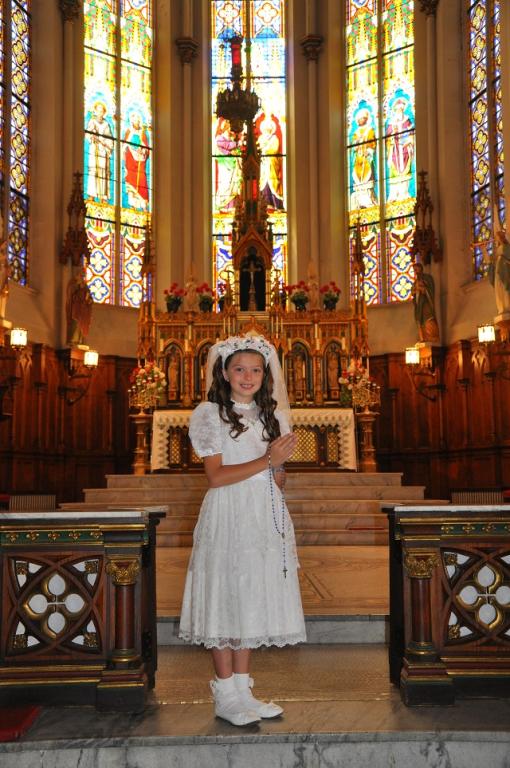
Our daughter at her first Holy Communion (7-24-11), at our home parish for 25 years this month: St. Joseph’s in Detroit (German Gothic Revival style: 1870s). It has some of the most beautiful stained glass in America and one of the largest bells.
* * *
(2-19-08)
* * *
This is from a thread on the CHN board.
* * *
Can. 846 ß1 The liturgical books, approved by the competent authority, are to be faithfully followed in the celebration of the sacraments. Accordingly, no one may on a personal initiative add to or omit or alter anything in those book
The Church has dealt with such abuses, in Redemptionis Sacramentum, On certain matters to be observed or to be avoided regarding the Most Holy Eucharist (Congregation for Divine Worship and the Discipline of the Sacraments, Rome, on the Solemnity of the Annunciation of the Lord, 25 March 2004; Francis Cardinal Arinze, Prefect):
[51.] Only those Eucharistic Prayers are to be used which are found in the Roman Missal or are legitimately approved by the Apostolic See, and according to the manner and the terms set forth by it. “It is not to be tolerated that some Priests take upon themselves the right to compose their own Eucharistic Prayers” or to change the same texts approved by the Church, or to introduce others composed by private individuals.
[52.] The proclamation of the Eucharistic Prayer, which by its very nature is the climax of the whole celebration, is proper to the Priest by virtue of his Ordination. It is therefore an abuse to proffer it in such a way that some parts of the Eucharistic Prayer are recited by a Deacon, a lay minister, or by an individual member of the faithful, or by all members of the faithful together. The Eucharistic Prayer, then, is to be recited by the Priest alone in full.
[53.] While the Priest proclaims the Eucharistic Prayer “there should be no other prayers or singing, and the organ or other musical instruments should be silent”, except for the people’s acclamations that have been duly approved, as described below.
[54.] The people, however, are always involved actively and never merely passively: for they “silently join themselves with the Priest in faith, as well as in their interventions during the course of the Eucharistic Prayer as prescribed, namely in the responses in the Preface dialogue, the Sanctus, the acclamation after the consecration and the “Amen” after the final doxology, and in other acclamations approved by the Conference of Bishops with the recognitio of the Holy See.”
59.] The reprobated practice by which Priests, Deacons or the faithful here and there alter or vary at will the texts of the Sacred Liturgy that they are charged to pronounce, must cease. For in doing thus, they render the celebration of the Sacred Liturgy unstable, and not infrequently distort the authentic meaning of the Liturgy.
It seems simple enough that a priest ought to be up to speed as to what he is permitted to do and not do, with the liturgy. How difficult is that? A night or two curled up on a couch with the appropriate documents would seem to be sufficient. Because it is seemingly not difficult to determine the rules and rubrics (we are doing it ourselves here in this thread), one can only conclude that priests who do not either are lax in the matter or being deliberately disobedient and seeing how much they can get away with.
My solution? Of course it is always great to pray in any situation, but one way (as a last resort. mind you) that will accomplish this goal is to speak with your feet: find another parish that does honor the instructions of the magisterium. People leaving cause income of the parish to go down. Money speaks. It’s sad that it has to be that way, but whatever works . . .
We as laypeople have a perfect right to experience the Mass the way it is intended to be conducted. As long as we don’t fall into a “church-hopping” mentality, we can choose to (after having exhausted all other avenues) leave a parish if there are serious problems that do not seem to ever be rectified.
I want to make it very clear that one should choose to leave a parish in the event of truly serious, ongoing abuses, not just a few incorrect words here and there. The Eucharist is what it is, of course, but that’s not at issue, which is the right of Catholics to participate in Mass the way it is intended to be by the Church.
It’s precisely because every individual Catholic has an authority higher than the parish priest (the bishop and the pope and the magisterium of the Church), that sometimes he or she can “vote with their feet” and be perfectly within their “rights” as a Catholic to do so (and not merely an individualist, as so often in Protestantism). The problem lies with the priest or other “liturgy abusers” at their parish, not with them.
But I fully agree that this is a final recourse, not the first thing to impulsively do. Speaking for myself, I haven’t personally criticized a priest in my parish a single time for anything, in my 17+ years as a Catholic. But of course I am spoiled a bit at my parish because everything is conducted so wonderfully there.
The fact remains that there are rubrics and instructions, and these are sufficiently clear. If we point out an abuse to a priest (backed with authoritative Church documents), with perfect humility and graciousness (maybe over dinner or in the midst of twenty compliments, etc., and without the slightest hint of an unsavory “judgmental” or superior attitude) and he simply refuses to make the needed changes, then whether or not his error was inadvertent before, it is now deliberately opposed to Church instruction, since he has been informed of his error.
And what does one do in that situation, if the priest persists in the error? Watch your attitude; pray; absolutely! That’s a given. But in the final analysis, like I said, the layman has the right as a Catholic, to the Mass as it ought to be (just as the increasing yearning for the Tridentine Mass as a live option in Catholic worship has arguably played a big role in the present greater availability of that Mass).
Again, I agree with you about attitudes and priorities, and not entering into unwise battles over relatively small abuses (though they be real and troubling). But there comes a point when one can leave in good conscience, having tried other means with no success.
We all have our own experiences. I haven’t (thank God) been subject to all these abuses and doctrinal absurdities (including RCIA horror stories), that I hear about distressingly often here, and from other Catholics elsewhere. Consequently, I’ve been at my parish the entire time since I was received into the Church (in February 1991), and have not had a single situation where I felt compelled to ever “correct” my parish priest.
I would say in summary that a priest has a responsibility to make sure the liturgy is done properly and correctly. This is central to his task as a priest (along with dispensing sacraments, administration, prayer, visitation, etc.). He is no more immune from doing his job properly than anyone is, whether it is making sure to teach proper Catholic doctrine (as in my situation as an apologist and now moderator of the CHN discussion board) or balancing the books properly if one is an accountant or following the standard procedures of doctors and nurses, or constructing a road or a building the right way, or preparing a good meal at a restaurant. Whatever it is, a worker in his field has the responsibility to do it right. All the more in the case of the Catholic liturgy, because of its supreme importance.
Many priests may simply be unaware that they are doing anything wrong. I grant that, and am happy this is the reason rather than disobedience. But once they are made aware that they ought not do something and continue to do so, then there is a serious problem in their attitude, not necessarily in the super-seriousness of a word here or there being botched.
I respect no people on earth more than I do priests and religious. I’m in awe of them. But they are not immune from criticism, when they do things wrong, and come to know without a doubt that they are wrong, yet continue to do it.
The priest is subject to the bishop, and so a layman can appeal to a bishop for recourse against priestly abuses of the liturgy, just as we can sometimes go over the head of our supervisors at work, to the “big boss” (or higher up the ranks in the military, in serious situations).
That is not taking matters “into my own hands.” Laymen are not deprived of all say-so whatsoever in the Church, as if we are dumb sheep. That’s not even true in doctrinal matters, where there is such a thing as the “consent of the faithful” (sensus fidelium) that Cardinal Newman has eloquently written about. It’s how the Catholic Church works. And we can also appeal to the pope in the case of erring bishops.
Let it be rare, well thought through and considered, done with the right attitude, soaked in prayer; amen! But I don’t see how it is intrinsically improper to take such measures, failing gentler ones. I think this is a sort of assumed premise or “sub-discussion” that is occurring in this thread alongside the original topic of the objectionable liturgical messing-around of some priests.
* * *
Vatican II highly stressed active liturgical participation of all at Mass. It occurred to me that this is another very relevant factor in laymen speaking up about liturgical abuse. This means that, to the extent that abuses occur, now we are also forced to participate (in one sense) in the same error. And that is simply unacceptable. It doesn’t have to be, and there are things we can do about it.
If talking charitably, kindly, but firmly to our priests and bishops does not change this, then we should go to a parish where it is done right, and if enough people together decide to do that, then perhaps some necessary changes will be made.
This is being a conscientious Catholic and seeking to worship at Mass the way that the magisterium wants it to be, not trying to simply go our own way, as if there was anything wrong with it.
I again offer the analogy of the availability of the Tridentine Mass. If the faithful kept expressing that they wanted that option (and often due to the shabby, shoddy nature of how so many Novus Ordo Masses are done today), and that helped to cause two popes to increasingly abide by their wishes, then surely we can also complain about liturgical abuses and try to rectify that situation as well. The last two popes have often written about such things, so it is perfectly proper for laypeople to follow their lead, as long as we do it with the proper respect and humility for those who have authority over us in the Church.
* * *
Absurd, prejudicial reactions to “liturgical protests” from priests and bishops, where they occur, are indicative of a problem in these priests and bishops. They seem too often to be beset by a certain paranoia or abject fear of an intelligent, faithful, articulate layman pointing out to them (based on clear Church guidelines) that they have done anything wrong. It’s as if they see themselves as immune from all criticism. This is “sacerdotalism” at its worst, and (somewhat ironically) approaches the mentality of Protestant pastors, who are also often unapproachable (as I know from sad personal experience).
Surely there are nuts and overly self-important zealots among the laymen who go about such a things wrongly and with a self-righteous, condemnatory attitude. But that doesn’t mean there are no legitimate complaints or none that should be made. We shouldn’t cease saying what needs to be said because some of our clergy act improperly when someone dares to correct them, in charity and with humility and reverence for their office. The reaction ought not totally determine what we do.
And so I would contend that — precisely because of these manifested ridiculous attitudes (where they occur) –, sometimes (as a last resort only) we are forced to vote with our feet. We have a right to the Mass as intended by the Church. If we allow ourselves to be subjected to nonsense, as a result of a man who is not following Church guidelines, we are subject to the whims of mere men.
Man, I’m so glad I’m in a parish where this stuff doesn’t happen! I don’t have the patience for it. The way I deal with liberalism and nonsense in the Church is to 1) ignore it on a personal level, and 2) denounce it in my writings. But I have the luxury of being in a great parish, that (sadly) not many have.
One CHN board member was asking about how to identify a good parish:
Today, it is fairly easy to find a good parish, almost by a default method. If it doesn’t present a goofy, trendy version of the liturgy, and gets it right, that is the first big clue. Follow the missal, to verify that. And if it offers all these sorts of things that you mention, that is the other big clue.
Devotion to the Blessed Virgin and obedience to the Holy Father are two other clear indications that you are in a solid, orthodox parish. Look at any books that are offered. If you see good orthodox publishers like Ignatius, OSV, and Sophia, and promotion of EWTN and Catholic radio, then you’re probably in a good parish.
It is simply a matter of learning a few telltale signs, so you can avoid nonsense before ever getting committed to a particular parish. The goal is to find a good parish, not the church-hopping mentality. Once you find one, stay there, and be very committed to it, and don’t ever plan on leaving for less than extremely serious or necessary reasons. I’ve been at mine for over 17 years.
In any relatively large metro area, you should be able to find a very good, orthodox parish (mine is right outside of downtown Detroit, near the baseball and football stadiums). In rural areas, however, one doesn’t have much of a choice, usually, and it can be a cross to bear, enduring mediocrity, spiritual pablum in homilies, and departures from the rubrics. But you still have Jesus present in the Eucharist, unless it is an outright invalid Mass (which is rare). Keep your focus on that (i.e., Him).
***
Let criticism of a priest be rare, well thought-out, with the right attitude, & soaked in prayer. But it’s not intrinsically improper to take such measures.
***
*
Practical Matters: Perhaps some of my 3,900+ free online articles (the most comprehensive “one-stop” Catholic apologetics site) or fifty books have helped you (by God’s grace) to decide to become Catholic or to return to the Church, or better understand some doctrines and why we believe them.
*
Or you may believe my work is worthy to support for the purpose of apologetics and evangelism in general. If so, please seriously consider a much-needed financial contribution. I’m always in need of more funds: especially monthly support. “The laborer is worthy of his wages” (1 Tim 5:18, NKJV). 1 December 2021 was my 20th anniversary as a full-time Catholic apologist, and February 2022 marked the 25th anniversary of my blog.
*
PayPal donations are the easiest: just send to my email address: [email protected]. You’ll see the term “Catholic Used Book Service”, which is my old side-business. To learn about the different methods of contributing, including 100% tax deduction, etc., see my page: About Catholic Apologist Dave Armstrong / Donation Information. Thanks a million from the bottom of my heart!
*
***
Traditionalism vs. Radical Catholic Reactionaries
Previous Post
March 3, 2016
"Pro-Lifers" Vote for Childkillers? Huh?!
Next Post
March 4, 2016 The Devil's Stupidity and Vanity
Browse Our Archives
Select a Category & Last Things About Me Anti-Catholicism Atheism & Agnosticism Baptism and Sacramentalism Bible and Tradition Blessed Virgin Mary Books by Dave Armstrong C. S. Lewis Calvinism & General Protestantism Catholic Apologetics Catholic Apologists Catholic conversion Catholic converts Christmas Church (Ecclesiology) Church History Conversion and Converts Development of Doctrine Eastern Orthodoxy Ecumenism & Christian Unity Eucharist & Liturgy Fathers of the Church French Translations G. K. Chesterton Hell Hell & Satan Hell & Satan & Last Things Heresies & Comparative Religion Holistic Health Inquisition & Crusades & Scandals James White Jews & Judaism & Old Testament John Calvin John Henry Newman Liberal / Modernist Theology Life Issues Literary Resume Lutheranism Mariology Martin Luther Music Orthodoxy Papacy & Infallibility Personal Page Philosophy & Science Political & Ethical & Moral Issues Protestant Persecution & Intolerance Protestantism Purgatory Purgatory & Penance Romantic & Imaginative Theology Saints & Purgatory & Penance Salvation Salvation & Justification Satan & Last Things Sexuality and Gender Issues Spanish Translations Traditionalism vs. Radical Catholic Reactionaries Traducciones al español / tradução para português Trinitarianism & Christology Uncategorized Videos
Select a Month October 2026 September 2026 August 2026 July 2026 June 2026 May 2026 April 2026 March 2026 February 2026 January 2026 December 2025 November 2025 October 2025 September 2025 August 2025 July 2025 June 2025 May 2025 April 2025 March 2025 February 2025 January 2025 December 2024 November 2024 October 2024 September 2024 August 2024 July 2024 June 2024 May 2024 April 2024 March 2024 February 2024 January 2024 December 2023 November 2023 October 2023 September 2023 August 2023 July 2023 June 2023 May 2023 April 2023 March 2023 February 2023 January 2023 December 2022 November 2022 October 2022 September 2022 August 2022 July 2022 June 2022 May 2022 April 2022 March 2022 February 2022 January 2022 December 2021 November 2021 October 2021 September 2021 August 2021 July 2021 June 2021 May 2021 April 2021 March 2021 February 2021 January 2021 December 2020 November 2020 October 2020 September 2020 August 2020 July 2020 June 2020 May 2020 April 2020 March 2020 February 2020 January 2020 December 2019 November 2019 October 2019 September 2019 August 2019 July 2019 June 2019 May 2019 April 2019 March 2019 February 2019 January 2019 December 2018 November 2018 October 2018 September 2018 August 2018 July 2018 June 2018 May 2018 April 2018 March 2018 February 2018 January 2018 December 2017 November 2017 October 2017 September 2017 August 2017 July 2017 June 2017 May 2017 April 2017 March 2017 February 2017 January 2017 December 2016 November 2016 October 2016 September 2016 August 2016 July 2016 June 2016 May 2016 April 2016 March 2016 February 2016 January 2016 December 2015 November 2015 October 2015 September 2015 August 2015 July 2015 June 2015 May 2015 April 2015 March 2015 February 2015 January 2015 December 2014 November 2014 October 2014 September 2014 August 2014 July 2014 June 2014 April 2014 March 2014 February 2014 January 2014 December 2013 November 2013 October 2013 September 2013 August 2013 July 2013 June 2013 April 2013 March 2013 February 2013 January 2013 December 2012 November 2012 October 2012 September 2012 August 2012 July 2012 June 2012 May 2012 April 2012 March 2012 February 2012 January 2012 December 2011 November 2011 October 2011 September 2011 August 2011 July 2011 June 2011 April 2011 March 2011 February 2011 October 2010 September 2010 August 2010 July 2010 April 2010 March 2010 December 2009 October 2009 August 2009 July 2009 June 2009 May 2009 March 2009 February 2009 October 2008 September 2008 April 2008 March 2008 February 2008 January 2008 December 2007 November 2007 October 2007 May 2007 March 2007 February 2007 January 2007 November 2006 October 2006 September 2006 August 2006 July 2006 June 2006 May 2006 April 2006 March 2006 February 2006 October 2005 June 2005 April 2005 February 2005 July 2004 May 2004 April 2004
Follow Us!
TAKE THE
Religious Wisdom Quiz
I lift my eyes to the _________, where does my help come from? My help comes from the LORD.
Select your answer to see how you score.
Heavens Seas Hills Sky
Books by This Author Books by Dave Armstrong
Related posts from Biblical Evidence for Catholicism

The Mass & Development of Doctrine (vs. Wes...
Biblical Evidence for Catholicism

Miraculous Eucharist (vs. Francois Turretin #4)
Biblical Evidence for Catholicism

God's Presence, the Ark, the Eucharist, & Death
Biblical Evidence for Catholicism
Protestant Eucharistic Objections Fail (Turretin)
Biblical Evidence for Catholicism
TRENDING AT PATHEOS Catholic

In "Irreplaceable," our book on vocation and technology, Trevor Sutton and I...

I was strolling through the top floor of the brand new Parthenon...

What Does Gêvâh Mean For Kimberley Guifoyle &...
This week, a lot of the news is focused on Kimberly Guilfoyle....

INNER CIRCLE: Profound Mystery (Of Christ In All...
Ephesians 5:31-32 “For this reason, a man will leave his father and...

Do Not Rejoice When Your Enemy Falls: The...
Turning an execution into a public spectacle is a disturbing expression of...

'The Chosen' S6 Trailer: The Passion Gets Very...
Not many watching 'The Chosen' worry about spoilers, but just because they...
view all Catholic blogs
Ad-Free & Subscriber Log-In Subscription Support
- About Us
- 2026 Calendar
- Videos
- Podcasts
- Library of World Religions
- Faith In Media Tracker
- Advertise With Us
- Write for Us
- Privacy Policy
- Terms of Service
- Do Not Sell My Data
- Contact Us
- Radiant Digital
- Manage Newsletter Subscriptions
- Unsubscribe From Notifications
- Sitemap
Copyright 2008-2026, Patheos. All rights reserved.
Subscription Support Ad-Free & Subscriber Log-In
Follow Patheos