
BuddhistCatholicContemplativeEvangelicalGeneral ChristianHinduJewishLatter-day SaintMuslimNew VisionsProgressive Christian
Beliefs
- Buddhist
- Catholic
- Contemplative
- Evangelical
- General Christian
- Hindu
- Jewish
- Latter-day Saint
- More Voices
- Muslim
- New Visions
- Pagan
- Progressive Christian
Topics
- Religion News
- Food and Religion
- Sports and Religion
- Religious Art
- Religious Music and Entertainment
- Religious Events
- History and Religion
- Style and Religion
- Politics and Religion
- Women in Religion
- Recreation Outdoors and Religion
- Business Finance and Religion
- Careers Workplace and Religion
- Education and Religion
- Family Parenting and Religion
- Health Fitness and Religion
- Home and Religion
- Relationships and Religion
- Technology and Religion
- Travel and Religion
Columnists
- Buddhist Columnists
- Business Finance and Religion Columnists
- Careers Workplace and Religion Columnists
- Catholic Columnists
- Contemplative Columnists
- Education and Religion Columnists
- Evangelists Columnists
- Family Parenting and Religion Columnists
- General Christian Columnists
- Health Fitness and Religion Columnists
- Hindu Columnists
- History and Religion Columnists
- Home and Religion Columnists
- Jewish Columnists
- More Voices Columnists
- Latter Day Columnists
- Muslim Columnists
- New Visions Columnists
- Nonreligious Columnists
- Pagan Columnists
- Politics and Religion Columnists
- Progressive Columnists
- Recreation Outdoors and Religion Columnists
- Relationships and Religion Columnists
- Religion News Columnists
- Religious Art Columnists
- Religious Events Columnists
- Religious Music and Entertainment Columnists
- Sports and Religion Columnists
- Style and Religion Columnists
- Technology and Religion Columnists
- Travel and Religion Columnists
- Women in Religion Columnists
Resource Library
- 2026 Calendar
- Library of World Religions
- The 100 Most Holy Places on Earth
- Patheos Answers
- Podcasts
- Videos
- Faith Leaders Database
- Anglican Episcopalian
- Bahai
- Baptist
- Buddhism
- Christianity
- Confucianism
- Eastern Orthodoxy
- Hinduism
- Holiness and Pentecostal
- ISKCON
- Islam
- Judaism
- Lutheran
- Methodist
- The Church of Jesus Christ of Latter-day Saints
- New Age
- Paganism
- Presbytarian and Reformed
- Protestantism
- Religion Behind the Scenes
- Roman Catholic
- Scientology
- Shia Islam
- Sikhism
- Sufism
- Sunni Islam
- Taoism
- Zen
- See all religions
Research Tools
 Ad-Free & Subscriber Log-In Subscription Support
Ad-Free & Subscriber Log-In Subscription Support
Follow Patheos 

- Trending:
- Forgiveness
- |
- Marriage
- |
- Consciousness
- |
- Death Penalty
- |
- Election
- |
- Halloween

-
About
-
Catholic Apologetics
-
Church History
-
Great Apologists
-
Christian Worldview
-
Protestantism & Misc.
- Home
- Catholic
- History and Religion
- Jesus’ Interactions with Mary in Relation to Marian Veneration
Jesus’ Interactions with Mary in Relation to Marian Veneration
Last updated on: March 24, 2017 at 2:19 pm by Dave Armstrong
Jesus’ Interactions with Mary in Relation to Marian Veneration 2017-03-24T14:19:49-04:00 Dave Armstrong
Patheos Explore the world's faith through different perspectives on religion and spirituality! Patheos has the views of the prevalent religions and spiritualities of the world.
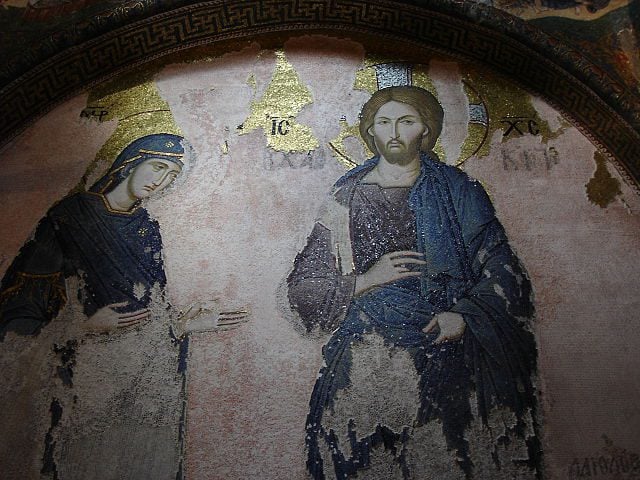
Istanbul: Chora Church Museum (Kariye Cami). Nartex. A mosaic showing the Virgin Mary beside Jesus. Photograph by Giovanni Dall’Orto, May 29, 2006. Released into public domain by the photographer [Wikimedia Commons]

* * *
(10-29-08)
* * *
I was asked on the CHNI board:
The passage where Jesus says “who are my mothers and brothers” in answer to someone saying his mother was there. The pastor wonders if we are supposed to show such veneration to Christ’s mother, why didn’t He do it Himself in that instance?
Here are the passages:
Matthew 12:46-50 (RSV) While he was still speaking to the people, behold, his mother and his brothers stood outside, asking to speak to him. But he replied to the man who told him, “Who is my mother, and who are my brothers?” And stretching out his hand toward his disciples, he said, “Here are my mother and my brothers! For whoever does the will of my Father in heaven is my brother, and sister, and mother.” [note: v. 47 is a disputed text, and is actually skipped in the RSV and other recent translations]
Mark 3:31-35 And his mother and his brothers came; and standing outside they sent to him and called him. And a crowd was sitting about him; and they said to him, “Your mother and your brothers are outside, asking for you.” And he replied, “Who are my mother and my brothers?” And looking around on those who sat about him, he said, “Here are my mother and my brothers! Whoever does the will of God is my brother, and sister, and mother.”
Luke 8:19-21 Then his mother and his brothers came to him, but they could not reach him for the crowd. And he was told, “Your mother and your brothers are standing outside, desiring to see you.” But he said to them, “My mother and my brothers are those who hear the word of God and do it.”
The Catholic Encyclopedia (“The Blessed Virgin Mary”) comments on this:
At first sight, it seems that Jesus Himself depreciated the dignity of His Blessed Mother. When He was told: “Behold thy mother and thy brethren stand without, seeking thee”, He answered: “Who is my mother, and who are my brethren? And stretching forth his hand towards his disciples, he said: Behold my mother and my brethren. For whosoever shall do the will of my Father, that is in heaven, he is my brother, and my sister, and my mother” (Matthew 12:47-50; cf. Mark 3:31-35; Luke 8:19-21). On another occasion, “a certain woman from the crowd, lifting up her voice, said to him: Blessed is the womb that bore thee, and the paps that gave thee suck. But he said: Yea rather, blessed are they who hear the word of God, and keep it” (Luke 11:27-28).
In reality, Jesus in both these passages places the bond that unites the soul with God above the natural bond of parentage which unites the Mother of God with her Divine Son. The latter dignity is not belittled; as men naturally appreciate it more easily, it is employed by Our Lord as a means to make known the real value of holiness. Jesus, therefore, really, praises His mother in a most emphatic way; for she excelled the rest of men in holiness not less than in dignity. Most probably, Mary was found also among the holy women who ministered to Jesus and His apostles during their ministry in Galilee (cf. Luke 8:2-3); the Evangelists do not mention any other public appearance of Mary during the time of Jesus’s journeys through Galilee or Judea. But we must remember that when the sun appears, even the brightest stars become invisible.
Earlier in the article, the author dealt with the similar question of the miracle of the wedding at Cana (used in Protestant “anti-Marian” polemics in the same skeptical way):
The evangelists connect Mary’s name with three different events in Our Lord’s public life: with the miracle in Cana, with His preaching, and with His passion. The first of these incidents is related in John 2:1-10.
There was a marriage feast in Cana of Galilee. . .and the mother of Jesus was there. And Jesus also was invited, and his disciples, to the marriage. And the wine failing, the mother of Jesus saith to him: They have no wine. And Jesus saith to her: Woman, what is that to me and to thee? my hour is not yet come.
One naturally supposes that one of the contracting parties was related to Mary, and that Jesus had been invited on account of his mother’s relationship. The couple must have been rather poor, since the wine was actually failing. Mary wishes to save her friends from the shame of not being able to provide properly for the guests, and has recourse to her Divine Son. She merely states their need, without adding any further petition. In addressing women, Jesus uniformly employs the word “woman” (Matthew 15:28; Luke 13:12; John 4:21; 8:10; 19:26; 20:15), an expression used by classical writers as a respectful and honourable address. The above cited passages show that in the language of Jesus the address “woman” has a most respectful meaning. The clause “what is that to me and to thee” renders the Greek ti emoi kai soi, which in its turn corresponds to the Hebrew phrase mah li walakh. This latter occurs in Judges 11:12; 2 Samuel 16:10; 19:23; 1 Kings 17:18; 2 Kings 3:13; 9:18; 2 Chronicles 35:21.
The New Testament shows equivalent expressions in Matthew 8:29; Mark 1:24; Luke 4:34; 8:28; Matthew 27:19. The meaning of the phrase varies according to the character of the speakers, ranging from a most pronounced opposition to a courteous compliance. Such a variable meaning makes it hard for the translator to find an equally variable equivalent. “What have I to do with thee”, “this is neither your nor my business”, “why art thou troublesome to me”, “allow me to attend to this”, are some of the renderings suggested. In general, the words seem to refer to well or ill-meant importunity which they endeavour to remove. The last part of Our Lord’s answer presents less difficulty to the interpreter: “my hour is not yet come”, cannot refer to the precise moment at which the need of wine will require the miraculous intervention of Jesus; for in the language of St. John “my hour” or “the hour” denotes the time preordained for some important event (John 4:21-23; 5:25-28; 7:30; 8:29; 12:23; 13:1; 16:21; 17:1).
Hence the meaning of Our Lord’s answer is: “Why are you troubling me by asking me for such an intervention? The divinely appointed time for such a manifestation has not yet come”; or, “why are you worrying? has not the time of manifesting my power come?” The former of these meanings implies that on account of the intercession of Mary Jesus anticipated the time set for the manifestation of His miraculous power; the second meaning is obtained by understanding the last part of Our Lord’s words as a question, as was done by St. Gregory of Nyssa, and by the Arabic version of Tatian’s “Diatessaron” (Rome, 1888). Mary understood her Son’s words in their proper sense; she merely warned the waiters, “Whatsoever he shall say to you, do ye” (John 2:5). There can be no question of explaining Jesus’ answer in the sense of a refusal.
Previous Post

March 15, 2016
Jesus' "Brothers" Always "Hangin' Around" Mary ...
Next Post
March 16, 2016 Crucifixes: Abominable Idols or Devotional Aids?
Browse Our Archives
Select a Category & Last Things About Me Anti-Catholicism Atheism & Agnosticism Baptism and Sacramentalism Bible and Tradition Blessed Virgin Mary Books by Dave Armstrong C. S. Lewis Calvinism & General Protestantism Catholic Apologetics Catholic Apologists Catholic conversion Catholic converts Christmas Church (Ecclesiology) Church History Conversion and Converts Development of Doctrine Eastern Orthodoxy Ecumenism & Christian Unity Eucharist & Liturgy Fathers of the Church French Translations G. K. Chesterton Hell Hell & Satan Hell & Satan & Last Things Heresies & Comparative Religion Holistic Health Inquisition & Crusades & Scandals James White Jews & Judaism & Old Testament John Calvin John Henry Newman Liberal / Modernist Theology Life Issues Literary Resume Lutheranism Mariology Martin Luther Music Orthodoxy Papacy & Infallibility Personal Page Philosophy & Science Political & Ethical & Moral Issues Protestant Persecution & Intolerance Protestantism Purgatory Purgatory & Penance Romantic & Imaginative Theology Saints & Purgatory & Penance Salvation Salvation & Justification Satan & Last Things Sexuality and Gender Issues Spanish Translations Traditionalism vs. Radical Catholic Reactionaries Traducciones al español / tradução para português Trinitarianism & Christology Uncategorized Videos
Select a Month October 2026 September 2026 August 2026 July 2026 June 2026 May 2026 April 2026 March 2026 February 2026 January 2026 December 2025 November 2025 October 2025 September 2025 August 2025 July 2025 June 2025 May 2025 April 2025 March 2025 February 2025 January 2025 December 2024 November 2024 October 2024 September 2024 August 2024 July 2024 June 2024 May 2024 April 2024 March 2024 February 2024 January 2024 December 2023 November 2023 October 2023 September 2023 August 2023 July 2023 June 2023 May 2023 April 2023 March 2023 February 2023 January 2023 December 2022 November 2022 October 2022 September 2022 August 2022 July 2022 June 2022 May 2022 April 2022 March 2022 February 2022 January 2022 December 2021 November 2021 October 2021 September 2021 August 2021 July 2021 June 2021 May 2021 April 2021 March 2021 February 2021 January 2021 December 2020 November 2020 October 2020 September 2020 August 2020 July 2020 June 2020 May 2020 April 2020 March 2020 February 2020 January 2020 December 2019 November 2019 October 2019 September 2019 August 2019 July 2019 June 2019 May 2019 April 2019 March 2019 February 2019 January 2019 December 2018 November 2018 October 2018 September 2018 August 2018 July 2018 June 2018 May 2018 April 2018 March 2018 February 2018 January 2018 December 2017 November 2017 October 2017 September 2017 August 2017 July 2017 June 2017 May 2017 April 2017 March 2017 February 2017 January 2017 December 2016 November 2016 October 2016 September 2016 August 2016 July 2016 June 2016 May 2016 April 2016 March 2016 February 2016 January 2016 December 2015 November 2015 October 2015 September 2015 August 2015 July 2015 June 2015 May 2015 April 2015 March 2015 February 2015 January 2015 December 2014 November 2014 October 2014 September 2014 August 2014 July 2014 June 2014 April 2014 March 2014 February 2014 January 2014 December 2013 November 2013 October 2013 September 2013 August 2013 July 2013 June 2013 April 2013 March 2013 February 2013 January 2013 December 2012 November 2012 October 2012 September 2012 August 2012 July 2012 June 2012 May 2012 April 2012 March 2012 February 2012 January 2012 December 2011 November 2011 October 2011 September 2011 August 2011 July 2011 June 2011 April 2011 March 2011 February 2011 October 2010 September 2010 August 2010 July 2010 April 2010 March 2010 December 2009 October 2009 August 2009 July 2009 June 2009 May 2009 March 2009 February 2009 October 2008 September 2008 April 2008 March 2008 February 2008 January 2008 December 2007 November 2007 October 2007 May 2007 March 2007 February 2007 January 2007 November 2006 October 2006 September 2006 August 2006 July 2006 June 2006 May 2006 April 2006 March 2006 February 2006 October 2005 June 2005 April 2005 February 2005 July 2004 May 2004 April 2004
Follow Us!
TAKE THE
Religious Wisdom Quiz
What does "Pentateuch" mean?
Select your answer to see how you score.
Five Scrolls God's Law Sacred Teachings Holy Writings
Books by This Author Books by Dave Armstrong
Related posts from Biblical Evidence for Catholicism

Does Catholic Intercession of Saints Require Omniscience?
Biblical Evidence for Catholicism

Capabilities of Heavenly Saints: Protestant Commentaries
Biblical Evidence for Catholicism

Revelation 5 & 8 (Intercession of Saints &...
Biblical Evidence for Catholicism

Holy Ground: Why Mary Had NO Other Children...
Biblical Evidence for Catholicism
TRENDING AT PATHEOS Catholic

In "Irreplaceable," our book on vocation and technology, Trevor Sutton and I...

I was strolling through the top floor of the brand new Parthenon...

What Does Gêvâh Mean For Kimberley Guifoyle &...
This week, a lot of the news is focused on Kimberly Guilfoyle....

INNER CIRCLE: Profound Mystery (Of Christ In All...
Ephesians 5:31-32 “For this reason, a man will leave his father and...

Do Not Rejoice When Your Enemy Falls: The...
Turning an execution into a public spectacle is a disturbing expression of...

'The Chosen' S6 Trailer: The Passion Gets Very...
Not many watching 'The Chosen' worry about spoilers, but just because they...
view all Catholic blogs
Ad-Free & Subscriber Log-In Subscription Support
- About Us
- 2026 Calendar
- Videos
- Podcasts
- Library of World Religions
- Faith In Media Tracker
- Advertise With Us
- Write for Us
- Privacy Policy
- Terms of Service
- Do Not Sell My Data
- Contact Us
- Radiant Digital
- Manage Newsletter Subscriptions
- Unsubscribe From Notifications
- Sitemap
Copyright 2008-2026, Patheos. All rights reserved.
Subscription Support Ad-Free & Subscriber Log-In
Follow Patheos