
BuddhistCatholicContemplativeEvangelicalGeneral ChristianHinduJewishLatter-day SaintMuslimNew VisionsProgressive Christian
Beliefs
- Buddhist
- Catholic
- Contemplative
- Evangelical
- General Christian
- Hindu
- Jewish
- Latter-day Saint
- More Voices
- Muslim
- New Visions
- Pagan
- Progressive Christian
Topics
- Religion News
- Food and Religion
- Sports and Religion
- Religious Art
- Religious Music and Entertainment
- Religious Events
- History and Religion
- Style and Religion
- Politics and Religion
- Women in Religion
- Recreation Outdoors and Religion
- Business Finance and Religion
- Careers Workplace and Religion
- Education and Religion
- Family Parenting and Religion
- Health Fitness and Religion
- Home and Religion
- Relationships and Religion
- Technology and Religion
- Travel and Religion
Columnists
- Buddhist Columnists
- Business Finance and Religion Columnists
- Careers Workplace and Religion Columnists
- Catholic Columnists
- Contemplative Columnists
- Education and Religion Columnists
- Evangelists Columnists
- Family Parenting and Religion Columnists
- General Christian Columnists
- Health Fitness and Religion Columnists
- Hindu Columnists
- History and Religion Columnists
- Home and Religion Columnists
- Jewish Columnists
- More Voices Columnists
- Latter Day Columnists
- Muslim Columnists
- New Visions Columnists
- Nonreligious Columnists
- Pagan Columnists
- Politics and Religion Columnists
- Progressive Columnists
- Recreation Outdoors and Religion Columnists
- Relationships and Religion Columnists
- Religion News Columnists
- Religious Art Columnists
- Religious Events Columnists
- Religious Music and Entertainment Columnists
- Sports and Religion Columnists
- Style and Religion Columnists
- Technology and Religion Columnists
- Travel and Religion Columnists
- Women in Religion Columnists
Resource Library
- 2026 Calendar
- Library of World Religions
- The 100 Most Holy Places on Earth
- Patheos Answers
- Podcasts
- Videos
- Faith Leaders Database
- Anglican Episcopalian
- Bahai
- Baptist
- Buddhism
- Christianity
- Confucianism
- Eastern Orthodoxy
- Hinduism
- Holiness and Pentecostal
- ISKCON
- Islam
- Judaism
- Lutheran
- Methodist
- The Church of Jesus Christ of Latter-day Saints
- New Age
- Paganism
- Presbytarian and Reformed
- Protestantism
- Religion Behind the Scenes
- Roman Catholic
- Scientology
- Shia Islam
- Sikhism
- Sufism
- Sunni Islam
- Taoism
- Zen
- See all religions
Research Tools
 Ad-Free & Subscriber Log-In Subscription Support
Ad-Free & Subscriber Log-In Subscription Support
Follow Patheos 

- Trending:
- Forgiveness
- |
- Marriage
- |
- Consciousness
- |
- Death Penalty
- |
- Election
- |
- Halloween

-
About
-
Catholic Apologetics
-
Church History
-
Great Apologists
-
Christian Worldview
-
Protestantism & Misc.
- Home
- Catholic
- History and Religion
- Douthat’s Flawed Critique of “Conservative” Catholicism
Douthat’s Flawed Critique of “Conservative” Catholicism
Last updated on: June 6, 2026 at 12:30 am by Dave Armstrong
Douthat’s Flawed Critique of “Conservative” Catholicism 2026-06-06T00:30:11-04:00 Dave Armstrong
Patheos Explore the world's faith through different perspectives on religion and spirituality! Patheos has the views of the prevalent religions and spiritualities of the world.
Newsflash!: God Continues to Supernaturally Guide His Church, Despite Manifest Sins & Shortcomings of Men
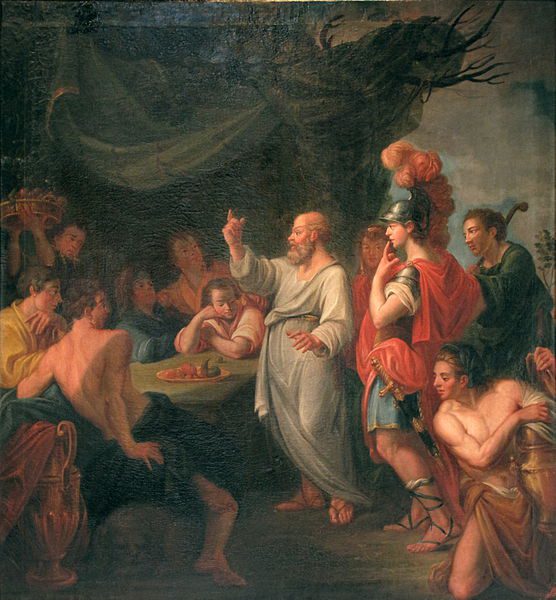
Socrates Teaching Pericles (1780), by Nicolas Guibal (1725-1784) [Wikimedia Commons / Creative Commons Attribution-Share Alike 2.0 France license]

* * * * *
Socrates is the single largest non-Christian influence on my thinking and apologetics methodology. My love of back-and-forth dialogue and massive use of it as a teaching tool ultimately stems from him (with honorable mention to Peter Kreeft as well). Socrates taught by example, the technique of relentless examination of the premises of one’s dialogical opponents. That’s a lot of what I do: at least in dialogue. I like to call it “going for the jugular”: in a dialogical / gentlemanly discussion sense.
For the premises that one assumes are utilized as the foundation for larger theories and “grand opinions.” If the premises are wrong, so are the theories built upon those foundations of sand. And folks are often unaware of their own false premises, so that they all of a sudden introduce them (usually unconsciously) into a stream of reasoning. Quite often, readers don’t realize that the false premise was “smuggled in.” It itself has to be analyzed, as to whether it is true or false. If a false premise is assumed without proper scrutiny, then the person making a particular argument is building upon sand. His argument doesn’t follow. It’s fallacious, or at least insufficiently grounded in logic and (perhaps also) fact.
This approach will explain much of what I state below in reply to Catholic writer Ross Douthat’s much-discussed article, “A Crisis of Conservative Catholicism” (First Things, January 2016). His words will be in blue.
Given the endless debates about what the current pontiff actually believes, it should be stressed that Francis is not a theological liberal as we understand the term in the United States. He is too supernaturalist, too pietistic, too much of a moral conservative, too Catholic for that.
This is true, and it’s good that Ross says this, but he seems to forget what he says here, later on, as we shall see.
However, his economic views are a little more radical and a lot more strongly felt than those of his immediate predecessors, he plainly feels that the Church under John Paul and Benedict laid too much stress on issues like abortion and marriage and not enough on poverty, immigration, and the environment,
Yes. All of this can be (and I think is) true, without the Holy Father being a theological liberal (nor an “indifferentist” on abortion and marriage). The Catholic Church allows a wide latitude of economic positions, and a third way which isn’t totally consistent with either capitalism or socialism. Ross acknowledges this himself later in the article, so it is not at issue. This “third way” critiques the manifest excesses of the former, and the manifest failures of the invariably secularized versions of the latter. Catholic social teaching is really a thing in and of itself. I myself (full disclosure) am a distributist: an economic way of thinking popularized by G. K. Chesterton and Hilaire Belloc, directly based on Catholic social teaching (particularly that of Pope Leo XIII).
Pope Francis is no more necessarily “liberal” than Chesterton and Belloc were, simply by virtue of speaking about economic issues in a way that sounds a bit “foreign” to [materialist / corporate] capitalist American ears. And it’s simple enough to find similar economic / social sentiments, in his two predecessors. This is nothing all that new. The emphasis is greater (granted), but not the essence of the socio-economic thinking.
and he has sympathy for liberal proposals—particularly concerning divorce and remarriage—that seem to promise to bring more people back to the sacraments and full participation in the faith.
That is an assumption (or premise) not sufficiently established. At the moment, we are waiting to see what he says in his pronouncement about the Synod on the Family. There are plenty of indications that he will uphold the existing moral tradition and restriction of reception of Holy Communion as it is now.
Put those tendencies together, and you have a pontificate that—in words, deeds, and appointments—has reopened doors that seemed to be closed since 1978, offering liberal Catholicism a second chance, a new springtime of the sort that seemed hard to imagine just a few short years ago.
Now we see Ross jumping to conclusions based on false premises. Nothing in what he said three entries back is “liberal” or destructive of Catholic tradition. Nor is it proven that the pope is some kind of liberal regarding divorced people receiving Holy Communion. Yet Ross leaps from those things to the wild assumption that he is “offering liberal Catholicism a second chance, a new springtime . . .” He has done no such thing. It’s been projected onto him, no doubt, in the current virtual hysteria of people obsessed with every utterance that the pope makes (especially orally, in interviews). But there is no hard evidence of this; no proof that any doctrine of the Church has been subverted by this pope.
There is plenty of evidence and data, on the other hand, that he is perfectly orthodox. My friend, Dan Marcum, documented this from his own words, in 24 different areas. But of course, the current hysteria has gotten so bad that radical Catholic reactionaries like, for example, Steve Skojec, of One Peter Five infamy, simply say (as he in fact did recently) that the pope says orthodox things merely to fool people, so he can diabolically, cynically advance his true agenda: a radical heterodoxy and modernism / liberalism. See how that sort of conspiratorialism works? Orthodox statements by the pope “prove” not that he is orthodox, but that he is a bald-faced liar pretending to be orthodox, so he can fool folks.
The recent Synod on the Family and the many arguments swirling around its deliberations have been dominated by ideas that many conservatives thought had been put to rest by John Paul II, from sociological updatings of gospel faith to visions of an essentially Anglicanized Catholicism. Didn’t we win these arguments already? The answer is yes—but not as permanently as conservative Catholics had sometimes thought.
This is nothing new or alarming, either. Of course, you have dissenting, heterodox voices in a synod, just as we saw during Vatican II and every ecumenical council, going back to Nicaea in 325 AD. The shocking thing is not that it exists (which is tragic, but not shocking), but rather, that anyone is surprised by it. Anyone who is, certainly doesn’t know much Catholic history, or the history of councils. Nor do they know the Bible very well. The Galatians and Corinthians, whom Paul wrote to, will quickly disabuse anyone of the foolish notion that the early Church was any different, in terms of sin or scandal, than the Church is today.
All that matters is the dogmatic or magisterial result of such councils and synods. Vatican II was orthodox. So far, this synod appears to be as well. If the pope issues a strong reiteration of tradition again, in his summary proclamation, then the “official orthodoxy” of the synod will be a done deal. If he doesn’t do so, then I agree, we have a problem.
Douthat acts (very much like purely secular minds do) as if there is no place or function of the Holy Spirit at all, in such synods. It’s all about the machinations of men, and factions, and Machiavellian maneuvering of the liberals. They do do that, assuredly, but they have not been successful in overturning a single Catholic doctrine thus far (all through history). Surely that is significant. But if one looks at things with merely a secular, sociological eye, and neglects God’s supernatural protection of His Church (which ultimately gets into the issue of indefectibility), then all they will see is the bad stuff (i.e., among men). Hence, they will assume a doom-and-gloom outlook, rather than a faithful, optimistic one: through the “eyes of faith.” This is where we are at today, with widespread daily, hand-wringing apocalypticism and (increasingly) conspiratorialism regarding Pope Francis, minus any compelling proof that the End is Near.
Seminaries really have changed dramatically since the ’70s, there really is a John Paul II and Benedict generation of younger priests, and the hierarchy is markedly more conservative than it was in the later years of Paul VI. Moreover, I do not think that most of the cardinals voting for Jorge Bergoglio thought that they were voting to reopen the Communion-and-remarriage debate, let alone that their votes were any kind of deliberate rejection of the magisterium of the previous two popes.
This is all true.
The fact remains that all of the bishops who have agitated for changing the Church’s doctrine—or, as they claim, the Church’s discipline—on marriage and the sacraments were appointed by the last two popes.
This is very troubling, but not altogether surprising, either. There is laxity and shortcomings among bishops, just as there are among Catholics, generally speaking. Almost the entire collective of western bishops, after all, became Arians in the 4th and 5th centuries, and the East literally almost apostatized to the heresies of Arianism, Monophysitism, or Monotheletism, in those centuries and for a time after. Then there was a huge debate about iconoclasm in the East after that (8th and 9th centuries). All the bishops but one in England during Butcher Henry VIII forsook the faith, save one (St. John Fisher). For that, his beheaded body was treated as follows, by the wicked tyrant:
. . . stripped and left on the scaffold until the evening, when it was taken on pikes and thrown naked into a rough grave in the churchyard of All Hallows’ Barking, also known as All Hallows-by-the-Tower. There was no funeral prayer. A fortnight later, his body was laid beside that of Sir Thomas More in the chapel of St Peter ad Vincula within the Tower of London. Fisher’s head was stuck upon a pole on London Bridge but its ruddy and lifelike appearance excited so much attention that, after a fortnight, it was thrown into the Thames, its place being taken by that of Sir Thomas More, whose martyrdom, also at Tower Hill, occurred on 6 July. [Wikipedia]
St. John Fisher certainly paid a price for being an obedient Catholic bishop. Many bishops today don’t want to pay any price, I guess, if it means going against the grain of more liberal colleagues. It’s a problem in government, in business, in just about any human group, and in the Church. James Hitchcock famously wrote about it, in his article, “Conservative Bishops, Liberal Results” (Catholic World Report, May 1995). But the results are not on the doctrinal level. I agree that we need massive reform on the parish, school, and seminary institutional level (how to do that is an entirely different matter and discussion), but what I’m defending is the existing doctrines and dogmas of Holy Mother Church. They have not been changed.
And the fact remains that while the majority of bishops do seem loyal in principle to the magisterium of John Paul II, there has been no shortage of episcopal enthusiasm for an essentially Hegelian understanding of the development of doctrine.
Whether these bishops (and which ones) are “essentially Hegelian” as regards development of doctrine would have to be closely analyzed. I highly doubt it. Many people misunderstand the very nature of development of doctrine, and so I’m certainly not prepared to take Douthat’s bald assertion as any sort of proof that this is actually the case among many bishops. That has to be proven, not merely asserted. And that’s part of the problem with “negative analyses” of these sorts. It’s easy to string along a huge list of “bad stuff” (as is being done with the pope), but it’s quite another thing to demonstrate each negative assertion. So the long dirty laundry lists may give the appearance of strength, but the list is only as god as each item on the list is proven: with hard facts.
A “spirit of Vatican II” vision for the Church does indeed have many of the weaknesses that conservatives have spent the last few decades pointing out, and the fate of the Protestant Mainline does indeed suggest that a full Hegelianism is the royal road to institutional suicide. But the promise of some kind of reconciliation between Catholicism and contemporary liberal modernity, sexual modernity especially, has a persistent, entirely understandable appeal, which is why theological liberalism is rediscovered as often as it seems to wane. And the Church exists within a larger cultural matrix that persistently regards a liberalized, Protestantized Catholicism as the coming thing, the inevitable next step for the Church, a prophecy that need not be fulfilled to shape the way that millions of Catholics think about their faith.
Once again, God is never mentioned in this equation: as if He plays no role at all. In fact, God is only mentioned twice in the entire article, and only in a passing, rhetorical sense. The Holy Spirit is never mentioned at all. How can this be, in an article that purports to deeply analyze the state of the Church? Is it merely a man-made institution, like the post office or the IRS? Does not the faithful Catholic (which Douthat is) believe that God guides and protects His One True Church, despite all the nonsense and foibles and compromises and sins of men?
I would contend that it is quite obvious (virtually unarguable) that He does do so, seeing what has happened within Protestantism, and seeing that we have maintained our doctrine pure and incorrupt for 2,000 years. Why should it be any different now? How is it that we still have, for example, the prohibition of contraception in place, despite all, despite even Blessed Pope Paul VI’s advisors, almost to a man, telling him he should change what is unchangeable dogma? Everyone else has caved: even the Orthodox, but not us. Why? Well, pure and simple: it’s the Holy Spirit’s protection. Yet that crucial, game-changing, all-important factor is utterly neglected in this article. Certainly, contraception is far more controversial than the divorced and “remarried” receiving communion, yet it’s not going anywhere (being infallible teaching). There is no evidence whatsoever that the Catholic Church is about to “go Episcopalian.” Many individual Catholics (even bishops, God help us) assuredly think like that, yet the doctrines remain in place.
Pope Francis has, as I see it, a Humanae Vitae “moment” coming up, with all these liberal compromisers and half-Protestants agitating for change:as he prepares his final statement on the Synod. Will he give in to them, or will he uphold constant tradition? We’ll see, won’t we? But that battle is about to be concluded one way or another, very soon.
So conservative Catholics need to recalibrate their expectations. The idea that there would be a “biological solution” to the post–Vatican II divisions in the Church—in which liberal Catholics have small families, fail to raise them in the faith, and gradually go extinct—looks too simplistic. Liberal Catholicism will be with us for generations yet to come.
I’m not nearly that pessimistic. The quintessential liberals still have a ways to go to all die out. These things change slowly. All we need to do is have lots of kids (and homeschooling helps a lot, too), and raise them as good Catholic disciples of Jesus and things will be great. Demographics is destiny. The problem is that “conservative” or orthodox Catholics, who agree with Humanae Vitae and the Gospel of Life, have hardly any more children than those in the larger secular society do.
The Church has been through many dire, decadent, disgraceful periods (read your Church history folks!), and a revival always improved them in the next century. We’re only 16 years into this new century. Unless Jesus comes first, a profound revival is virtually certain in this century, given what we know about past Church history. Just in the last 250 years, we had the French-led, so-called “Enlightenment” and French Revolution try to bury the Church. Marxism and Communism tried the same, with the same result. The Nazis (slow learners, I guess) also attempted to do it. Where are they all now?
Now we have to deal with modernism, which really kicked up in larger Christian circles by the mid-19th century, and in Catholic circles since the mid-20th. It’s compounded by rampant, conquer-all secularism and the sexual revolution, and now radical jihadists. These are huge foes, but if we beat the others (and former ones such as the Arians, Donatists, Marcionites, Cathari, Albigensians, Hussites, Gnostics, Roman pagans, barbarians, Attila the Hun, Genghis Khan, Vikings, the first Muslims, the later Turks, and the Protestant revolutionaries [insofar as they disagreed with us]), we will also defeat these. It’ll take a while.
But then, finally, there is a form of liberal Catholicism that envisions a Catholicism too much like the present Protestant Mainline or the deteriorating Anglican Communion to be recognized as Catholic. This form has revolutionary ambitions, it proceeds from premises that owe more to a brief era in twentieth-century theology than to the full inheritance of the Church, and its theological vision and Catholic orthodoxy are not ultimately compatible. Indeed, they are locked in a conflict that’s as serious as the Church’s struggle with Arianism or Gnosticism (and resembles those conflicts on specific theological points as well).
I heartily agree.
It may be that this conflict has only just begun. And it may be that as with previous conflicts in church history, it will eventually be serious enough to end in real schism, a permanent parting of the ways.
And it may be that the Holy Spirit (remember Him?) will defeat it, just as He has defeated all the other wicked false doctrines and dangerous ideas all through Church history. People may leave the Church (that has always be the case), but the Church has never, and will not ever, leave the truth that it has been commissioned to protect and cherish and proclaim far and wide.
Note that this is not the same as saying that the pope can actually fall into heresy, or teach it ex cathedra as doctrine. But a glance at Catholic history indicates that even if they are preserved from the gravest errors, popes are not necessarily the heroic protagonists in major theological conflicts. In many cases, we remember councils and saints rather than popes—Nicea and Trent, Athanasius and Ignatius. Rome tends to move late and not always effectually at first, and in some cases (the unfortunate Pope Honorius being only the starkest example), the papacy has conspicuously failed to be either wise or courageous when orthodoxy is on the line. And occasionally we even get Avignons and anti-popes as well!
That’s correct. But in our current era, we have a long string of heroic popes who resisted the leading wicked societal forces of their times: Pope Leo XIII against secular liberal ideas and capitalism gone awry, Pope St. Pius X against modernism, Popes Pius XI and Ven. Pope XII against the Nazis, Blessed Pope Paul VI against contraception (the sexual revolution), Pope St. John Paul II against the culture of death, and Soviet Communism. That’s the trend. We can talk about the bad popes (indeed, I have written about it), but they are always “way back” in history.
That’s not to say that an exception may not come around, but the trend is overwhelmingly against it, and Pope Francis has not been shown to be a “bad pope” at all. If he is a critic against materialistic and capitalistic excesses (if that is to be his legacy), he will be not all that different from Pope Leo XIII in the eyes of history. We just have a more difficult time hearing and accepting his teachings because we are so far compromised with the idols of our secular and hyper-materialistic, and sex-obsessed society.
Here conservatives should take cautionary instruction from the liberal ultramontanism suddenly flourishing around Francis. We have lately been informed that the pope is singlehandedly developing doctrine with his comments on the death penalty;
This is untrue. Capital punishment is not intrinsically evil; nor has the Church prohibited nations to exercise it (Romans 13 gives them the “power of the sword”). Thus it is not a doctrinal issue per se. What the Church is doing is suggesting that it is not as necessary and to voluntarily oppose it, as part of a larger Culture of Life. So no changing of doctrine is involved here, and what the pope is saying is perfectly consistent with what his two predecessors had also developed.
we’ve heard accounts of bishops at the synod discussing how the pope can allegedly “twist the hands of God” or show the mercy of Moses (as opposed to Jesus) on marriage and divorce;
Who cares what individual bishops at a synod say? That’s not the magisterium; nor are even their combined declarations in bishops’ conferences or in synods and councils. It’s only magisterial when they agree with the pope to promulgate something.
and we have prominent Jesuits acting shocked, shocked that conservative cardinals might ever dare to differ with the pope.
Then they are plain dumb.
It’s easy to mock this sudden enthusiasm for papal authority. But a conservative Catholicism that became too quick to play the “magisterium” card as a substitute for sustained argument must acknowledge that it’s being hoisted on its own petard.
I’m not among these people being hoisted, because I’ve understood from my conversion in 1990 (having been mostly influenced by Cardinal Newman), that he wrote about the role of laypeople in history: particularly regarding Arianism in the 4th century over against bishops and sometimes personally wavering popes. Once again, learning from history is key to how we view things in the Church now.
In thinking through these issues, it seems to me that the revival of 1970s-era debates is evidence that conservative Catholics need a more robust theory of the development of doctrine. Or, perhaps more aptly, they need a clearer theory of how development of doctrine applies to developments that have occurred since John Henry Newman wrote his famous essay. Of which, as liberal Catholics love to point out, there have been a great many: not only the explicit shifts that came in with Vatican II, on religious liberty especially, but the various debates where the range of acceptable Catholic viewpoints has clearly shifted in one direction or another over the last century. A few examples might include the possibility of universal salvation, the precise moral status of the death penalty, whether slavery and torture are intrinsic evils, as well as the question of supersessionism and the Church’s relationship to the Jews. One could multiply examples.
I’m always in favor of more understanding of development of doctrine. It’s what made me a Catholic, and is my very favorite theological topic. But Douthat, while calling for more understanding, seems to be confused as to what doctrinal development is. Religious liberty issues are not doctrinal, but rather, ways in which we can variously view falsehood and heresy and the people holding to them. What we understand much better now is that people may hold false views, but not in bad faith. In the Middle Ages it was usually casually assumed that anyone holding to heresy was completely personally responsible, and in no sense a victim; only a wicked perpetrator of what they themselves (so it was thought) believe to be deliberate evil. As a partial result of a much better understanding of that, authentic ecumenism has rapidly developed since World War II and Vatican II.
Universal salvation has not been taught in any magisterial doctrine. It’s not developing at all, because it’s a heresy. The Bible rejects it. There has merely been thinking about how much we may hope that all men are saved: in effect, no different from the notion of universal atonement, or the desire of God that all be saved. But since men have free will, not all will be. Some will reject God’s grace.
To bring things to a finer point: I firmly believe that the proposals to admit remarried Catholics to Communion without an annulment strike at the heart of how the Church has traditionally understood the sacraments, and threaten to unravel (as for some supporters, they are intended to unravel) the Church’s entire teaching on sexual ethics. I feel more certain about this than I am about the precise arguments in Humanae Vitae;
I agree. That’s why I have been predicting that the Holy Father will uphold this tradition and have his own “Humanae Vitae moment.” Stay tuned! I’ve been defending this pope all along (I’m a big fan of his), and am confident that he will heroically arise to the occasion.
Conservative Catholics need to come to terms with certain essential failures of Vatican II. For two generations now, conservatives in the Church have felt a need to rescue the real council, the orthodox council, from what Pope Benedict called “the council of the media.” . . . the council as experienced by most Catholics was the “council of the media,” the “spirit of Vatican II” council, and that the faithful’s experience of a council and its aftermath is a large part of its historical reality, no matter how much we might wish it to be otherwise.
What has occurred is no more the failure of the council itself, than it is a failure of Pope Francis when the media and popular secular culture distort his view on a given subject. This is not an essential failure of Vatican II. Douthat seems particularly confused on this point: throwing out the baby with the bathwater. The misguided liberal “spirit of Vatican II” only proves that people delude themselves about the magisterium, and try to spin and distort it to the public. The fault for that lies on those who do it, not the council. Is this not utterly obvious?
But its deliberations simply took place too soon to address the problems that broke across Catholicism and Christianity with the sexual revolution and that still preoccupy us now.
All the more reason to understand that it is not responsible (at all!) for those problems. The sexual revolution was just getting underway.
Which is not to say that what the Church needs right now is a Council of Trent, exactly. The recent Synod on the Family suggests that, if attempted, the outcome would be either empty or disastrous.
Again, the jury is still out on the Synod. What has already been proclaimed by it (sub-magisterial) was not heterodox. It matters not a whit what idiotic things may have been bandied about by liberal bishops; only the result is relevant (in terms of doctrine and dogma). We’re still waiting for the pope to release his Letter. Why is it viewed from the perspective that excludes the Holy Spirit’s protection? This has already arguably manifested itself, and will all the more gloriously if the pope strongly reiterates (as I fully expect him to) existing tradition on marital status and Holy Communion.
Traditionalism vs. Radical Catholic Reactionaries
Previous Post

March 2, 2016
Is Mary Impeccable (Incapable of Sinning)?
Next Post
March 2, 2016 Is John 6 About Holy Communion?
Browse Our Archives
Select a Category & Last Things About Me Anti-Catholicism Atheism & Agnosticism Baptism and Sacramentalism Bible and Tradition Blessed Virgin Mary Books by Dave Armstrong C. S. Lewis Calvinism & General Protestantism Catholic Apologetics Catholic Apologists Catholic conversion Catholic converts Christmas Church (Ecclesiology) Church History Conversion and Converts Development of Doctrine Eastern Orthodoxy Ecumenism & Christian Unity Eucharist & Liturgy Fathers of the Church French Translations G. K. Chesterton Hell Hell & Satan Hell & Satan & Last Things Heresies & Comparative Religion Holistic Health Inquisition & Crusades & Scandals James White Jews & Judaism & Old Testament John Calvin John Henry Newman Liberal / Modernist Theology Life Issues Literary Resume Lutheranism Mariology Martin Luther Music Orthodoxy Papacy & Infallibility Personal Page Philosophy & Science Political & Ethical & Moral Issues Protestant Persecution & Intolerance Protestantism Purgatory Purgatory & Penance Romantic & Imaginative Theology Saints & Purgatory & Penance Salvation Salvation & Justification Satan & Last Things Sexuality and Gender Issues Spanish Translations Traditionalism vs. Radical Catholic Reactionaries Traducciones al español / tradução para português Trinitarianism & Christology Uncategorized Videos
Select a Month October 2026 September 2026 August 2026 July 2026 June 2026 May 2026 April 2026 March 2026 February 2026 January 2026 December 2025 November 2025 October 2025 September 2025 August 2025 July 2025 June 2025 May 2025 April 2025 March 2025 February 2025 January 2025 December 2024 November 2024 October 2024 September 2024 August 2024 July 2024 June 2024 May 2024 April 2024 March 2024 February 2024 January 2024 December 2023 November 2023 October 2023 September 2023 August 2023 July 2023 June 2023 May 2023 April 2023 March 2023 February 2023 January 2023 December 2022 November 2022 October 2022 September 2022 August 2022 July 2022 June 2022 May 2022 April 2022 March 2022 February 2022 January 2022 December 2021 November 2021 October 2021 September 2021 August 2021 July 2021 June 2021 May 2021 April 2021 March 2021 February 2021 January 2021 December 2020 November 2020 October 2020 September 2020 August 2020 July 2020 June 2020 May 2020 April 2020 March 2020 February 2020 January 2020 December 2019 November 2019 October 2019 September 2019 August 2019 July 2019 June 2019 May 2019 April 2019 March 2019 February 2019 January 2019 December 2018 November 2018 October 2018 September 2018 August 2018 July 2018 June 2018 May 2018 April 2018 March 2018 February 2018 January 2018 December 2017 November 2017 October 2017 September 2017 August 2017 July 2017 June 2017 May 2017 April 2017 March 2017 February 2017 January 2017 December 2016 November 2016 October 2016 September 2016 August 2016 July 2016 June 2016 May 2016 April 2016 March 2016 February 2016 January 2016 December 2015 November 2015 October 2015 September 2015 August 2015 July 2015 June 2015 May 2015 April 2015 March 2015 February 2015 January 2015 December 2014 November 2014 October 2014 September 2014 August 2014 July 2014 June 2014 April 2014 March 2014 February 2014 January 2014 December 2013 November 2013 October 2013 September 2013 August 2013 July 2013 June 2013 April 2013 March 2013 February 2013 January 2013 December 2012 November 2012 October 2012 September 2012 August 2012 July 2012 June 2012 May 2012 April 2012 March 2012 February 2012 January 2012 December 2011 November 2011 October 2011 September 2011 August 2011 July 2011 June 2011 April 2011 March 2011 February 2011 October 2010 September 2010 August 2010 July 2010 April 2010 March 2010 December 2009 October 2009 August 2009 July 2009 June 2009 May 2009 March 2009 February 2009 October 2008 September 2008 April 2008 March 2008 February 2008 January 2008 December 2007 November 2007 October 2007 May 2007 March 2007 February 2007 January 2007 November 2006 October 2006 September 2006 August 2006 July 2006 June 2006 May 2006 April 2006 March 2006 February 2006 October 2005 June 2005 April 2005 February 2005 July 2004 May 2004 April 2004
Follow Us!
TAKE THE
Religious Wisdom Quiz
Which book of the Bible has the most chapters?
Select your answer to see how you score.
Proverbs Genesis Psalms Isaiah
Books by This Author Books by Dave Armstrong
Related posts from Biblical Evidence for Catholicism

Was Peter "Any Old" Apostle? 10 Anti-Papal Arguments
Biblical Evidence for Catholicism

Jesus Founded the [Catholic] Church. If Not Him,...
Biblical Evidence for Catholicism

Jerusalem Council vs. James White & Sola Scriptura
Biblical Evidence for Catholicism

11 Protestant Objections to Papal Authority Debunked
Biblical Evidence for Catholicism
TRENDING AT PATHEOS Catholic

The Sermon on the Mount, Part I: Matthew...
The Sermon on the Mount, Part I (Matthew 4:12-5:12) St. Matthew moves...

What's up from Crossway: Reviewing some of their latest A few weeks...

Janie Learns the Way of the Cross: A...
Teaching children about Jesus' Passion can be challenging. Many parents and educators...

Looking For Good Catholic Writing - October 2026
He alone extends the heavens, and he walks upon the waves of...

In "Irreplaceable," our book on vocation and technology, Trevor Sutton and I...

I was strolling through the top floor of the brand new Parthenon...
view all Catholic blogs
Ad-Free & Subscriber Log-In Subscription Support
- About Us
- 2026 Calendar
- Videos
- Podcasts
- Library of World Religions
- Faith In Media Tracker
- Advertise With Us
- Write for Us
- Privacy Policy
- Terms of Service
- Do Not Sell My Data
- Contact Us
- Radiant Digital
- Manage Newsletter Subscriptions
- Unsubscribe From Notifications
- Sitemap
Copyright 2008-2026, Patheos. All rights reserved.
Subscription Support Ad-Free & Subscriber Log-In
Follow Patheos