
BuddhistCatholicContemplativeEvangelicalGeneral ChristianHinduJewishLatter-day SaintMuslimNew VisionsProgressive Christian
Beliefs
- Buddhist
- Catholic
- Contemplative
- Evangelical
- General Christian
- Hindu
- Jewish
- Latter-day Saint
- More Voices
- Muslim
- New Visions
- Pagan
- Progressive Christian
Topics
- Religion News
- Food and Religion
- Sports and Religion
- Religious Art
- Religious Music and Entertainment
- Religious Events
- History and Religion
- Style and Religion
- Politics and Religion
- Women in Religion
- Recreation Outdoors and Religion
- Business Finance and Religion
- Careers Workplace and Religion
- Education and Religion
- Family Parenting and Religion
- Health Fitness and Religion
- Home and Religion
- Relationships and Religion
- Technology and Religion
- Travel and Religion
Columnists
- Buddhist Columnists
- Business Finance and Religion Columnists
- Careers Workplace and Religion Columnists
- Catholic Columnists
- Contemplative Columnists
- Education and Religion Columnists
- Evangelists Columnists
- Family Parenting and Religion Columnists
- General Christian Columnists
- Health Fitness and Religion Columnists
- Hindu Columnists
- History and Religion Columnists
- Home and Religion Columnists
- Jewish Columnists
- More Voices Columnists
- Latter Day Columnists
- Muslim Columnists
- New Visions Columnists
- Nonreligious Columnists
- Pagan Columnists
- Politics and Religion Columnists
- Progressive Columnists
- Recreation Outdoors and Religion Columnists
- Relationships and Religion Columnists
- Religion News Columnists
- Religious Art Columnists
- Religious Events Columnists
- Religious Music and Entertainment Columnists
- Sports and Religion Columnists
- Style and Religion Columnists
- Technology and Religion Columnists
- Travel and Religion Columnists
- Women in Religion Columnists
Resource Library
- 2026 Calendar
- Library of World Religions
- The 100 Most Holy Places on Earth
- Patheos Answers
- Podcasts
- Videos
- Faith Leaders Database
- Anglican Episcopalian
- Bahai
- Baptist
- Buddhism
- Christianity
- Confucianism
- Eastern Orthodoxy
- Hinduism
- Holiness and Pentecostal
- ISKCON
- Islam
- Judaism
- Lutheran
- Methodist
- The Church of Jesus Christ of Latter-day Saints
- New Age
- Paganism
- Presbytarian and Reformed
- Protestantism
- Religion Behind the Scenes
- Roman Catholic
- Scientology
- Shia Islam
- Sikhism
- Sufism
- Sunni Islam
- Taoism
- Zen
- See all religions
Research Tools
 Ad-Free & Subscriber Log-In Subscription Support
Ad-Free & Subscriber Log-In Subscription Support
Follow Patheos 

- Trending:
- Forgiveness
- |
- Marriage
- |
- Consciousness
- |
- Death Penalty
- |
- Election
- |
- Halloween

-
About
-
Catholic Apologetics
-
Church History
-
Great Apologists
-
Christian Worldview
-
Protestantism & Misc.
- Home
- Catholic
- History and Religion
- Biblical Evidence for Mary Mediatrix
Biblical Evidence for Mary Mediatrix
Last updated on: March 27, 2017 at 12:16 pm by Dave Armstrong
Biblical Evidence for Mary Mediatrix 2017-03-27T12:16:19-04:00 Dave Armstrong
Patheos Explore the world's faith through different perspectives on religion and spirituality! Patheos has the views of the prevalent religions and spiritualities of the world.
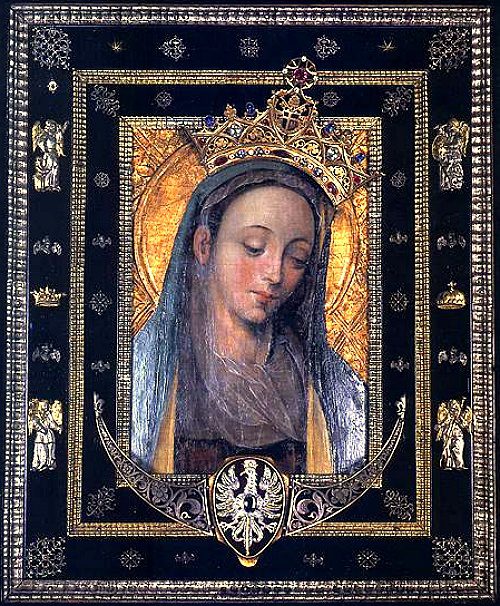
Crowned Madonna, Rokitno, Poland, 1671 [public domain / Wikimedia Commons]

* *
(11-25-08)
* * *
This came about as a result of some questions asked on the CHNI forum, from a few people who are seriously considering conversion to Catholicism.
* * * * *
I struggle with this and don’t know what to make of it. I hear or read Catholics make comments or prayers to Mary that seem over the top. I can understand the idea of asking Mary to intercede for us, but sometimes the praise and prayers given to her seem to take the place of God. Things like ‘Mary saves us’ or when prayer is directed to her saying we give our heart to Mary or asking Mary to do whatever the request is – as though she herself has the power to grant our request. In the past I’ve put this down to Marian devotion gone wrong, but then I’ve also read Catholic explanations for these types of prayers or praise along the lines of ‘well, that’s not really what we mean’ – to which I tend to respond ‘then say or pray what you mean’ – speak & say according to your actual theology. To do otherwise seems like mental gymnastics, or dancing around the issue semantically – and not quite honest. I feel like it’s misleading to pray or praise Mary in terms that in a non-Catholic’s mind should be reserved for God alone.
This is especially difficult when the comments are from Pope Benedict XVI: “We implore you to have pity today on the nations that have gone astray, on all Europe, on the whole world, that they might repent and return to your heart.” It almost seems to undermine the whole persuasive argument for the fullness of truth being found in the Catholic Church. This is a huge stumbling block to me and the last few days has felt like a complete roadblock on the journey I’ve been on back towards the Catholic faith. I know this may sound angry, but I need some good answers & honesty without someone dancing around this issue with words. Thanks.
Good and fair questions. I think the main difficulty you are expressing can probably be adequately explained, for the most part, in terms of:
Flowery, poetic language that is not intrinsically literal in nature or intent.
Interpreting the words in context (especially a Christological context).
Taking into account the many less or inadequately educated Catholics who don’t understand the fine distinctions in Catholic theology. They aren’t helping matters any.
Protestants have so minimized and underemphasized Mary and have categorized any devotion to her in terms of rank idolatry, and this has so penetrated the entire Christian community (especially in Protestant-to-the-bone North America), that now virtually any devotion at all can seem to be excessive, because of the stark contrast. We all (bar none) pick up influences from our surroundings.
* * *
Let’s not get carried away here, with the “save” terminology. To speak of a human being as participating in “saving” others is perfectly biblical:
1 Corinthians 9:22 I have become all things to all men, that I might by all means save some.
[Paul “saves” other people]
1 Timothy 4:16 Take heed to yourself and to your teaching: hold to that, for by so doing you will save both yourself and your hearers.
[ Doesn’t Paul know that only God can save??!!!]
Philippians 2:12b-13 . . . work out your own salvation with fear and trembling; for God is at work in you, both to will and to work for his good pleasure.
[If someone says that God is mentioned in the second part, the Calvinist “monergist” still has to explain how a human being can participate at all in what only God can do (according to the monergist) ]
2 Corinthians 4:15 For it [his many sufferings: 4:8-12,17] is all for your sake, so that as grace extends to more and more people it may increase thanksgiving, to the glory of God.
Ephesians 3:2 assuming that you have heard of the stewardship of God’s grace that was given to me for you…
Ephesians 4:29 Let no evil talk come out of your mouths, but only such as is good for edifying, as fits the occasion, that it may impart grace to those who hear.
[Paul distributes divine grace, just as we believe Mary does, and teaches that others can do the same]
St. Peter also joins in this folly of teaching that Christians can distribute divine grace to each other:
1 Peter 4:8b-10 . . . love covers a multitude of sins. Practice hospitality ungrudgingly to one another. As each has received a gift, employ it for one another, as good stewards of God’s varied grace.
Even the angels help to give grace:
Revelation 1:4-5a John to the seven churches that are in Asia: Grace to you and peace from him who is and who was and who is to come, and from the seven spirits who are before his throne, and from Jesus Christ . . .
[ it was nice of John to add in Jesus Christ at the end, along with his own and the angels’ giving of grace, just so we’ll remember that there is but one mediator of God’s grace. Not a lot of “monergism” there, I reckon . . .]
This is especially difficult when the comments are from Pope Benedict XVI: “We implore you to have pity today on the nations that have gone astray, on all Europe, on the whole world, that they might repent and return to your heart.
*
There is nothing whatever wrong with this prayer, or the Holy Father’s reciting of it. It is perfectly orthodox. I would caution young Catholics and those considering the Church against judging high forms of Catholic pious expression. These things are not simple. It takes years to learn to appreciate them and to spiritually “resonate” with them, so to speak. One cannot do that in a few months’ time.
Believe me, I’m still learning lots of things all the time, and I’ve been a Catholic for 18 years, and defend the Church almost on a daily basis. I consider myself to have a fairly strong devotion to the Blessed Virgin, but there are still some prayers that strike me even now as “excessive.”
But the difference is that I recognize the limitation in myself, from years or Protestant and secular thinking (32 years, before I converted). I acknowledge that I am insufficiently Catholic, rather than concluding that the Church is insufficiently correct or biblical. It is because my “lens” through which this material is “filtered” is not yet fully Catholic, or without impurities that blur my vision and reception, that I think any of it is excessive, not because it actually is.
It’s fine to say that one doesn’t fully understand something, but to start judging popes and the Church when one still personally has a great deal to learn about the faith; that is where it becomes wrong, in my opinion, and presumptuous. It requires a lot of humility to admit to ourselves that there are things we don’t yet know: that saints and doctors of the Church have pondered and thought about for centuries.
This is one such instance. This is how a Catholic thinks. He or she bows to the superior wisdom of the Church of the Ages and recognizes that it is Holy Mother Church that determines truth and falsehood in the end, not the lone individual, stock-full of many biases and cultural / philosophical / religious (sometimes ethnic) influences hostile to the Church.
I wouldn’t expect a brand-new Catholic who is barely starting to understand Mariology in all its fullness, to grasp a prayer like this. It would be like asking a person who just learned their time tables, to comprehend algebra, or calculus, or trigonometry. Does that make any sense?
Mariology and Marian veneration is a very high level of spirituality. That’s precisely why millions of Protestants don’t engage in it at all. They have jettisoned this whole aspect of Christianity from their faith, and have never learned about it. Every Protestant has to “unlearn” that built-in hostility and then be willing to learn to think in a very different way: a Catholic, traditional way (that is, when closely examined, more deeply and profoundly “biblical” than any form of Protestantism).
*
The way to deal with this is not to quickly determine that the pope is wrong, or sinful, or that this is proof that Catholicism isn’t perfect (like every other option out there). No; it is a time to dig in and do some serious study, to understand why these expressions are used, and why they seem so foreign and “unbiblical” and “excessive” to us (if that is how we feel about it).
There are reasons for these things. We are what we eat. We take in the philosophy of our surroundings. America was a thoroughly Protestant country, and now is increasingly a secular one. American thought is not exactly renowned for its deep understanding of the Catholic worldview. We all deal with this. It’s a constant process. Romans 12:2-3 states:
Do not be conformed to this world but be transformed by the renewal of your mind, that you may prove what is the will of God, what is good and acceptable and perfect. For by the grace given to me I bid every one among you not to think of himself more highly than he ought to think, but to think with sober judgment, each according to the measure of faith which God has assigned him.
It’s like any debate. We shouldn’t feel that we can comment authoritatively on the wrongness of some other position (much less in public!) until we have first learned about that thing inside and out, and know the position as well or even better than our “opponents” who hold it.
Now, as to young Catholics and all aspects of Catholic Mariology; sorry, there are a ton of things that have yet to be learned. But if you already know pretty much that the Catholic Church is the One True Church and the fullness of the faith, then I would strongly urge you to be most reluctant to judge her devotions, no matter how difficult it may be for you at this time to completely understand the basis of them.
In this instance, there is a quick judgment upon a holy person who has been deemed to be “Blessed” by Holy Mother Church (and upon the present Holy Father: who is himself an extraordinary theologian: not all popes are). Does anyone really think that his Mariology would be horrendously heretical, seeing that he has been declared “Blessed”? The Church takes painstaking care to make sure everyone who is being considered for sainthood has orthodox views.
*
Here, we are talking about Blessed Bartolo Longo (see Wikipedia). His writings are used as part of the Luminous Mysteries of the Rosary.
You can read the original prayer that the Holy Father recited in an article about it. But be prepared to be jolted yet again if you are not familiar with the most florid expressions of Catholic Marian piety. I reiterate what I stated above: if these things trouble you, it is a time for you to start from scratch and learn the basis of this sort of Marian piety in Catholic spirituality. Resolve to learn, not to judge. That is my advice, for whatever it is worth. The newest person on a sports team does not immediately start judging the actions and decisions and rationales of the coach, does he? Is it not his place to be quiet and to learn a bit before taking on the coach (if he ever does so)?
First of all, like all truly authentic Marian piety, this prayer is not without many references to Jesus Christ, Whose ultimate authority as God is always presupposed and deeply ingrained in the consciousness of Catholics who are also devoted to Mary. When one presupposes something they do not always mention it again and again. Outsiders may misunderstand and think that the assumed thing that is not always mentioned in every other sentence, is therefore, denied, but that doesn’t follow, logically, at all. That said, here are some references to Jesus in the prayer:
. . . redeemed through the blood of our sweet Jesus . . .
. . . That we may be made worthy of the promises of Christ. . . . [four times, recurring in the prayer]
. . . we, . . . are the first who crucify Jesus in our hearts . . .
. . . the testament of our dying Redeemer. And this testament of a God, sealed with the blood of a Man-God, appointed thee our Mother, the Mother of sinners. Thus, as our Mother, thou art our Advocate and our Hope.
. . . yet wound the loving heart of thy Son.
Did not Jesus entrust to thy hands all the treasures of his graces and mercies?
The divine Child we behold on thy knees, . . .
Certainly no Protestant could object to any of these references to Jesus. They’re in there, and they can’t be dismissed and discounted. I can see that probably the most controversial passage in the prayer would be the line:
Thou art almighty by grace, and therefore thou canst save us.
Before anyone drops dead from shock, this is perfectly explainable in an orthodox, biblical sense. The language of “save” is (as I have shown above) perfectly biblical. The Bible teaches that God uses His creatures to distribute His grace, that always originates from Him and He alone. Paul uses the same language.
Catholics believe that God uses Mary in the distribution of grace, even for all graces received (yes, that is firm, longstanding Catholic doctrine, reaffirmed by all recent popes: just not yet defined at the very highest dogmatic level). God can do that if He so chooses. It is neither impossible nor contrary to the Bible, nor denigrating of God. It is, we believe in faith, how God chose to act. Here one who is just starting to explore Catholic Mariology, needs to take a deep breath, relax, and read a few elementary, prerequisite treatments of the topic.
The definition of the word “almighty” is not limited to reference to God alone, as literally all-powerful. It can also have a second meaning of “great power.” For example, Merriam-Webster online, gives as a second definition:
relatively unlimited in power almighty board of directors> b**:** having or regarded as having great power or importance almighty dollar>
Note that in the prayer, Mary is “almighty by grace,” which precisely expresses that whatever power she has comes from God, by grace. God needs no grace; only His creatures do, including Mary, who was saved by her immaculate conception, by the sheer grace of God. God gives her extraordinary grace to be very powerful (“almighty” in the second permitted sense of the word).
*
Dictionary.com confirms the above, in its first entry, from the Random House Unabridged Dictionary (2006):
- having very great power, influence, etc.: The almighty press condemned him without trial.
So this becomes a simple matter of understanding the language, and the permitted latitude in language, according to dictionary definition. But people often see what they want to see, don’t they?: according to their predispositions coming in. Many Protestants who see this (already hampered by a highly distorted notion of what Catholics believe about Mary) will immediately conclude that Mary is being equated with God, and given power that only He has (omnipotence). They do the same in how they interpret our asking Mary to pray for us. That is simply not the case. And if they don’t give Catholics the least benefit of the doubt, then they will continue on with their distortions and calumnies.
All I’m saying, basically, is that someone just coming into a worldview will likely not understand some of its most complex points. That (itself self-evident, I think) would seem to me to call for an approach of a bit more reluctance to make the strong criticisms that we have seen: against the pope, no less. It’s okay to not understand and even to disagree at this point, but please understand that these are complex matters and have a full justification from a Catholic perspective. That is the point I was trying to make. Sometimes we apologists gotta say things that are a little difficult for others to hear. Part of the job.
As the “novice” coming in, it is proper, I think, to realize that a person that much more wise would obviously have a good reason for what he says, and we can recognize that we may not yet know or fully understand what that reason would be. The Marian doctrines are all solidly established over many centuries. But the least we owe the Holy Father is to understand why he might say such a thing, and not to presume without any analysis and examination that he was saying or believing some awful, indefensible notion.
It’s an issue of where the lines should be drawn, and how to properly disagree, within a Catholic framework. This is stuff where new and prospective Catholics have a lot to learn: quite understandably so. I’m not blaming anyone for being an inexperienced Catholic or insufficiently aware of “Catholic stuff.” That would be silly. I’m simply calling for a restraint and a recognizing that this is probably the case: over-dogmatism is not commensurate with being new in any given thing or environment. That was my analogy to a sports coach: saying that the rookie on the team doesn’t start telling the coach what to do.
I’m saying that anyone struggling with Catholic Marian doctrines (and they are legion!) should also take the time to learn more about why Catholics use this sort of language about Mary. No one has to be in the dark. There is plenty of material out there. I’ve tried to do some of that educating in this thread, which is my job. non-Catholics can disagree with it. But those considering conversion need to understand that the prayer is Catholic, and is part of the faith that they would be adopting, should they decide to become Catholic. The Holy Father was not mistaken at all, within the framework of Catholic orthodoxy.
That may bother and offend and alarm some folks; it may even set them back on their journey towards the Catholic Church, for all I know, but I can’t sit here and pretend that it is not part of orthodox Catholic faith. It is. I would be negligent of my duty as a Catholic teacher if I denied that. Any possible convert can choose to learn more about it and perhaps be convinced of it or not. They’re not obliged to engage in every form of Catholic Marian piety even after they are Catholics, or to say the Rosary, or say any Marian prayer if they don’t want to.
Apologists and catechists and priests and anyone who is sharing the Catholic faith are, however, duty-bound to accurately explain what a convert is “in for” once they become Catholic (doctrine-wise). Some things are far more complex and take more time to grasp (Mariology being the classic case) but if we don’t try to explain Mariology when questions come up we are guilty of selling someone a bill of goods, when they are considering conversion. I don’t see the point of trying to do “Catholic Lite” or “Protestantizing” the faith to make it more palatable to Protestants.
I myself use lots of Scripture in my apologetics because that is what Protestants can relate to, and I love to study the Bible in the first place, but I never attempt to water down the faith or not say what it teaches, if asked. This is one such occasion. And that is because I believe that the entirety of the Catholic faith (not all actions of Catholics for all time) can be reasonably defended, and shown to be completely harmonious with the Bible.
If “checking my mind at the door” had been a requirement of Catholicism, I would never have become Catholic myself. I was quite happy as an evangelical. I think my experience was that of folks like G. K. Chesterton and the vast majority of Catholic converts: we were challenged in our minds far more deeply than we ever were as Protestants. I have learned far more about the depths of Scripture, too, than I ever did as a Protestant. The liberation and the joy (even intellectually) come with the realization that Catholicism is profoundly true. What is true will never shackle the human mind. To the contrary, it liberates and illumines it to the highest degree.
Previous Post
March 1, 2016
Lenten Meditation: New Testament on Suffering with Christ
Next Post

March 2, 2016 Is Mary Impeccable (Incapable of Sinning)?
Browse Our Archives
Select a Category & Last Things About Me Anti-Catholicism Atheism & Agnosticism Baptism and Sacramentalism Bible and Tradition Blessed Virgin Mary Books by Dave Armstrong C. S. Lewis Calvinism & General Protestantism Catholic Apologetics Catholic Apologists Catholic conversion Catholic converts Christmas Church (Ecclesiology) Church History Conversion and Converts Development of Doctrine Eastern Orthodoxy Ecumenism & Christian Unity Eucharist & Liturgy Fathers of the Church French Translations G. K. Chesterton Hell Hell & Satan Hell & Satan & Last Things Heresies & Comparative Religion Holistic Health Inquisition & Crusades & Scandals James White Jews & Judaism & Old Testament John Calvin John Henry Newman Liberal / Modernist Theology Life Issues Literary Resume Lutheranism Mariology Martin Luther Music Orthodoxy Papacy & Infallibility Personal Page Philosophy & Science Political & Ethical & Moral Issues Protestant Persecution & Intolerance Protestantism Purgatory Purgatory & Penance Romantic & Imaginative Theology Saints & Purgatory & Penance Salvation Salvation & Justification Satan & Last Things Sexuality and Gender Issues Spanish Translations Traditionalism vs. Radical Catholic Reactionaries Traducciones al español / tradução para português Trinitarianism & Christology Uncategorized Videos
Select a Month October 2026 September 2026 August 2026 July 2026 June 2026 May 2026 April 2026 March 2026 February 2026 January 2026 December 2025 November 2025 October 2025 September 2025 August 2025 July 2025 June 2025 May 2025 April 2025 March 2025 February 2025 January 2025 December 2024 November 2024 October 2024 September 2024 August 2024 July 2024 June 2024 May 2024 April 2024 March 2024 February 2024 January 2024 December 2023 November 2023 October 2023 September 2023 August 2023 July 2023 June 2023 May 2023 April 2023 March 2023 February 2023 January 2023 December 2022 November 2022 October 2022 September 2022 August 2022 July 2022 June 2022 May 2022 April 2022 March 2022 February 2022 January 2022 December 2021 November 2021 October 2021 September 2021 August 2021 July 2021 June 2021 May 2021 April 2021 March 2021 February 2021 January 2021 December 2020 November 2020 October 2020 September 2020 August 2020 July 2020 June 2020 May 2020 April 2020 March 2020 February 2020 January 2020 December 2019 November 2019 October 2019 September 2019 August 2019 July 2019 June 2019 May 2019 April 2019 March 2019 February 2019 January 2019 December 2018 November 2018 October 2018 September 2018 August 2018 July 2018 June 2018 May 2018 April 2018 March 2018 February 2018 January 2018 December 2017 November 2017 October 2017 September 2017 August 2017 July 2017 June 2017 May 2017 April 2017 March 2017 February 2017 January 2017 December 2016 November 2016 October 2016 September 2016 August 2016 July 2016 June 2016 May 2016 April 2016 March 2016 February 2016 January 2016 December 2015 November 2015 October 2015 September 2015 August 2015 July 2015 June 2015 May 2015 April 2015 March 2015 February 2015 January 2015 December 2014 November 2014 October 2014 September 2014 August 2014 July 2014 June 2014 April 2014 March 2014 February 2014 January 2014 December 2013 November 2013 October 2013 September 2013 August 2013 July 2013 June 2013 April 2013 March 2013 February 2013 January 2013 December 2012 November 2012 October 2012 September 2012 August 2012 July 2012 June 2012 May 2012 April 2012 March 2012 February 2012 January 2012 December 2011 November 2011 October 2011 September 2011 August 2011 July 2011 June 2011 April 2011 March 2011 February 2011 October 2010 September 2010 August 2010 July 2010 April 2010 March 2010 December 2009 October 2009 August 2009 July 2009 June 2009 May 2009 March 2009 February 2009 October 2008 September 2008 April 2008 March 2008 February 2008 January 2008 December 2007 November 2007 October 2007 May 2007 March 2007 February 2007 January 2007 November 2006 October 2006 September 2006 August 2006 July 2006 June 2006 May 2006 April 2006 March 2006 February 2006 October 2005 June 2005 April 2005 February 2005 July 2004 May 2004 April 2004
Follow Us!
TAKE THE
Religious Wisdom Quiz
What does "Selah" (found in Psalms) most likely mean?
Select your answer to see how you score.
Pause/Reflect Sing Hallelujah Amen
Books by This Author Books by Dave Armstrong
Related posts from Biblical Evidence for Catholicism

Holy Ground: Why Mary Had NO Other Children...
Biblical Evidence for Catholicism
Protestant Confessions & "Ever-Virgin" Mary
Biblical Evidence for Catholicism

Mary Wife of Clopas (Jn 19:25): Mary's Sister-in-Law?
Biblical Evidence for Catholicism

Jesus Had Four Brothers? The Bible Sez No!
Biblical Evidence for Catholicism
TRENDING AT PATHEOS Catholic

Nearly every morning, I make the drive to Detroit with my high-school-age...

The Real AI Story Is Adoption Without Trust
Artificial intelligence has crossed a political threshold. It is no longer a...

A new article, written by Jeff Lindsay and Gale L. Pooley,...

Swimfan: Forgotten Aughts Pleasures
This is a recovery effort. In 2002, My Big Fat Greek Wedding...

Top Three Anti-Catholic Lies About Catholicism
This is my initial transcript for the video, "THE 3 WORST...

Pope Leo Celebrates Mass for Nurses & Docs...
I don't have any idea how he did it, but Pope Leo...
view all Catholic blogs
Ad-Free & Subscriber Log-In Subscription Support
- About Us
- 2026 Calendar
- Videos
- Podcasts
- Library of World Religions
- Faith In Media Tracker
- Advertise With Us
- Write for Us
- Privacy Policy
- Terms of Service
- Do Not Sell My Data
- Contact Us
- Radiant Digital
- Manage Newsletter Subscriptions
- Unsubscribe From Notifications
- Sitemap
Copyright 2008-2026, Patheos. All rights reserved.
Subscription Support Ad-Free & Subscriber Log-In
Follow Patheos