
BuddhistCatholicContemplativeEvangelicalGeneral ChristianHinduJewishLatter-day SaintMuslimNew VisionsProgressive Christian
Beliefs
- Buddhist
- Catholic
- Contemplative
- Evangelical
- General Christian
- Hindu
- Jewish
- Latter-day Saint
- More Voices
- Muslim
- New Visions
- Pagan
- Progressive Christian
Topics
- Religion News
- Food and Religion
- Sports and Religion
- Religious Art
- Religious Music and Entertainment
- Religious Events
- History and Religion
- Style and Religion
- Politics and Religion
- Women in Religion
- Recreation Outdoors and Religion
- Business Finance and Religion
- Careers Workplace and Religion
- Education and Religion
- Family Parenting and Religion
- Health Fitness and Religion
- Home and Religion
- Relationships and Religion
- Technology and Religion
- Travel and Religion
Columnists
- Buddhist Columnists
- Business Finance and Religion Columnists
- Careers Workplace and Religion Columnists
- Catholic Columnists
- Contemplative Columnists
- Education and Religion Columnists
- Evangelists Columnists
- Family Parenting and Religion Columnists
- General Christian Columnists
- Health Fitness and Religion Columnists
- Hindu Columnists
- History and Religion Columnists
- Home and Religion Columnists
- Jewish Columnists
- More Voices Columnists
- Latter Day Columnists
- Muslim Columnists
- New Visions Columnists
- Nonreligious Columnists
- Pagan Columnists
- Politics and Religion Columnists
- Progressive Columnists
- Recreation Outdoors and Religion Columnists
- Relationships and Religion Columnists
- Religion News Columnists
- Religious Art Columnists
- Religious Events Columnists
- Religious Music and Entertainment Columnists
- Sports and Religion Columnists
- Style and Religion Columnists
- Technology and Religion Columnists
- Travel and Religion Columnists
- Women in Religion Columnists
Resource Library
- 2026 Calendar
- Library of World Religions
- The 100 Most Holy Places on Earth
- Patheos Answers
- Podcasts
- Videos
- Faith Leaders Database
- Anglican Episcopalian
- Bahai
- Baptist
- Buddhism
- Christianity
- Confucianism
- Eastern Orthodoxy
- Hinduism
- Holiness and Pentecostal
- ISKCON
- Islam
- Judaism
- Lutheran
- Methodist
- The Church of Jesus Christ of Latter-day Saints
- New Age
- Paganism
- Presbytarian and Reformed
- Protestantism
- Religion Behind the Scenes
- Roman Catholic
- Scientology
- Shia Islam
- Sikhism
- Sufism
- Sunni Islam
- Taoism
- Zen
- See all religions
Research Tools
 Ad-Free & Subscriber Log-In Subscription Support
Ad-Free & Subscriber Log-In Subscription Support
Follow Patheos 

- Trending:
- Forgiveness
- |
- Marriage
- |
- Consciousness
- |
- Death Penalty
- |
- Election
- |
- Halloween

-
About
-
Catholic Apologetics
-
Church History
-
Great Apologists
-
Christian Worldview
-
Protestantism & Misc.
- Home
- Catholic
- History and Religion
- The Bible on Holy Places and Things
The Bible on Holy Places and Things
Last updated on: June 24, 2018 at 5:01 pm by Dave Armstrong
The Bible on Holy Places and Things 2018-06-24T17:01:36-04:00 Dave Armstrong
Patheos Explore the world's faith through different perspectives on religion and spirituality! Patheos has the views of the prevalent religions and spiritualities of the world.
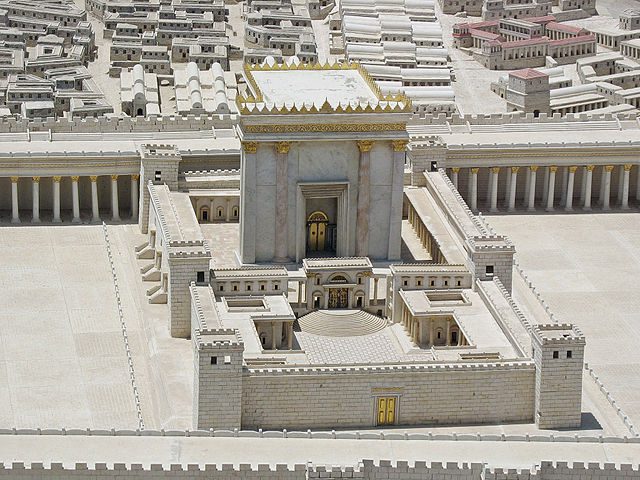
The Second Jewish Temple. Model in the Israel Museum. Photo by “Ariely” (1-8-08) [Wikimedia Commons / Creative Commons Attribution 3.0 Unported license]
* * * * *
The “holy place” is a thoroughly biblical notion. Jerusalem was and is a holy city:
Matthew 4:5 (RSV) Then the devil took him to the holy city, and set him on the pinnacle of the temple, (cf. Neh 11:1, 18; Is 48:2)
Matthew 27:53 and coming out of the tombs after his resurrection they went into the holy city and appeared to many.
The temple in Jerusalem (destroyed by the Romans in 70 A. D.) was a particularly holy place:
1 Chronicles 29:3 Moreover, in addition to all that I have provided for the holy house, I have a treasure of my own of gold and silver, and because of my devotion to the house of my God I give it to the house of my God:
Psalm 5:7 But I through the abundance of thy steadfast love will enter thy house, I will worship toward thy holy temple in the fear of thee. (cf. 138:2)
Isaiah 56:7 these I will bring to my holy mountain, and make them joyful in my house of prayer; their burnt offerings and their sacrifices will be accepted on my altar; for my house shall be called a house of prayer for all peoples. (cf. Mt 21:13; Mk 11:17; Lk 19:46)
The inner sanctum of the temple: called the Holy of Holies (Lev 16) was the ultimate holy place in the world, and in Judaism. Originally the wooden, treasure chest-like ark of the covenant was in the Holy of Holies, and God was thought to be present there in a very special way, on what was called the mercy seat, in between two carved cherubim:
Exodus 25:21-22 And you shall put the mercy seat on the top of the ark; and in the ark you shall put the testimony that I shall give you. [22] There I will meet with you, and from above the mercy seat, from between the two cherubim that are upon the ark of the testimony, I will speak with you of all that I will give you in commandment for the people of Israel.
It was so holy it could not be touched, and hence it was transported with poles that ran through rings on its side (Ex 25:13-15). In fact, on one occasion, when it was about to fall over while being moved, after the oxen stumbled, one Uzziah merely reached out to steady it and was immediately struck dead:
2 Samuel 6:7 And the anger of the LORD was kindled against Uzzah; and God smote him there because he put forth his hand to the ark; and he died there beside the ark of God.
The men of Beth-shemesh also died when they simply looked inside the ark:
1 Samuel 6:19 And he slew some of the men of Beth-she’mesh, because they looked into the ark of the LORD; he slew seventy men of them, and the people mourned because the LORD had made a great slaughter among the people. (cf. Ex 33:20).
It was not that God was “cruel.” He had to get through to stubborn, sinful men, the notion that some things are sanctified or holy: so much so that they have to be approached with the utmost reverence and solemnity, and are not even to be touched.
It’s a bit like the child touching the hot oven. They learn not to, when they get hurt by it. Once a few Israelites were killed by touching holy things, the people learned very quickly. God is a transcendent “Other” and completely holy. To get too close to Him is as frightening as it is exhilarating, as the Bible illustrates in many places.
Mt. Sinai was holy due to God’s tangible presence there, in the burning bush (Ex 3:5). Just before the Hebrews were to receive the Ten Commandments, God charged the people to not even touch the mountain, or its “border,” on pain of death (19:12-13). Even animals were included in the restriction!
God’s special presence – considered apart from the fact that He is also omnipresent – imparts holiness:
Deuteronomy 7:6 For you are a people holy to the LORD your God; the LORD your God has chosen you to be a people for his own possession, out of all the peoples that are on the face of the earth. (cf. 26:19; Jer 2:3)
Angels are called “holy ones” in Scripture precisely because of their proximity to God:
Psalm 89:6-7 For who in the skies can be compared to the LORD? Who among the heavenly beings is like the LORD, [7] a God feared in the council of the holy ones, great and terrible above all that are round about him?
This is a bare summary of what the Bible teaches about holy places. And lest anyone try to make the tired, foolish argument that most of the foregoing passages are in the Old Testament, and as such supposedly “don’t count anymore,” the New Testament continues to refer to Jerusalem as the “holy city” (Mt 4:5; 27:53 above), and Jesus spoke of the Holy of Holies as “the holy place” (Mt 24:15; cf. Heb 9:2, 12, 25).
St. Peter calls the Mount of Transfiguration “the holy mountain” (2 Pet 1:17-18; cf. Mt 17:1-6). Protestants widely use the terms “Holy Bible” and “Holy Land”. In so doing, they tacitly acknowledge the notion of “holy things”: even though, if pressed, they may argue against it, as I once did myself.
My standard argument to shock Protestants of this sort into the realization that they themselves – down deep –, accept the existence of holy places and things, is to ask them whether they would bulldoze the spot they believe to be the location of Jesus’ crucifixion, and put up a fast food restaurant. Most would be outraged by the very notion, and would consider it an insulting or ridiculous question. Why? Well, because they do believe in holy places, after all.
The difference for the Catholic or Orthodox Christian, however, is that the holy thing literally conveys grace, as the sacraments do (though in a somewhat different sense, similar to what is called a sacramental: holy water, crucifixes, scapulars, etc.).
Previous Post
March 4, 2016
The Devil's Stupidity and Vanity
Next Post
March 5, 2016 25 Arguments Regarding Binding Church Authority
Browse Our Archives
Select a Category & Last Things About Me Anti-Catholicism Atheism & Agnosticism Baptism and Sacramentalism Bible and Tradition Blessed Virgin Mary Books by Dave Armstrong C. S. Lewis Calvinism & General Protestantism Catholic Apologetics Catholic Apologists Catholic conversion Catholic converts Christmas Church (Ecclesiology) Church History Conversion and Converts Development of Doctrine Eastern Orthodoxy Ecumenism & Christian Unity Eucharist & Liturgy Fathers of the Church French Translations G. K. Chesterton Hell Hell & Satan Hell & Satan & Last Things Heresies & Comparative Religion Holistic Health Inquisition & Crusades & Scandals James White Jews & Judaism & Old Testament John Calvin John Henry Newman Liberal / Modernist Theology Life Issues Literary Resume Lutheranism Mariology Martin Luther Music Orthodoxy Papacy & Infallibility Personal Page Philosophy & Science Political & Ethical & Moral Issues Protestant Persecution & Intolerance Protestantism Purgatory Purgatory & Penance Romantic & Imaginative Theology Saints & Purgatory & Penance Salvation Salvation & Justification Satan & Last Things Sexuality and Gender Issues Spanish Translations Traditionalism vs. Radical Catholic Reactionaries Traducciones al español / tradução para português Trinitarianism & Christology Uncategorized Videos
Select a Month October 2026 September 2026 August 2026 July 2026 June 2026 May 2026 April 2026 March 2026 February 2026 January 2026 December 2025 November 2025 October 2025 September 2025 August 2025 July 2025 June 2025 May 2025 April 2025 March 2025 February 2025 January 2025 December 2024 November 2024 October 2024 September 2024 August 2024 July 2024 June 2024 May 2024 April 2024 March 2024 February 2024 January 2024 December 2023 November 2023 October 2023 September 2023 August 2023 July 2023 June 2023 May 2023 April 2023 March 2023 February 2023 January 2023 December 2022 November 2022 October 2022 September 2022 August 2022 July 2022 June 2022 May 2022 April 2022 March 2022 February 2022 January 2022 December 2021 November 2021 October 2021 September 2021 August 2021 July 2021 June 2021 May 2021 April 2021 March 2021 February 2021 January 2021 December 2020 November 2020 October 2020 September 2020 August 2020 July 2020 June 2020 May 2020 April 2020 March 2020 February 2020 January 2020 December 2019 November 2019 October 2019 September 2019 August 2019 July 2019 June 2019 May 2019 April 2019 March 2019 February 2019 January 2019 December 2018 November 2018 October 2018 September 2018 August 2018 July 2018 June 2018 May 2018 April 2018 March 2018 February 2018 January 2018 December 2017 November 2017 October 2017 September 2017 August 2017 July 2017 June 2017 May 2017 April 2017 March 2017 February 2017 January 2017 December 2016 November 2016 October 2016 September 2016 August 2016 July 2016 June 2016 May 2016 April 2016 March 2016 February 2016 January 2016 December 2015 November 2015 October 2015 September 2015 August 2015 July 2015 June 2015 May 2015 April 2015 March 2015 February 2015 January 2015 December 2014 November 2014 October 2014 September 2014 August 2014 July 2014 June 2014 April 2014 March 2014 February 2014 January 2014 December 2013 November 2013 October 2013 September 2013 August 2013 July 2013 June 2013 April 2013 March 2013 February 2013 January 2013 December 2012 November 2012 October 2012 September 2012 August 2012 July 2012 June 2012 May 2012 April 2012 March 2012 February 2012 January 2012 December 2011 November 2011 October 2011 September 2011 August 2011 July 2011 June 2011 April 2011 March 2011 February 2011 October 2010 September 2010 August 2010 July 2010 April 2010 March 2010 December 2009 October 2009 August 2009 July 2009 June 2009 May 2009 March 2009 February 2009 October 2008 September 2008 April 2008 March 2008 February 2008 January 2008 December 2007 November 2007 October 2007 May 2007 March 2007 February 2007 January 2007 November 2006 October 2006 September 2006 August 2006 July 2006 June 2006 May 2006 April 2006 March 2006 February 2006 October 2005 June 2005 April 2005 February 2005 July 2004 May 2004 April 2004
Follow Us!
TAKE THE
Religious Wisdom Quiz
What did Jesus do for Lazarus in Bethany?
Select your answer to see how you score.
Healed his blindness Turned him invisible Raised him from the dead Fed him
Books by This Author Books by Dave Armstrong
Related posts from Biblical Evidence for Catholicism

The Mass & Development of Doctrine (vs. Wes...
Biblical Evidence for Catholicism

Miraculous Eucharist (vs. Francois Turretin #4)
Biblical Evidence for Catholicism

God's Presence, the Ark, the Eucharist, & Death
Biblical Evidence for Catholicism
Protestant Eucharistic Objections Fail (Turretin)
Biblical Evidence for Catholicism
TRENDING AT PATHEOS Catholic

Janie Learns the Way of the Cross: A...
Teaching children about Jesus' Passion can be challenging. Many parents and educators...

Looking For Good Catholic Writing - October 2026
He alone extends the heavens, and he walks upon the waves of...

In "Irreplaceable," our book on vocation and technology, Trevor Sutton and I...

I was strolling through the top floor of the brand new Parthenon...

What Does Gêvâh Mean For Kimberley Guifoyle &...
This week, a lot of the news is focused on Kimberly Guilfoyle....

INNER CIRCLE: Profound Mystery (Of Christ In All...
Ephesians 5:31-32 “For this reason, a man will leave his father and...
view all Catholic blogs
Ad-Free & Subscriber Log-In Subscription Support
- About Us
- 2026 Calendar
- Videos
- Podcasts
- Library of World Religions
- Faith In Media Tracker
- Advertise With Us
- Write for Us
- Privacy Policy
- Terms of Service
- Do Not Sell My Data
- Contact Us
- Radiant Digital
- Manage Newsletter Subscriptions
- Unsubscribe From Notifications
- Sitemap
Copyright 2008-2026, Patheos. All rights reserved.
Subscription Support Ad-Free & Subscriber Log-In
Follow Patheos