
BuddhistCatholicContemplativeEvangelicalGeneral ChristianHinduJewishLatter-day SaintMuslimNew VisionsProgressive Christian
Beliefs
- Buddhist
- Catholic
- Contemplative
- Evangelical
- General Christian
- Hindu
- Jewish
- Latter-day Saint
- More Voices
- Muslim
- New Visions
- Pagan
- Progressive Christian
Topics
- Religion News
- Food and Religion
- Sports and Religion
- Religious Art
- Religious Music and Entertainment
- Religious Events
- History and Religion
- Style and Religion
- Politics and Religion
- Women in Religion
- Recreation Outdoors and Religion
- Business Finance and Religion
- Careers Workplace and Religion
- Education and Religion
- Family Parenting and Religion
- Health Fitness and Religion
- Home and Religion
- Relationships and Religion
- Technology and Religion
- Travel and Religion
Columnists
- Buddhist Columnists
- Business Finance and Religion Columnists
- Careers Workplace and Religion Columnists
- Catholic Columnists
- Contemplative Columnists
- Education and Religion Columnists
- Evangelists Columnists
- Family Parenting and Religion Columnists
- General Christian Columnists
- Health Fitness and Religion Columnists
- Hindu Columnists
- History and Religion Columnists
- Home and Religion Columnists
- Jewish Columnists
- More Voices Columnists
- Latter Day Columnists
- Muslim Columnists
- New Visions Columnists
- Nonreligious Columnists
- Pagan Columnists
- Politics and Religion Columnists
- Progressive Columnists
- Recreation Outdoors and Religion Columnists
- Relationships and Religion Columnists
- Religion News Columnists
- Religious Art Columnists
- Religious Events Columnists
- Religious Music and Entertainment Columnists
- Sports and Religion Columnists
- Style and Religion Columnists
- Technology and Religion Columnists
- Travel and Religion Columnists
- Women in Religion Columnists
Resource Library
- 2026 Calendar
- Library of World Religions
- The 100 Most Holy Places on Earth
- Patheos Answers
- Podcasts
- Videos
- Faith Leaders Database
- Anglican Episcopalian
- Bahai
- Baptist
- Buddhism
- Christianity
- Confucianism
- Eastern Orthodoxy
- Hinduism
- Holiness and Pentecostal
- ISKCON
- Islam
- Judaism
- Lutheran
- Methodist
- The Church of Jesus Christ of Latter-day Saints
- New Age
- Paganism
- Presbytarian and Reformed
- Protestantism
- Religion Behind the Scenes
- Roman Catholic
- Scientology
- Shia Islam
- Sikhism
- Sufism
- Sunni Islam
- Taoism
- Zen
- See all religions
Research Tools
 Ad-Free & Subscriber Log-In Subscription Support
Ad-Free & Subscriber Log-In Subscription Support
Follow Patheos 

- Trending:
- Forgiveness
- |
- Marriage
- |
- Consciousness
- |
- Death Penalty
- |
- Election
- |
- Halloween

-
About
-
Catholic Apologetics
-
Church History
-
Great Apologists
-
Christian Worldview
-
Protestantism & Misc.
- Home
- Catholic
- History and Religion
- Baptism: Apostolic Teaching & Doctrinal Development
Baptism: Apostolic Teaching & Doctrinal Development
Last updated on: March 25, 2017 at 3:41 pm by Dave Armstrong
Baptism: Apostolic Teaching & Doctrinal Development 2017-03-25T15:41:40-04:00 Dave Armstrong
Patheos Explore the world's faith through different perspectives on religion and spirituality! Patheos has the views of the prevalent religions and spiritualities of the world.
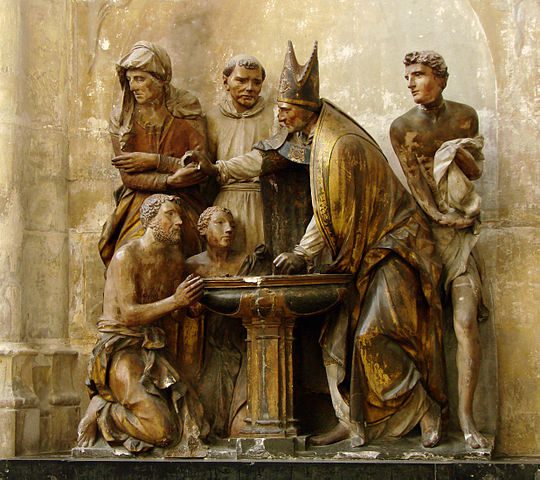
Baptism of St. Augustine, as represented in a sculptural group in Troyes cathedral, France (1549) [public domain / Wikimedia Commons]

* * *
(3-8-06)
* * * * *
I think the choices with regard to the history of the doctrine of baptism really boil down to: 1) belief that the Apostles had one teaching on the subject, and 2) belief that the Apostles contradicted each other, and/or that the Bible is internally incoherent on baptism, and/or that several contradictory positions can be legitimately, simultaneously held by Christians, which absolutely guarantees the presence of outright falsehood in the Church (by the law of contradiction).As for the view of the early Church (first two centuries) on baptism, respected Protestant Church historian J. N. D. Kelly writes:
It was always held to convey the remission of sins . . . the theory that it mediated the Holy Spirit was fairly general . . . The early view, therefore, like the Pauline, would seem to be that baptism itself is the vehicle for conveying the Spirit to believers; in all this period we nowhere come across any clear pointers to the existence of a separate rite, such as unction or the laying on of hands, appropriated to this purpose.
(Early Christian Doctrines, San Francisco: Harper Collins, rev. ed., 1978, 194-195)
Likewise, The New International Dictionary of the Christian Church (ed. J. D. Douglas, Grand Rapids, Michigan: Zondervan, rev. ed., 1978, 100, “Baptism”), another respected Protestant reference work, which shows no inclination for Catholicism at all, in its tone or content, states:
Doctrinally, baptism very early came to be understood as a means of grace or a
sacrament, in the sense of an instrumental means of regeneration . . . Infant baptism was practiced in the second century, but only with the aid of an adult sponsor.
The Nicene Creed includes the phrase: “We acknowledge one baptism for the forgiveness of sins.”
The second century is not late at all for a doctrine to be fairly developmentally “mature,” when we stop to recognize something like, e.g., the canon of Scripture. Before 160, the NT itself was not always clearly distinguished from other Christian writings. Justin Martyr’s “gospels” contained apocryphal material (he also did not accept Philippians, 1 and 2 Timothy, Titus, and Philemon as Scripture); Acts was scarcely known or quoted. Hebrews, James, 1 and 2 Peter, 1,2,3 John, Jude, and Revelation were not considered part of the canon, and many of these books weren’t even yet quoted. Therefore, if infant baptism must go due to lack of early enough attestation (as if the 2nd century were too “late”), then the NT canon goes with it. Since Protestants will not relinquish the NT canon on these grounds, then the argument against infant baptism on the same grounds must collapse, lest a double standard be applied.
Moreover, original sin is accepted by Protestants, yet it, too, was a late development, and was not even included in the Nicene Creed. That doesn’t stop Protestants from accepting it, despite its “lateness.” Ditto for infant baptism. The patristic and biblical evidences for infant and regenerative baptism are quite good.
Scripture is not unclear about baptismal regeneration. I think it is quite clear, with a number of unambiguous and strong proof texts. Secondly, since regeneration is a power conferred in the water (ex opere operato, as we say, lit., “in working, it works” – i.e., it has inherent sacramental power to give grace), it can be applied to a baby just as to an adult. If one believes that it takes away original sin, and all people have original sin, including babies, and that knowledge of what is happening is not essential to the practice (and sacrament) then infant baptism follows straightforwardly).
I would contend, therefore, that the evidence for baptismal regeneration is strong in Scripture. Strong deductive reasoning leads to infant baptism as a result of that conclusion. Infant baptism is also suggested in Scripture, though far less directly. The patristic consensus was uniform on this matter. There is a reason for that. We say it is because it is true in the first place. God guides His Church, and such a consensus is the outward, objective indication of that, and the means of apostolic succession.
If one claims that the early Church on baptism is like current Protestantism, then why not be like them with regard to the canon of Scripture in the 2nd century? If doctrinal diversity on baptism in the early Church suggests the same should accrue today, then why not canonical diversity? Why not diversity on the nature of the godhead (Arians didn’t emerge till the 4th century, Nestorianism in the 5th, and Monophysitism even later)? Why not allow all that diversity? If we are going to establish principles and analogies on one doctrine, then why just one and not others? How do we decide which ones to choose to compare to the situation in the early Church?
Well, I think when all is said and done, the argument becomes a circular one: Protestants choose those things which fit into the Protestant thinking and reject those which do not. Why? Because Protestants claim to go by the Bible alone, and history is never determinative. So it is used selectively, wherever it seems to “fit” the Protestant mold. Scripture supposedly, in theory, settles every major issue, since it is “perspicuous.” Yet with central, important issues like baptism and Eucharist, Protestants can’t figure out what the Bible teaches. Thus, they are forced to relativize and (in effect) trivialize those things and assert that whatever one believes about them is fine. I think that is a thoroughly unbiblical attitude, and irrational as well.
Catholics think consensus through history is important because we look at doctrine incarnationally. God preserves His Church, His Body. The Church is the living embodiment of God’s truth, in the apostolic doctrine, passed down. We are not determining truth by a “head count,” yet we think that whatever is true will be seen to have achieved a consensus among Christians throughout history (what we Catholics call the sensus fidelium), precisely because God so ordained it and preserved His truth.
It is similar to what I have called in other apologetic contexts, the “reverse pragmatic argument”: something is not true because it works, but it works because it is true. So the Catholic believes in faith that the true doctrines will be adopted by the majority of Christians. They don’t believe in the doctrines merely because of numbers. In other words, history means something. It means much more than just the Protestant “advise and consent.”
Genesis 18:19 (NIV) For I have chosen him, so that he will direct his children and his household after him to keep the way of the Lord by doing what is right and just, . . .
Grammatically and linguistically, “Children” and “household” are distinct, however, conceptually or logically, I think this shows that the two are present together, and not incompatible at all.
The Hebrew bayith (Strong’s word #1004) indeed has a wide range of application, akin to adelphos (lit., “brother”), which is key to the disputes over Mary’s perpetual virginity. So we must look at context and consult lexicons and commentaries. Gesenius’ Hebrew-Chaldee Lexicon to the Old Testament, p. 116, section 8 for this word, states that the word bayith in Gen 18:19 means:
those sprung from any family, descendants, offspring, progeny.
I don’t see any bias against children or infants in that definition. It’s not airtight, but on the other hand, to exclude children from it strikes me as arbitrary and unfounded. Children were already part of the covenant. The New Bible Dictionary (ed. J. D. Douglas, Grand Rapids, Michigan: Eerdmans, 1962), in its article on “Covenant” (pp. 264-265) makes this clear:
[the Noahic covenant: Gen 9:9-17] is universal in its scope; it embraces not only Noah but his seed after him and every living creature. The scope demonstrates that the grace bestowed is not dependent upon intelligent understanding or favourable response on the part of the beneficiaries.
As for the Abrahamic covenant:
The sign of the covenant is circumcision . . . seal of the covenant in the highest reaches of its spirituality; it is even called the covenant (Gen 17:10). Circumcision signifies the purification (cf. Ex 6:12,30, Lv 19:23, 26:41, Dt 10:16, 30:6, Jer 4:4, 6:10, 9:25) indispensable to that communion with God which is the central blessing of the covenant (Gen 17:7).
St. Paul makes the analogy of circumcision as the seal of the Old Covenant and entrance into the House of Israel to baptism as the new seal, and entrance into the New Covenant and the Church (Col 2:9-14; 3:1-4,17 – “God’s chosen people” – NIV). To my mind, children (including infants) are definitely in view in all these passages and concepts. As a purely linguistic matter, I hope God could say of me:
Dave will direct his children and his household after him to keep the way of the Lord by doing what is right and just, . . .
The thrust of the passage is towards the future. My own household includes four children: the youngest now being 11 months old. And who says this “directing” is all verbal and conceptual in the first place? I submit that even a newborn is already being directed in the ways of God, by example. One loves a baby (as opposed to abusing or neglecting it), and this might be seen as a form of “directing.”
Furthermore, we find the following passage (NIV):
. . . Abraham took his son Ishmael and all those born in his household . . . . and circumcised them . . . every male in Abraham’s household, including those born in his household or bought from a foreigner, was circumcised with him. (Gen 17:23,27)
Are we to somehow conclude that those “born in a household” are not part of that household (and of the covenant)? No. And in the accounts of baptisms of households in Acts, the application is clearly to a family (possibly nuclear but probably extended, in accordance with ancient Jewish culture). Thus the meaning is clear in context: Cornelius’ household is baptized (Acts 10:24,47-48). This included “friends” as well as “relatives.” I see no reason to exclude a priori, infants or children. Likewise, with Lydia (Acts 16:15). It’s fine and dandy to note a wider application of the notion “household” but that doesn’t prove that the wider scope prevails in every instance. Only context and cross-referencing can determine the interpretation of a given passage.
Greek linguist Gerhard Kittel informs us that the cognate oikia sometimes refers to “family” (Mt 10:12, 12:25). and notes the use of oikos in the same sense (1 Cor 1:16, Phlm 2, Acts 5:42, 11:14 [Cornelius’ house], 16:15 [Lydia’s house, also seen above], 16:31,34, probably Acts 18:18, Acts 20:20, 1 Tim 3:4,12, 2 Tim 1:16, Titus 1:11); as well as similar use in St. Ignatius’ Letter to the Smyrneans (13:10) and in Polycarp (8:2).
Genesis 31:41 It was like this for the twenty years I was in your household. I worked for you fourteen years for your two daughters . . .
Since the covenant included circumcised infants, their inclusion in the description “children” is, I think, implied. If “daughters” are implied as part of a household here (the notion of which is self-evident, so I would argue), then I don’t see that infant daughters would necessarily be excluded (if they happened to be present). The burden of proof lies on those who believe in adult baptism only, to show that the exclusion of infants is plausible at all.
Genesis 36:6 Esau took his wives and sons and daughters and all the members of his household, . . . .
Baptism of infants is entirely consistent with Paul’s analogy to circumcision, and the biblical understanding of covenant as extended to children (which all Christians, who don’t think that all unbaptized children or those under the age of reason, or severely retarded, etc., who die, go to hell, accept). The larger task is to synthesize all the biblical data we have with regard to baptism. When we do that, though we readily concede that the passages about “households” don’t prove infant baptism; yet they are entirely consistent with it. And that is why the vast majority of Christians all through the ages (including a sizable majority of Protestants) have practiced it. The nature of sacramentalism, also, suggests it.
No one has ever proven that no infants are ever included. Why don’t those who deny infant baptism come up with a passage which expressly teaches their view? And furthermore, if Paul and other NT writers believed in adult baptism, why didn’t they come right out and say that explicitly? It would be simple enough. But no such verse can be found.
I think we must lean a bit more upon Church history to see where Christians have come down on the issue. And it is overwhelmingly in favor of infant (and regenerative) baptism. That matters only to people who are interested in the importance and authority of Church history: those who believe that God guides His Church and His people.
Unless one believes that all infants under the age of reason, or adults who are severely-retarded, brain-damaged, comatose, or who have never ever heard the gospel, etc. (the “hard cases”) are going to hell, then one is already accepting some form of inclusion into salvation and the covenant apart from mental assent and willful decision. One has to either assert that these people automatically go to hell (in effect, predestined to go there, since they have little or no free will), and try to defend that notion, or qualify one’s understanding of what it means to be saved (or baptized, to bring it back to the present discussion).
In Catholic theology, we allow for the baptism of desire in exceptional cases where the sacrament cannot be had (e.g., in the minute before a non-baptized person succumbs to injuries from a fatal car crash). That doesn’t mean that people who can be baptized and know that they are commanded to do so are let “off the hook.” Exceptional cases do not disprove the rule. As C.S. Lewis said: “the rules of chess create chess problems.” Baptism is a command, and it is a sacrament which regenerates the person who receives it. Baptism is necessary because original sin is universal, since the Fall.
In the early Church there was disagreement on NT books that all parties accept today. If a Protestant thinks that scenario is analogous to ancient diversity on baptism, then they should accept a diversity of canons today. And of course no evangelical Protestant will do that. So, baptism ought to be viewed in the same way. It developed just as the canon did, and infant, regenerative baptism became the Orthodox position, challenged only in the 16th century, and even then (with regard to infant baptism), by a minority of Protestants only.
Previous Post

March 7, 2016
Lutherans, Corpus Christi, & Eucharistic Adoration
Next Post
March 7, 2016 Top Ten Desert Island Catholic Books
Browse Our Archives
Select a Category & Last Things About Me Anti-Catholicism Atheism & Agnosticism Baptism and Sacramentalism Bible and Tradition Blessed Virgin Mary Books by Dave Armstrong C. S. Lewis Calvinism & General Protestantism Catholic Apologetics Catholic Apologists Catholic conversion Catholic converts Christmas Church (Ecclesiology) Church History Conversion and Converts Development of Doctrine Eastern Orthodoxy Ecumenism & Christian Unity Eucharist & Liturgy Fathers of the Church French Translations G. K. Chesterton Hell Hell & Satan Hell & Satan & Last Things Heresies & Comparative Religion Holistic Health Inquisition & Crusades & Scandals James White Jews & Judaism & Old Testament John Calvin John Henry Newman Liberal / Modernist Theology Life Issues Literary Resume Lutheranism Mariology Martin Luther Music Orthodoxy Papacy & Infallibility Personal Page Philosophy & Science Political & Ethical & Moral Issues Protestant Persecution & Intolerance Protestantism Purgatory Purgatory & Penance Romantic & Imaginative Theology Saints & Purgatory & Penance Salvation Salvation & Justification Satan & Last Things Sexuality and Gender Issues Spanish Translations Traditionalism vs. Radical Catholic Reactionaries Traducciones al español / tradução para português Trinitarianism & Christology Uncategorized Videos
Select a Month October 2026 September 2026 August 2026 July 2026 June 2026 May 2026 April 2026 March 2026 February 2026 January 2026 December 2025 November 2025 October 2025 September 2025 August 2025 July 2025 June 2025 May 2025 April 2025 March 2025 February 2025 January 2025 December 2024 November 2024 October 2024 September 2024 August 2024 July 2024 June 2024 May 2024 April 2024 March 2024 February 2024 January 2024 December 2023 November 2023 October 2023 September 2023 August 2023 July 2023 June 2023 May 2023 April 2023 March 2023 February 2023 January 2023 December 2022 November 2022 October 2022 September 2022 August 2022 July 2022 June 2022 May 2022 April 2022 March 2022 February 2022 January 2022 December 2021 November 2021 October 2021 September 2021 August 2021 July 2021 June 2021 May 2021 April 2021 March 2021 February 2021 January 2021 December 2020 November 2020 October 2020 September 2020 August 2020 July 2020 June 2020 May 2020 April 2020 March 2020 February 2020 January 2020 December 2019 November 2019 October 2019 September 2019 August 2019 July 2019 June 2019 May 2019 April 2019 March 2019 February 2019 January 2019 December 2018 November 2018 October 2018 September 2018 August 2018 July 2018 June 2018 May 2018 April 2018 March 2018 February 2018 January 2018 December 2017 November 2017 October 2017 September 2017 August 2017 July 2017 June 2017 May 2017 April 2017 March 2017 February 2017 January 2017 December 2016 November 2016 October 2016 September 2016 August 2016 July 2016 June 2016 May 2016 April 2016 March 2016 February 2016 January 2016 December 2015 November 2015 October 2015 September 2015 August 2015 July 2015 June 2015 May 2015 April 2015 March 2015 February 2015 January 2015 December 2014 November 2014 October 2014 September 2014 August 2014 July 2014 June 2014 April 2014 March 2014 February 2014 January 2014 December 2013 November 2013 October 2013 September 2013 August 2013 July 2013 June 2013 April 2013 March 2013 February 2013 January 2013 December 2012 November 2012 October 2012 September 2012 August 2012 July 2012 June 2012 May 2012 April 2012 March 2012 February 2012 January 2012 December 2011 November 2011 October 2011 September 2011 August 2011 July 2011 June 2011 April 2011 March 2011 February 2011 October 2010 September 2010 August 2010 July 2010 April 2010 March 2010 December 2009 October 2009 August 2009 July 2009 June 2009 May 2009 March 2009 February 2009 October 2008 September 2008 April 2008 March 2008 February 2008 January 2008 December 2007 November 2007 October 2007 May 2007 March 2007 February 2007 January 2007 November 2006 October 2006 September 2006 August 2006 July 2006 June 2006 May 2006 April 2006 March 2006 February 2006 October 2005 June 2005 April 2005 February 2005 July 2004 May 2004 April 2004
Follow Us!
TAKE THE
Religious Wisdom Quiz
What was Paul’s profession before becoming an apostle?
Select your answer to see how you score.
Tentmaker Tax Collector Fisherman Carpenter
Books by This Author Books by Dave Armstrong
Related posts from Biblical Evidence for Catholicism

A Few "Worst" & "Best" Arguments vs. Protestantism
Biblical Evidence for Catholicism

"Baptism" & Romans 10 (Engwer's Silly Word Games)
Biblical Evidence for Catholicism

50 Biblical Disproofs of "Evident Clearness" of the...
Biblical Evidence for Catholicism

The Mass & Development of Doctrine (vs. Wes...
Biblical Evidence for Catholicism
TRENDING AT PATHEOS Catholic

I was strolling through the top floor of the brand new Parthenon...

What Does Gêvâh Mean For Kimberley Guifoyle &...
This week, a lot of the news is focused on Kimberly Guilfoyle....

INNER CIRCLE: Profound Mystery (Of Christ In All...
Ephesians 5:31-32 “For this reason, a man will leave his father and...

Do Not Rejoice When Your Enemy Falls: The...
Turning an execution into a public spectacle is a disturbing expression of...

'The Chosen' S6 Trailer: The Passion Gets Very...
Not many watching 'The Chosen' worry about spoilers, but just because they...

The purpose-driven labor priest
A labor activist reads Rick Warren and it gets me wondering about...
view all Catholic blogs
Ad-Free & Subscriber Log-In Subscription Support
- About Us
- 2026 Calendar
- Videos
- Podcasts
- Library of World Religions
- Faith In Media Tracker
- Advertise With Us
- Write for Us
- Privacy Policy
- Terms of Service
- Do Not Sell My Data
- Contact Us
- Radiant Digital
- Manage Newsletter Subscriptions
- Unsubscribe From Notifications
- Sitemap
Copyright 2008-2026, Patheos. All rights reserved.
Subscription Support Ad-Free & Subscriber Log-In
Follow Patheos