
BuddhistCatholicContemplativeEvangelicalGeneral ChristianHinduJewishLatter-day SaintMuslimNew VisionsProgressive Christian
Beliefs
- Buddhist
- Catholic
- Contemplative
- Evangelical
- General Christian
- Hindu
- Jewish
- Latter-day Saint
- More Voices
- Muslim
- New Visions
- Pagan
- Progressive Christian
Topics
- Religion News
- Food and Religion
- Sports and Religion
- Religious Art
- Religious Music and Entertainment
- Religious Events
- History and Religion
- Style and Religion
- Politics and Religion
- Women in Religion
- Recreation Outdoors and Religion
- Business Finance and Religion
- Careers Workplace and Religion
- Education and Religion
- Family Parenting and Religion
- Health Fitness and Religion
- Home and Religion
- Relationships and Religion
- Technology and Religion
- Travel and Religion
Columnists
- Buddhist Columnists
- Business Finance and Religion Columnists
- Careers Workplace and Religion Columnists
- Catholic Columnists
- Contemplative Columnists
- Education and Religion Columnists
- Evangelists Columnists
- Family Parenting and Religion Columnists
- General Christian Columnists
- Health Fitness and Religion Columnists
- Hindu Columnists
- History and Religion Columnists
- Home and Religion Columnists
- Jewish Columnists
- More Voices Columnists
- Latter Day Columnists
- Muslim Columnists
- New Visions Columnists
- Nonreligious Columnists
- Pagan Columnists
- Politics and Religion Columnists
- Progressive Columnists
- Recreation Outdoors and Religion Columnists
- Relationships and Religion Columnists
- Religion News Columnists
- Religious Art Columnists
- Religious Events Columnists
- Religious Music and Entertainment Columnists
- Sports and Religion Columnists
- Style and Religion Columnists
- Technology and Religion Columnists
- Travel and Religion Columnists
- Women in Religion Columnists
Resource Library
- 2026 Calendar
- Library of World Religions
- The 100 Most Holy Places on Earth
- Patheos Answers
- Podcasts
- Videos
- Faith Leaders Database
- Anglican Episcopalian
- Bahai
- Baptist
- Buddhism
- Christianity
- Confucianism
- Eastern Orthodoxy
- Hinduism
- Holiness and Pentecostal
- ISKCON
- Islam
- Judaism
- Lutheran
- Methodist
- The Church of Jesus Christ of Latter-day Saints
- New Age
- Paganism
- Presbytarian and Reformed
- Protestantism
- Religion Behind the Scenes
- Roman Catholic
- Scientology
- Shia Islam
- Sikhism
- Sufism
- Sunni Islam
- Taoism
- Zen
- See all religions
Research Tools
 Ad-Free & Subscriber Log-In Subscription Support
Ad-Free & Subscriber Log-In Subscription Support
Follow Patheos 

- Trending:
- Forgiveness
- |
- Marriage
- |
- Consciousness
- |
- Death Penalty
- |
- Election
- |
- Halloween

-
About
-
Catholic Apologetics
-
Church History
-
Great Apologists
-
Christian Worldview
-
Protestantism & Misc.
- Home
- Catholic
- History and Religion
- Abstinence on Fridays & Meat: Doctrine or Discipline?
Abstinence on Fridays & Meat: Doctrine or Discipline?
Last updated on: March 24, 2017 at 2:00 pm by Dave Armstrong
Abstinence on Fridays & Meat: Doctrine or Discipline? 2017-03-24T14:00:50-04:00 Dave Armstrong
Patheos Explore the world's faith through different perspectives on religion and spirituality! Patheos has the views of the prevalent religions and spiritualities of the world.
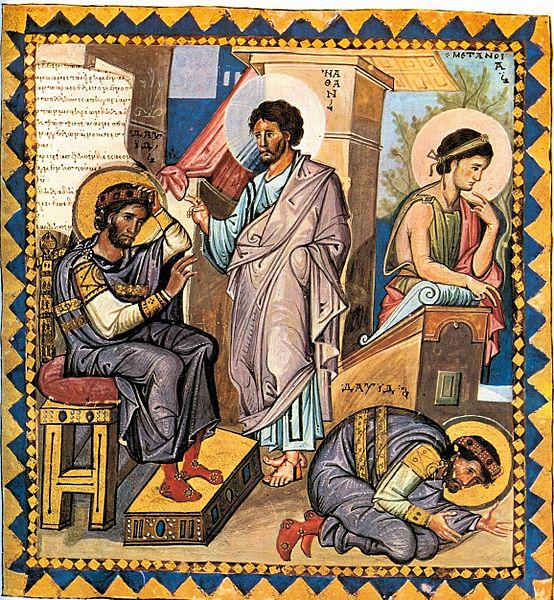
The reproach of Nathan and the penance of King David (Paris Psalter, folio 136v, 10th century) [public domain / Wikimedia Commons]

(4-11-11)
* * * * *
My friend “Pilgrimsarbor” (Presbyterian: OPC) was commenting on the anti-Catholic Reformed Apologist site, in the combox for the post, “Carl Trueman and A Need For A Contemporary Polemic Against Romanism”. I responded. “Pilgrimsarbor”‘s words will be in blue.
* * *
Regarding a need for a contemporary polemic against Romanism, as much as my Catholic friends would protest, things do and have changed within that communion. If certain practices have changed, for example, not eating meat on Fridays, there would have to be a constituent doctrinal basis for the change, wouldn’t that be true? . . .
Well, as I said, what is the doctrine that dictates that one should not eat meat on Friday?
It’s not a doctrine at all. It is simply a penitential requirement that once held and has now been relaxed. It would be like a Protestant pastor requiring all his congregants to attend a Wednesday night Bible study, and then later saying they were no longer required to do so. No doctrine is involved. It is strictly a practice of one’s faith.
My point is, since that practice has changed, doesn’t it follow that the doctrine which gives birth to that practice has changed?
Not at all. Fasting, for example, is a quite explicitly biblical concept. Jesus did it, Paul did it, and we are to imitate them. Therefore, various Christian belief-systems might develop various ways to implement a program for fasting, especially if they observe Lent (Anglicans, Methodists; I believe Lutherans also). How is that doctrinal? No doctrine is involved whatever. Same thing for us “Romanists.”
I realize that a Catholic would not call it a change in doctrine, but it must be so nonetheless.
Really? Why “must” it be? What is so difficult about the distinction between religious practice and doctrine? An example of another Protestant practice would be the “altar call.” In some circles (evangelical, Baptist, pentecostal: and I have been part of all of these) this is a virtual requirement in order to be “saved.”
But it may not be so in other contexts (Reformed, Presbyterian, Methodist, etc.). All these groups believe in salvation by grace alone (as do we). But the practice is different. But that is already more “doctrinal” than abstaining from meat.
I should also note, however, that the underlying, presuppositional requirement to practice some sort of penance on Fridays has not changed: only the specific requirement of no meat has been relaxed.
It is a binding discipline, to practice penance on Fridays. Disciplines are practices (usually devotional or contemplative in nature) recommended or required by the Church, as opposed to doctrines and dogmas that have to do with theological belief. If one doesn’t abstain from meat it is required that they practice some form of penance. I myself abstain from meat (well, in my case, poultry, since I don’t eat red meat), since it is easy to remember, and was the traditional abstinence requirement.
Or perhaps, they would say that it was not infallible dogma.
Of course it is not. It’s not even a doctrinal matter, let alone dogmatic, or a question of infallibility. The celibacy of priests in the Latin rites is a similar example. That’s not doctrinal either. It is a disciplinary requirement that doesn’t even apply to non-Roman rite Eastern Catholics, based on 1 Corinthians 7 (the single person can be more devoted to God, since there are not divided allegiances with family) and Jesus’ noting that there are voluntary eunuchs for the sake of the kingdom.
To deny that, for example, the RCC practice of not eating meat on Friday had no doctrinal basis is, to me, unfathomable.
Hopefully, it is fathomable after you read this. This is not rocket science.
All church discipline and practice, no matter what it is and from whom, has a doctrinal basis.
In an indirect sense, it would have to do with Christ’s work on the cross and the atonement and redemption on our behalf, since we observe it in the first place to recall Good Friday. If that is what you mean by it having a “doctrinal basis” then we agree. But the practice itself is not “doctrinal.”
Having said that, I still think “changing doctrines” is not the point as much as perhaps changing emphases.
Better, but changing requirements and the range of practices for the same penitential notion is more accurate.
* * * * *
Additional Clarifications (11-9-09)
* * *
The current rule about Friday abstinence is explained by Colin B. Donovan, STL, in his article, Fast and Abstinence: hosted by EWTN:
*
It is a binding discipline, to practice penance on Fridays. Disciplines are practices (usually devotional or contemplative in nature) recommended or required by the Church, as opposed to doctrines and dogmas that have to do with theological belief. If one doesn’t abstain from meat (which is not required, at least not in the US) it is required that they practice some form of penance. I myself abstain from meat, since it is easy to remember, and was the traditional abstinence requirement.
*
Catholic apologist Jimmy Akin wrote in the July/August 1997 issue of This Rock:
*
Thus the law of abstinence from meat is still binding unless one’s national bishops’ conference has provided for alternate forms of penance. In the United States, the National Conference of Catholic Bishops has obtained permission from the Vatican for such substitution. Catholics are obliged to do some form of penance on Fridays and keep the day as per canon 1249, but now they can choose the form of penance they wish to do.
*
David W. Emery, my fellow moderator at the Coming Home Network forum, further clarified:
*
The EWTN wording shows that they too accept Friday penance (abstinence during Lent) as obligatory in the United States. The “not under pain of sin” point is specifically stated in the 1966 [USCCB] document. Previously, by canon law, it was under pain of sin. But this does not, in itself, remove the obligation, since they are separate issues under canon law. A discipline can be obligatory without being additionally under pain of sin.
*
Here is a link to the 2000 pastoral instruction from the USCCB. The relevant phrase for our discussion seems to be:
*
Fridays Throughout the Year — In memory of Christ’s suffering and death, the Church prescribes making each Friday throughout the year a penitential day. All of us are urged to prepare appropriately for that weekly Easter that comes with each Sunday.
*
The key word there is “prescribe.” That means that it is obligatory to practice some penance, but it doesn’t have to be abstinence from meat.
Previous Post

March 18, 2016
Bible on the Indefectibility of the Church
Next Post

March 21, 2016 God's Judgment of Humans (Sometimes, Entire Nations)
Browse Our Archives
Select a Category & Last Things About Me Anti-Catholicism Atheism & Agnosticism Baptism and Sacramentalism Bible and Tradition Blessed Virgin Mary Books by Dave Armstrong C. S. Lewis Calvinism & General Protestantism Catholic Apologetics Catholic Apologists Catholic conversion Catholic converts Christmas Church (Ecclesiology) Church History Conversion and Converts Development of Doctrine Eastern Orthodoxy Ecumenism & Christian Unity Eucharist & Liturgy Fathers of the Church French Translations G. K. Chesterton Hell Hell & Satan Hell & Satan & Last Things Heresies & Comparative Religion Holistic Health Inquisition & Crusades & Scandals James White Jews & Judaism & Old Testament John Calvin John Henry Newman Liberal / Modernist Theology Life Issues Literary Resume Lutheranism Mariology Martin Luther Music Orthodoxy Papacy & Infallibility Personal Page Philosophy & Science Political & Ethical & Moral Issues Protestant Persecution & Intolerance Protestantism Purgatory Purgatory & Penance Romantic & Imaginative Theology Saints & Purgatory & Penance Salvation Salvation & Justification Satan & Last Things Sexuality and Gender Issues Spanish Translations Traditionalism vs. Radical Catholic Reactionaries Traducciones al español / tradução para português Trinitarianism & Christology Uncategorized Videos
Select a Month October 2026 September 2026 August 2026 July 2026 June 2026 May 2026 April 2026 March 2026 February 2026 January 2026 December 2025 November 2025 October 2025 September 2025 August 2025 July 2025 June 2025 May 2025 April 2025 March 2025 February 2025 January 2025 December 2024 November 2024 October 2024 September 2024 August 2024 July 2024 June 2024 May 2024 April 2024 March 2024 February 2024 January 2024 December 2023 November 2023 October 2023 September 2023 August 2023 July 2023 June 2023 May 2023 April 2023 March 2023 February 2023 January 2023 December 2022 November 2022 October 2022 September 2022 August 2022 July 2022 June 2022 May 2022 April 2022 March 2022 February 2022 January 2022 December 2021 November 2021 October 2021 September 2021 August 2021 July 2021 June 2021 May 2021 April 2021 March 2021 February 2021 January 2021 December 2020 November 2020 October 2020 September 2020 August 2020 July 2020 June 2020 May 2020 April 2020 March 2020 February 2020 January 2020 December 2019 November 2019 October 2019 September 2019 August 2019 July 2019 June 2019 May 2019 April 2019 March 2019 February 2019 January 2019 December 2018 November 2018 October 2018 September 2018 August 2018 July 2018 June 2018 May 2018 April 2018 March 2018 February 2018 January 2018 December 2017 November 2017 October 2017 September 2017 August 2017 July 2017 June 2017 May 2017 April 2017 March 2017 February 2017 January 2017 December 2016 November 2016 October 2016 September 2016 August 2016 July 2016 June 2016 May 2016 April 2016 March 2016 February 2016 January 2016 December 2015 November 2015 October 2015 September 2015 August 2015 July 2015 June 2015 May 2015 April 2015 March 2015 February 2015 January 2015 December 2014 November 2014 October 2014 September 2014 August 2014 July 2014 June 2014 April 2014 March 2014 February 2014 January 2014 December 2013 November 2013 October 2013 September 2013 August 2013 July 2013 June 2013 April 2013 March 2013 February 2013 January 2013 December 2012 November 2012 October 2012 September 2012 August 2012 July 2012 June 2012 May 2012 April 2012 March 2012 February 2012 January 2012 December 2011 November 2011 October 2011 September 2011 August 2011 July 2011 June 2011 April 2011 March 2011 February 2011 October 2010 September 2010 August 2010 July 2010 April 2010 March 2010 December 2009 October 2009 August 2009 July 2009 June 2009 May 2009 March 2009 February 2009 October 2008 September 2008 April 2008 March 2008 February 2008 January 2008 December 2007 November 2007 October 2007 May 2007 March 2007 February 2007 January 2007 November 2006 October 2006 September 2006 August 2006 July 2006 June 2006 May 2006 April 2006 March 2006 February 2006 October 2005 June 2005 April 2005 February 2005 July 2004 May 2004 April 2004
Follow Us!
TAKE THE
Religious Wisdom Quiz
How old was Abraham when he died?
Select your answer to see how you score.
150 years 200 years 175 years 125 years
Books by This Author Books by Dave Armstrong
Related posts from Biblical Evidence for Catholicism

Bible & Catholicism on Mortal Sin (vs. John...
Biblical Evidence for Catholicism

Does Catholic Intercession of Saints Require Omniscience?
Biblical Evidence for Catholicism

Capabilities of Heavenly Saints: Protestant Commentaries
Biblical Evidence for Catholicism

Revelation 5 & 8 (Intercession of Saints &...
Biblical Evidence for Catholicism
TRENDING AT PATHEOS Catholic

Pope Leo Celebrates Mass for Nurses & Docs...
I don't have any idea how he did it, but Pope Leo...

The Sermon on the Mount, Part I: Matthew...
The Sermon on the Mount, Part I (Matthew 4:12-5:12) St. Matthew moves...

What's up from Crossway: Reviewing some of their latest A few weeks...

Janie Learns the Way of the Cross: A...
Teaching children about Jesus' Passion can be challenging. Many parents and educators...

Looking For Good Catholic Writing - October 2026
He alone extends the heavens, and he walks upon the waves of...

In "Irreplaceable," our book on vocation and technology, Trevor Sutton and I...
view all Catholic blogs
Ad-Free & Subscriber Log-In Subscription Support
- About Us
- 2026 Calendar
- Videos
- Podcasts
- Library of World Religions
- Faith In Media Tracker
- Advertise With Us
- Write for Us
- Privacy Policy
- Terms of Service
- Do Not Sell My Data
- Contact Us
- Radiant Digital
- Manage Newsletter Subscriptions
- Unsubscribe From Notifications
- Sitemap
Copyright 2008-2026, Patheos. All rights reserved.
Subscription Support Ad-Free & Subscriber Log-In
Follow Patheos